
WIREFRAME NEWS Daily Brief - Friday, June 12, 2026
The structure behind the story

The First Trillion
Today Elon Musk became the first trillionaire in recorded history. Not by inventing something. By completing the mechanism: government contracts backstop the equity; banks lend against it at Treasury rates; the public never taxes the borrowing; the company IPOs and the notional becomes liquid. SpaceX raised $75 billion today on a $1.77 trillion valuation and Musk’s net worth crossed $1.1 trillion. Then in London, NHS patients filled the streets chanting “Hands Off Our NHS” protesting Palantir’s contract to ingest national health data. Same day, different country, same structural argument: the public built it, a private actor captured it, and the people who use it took to the streets.
The Gilded Age Thesis Just Got Its Receipt
WHAT HAPPENED
SpaceX listed on Nasdaq today as SPCX, raising $75 billion at $135 per share, the largest IPO in recorded history. Saudi Aramco raised $29.4 billion in 2019. Alibaba raised $25 billion in 2014. SpaceX cleared both in a different conversation entirely. The company is valued at $1.77 trillion. Musk retains 80%+ of voting control. His net worth crossed $1.1 trillion, with SpaceX alone accounting for roughly $642 billion of that. No individual in recorded history has held this much wealth.
Senator Elizabeth Warren sent a 12-page letter to the SEC flagging the xAI acquisition as a potential valuation conflict ($1.25 trillion for a money-losing AI company folded into SpaceX before the S-1 filing), Musk’s “uniquely unchecked” 80%+ voting control, and a 94× revenue multiple against a $41.3 billion accumulated deficit. The SEC did not delay the IPO.
WHAT IT MEANS
In Why We Shouldn’t Want a New Gilded Age Part 2, the thesis was that Musk’s wealth structure depended on a specific mechanism: SpaceX’s government contracts (NASA, Space Force, NRO) function as near-Treasury backing for his equity, enabling banks to extend credit at low rates against stock that would otherwise be illiquid private-company risk. He borrows against the stock, pays no taxable income, and lives on loan proceeds at an effective tax rate under 4%. Today that mechanism completed publicly, at scale, with a $1.77 trillion price tag and retail investors absorbing the governance risk Musk retained.
The xAI acquisition is the new layer: Grok models, X’s data infrastructure, and xAI’s data centers — folded into SpaceX before the IPO, inflating the S-1 valuation, raising money against assets Musk previously held privately. The government-contract anchor now sits alongside AI-platform revenue and social-network data. Three private moats, one public vehicle, one vote structure.
WHY IT MATTERS
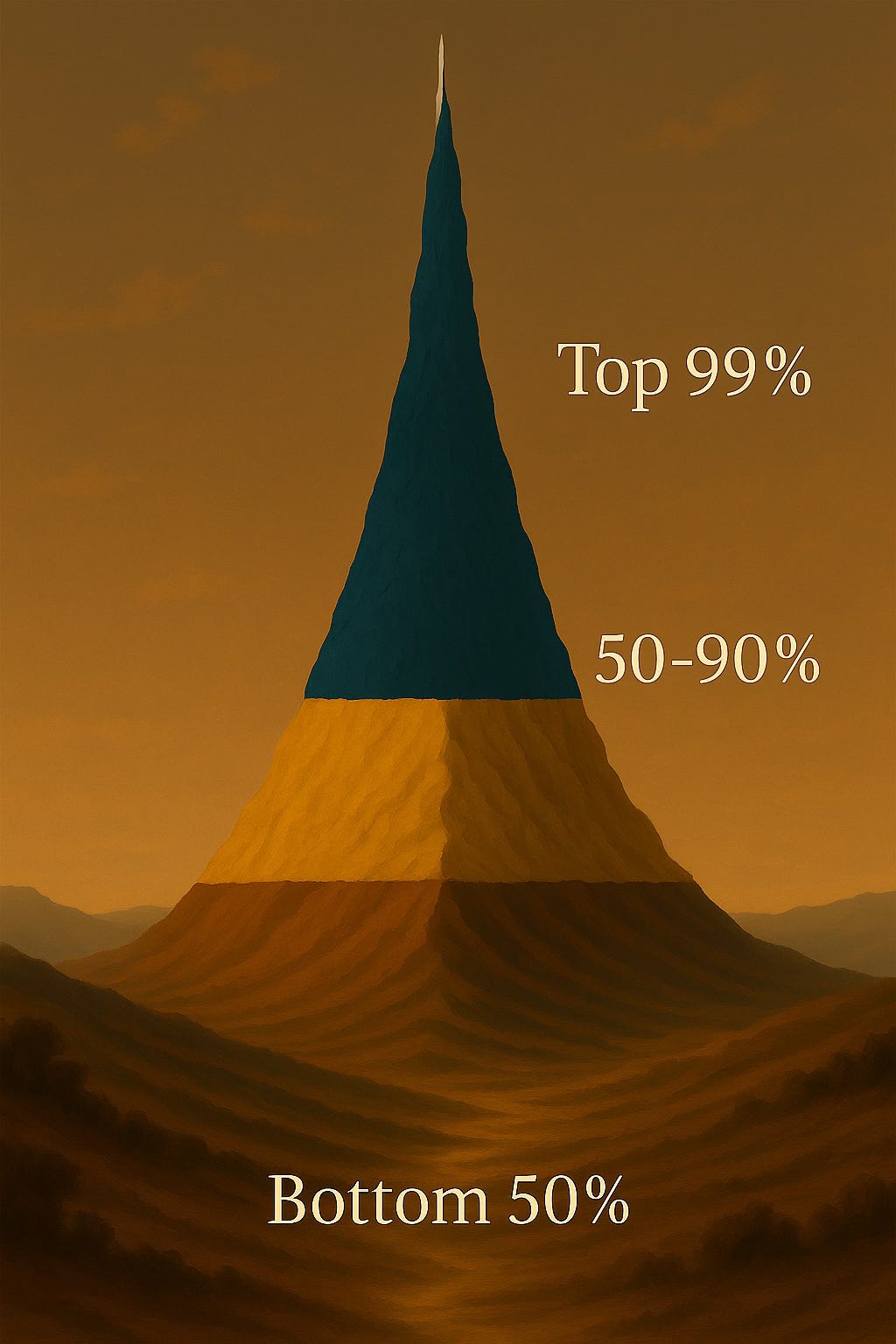
The $1 trillion threshold was always the structural argument: not just that this is unfair, but that a peak this high requires a base barely scraping by. Today that peak is documented. The buy-borrow-die structure didn’t break any rules, that’s the point. The rules were written to allow it. Warren’s letter didn’t stop the IPO. The SEC cleared it. The mechanism that was theorized in a Substack essay is now a $1.77 trillion public company with 555 million retail shareholders absorbing the risk while Musk controls the votes.
“Hands Off Our NHS” — The UK Draws a Line
WHAT HAPPENED
Anti-Palantir protests broke out across the UK today. Demonstrators are protesting Palantir’s contract to manage NHS health data covering 67 million people. Separately, Palantir is suing Sadiq Khan, the Mayor of London, after he blocked a £50 million Metropolitan Police contract on civil liberties grounds. The Times reports Palantir filed suit after Khan refused to allow the contract to proceed. Two simultaneous UK fights: national health records and police surveillance data. Palantir lost the police contract through a democratic process and responded with litigation.
WHAT IT MEANS
Yesterday’s financial surveillance executive order established the US domestic policy layer that precedes expanded Palantir federal data ingestion. Today the UK public is visibly resisting the same company’s penetration of public health infrastructure. The pattern: Palantir wins the contract, the public objects, the democratic process occasionally blocks it, Palantir sues. What is being contested is whether private AI infrastructure companies can operate inside public institutions with effective democratic accountability.
The NHS is not a marginal use case. It is one of the largest integrated health datasets in the world. A Palantir contract to manage it is not a technology procurement — it is a structural decision about who controls the health data layer of an entire nation’s population.
WHY IT MATTERS
The Palantir-IRS Super API (US) and the Palantir-NHS contract (UK) are the same structural move in two jurisdictions: a single private vendor gaining unified access to public data that the state originally collected for public purposes. The UK public is protesting it in the streets. The US equivalent has not yet produced comparable street-level resistance. The distribution-vs-concentration thesis predicts this dynamic: concentration is invisible until the costs become personal. NHS patients know what it means for Palantir to hold their health records. The abstraction collapses when the data is yours.
Iran: From Hormuz Closure to “Deal Is Near” in 24 Hours
WHAT HAPPENED
Twenty-four hours after Iran declared the Strait of Hormuz closed and Trump threatened to seize Kharg Island in a Venezuela-style operation, Trump announced he has canceled plans to strike Iran and that a deal is near. The Washington Post reports Trump revealed a “secret mission that moved 100 million barrels of oil via Hormuz” during the same window, a back-channel oil-flow arrangement that apparently ran concurrent with the public escalation. Qatar’s force majeure declaration on LNG contracts may be under review.
WHAT IT MEANS
The Hormuz closure and the Kharg Island threat were negotiating moves, not operational commitments. The 24-hour arc — closure, threat, deal claimed — is the Iran nuclear deal negotiating pattern applied at wartime speed. The secret oil mission is the tell: the closure was partial, managed, and coordinated with at least one back-channel. The escalation was theater for a negotiating audience.
WHY IT MATTERS
The ceasefire architecture is not stable — it is a series of escalation-and-retreat cycles with each peak slightly higher than the last. The Hormuz closure was a peak. The “deal near” claim is the retreat. Watch whether the ceasefire holds past the next IDF action in Lebanon or the next US asset targeted by Iranian proxy forces. The Lebanese casualty count stands at 3,696 killed, 11,413 wounded as of June 10. That does not pause during negotiating cycles.
The AI EO: Acknowledges Risk, Stops Short
WHAT HAPPENED
Trump signed an executive order on Advanced AI Innovation and Security. Per The Hill’s reporting, the order “acknowledges risks but stops short of regulating the industry.” The order includes provisions allowing the executive branch to vet deployed AI systems for security concerns, authority that did not previously exist in this form.
WHAT IT MEANS
The pattern runs at the EO layer now. The order acknowledges that advanced AI poses risks. It does not create binding constraints on the labs building it. It does create new executive authority to evaluate deployed systems, which is domestic surveillance architecture applied to AI infrastructure, not safety regulation. The Fable 5 release two days ago is the operational reality. The EO is the public-facing safety statement. Both are true simultaneously. They are designed to be.
WHY IT MATTERS
Watch whether the AI vetting provision is used to evaluate systems for political-loyalty rather than safety criteria — the Schedule F pattern applied to AI deployment authorization. If the executive branch controls which AI systems are “secure,” it controls which AI companies operate in federal contexts. Palantir’s federal contracts, Anthropic’s government API access, and OpenAI’s federal deployments all run through executive authorization. The EO gives the administration a new lever on that infrastructure. Three Castle Bravos named friction-compression as the pattern: safety architecture becomes the deployment vehicle. The EO names risk and then hands the deployment decision back to the people building the risk.
What to Watch
SPCX first-day trading: whether the 94× revenue multiple holds or whether retail investors price in the governance discount immediately
Warren / SEC: whether any investigation into the xAI valuation conflict opens or dies in the news cycle
Iran deal specifics: what “near” means; whether Iran formally reopens Hormuz; whether the 100M barrel oil mission is acknowledged
NHS Palantir contract: whether protests trigger parliamentary review or renegotiation
Palantir vs. Khan: which court, what timeline, whether it expands to other blocked contracts
AI EO vetting provision: which agency administers it; whether federal AI contracts require new certification
This is Wireframe News — the first trillionaire arrived the same day NHS patients took to the streets. The mechanism was always the same: public infrastructure, private capture, and the people who depend on it left holding the risk.