
Who Gets the Future
New global order: AI CEOs as heads of nation-states at G7

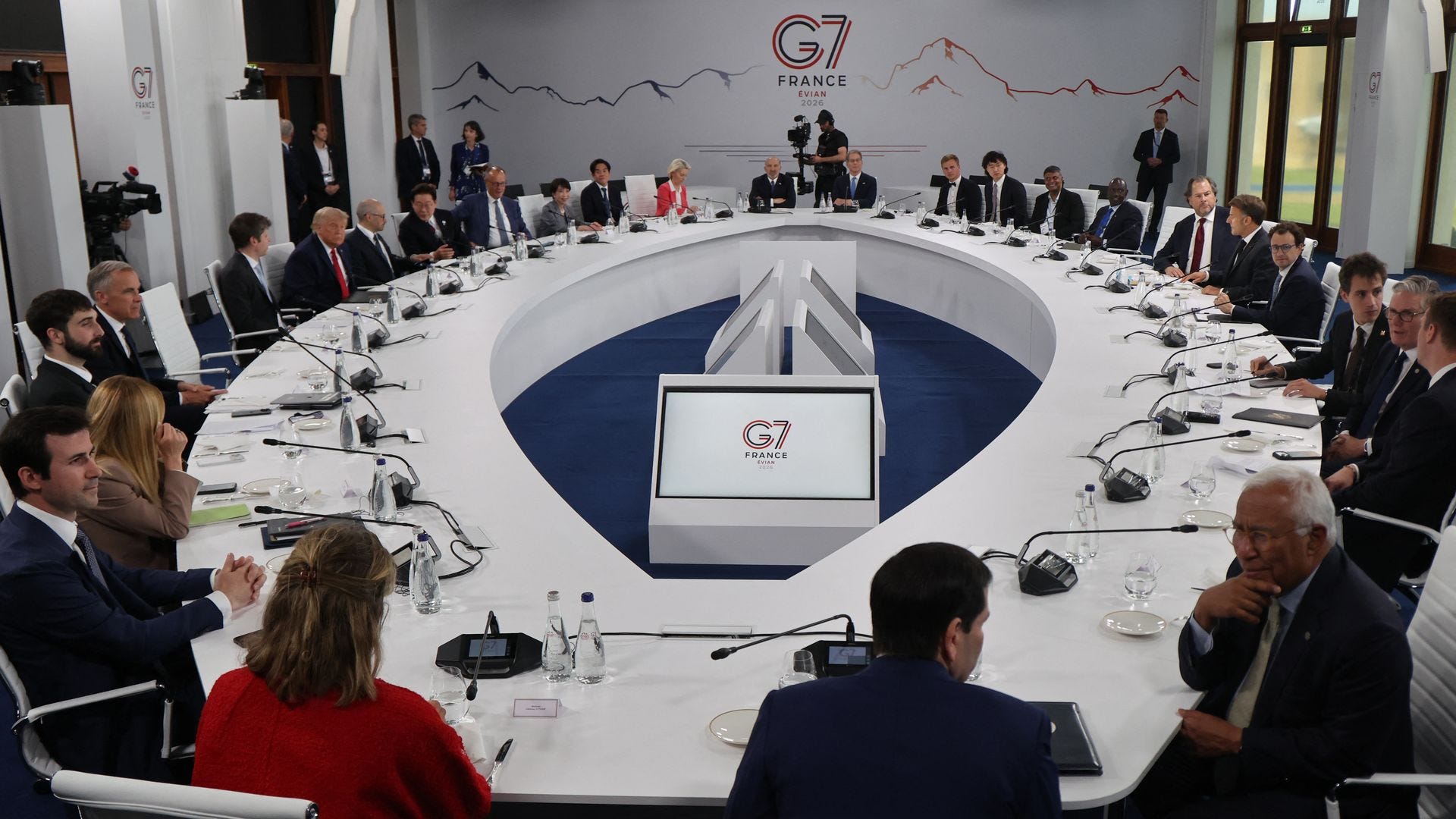
In June 2026, at the G7 summit in France, someone took a photograph that says it all.
At the leaders’ table sat the President of the United States, flanked by two men. On his right, Sam Altman, who runs OpenAI. On his left, Demis Hassabis, who runs Google DeepMind. Across the room the President of France sat between Dario Amodei of Anthropic and Marc Benioff of Salesforce. For the first time in the fifty-year history of the G7, the people who build the machines had chairs at the table where governments are supposed to answer to each other.
They did not come to listen. Amodei and Hassabis used the room to call for a US-led AI coalition. Altman pitched a global standards body for advanced models, one the United States would conveniently help run. CNBC, not a radical outlet, called the seating “a signal of where power sits.”
You weren’t at that table. Neither was anyone you know. They are deciding yours and your family’s future right now.
The bet
To see why a seating chart matters, go back two years, to a document almost nobody outside San Francisco read and almost everybody inside it did.
In June 2024 a researcher barely out of college named Leopold Aschenbrenner, freshly pushed out of OpenAI’s since-dissolved superalignment team, published 165 pages called Situational Awareness: The Decade Ahead. It was part forecast and part manifesto. It was also, though that took two years to see, part audition. It made a set of unusually specific bets, and most forecasts hedge. This one put numbers and years on the table and dared you to check them later.
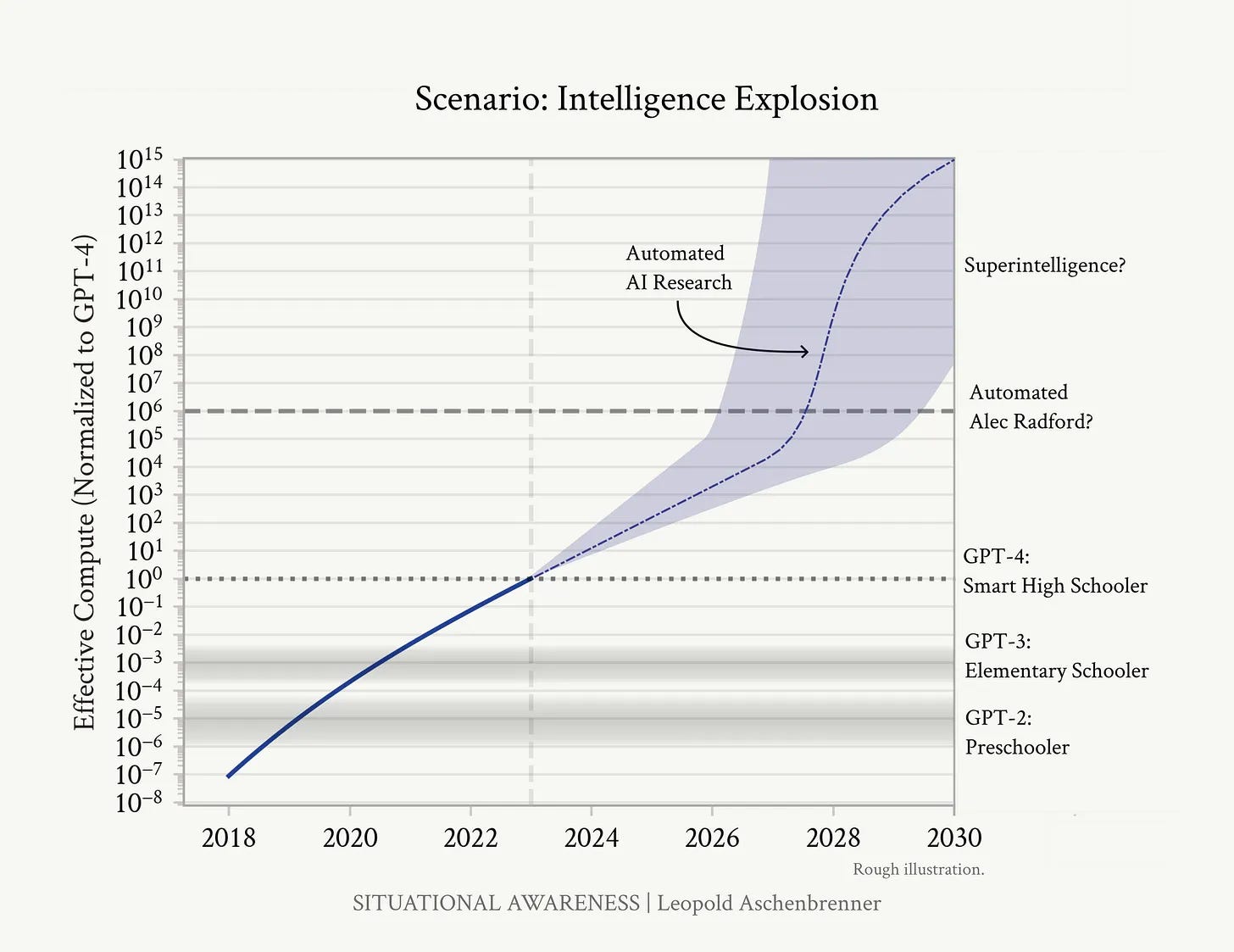
The core claim was that you can see artificial general intelligence (AGI — the threshold where machines can do the work of humans across all domains) coming by counting the orders of magnitude (OOM). Think of it the way you’d think about an engine. Every order of magnitude is a tenfold jump in effective horsepower, and Aschenbrenner argued the field had been adding them on a clock: about half an order from raw compute each year, about half an order from better algorithms, plus a third lever he called unhobbling.
That third one is where he was sharpest. A modern AI model, fresh out of training, is a race car delivered with the rev limiter bolted on: it knows an enormous amount and can use almost none of it. Unhobbling is taking the limiter off, one bolt at a time, teaching the model to use tools, to hold a long context, to stop and think before it answers instead of blurting the first plausible thing. Aschenbrenner’s bet was that the limiter was costing us far more than the engine was. Take it off and the same hardware lunges forward.
I’ve watched this unhobbling in my own work, and you can hear it from the teams building these models: once you trust the model and realize you are the limiter, your job changes. Coding engineers at Anthropic now ship roughly 8× what they did two years ago, with Claude writing 80% of the code. Their role is the thinking the model can’t do yet — set the goals, write the tests that prove the goal is met, then let it run with light oversight.
Add the three levers and his arithmetic said: another jump the size of GPT-2 to GPT-4, the leap from a model that strings together plausible sentences like a preschooler to one that aces the bar exam like a sharp high-schooler, except this time landing somewhere past the best PhDs. He put a date on it. AGI by 2027 was, in his word, “strikingly plausible.” And once machines could do the work of an AI researcher, he argued, they would improve themselves, compressing a decade of progress into a year. An intelligence explosion.
Then came the part that made the essay famous, and the part this piece is really about. Aschenbrenner argued that no startup could be allowed to hold something this powerful. By 2027 or 2028, he predicted, the United States government would step in and nationalize the whole effort. He called it The Project, and the analogy was explicit: the Manhattan Project, a SCIF, the bomb. Power that decisive does not stay in a San Francisco office park. The state comes and takes it.
Two years on, the receipts are in. So let’s keep score.
What he got right
Start with the part that should make you trust him, because he earned it.
The unhobbling call landed first, and it landed fast. Three months after he published, OpenAI released o1, a model that does exactly what he described: it stops and thinks, spending its effort at the moment you ask rather than only during training. Three months after that came o3. The rev limiter came off on his schedule, almost to the quarter. If you want one prediction to judge him by, that’s the one, and he nailed it.
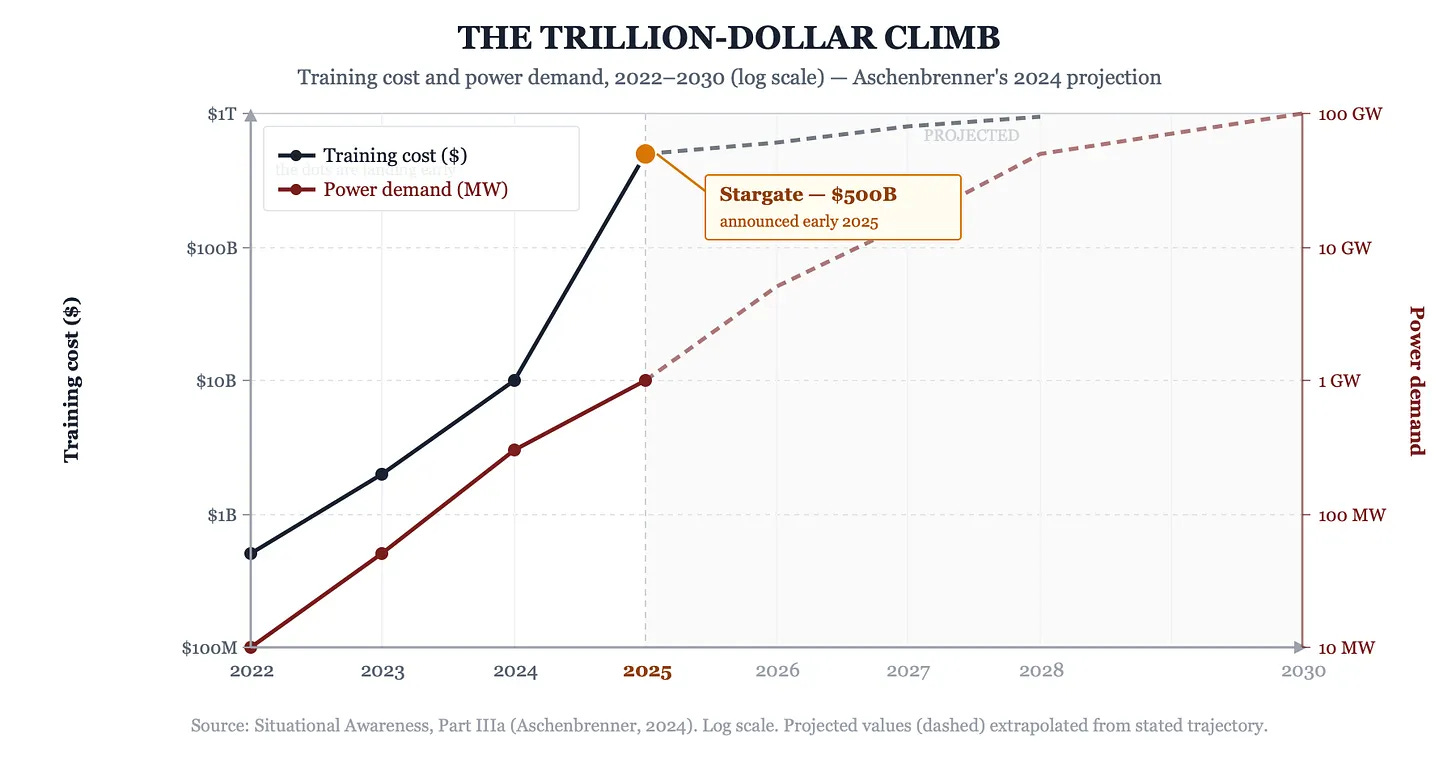
The power call landed next. Aschenbrenner said the binding constraint on AI would not be money or even chips but raw electricity, and he framed it as a physical problem: where, exactly, do you find ten gigawatts? In 2024 that sounded like a sci-fi flourish. By 2025 it was the entire industry. Tech companies were signing deals to restart mothballed nuclear plants, queuing gas turbines, and fighting over grid connections, because the limiting reagent really had become the wall socket. He didn’t predict the AI boom. He predicted what the AI boom would run out of, which is harder and more useful.
And the money call landed, early. His trajectory had clusters climbing from ten billion dollars toward a trillion, with annual AI investment rising into the trillions by decade’s end. Then in January 2025 came Stargate, a five-hundred-billion-dollar buildout announced in a single press conference. The trillion-dollar cluster he’d been mocked for is no longer a thought experiment. It’s a construction schedule.
So give him this plainly: he read the machine correctly, and he read it early. The engineering future arrived on schedule.
The miss that tells you everything
Now the other column.
AGI by 2027 looks late. The models got dramatically better at coding and at acting as agents, but the drop-in digital coworker who disappears for a week and comes back with a finished project is not here, and the self-improving intelligence explosion has not started yet. The jury is genuinely out, and reasonable people disagree about whether we’re behind his curve or right on it. Personally, it looks right on target — if anything, accelerating.
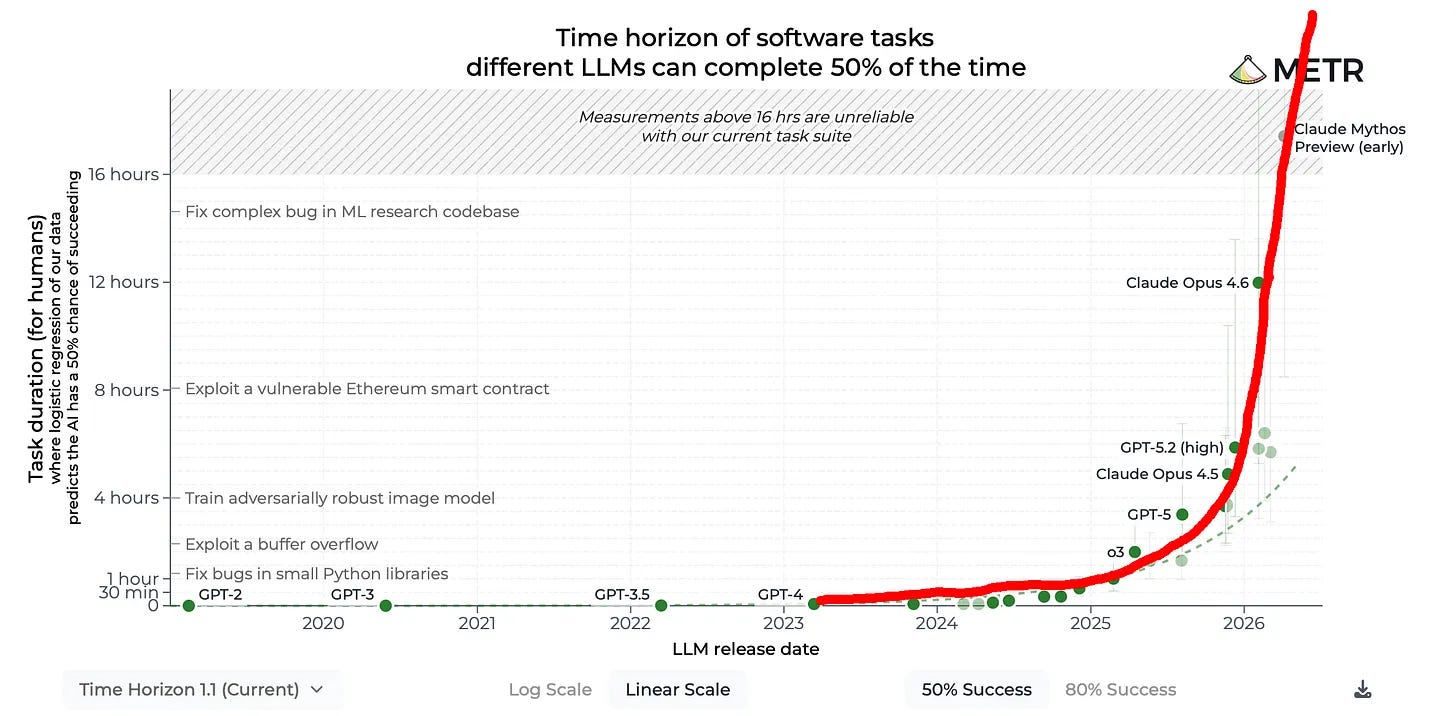
The chart above tells it: the green line was the trajectory through early 2025; the red is where the newest models actually went. Mythos doesn’t even fit, it broke the benchmark. Straight up.
But The Project, the centerpiece, did not just fail to happen. It happened in reverse, and it should be the thing everyone, and I mean everyone, is watching.
The government did get involved in AI. It got involved constantly. But it did not show up to govern the labs, to build guardrails or policy, or as Aschenbrenner proposed, to absorb them into a national mission. It showed up to play favorites. When the Justice Department went to court to defend Elon Musk’s xAI against a Clean Air Act suit over its gas turbines, it argued the company was “vital for national security.” That same season, the same government reportedly moved to choke a rival lab with export controls. A $620 million Pentagon loan was fast-tracked to a rare-earth firm, the magnets inside drones, motors, and guided weapons, that the president’s son’s venture fund had quietly taken a stake in months before. Loyalty bought a shield. Refusal bought a blacklist.
Aschenbrenner imagined the state conscripting the labs. Instead the labs captured the state, and are now capturing the world. Capture, not conscription. That is the inverted Project, and if you want it in a single image, go back to the photograph we started with. The men who run the labs are not being marched into a government facility to be questioned and held accountable. They are being seated at the head table, in the chair at the President’s right hand, writing the agenda and telling world leaders what they want.
Look closer at that table, because the history is the argument. The G7 was built in 1975 as a leaders-only room, a deliberate counterweight, the place where governments answered to each other and not to industry. Business was always kept one step removed, with its own parallel track called the B7 that hands recommendations to the summit from outside the door. The place where chief executives and heads of state mingled as peers was Davos, never this. As recently as 2024, when Microsoft’s and BlackRock’s CEOs turned up at the Italian summit, it was as side guests, near the table, not at it.
In 2026 the wall came down. The lab heads aren’t in the anteroom and aren’t working a side lunch. They’re in the principals’ chairs. The room built as the counterweight to concentrated private power now seats the most concentrated private power of the moment at its head.
From AGI to ASI
The most important rebuttal to Aschenbrenner didn’t come from a critic. It came from inside one of the labs at his own table.
In June 2026, Google DeepMind published a research report called From AGI to ASI, with a heavyweight set of authors including the AIXI theorist Marcus Hutter and DeepMind’s own chief AGI scientist, Shane Legg. It is everything Aschenbrenner’s manifesto is not: hedged where he is certain, institutional where he is urgent, a list of open questions where he had a countdown. And it makes one quiet move that matters enormously.
Let’s define AGI and ASI before we go on.
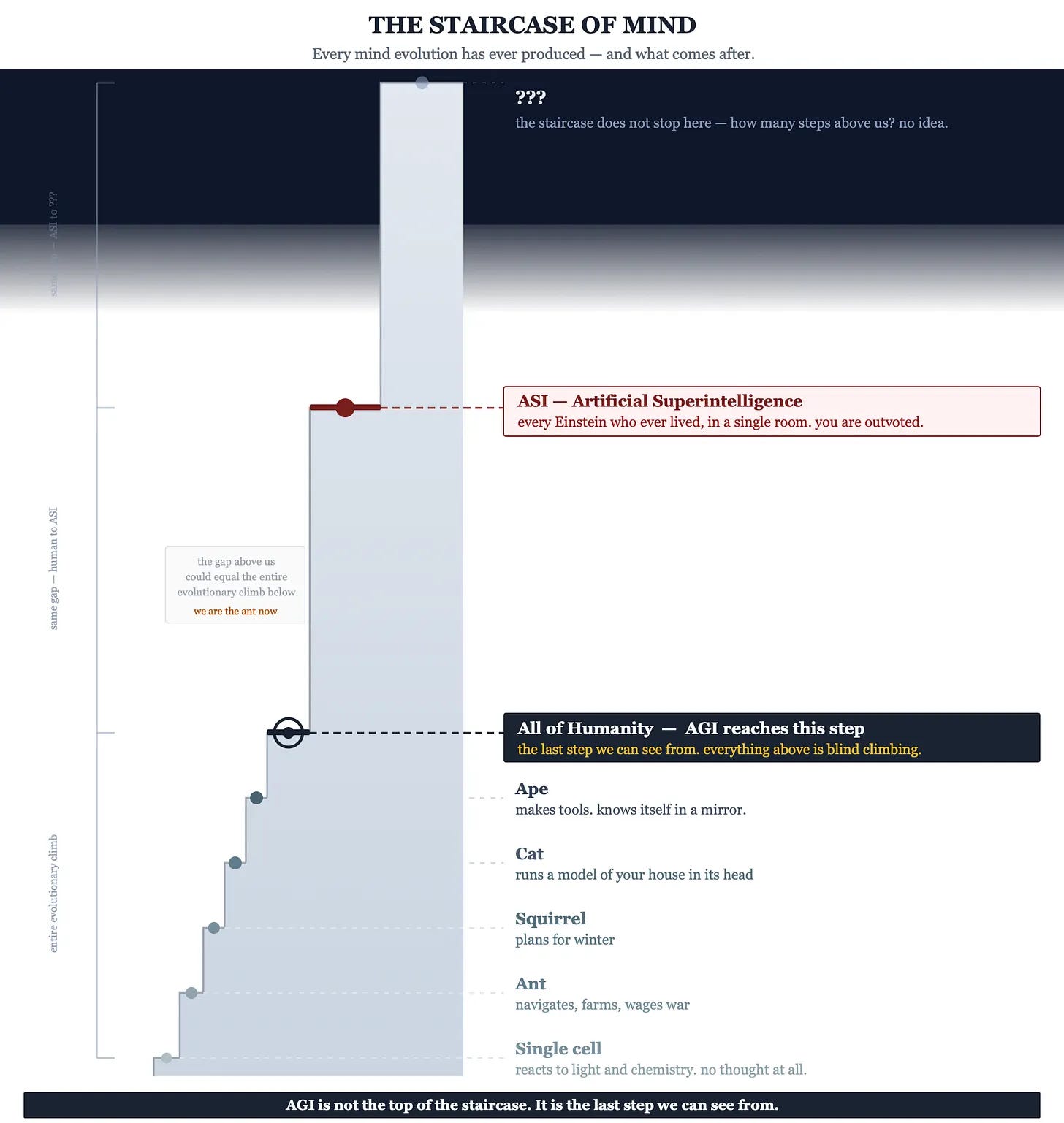
Picture a staircase, with the simplest living thing on the bottom step: a single cell, reacting to light and chemistry, no thought at all. Climb. A few steps up, an ant that navigates, farms, and wages war. Higher, a squirrel that plans for winter; a cat running a model of your house in its head; an ape that makes tools and knows itself in a mirror. A little above the ape, you reach a human. You are standing on that step right now.
Stretch that staircase out on an absolute scale, though, and the entire climb from single cell to human. Every mind evolution has ever produced is a short, crowded flight near the bottom. A chimp shares almost all your DNA; the step from ape to human is a small one. We just happen to stand on the highest rung we can see, so we mistake it for the top.
AGI is reaching the human step. Then comes the climb from AGI to ASI — artificial superintelligence — which the paper defines not as a smarter person but as a system “more cognitively capable than large organisations of humans.” Not one Einstein. Every Einstein, in every domain, who ever lived, in a single room, and you outvoted.
And the staircase does not stop at the human step, there is no reason it would. How many steps are above us? We have no idea, except that nothing says the number is small; the distance from a human to a superintelligence could be not the short hop that separates us from the ape, but more than the entire climb that produced us.
You can look down the staircase and understand every step, you can imagine the cat’s world, the ant’s. You cannot look up. An ant cannot be taught calculus; the concept lives on a step its mind can’t stand on. We are the ant now. AGI is not the top of the staircase when it’s reached. It is the last step we can see from, and everything above it, we climb toward blindly.
In Aschenbrenner’s world this is a cliff. One model crosses a line, the intelligence explosion fires, and everything is different the morning after, all at once. The DeepMind paper says the picture of “a single transformative step change” may simply be wrong. More apt, the authors write, is “a series of transformative societal changes,” wave after wave of breakthroughs across many fields, the pace gated by frictions and bottlenecks nobody can yet size.
Think of it the way a sailor thinks about weather. Aschenbrenner is forecasting one rogue wave: you either see it coming and get the bow into it or you’re swamped, and there’s a single moment that decides everything. DeepMind is forecasting a building sea, not one wave but a rising train of them, each bigger than the last, the danger less that any single one capsizes you and more that they never stop coming and you never get to rest. Don’t wait for the rogue wave. Watch the sea state.
And there’s already a crack in the cliff theory. In late 2024 a Chinese lab called DeepSeek released models near the global frontier at a small fraction of the cost everyone assumed was required. That mattered because Aschenbrenner’s whole edifice rests on compute as the moat: count the orders of magnitude, spend the trillions, win. DeepSeek suggested the frontier might be reachable with cleverness instead of capital, and in a single day that January, Nvidia shed close to six hundred billion dollars, the largest one-day loss in market history. The trillions are still pouring; Stargate is still rising. But it is no longer obvious that spending the most guarantees winning, and if it doesn’t, “the free world must out-build China” stops being a strategy, because out-building stops being decisive.
Which is right, the cliff or the sea, is not settled and won’t be for years. But notice what they all agree on, because the agreement is the tell. Both papers assume the thing is coming. Both assume it reorganizes power. Neither one, anywhere in 165 pages or a long technical report, assumes that you get a vote.
What it’s actually about
Strip the timelines and the OOM charts away and the fight between the cliff and the sea is a surface. Underneath it is the only question that has ever really mattered: does a consequential thing get distributed, or does it get concentrated?
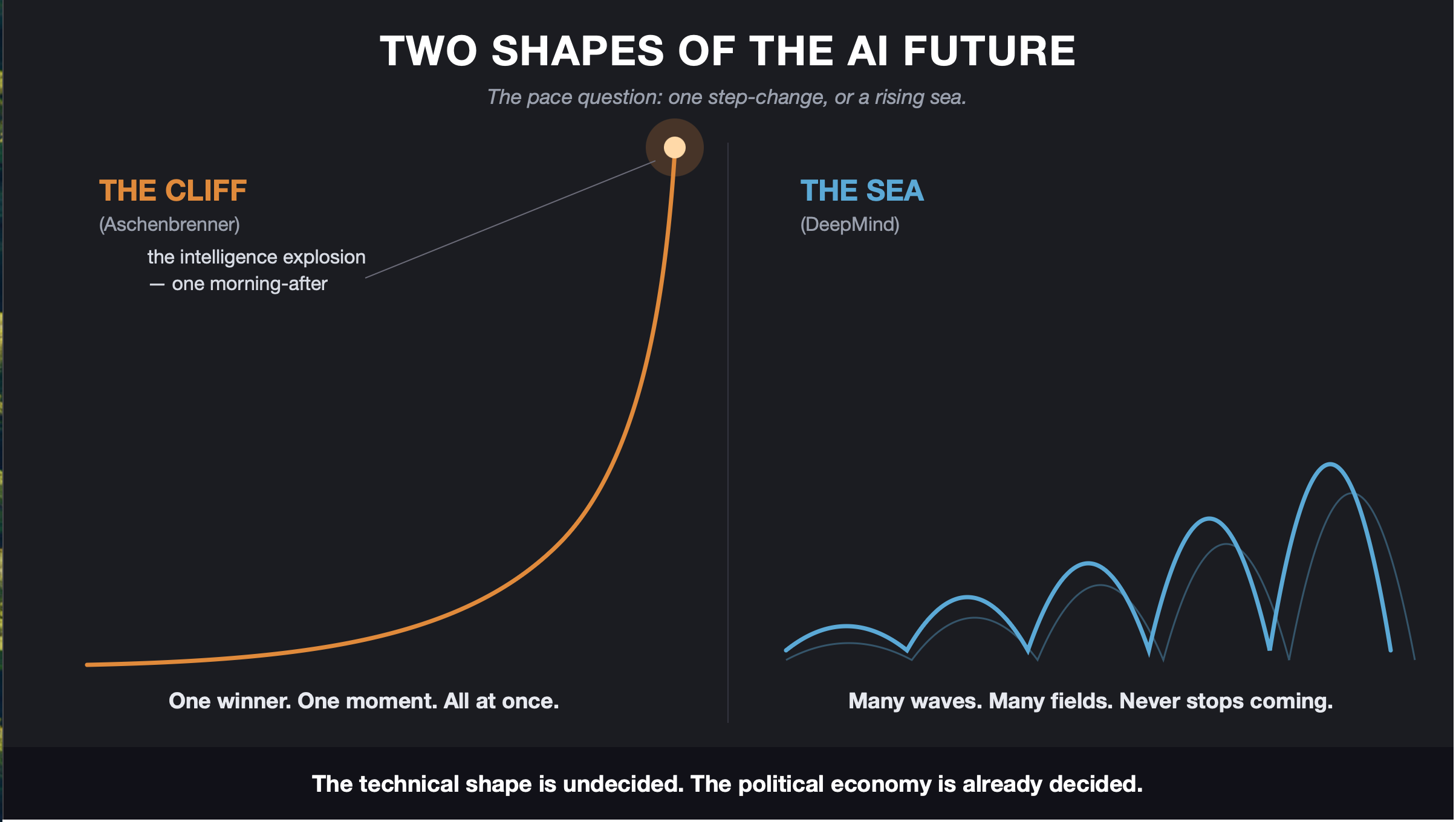
A step-change world concentrates by definition: one winner crosses first, and the intelligence explosion compounds the lead out of reach. A series of waves is, in principle, friendlier, value landing in medicine, materials, logistics, a hundred fields, captured by many hands over many years, the leaders knocked back toward the pack by the next DeepSeek.
So you’d think the distribution-minded among us should root for the sea. Here’s the trap, and it’s the reason that photograph matters more than either paper. The technical shape is still undecided. The political economy is already being decided, and it’s being decided for concentration regardless of which shape wins. Cliff or sea, the same handful of firms are buying the same handful of seats. They are drafting the standards bodies they will then be regulated by. They are getting their lawsuits defended as national security and their rivals choked as the same. The favoritism is shape-independent. It works whether the future arrives in one wave or a hundred.
That is the deepest thing two years of scorekeeping teaches. We spent those years arguing about when AGI arrives and how fast it takes off, which are the engineering questions, the ones Aschenbrenner mostly got right. We spent almost no energy on who ends up holding it, which is the political question, the one he got exactly backwards.
The ledger
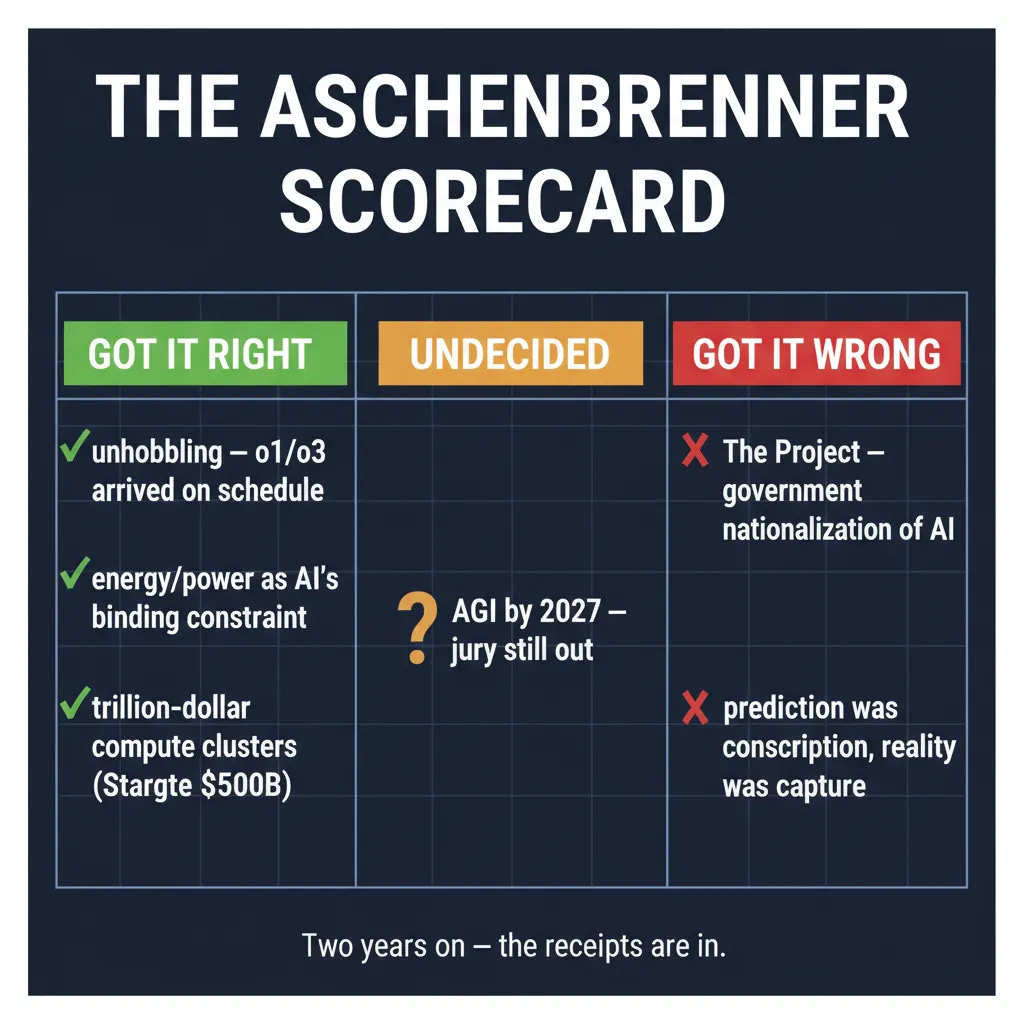
So here is the scorecard, two years in.
The machine Aschenbrenner forecasted: he read it beautifully, and early. The limiter came off on schedule. The power wall is real and binding. The trillion-dollar cluster is pouring concrete in the desert. Mark the engineering column for the prophet.
The politics: he read it backwards. There was no Project. There was a seating chart. The state did not absorb the labs; the labs bought the state, and then pulled their chairs up to its table. Mark the political column against him.
Now notice which column has your life in it. The engineering column is the one the forecasters win, and it determines how capable the machine becomes. The political column is the one they lose, and it determines who the machine answers to. Distribution was a choice in 1945, and again in 1975 when that leaders-only room was built precisely to keep concentrated private power one step from the table. It is a choice now too. It is simply not being made in any room you are allowed to enter.
Which exposes the last thing, the thing the scorecard finally reveals about the forecasts themselves. A prediction about the shape of the future is never only a prediction. Convince the world that AGI is a national-security inevitability and you become the indispensable man who must be allowed to build it. The forecast is a bid. It was always part audition. Aschenbrenner’s manifesto, the DeepMind report, the call at the G7 for a coalition only America can lead, strip the math away and they are all applications for the same small number of chairs.
Go back to the photograph. The President flanked by the men who build the machines. The standards body they offered to run. The empty space, everywhere outside the frame, where the rest of us are. They will tell you the urgent question is how fast the future is coming, the cliff or the sea, 2027 or 2035. It was never that. The seats are filling, and you don’t have one.
Sources
Leopold Aschenbrenner, Situational Awareness: The Decade Ahead (2024)
Google DeepMind, From AGI to ASI (2026)
AI chiefs at the G7 table (CNBC)
DOJ calls xAI “vital for national security” (Wired)
The $620M Pentagon loan to a Trump-Jr.-linked firm (ProPublica)
What the B7 is (U.S. Chamber of Commerce).