
When the Robots March South
Operation Southern Spear and the New American Way of War

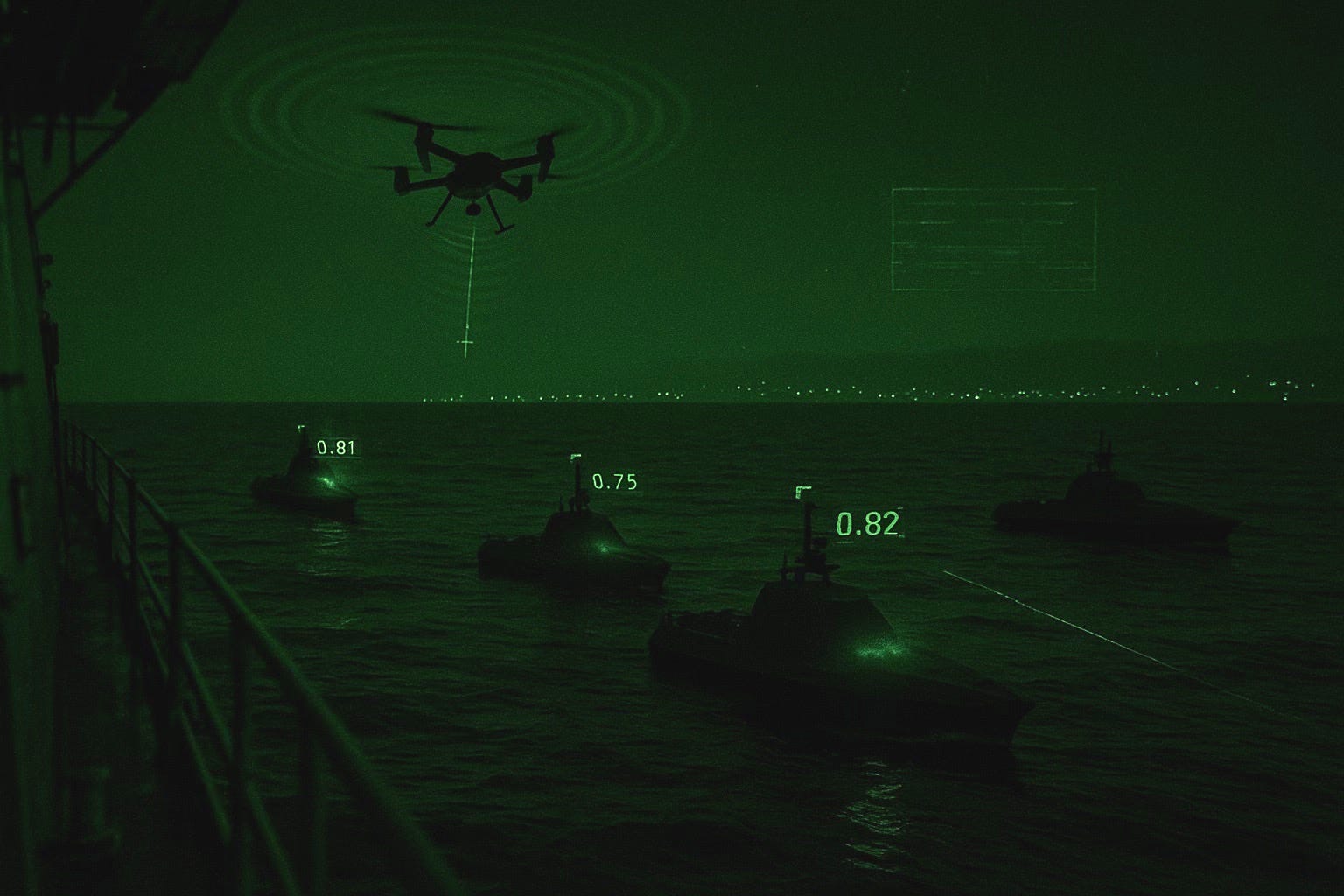
On November 13, Pete Hegseth stood up as “Secretary of War” and announced Operation Southern Spear, a named U.S. military operation in the Americas openly framed around “robotic and autonomous systems.”
Strip away the patriotic branding and it’s simple. A robotic fleet of unmanned surface vessels and vertical-takeoff drones is being knit into a hybrid Navy–Coast Guard–DHS grid from the Caribbean to the Eastern Pacific. That grid is already feeding targeting data for lethal strikes on “narco-terrorist” boats, with dozens killed and almost no transparency about who they were. The same architecture is now positioned off Venezuela alongside a carrier strike group, bombers, and Marines, as Trump weighs hitting land targets.
If this tips into a shooting war with Venezuela, Southern Spear becomes the proof-of-concept for AI-driven, low-casualty American wars: cheap autonomous systems doing the work, dead civilians on the other end, and a template that will migrate home.
The Zero-Casualty Promise
Trump’s pitch for this is simple and almost bulletproof: Why should American sons and daughters die stopping drug cartels when robots can do it? Why risk Marine pilots over Venezuelan air defenses when autonomous drones cost less than a Hellfire missile and come home in pieces, not body bags?
It’s America First as casualty calculus. We keep our people safe, project power without spilling American blood, and voters see results without funerals. No Dover test, no flag-draped coffins, no grieving families asking whether it was worth it.
This is the dark miracle of the political economy here. Trump can run on protecting American lives while multiplying the use of lethal force, because the costs that used to constrain presidents—dead troops, political backlash, congressional oversight—vanish when the machinery is unmanned. Every president since Vietnam has had to calculate whether the American public would tolerate casualties for a given objective. Trump is being handed a force structure that makes that calculation obsolete.
The question stops being “is this worth American lives?” and becomes “why wouldn’t we do this?” And once you’ve established that autonomous systems protect Americans by removing them from harm’s way, you’ve built a permission structure that doesn’t depend on public tolerance for sacrifice. The logic, protecting Americans from threats without exposing Americans to risk, doesn’t stop at the border. It was never going to.
Why Venezuela?
Let’s be clear: this isn’t about drugs. The narco-terrorist framing is cover. The real strategic logic is about China, resources, and hemispheric control.
Venezuela sits on the world’s largest proven oil reserves, 303 billion barrels, more than Saudi Arabia. China has poured $60-68 billion into Venezuela since 2007, making it the country with the most Chinese investment in the Western Hemisphere. In 2023, China and Venezuela upgraded to an “all-weather strategic partnership,” Beijing’s highest tier. As of 2024, 85 percent of Venezuelan oil exports go to China, and Chinese firms control key infrastructure under 20-year contracts.
It’s not just oil. Venezuela claims the world’s largest nickel reserves plus significant gold, bauxite, coltan, and rare earth elements essential for advanced technology and defense systems. China has been systematically positioning itself to control these supply chains, and Venezuela is a linchpin.
From a Trump administration perspective, the America First case writes itself. You’re taking back control of the world’s largest oil reserves from a Chinese client state. You’re disrupting China’s access to critical minerals. You’re breaking up China’s strategic foothold in “America’s neighborhood.” And you’re doing it with robotic systems that eliminate American casualties, which means no political cost at home.
This isn’t just about Venezuela. Earlier this year, Trump threatened to retake the Panama Canal because Hong Kong-based firms managed two ports at either end. Under pressure, those firms sold their stake to a U.S.-led consortium, and Panama withdrew from China’s Belt and Road Initiative. Venezuela is the bigger prize. Toppling Maduro puts the world’s largest oil reserves back under U.S.-friendly control, denies China a strategic asset, signals consequences for Beijing alignment, and establishes a template for using autonomous weapons to conduct regime change without domestic political cost.
So when Hegseth talks about “removing narco-terrorists,” he’s actually describing regime change in China’s most important Western Hemisphere partner, using robotic systems that eliminate traditional constraints on American use of force. The drug war framing is politically useful, but the actual objective is oil, minerals, China, and hemispheric dominance.
What Autonomous Warfare Looks Like
In January, U.S. Fourth Fleet announced Southern Spear to “operationalize robotic and autonomous systems” across Southern Command. That includes long-dwell robotic surface vessels, interceptor boats, and surveillance drones. Saildrone calls it a “robotic navy” and a “persistent, unblinking eye.”
Hegseth’s announcement rebranded this as Homeland defense and linked it to massive naval airpower, explicitly including strikes on Venezuelan land targets. A robotic fleet, originally pitched as counternarcotics, is now the backbone of a hemispheric military operation pointed at regime change.
The Pentagon’s policy allows autonomous weapons that “select and engage targets without further intervention by a human operator” while maintaining “appropriate levels of human judgment.” That second part does enormous work, because what counts as “appropriate” is flexible.
In practice: Robotic vessels and drones collect massive sensor data. Models flag “patterns of interest.” Systems assign labels like “probable drug runner.” Software assembles “target packages” with confidence scores. A human operator sees icons on a screen and has seconds to approve or veto the machine’s suggestion. On the org chart, the human is “in the loop.” In reality, the system decided what to notice, what to ignore, how to classify, and what to propose.
Right now, the U.S. has the USS Gerald R. Ford carrier strike group, F-35s, AC-130 gunships, Marines, and Southern Spear’s robotic grid all positioned. Venezuela is planning for guerrilla resistance if attacked.
What does this look like in war? First layer: robotic vessels and drones mapping traffic patterns, learning baselines. Deviations glow red. “Suspicious” becomes a data product, not human judgment. If Trump signs off on strikes, boats flagged as “narco-terrorist assets” justify hitting ports and infrastructure. Facilities tagged as “dual-use” get promoted to target lists. You saturate the area with autonomous drones, use AI to adjust routes in real time, let the machines soak up losses while mapping defenses. Ukraine proved $500 drones killing multi-million-dollar hardware works.
Geoffrey Hinton, one of AI’s core inventors, has been blunt: “The thing that stops rich countries invading poor countries is their citizens coming back in body bags. If you have lethal autonomous weapons, instead of dead people coming back, you’ll get dead robots coming back.”
Robotic fleets dramatically reduce U.S. risk. Venezuelan forces and civilians absorb the kinetic reality. Trump can pitch it as clean “precision” against narco-terrorists, even if targeting is driven by opaque models. American families aren’t burying their kids. Once you’ve normalized that framework in Latin America, you’ve rewritten the cost-benefit calculation for using force anywhere. Including at home.
How This Rewrites the Rules
Southern Spear is a proof of concept for a different model of American power.
It lowers the threshold for war. The UN, ICRC, and arms-control advocates all warn that autonomous weapons reduce perceived cost and risk, making conflict more likely. When voters aren’t seeing coffins, their tolerance for “surgical” wars goes up. What used to be a major decision, moving ships, risking crews, becomes a continuously available option.
It shifts from episodic war to continuous enforcement. “Persistent maritime domain awareness.” “Hybrid fleet campaign.” This is an operating system, not a one-off surge. The same architecture watching for drug boats today can watch for sanctioned shipments tomorrow and “terror-linked” migrants the day after. The robots never stand down.
And it’s industrializing the arsenal. Anduril is constructing “Arsenal-1,” a 5-million-square-foot facility in Ohio to churn out tens of thousands of autonomous systems. You don’t build that for a one-time operation. You build it for a future where autonomous systems are the default instrument of power. Southern Spear is the prototype. Arsenal-1 is the production pipeline.
The Same Logic, Turned Inward
Here’s where the circuit completes.
The Venezuela operation is sold as protecting Americans, from drugs, from cartels, from a hostile regime aligned with our adversaries. That framing justifies military action without congressional authorization, normalizes lethal autonomous systems, and establishes that eliminating threats to Americans is sufficient rationale for large-scale force.
Now ask: if autonomous systems protect Americans from foreign threats by eliminating the human cost of operations abroad, why wouldn’t you use them to protect Americans from domestic threats? The framing is identical. Drug cartels at the border. Criminal networks. Extremist cells. Enemies within. Trump has said explicitly that the internal threat is worse, and that the military might be needed to handle it.
The template established abroad slides directly into domestic application because the justification is the same: protecting Americans from threats. The only variable is who gets defined as the threat. Abroad, it’s a Venezuelan government aligned with China. At home, it could be anyone the system flags, protesters, activists, communities labeled as harboring extremists, political opposition framed as destabilizing.
The wall between “war abroad” and “security at home” is already an illusion. The same players behind Southern Spear—Palantir, Anduril, Saildrone—sell predictive policing to domestic law enforcement, AI-assisted border control, and autonomous surveillance for cities. Human Rights Watch warns these systems won’t be confined to battlefields. They’re already positioned for law enforcement, border security, crowd control.
Once you’ve accepted that black-box systems can label people “high-priority targets” based on data patterns, and that robotic platforms can act with minimal human intervention, you’ve built a template for gang suppression in U.S. cities, extremism monitoring for protests, aggressive border enforcement with lethal options just a policy tweak away.
Southern Spear is literally marketed as a border mission. Saildrone’s headline: “A Robotic Navy Sets Sail to Secure the Southern Border.” The infrastructure is dual-use by design. The zero-casualty promise that sold the war abroad becomes zero-tolerance justification for deployment at home. Protecting Americans from foreign enemies becomes protecting Americans from the wrong kind of Americans.
The robots marched south first because that’s where testing is easiest. But the logic that sent them there, zero casualties, maximum force, minimal accountability, doesn’t stop at the border. It was never designed to.
The Fork
The international system sees this coming. In 2023 and 2024, the UN General Assembly passed resolutions on autonomous weapons, with 161 states voting to maintain meaningful human control. The ICRC has called for clear legal limits. Human rights groups push for treaties banning weapons that autonomously select and engage people.
The U.S. line: we agree in principle, but we’re going to keep developing and fielding these systems. Southern Spear is that policy, live-fire.
If this rolls into a Venezuela war, it sets three precedents. First, a named U.S. operation where AI-driven robotic systems are openly core to the mission. Second, a demonstration that you can conduct lethal operations across a vast region with robots doing most of the work while Washington shrugs at international law. Third, proof that the U.S. can use autonomous weapons to conduct regime change against a Chinese partner state without triggering domestic political constraints.
That last point is critical. This establishes that zero-casualty warfare removes traditional limits on American use of force, pushing China out of the hemisphere, seizing critical resources. If it works in Venezuela, the model becomes available everywhere. Any government aligned with Beijing, any region where China has presence, any situation where U.S. interests are threatened, all targetable with systems that don’t generate coffins or congressional oversight.
So the fork is stark. Either you draw hard lines now, meaningful human control, real transparency, legal liability, bans on systems that select and engage people without direct human command, or you accept that “the robots march south” is the new baseline.
Today it’s Southern Spear and Venezuela, framed as removing narco-terrorists but actually about oil, minerals, and China. Tomorrow it’s some other emergency abroad. And sooner than people want to admit, the same architecture gets aimed inward, because the justification, protecting Americans from threats without exposing them to risk, works just as well domestically. Maybe better, because threats at home can be defined more flexibly, surveillance is denser, and targets can’t shoot back.
Hegseth just gave it a name and a theater of operations. What comes next depends on whether anyone is willing to say no before the proof of concept becomes the template, and the template becomes the default. The robots marched south because that’s where we let them go first, against a Chinese partner, in a resource-rich country, under cover of fighting drugs. They won’t stay there. It comes home. It was always going to.
DefenseScoop - “Hegseth announces Operation Southern Spear after 20th US strike against alleged ‘narco-terrorists’”
https://defensescoop.com/2025/11/14/hegseth-announces-operation-southern-spear-after-20th-us-strike-against-alleged-narco-terrorists/
RedState - “SecWar Pete Hegseth Announces ‘Operation Southern Spear’ As US Carrier Strike Group Enters the Caribbean”
https://redstate.com/streiff/2025/11/14/secwar-pete-hegseth-announces-operation-southern-spear-as-us-carrier-strike-group-enters-the-caribbean-n2196204
Breaking Defense - “Navy’s 4th Fleet to start operation focused on unmanned systems countering illicit trafficking”
https://breakingdefense.com/2025/02/navys-4th-fleet-to-start-operation-focused-on-unmanned-systems-countering-illicit-trafficking/
NPR - “The backstory of the USS Gerald R. Ford aircraft carrier”
https://www.npr.org/2025/11/16/nx-s1-5610508/uss-gerald-ford-aircraft-carrier-history-background
South China Morning Post - “US launches Operation Southern Spear, deploying robotic fleet to target cartels”
https://www.scmp.com/news/world/americas/article/3332740/us-launches-operation-southern-spear-deploying-robotic-fleet-target-cartels
Saildrone / Autonomous Surface Vessels
Saildrone - “A Robotic Navy Sets Sail to Secure the Southern Border”
https://www.saildrone.com/news/operation-southern-spear-secure-maritime-border
Saildrone Press Release - “Saildrone to Help Navy, CG, CBP Stop Flow of Illegal Drugs into US”
https://www.saildrone.com/media-room/press-releases/operation-southern-spear-jiatf-s
Naval Today - “Saildrone deploys 20 USVs to support US Navy’s activities along southern border”
https://www.navaltoday.com/2025/02/05/saildrone-deploys-20-usvs-to-support-us-navys-activities-along-southern-border/
AFCEA International - “U.S. Navy Saildrones On”
https://www.afcea.org/signal-media/us-navy-saildrones
DoD Policy on Autonomous Weapons
U.S. Department of Defense - “DoD Directive 3000.09: Autonomy in Weapon Systems” (January 2023)
https://www.esd.whs.mil/Portals/54/Documents/DD/issuances/dodd/300009p.PDF
Defense.gov - “DoD Updates Autonomy in Weapons System Directive”
https://www.defense.gov/News/News-Stories/Article/Article/3278065/dod-updates-autonomy-in-weapons-system-directive/
Congressional Research Service - “Department of Defense Directive 3000.09”
https://www.congress.gov/crs_external_products/IF/HTML/IF11150.web.html
Human Rights Watch - “Review of the 2023 US Policy on Autonomy in Weapons Systems”
https://www.hrw.org/news/2023/02/14/review-2023-us-policy-autonomy-weapons-systems
Wikipedia - “Department of Defense Directive 3000.09”
https://en.wikipedia.org/wiki/Department_of_Defense_Directive_3000.09
DefenseScoop - “After 3000.09 update, DOD stays quiet on lethal autonomous weapon reviews”
https://defensescoop.com/2023/10/27/after-3000-09-update-dod-stays-quiet-on-lethal-autonomous-weapon-reviews/
UN Resolutions on Autonomous Weapons
Stop Killer Robots - “161 states vote against the machine at the UN General Assembly”
https://www.stopkillerrobots.org/news/161-states-vote-against-the-machine-at-the-un-general-assembly/
Stop Killer Robots - “164 states Vote Against the Machine at the UN General Assembly” (2023)
https://www.stopkillerrobots.org/news/164-states-vote-against-the-machine/
Human Rights Watch - “Killer Robots: UN Vote Should Spur Treaty Negotiations”
https://www.hrw.org/news/2024/12/05/killer-robots-un-vote-should-spur-treaty-negotiations
Arms Control Association - “UN Moves to Expand Autonomous Weapons Discussions”
https://www.armscontrol.org/act/2024-12/news/un-moves-expand-autonomous-weapons-discussions
Arms Control Association - “UN to Address Autonomous Weapons Systems” (2023)
https://www.armscontrol.org/act/2023-12/news/un-address-autonomous-weapons-systems
Article 36 - “Opportunities after the UNGA Resolution on Autonomous Weapons”
https://article36.org/updates/opportunities-after-the-unga-resolution-on-autonomous-weapons-moving-toward-a-new-treaty/
Automated Decision Research - “Autonomous weapons at the 79th United Nations General Assembly First Committee”
https://automatedresearch.org/news/autonomous-weapons-at-the-79th-united-nations-general-assembly-first-committee/
UN First Committee - “First Committee Approves New Resolution on Lethal Autonomous Weapons”
https://press.un.org/en/2023/gadis3731.doc.htm
Venezuela-China Relations / Strategic Context
Venezuelanalysis - “Chinese Company Installs Its First Floating Oil Platform in Venezuela’s Maracaibo Lake”
https://venezuelanalysis.com/news/chinese-company-installs-first-floating-oil-platform-in-venezuelas-maracaibo-lake/
VOA News - “China stands by Maduro in Venezuela to safeguard its investments”
https://www.voanews.com/a/china-stands-by-maduro-in-venezuela-to-safeguard-its-investments/7729148.html
The National Interest - “Venezuela Has More Than Just Oil and China Knows It”
https://nationalinterest.org/feature/venezuela-has-more-just-oil-and-china-knows-it-206543
Wikipedia - “China–Venezuela relations”
https://en.wikipedia.org/wiki/China–Venezuela_relations
ScienceDirect - “Sino-Venezuelan oil-for-loan deal – the Chinese strategic gamble?”
https://www.sciencedirect.com/science/article/abs/pii/S1364032116302763
The Geopolitics - “China, Venezuela and the US: The Coming Confrontation in the Caribbean”
https://thegeopolitics.com/china-venezuela-and-the-us-the-coming-confrontation-in-the-caribbean/
Atlas Institute - “How Resource Nationalism Affects Investment in Venezuela”
https://atlasinstitute.org/how-resource-nationalism-affects-investment-in-venezuela/
Harvard International Review - “The Future of the Sino-Venezuelan Relationship: Make or Break?”
https://hir.harvard.edu/the-future-of-the-sino-venezuelan-relationship-make-or-break/
AInvest - “The Venezuela-China Energy Pivot: Seizing the Sanctions Opportunity”
https://www.ainvest.com/news/venezuela-china-energy-pivot-seizing-sanctions-opportunity-geopolitical-oil-plays-2505/
Xpert Digital - “World’s largest oil reserves: Venezuela’s economic situation”
https://xpert.digital/en/weltweit-groesste-erdoelreserven/