
When the Math Stops Working
Ray Dalio’s 500-Year Pattern Is Playing Out Right Now — And It’s Not What You Think, Politics Is Just The Side Show.

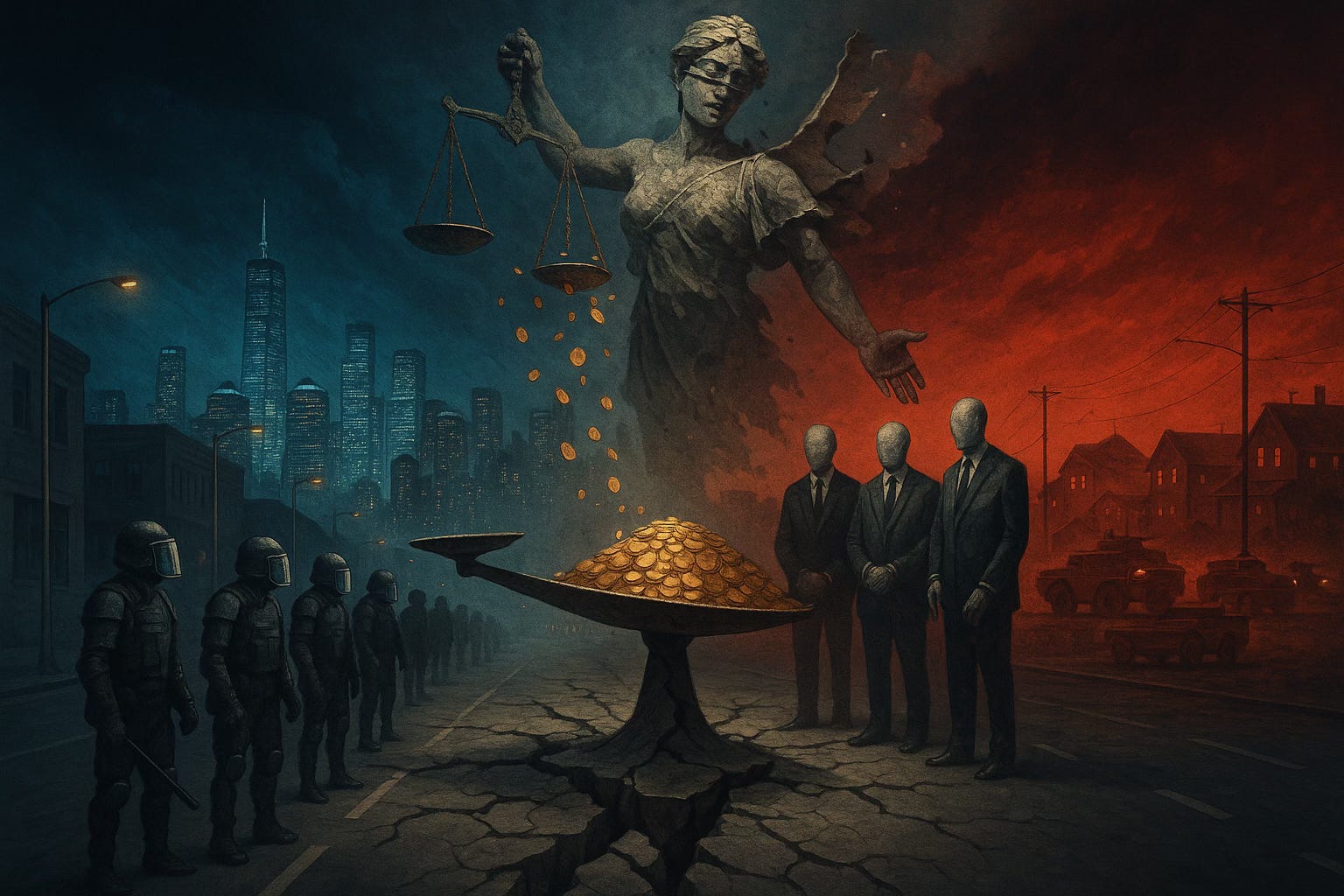
Between October 4 and October 9, 2025, something broke.
The Department of Defense became the Department of War. Federal troops deployed to Chicago over the governor’s objection. A federal judge blocked it as unconstitutional. The administration appealed. The troops stayed anyway.
Silicon Valley said nothing.
This isn’t partisan chaos. It’s not political dysfunction. It’s a pattern that’s been documented across 500 years of history, and it always ends the same way.
Ray Dalio saw it coming. And once you understand his framework, you’ll see it too.
Who Is Ray Dalio and Why Does His Framework Matter?
Ray Dalio runs Bridgewater Associates—the world’s largest hedge fund at $168 billion in assets under management. Both political parties use his research. He’s not a partisan. He’s a pattern recognition machine who’s been right about major turning points for forty years. For me, a kindred spirit, one of the first people when I hear him talk, I feel that I’m not crazy.
His edge isn’t ideology. It’s data. He studied the rise and fall of empires going back 500 years—the Dutch Republic, the British Empire, every major power shift. He tracked them across eight measurable indicators: education, innovation, economic output, military strength, financial center status, reserve currency, wealth inequality, and internal conflict.
What he found: The pattern always looks the same.
And what I most admire about him, he also believes in the human age arc, for him it’s time to transfer what he knows down and outward. And instead of going into great detail here, just watch his videos starting with this one:
The Arc: How Empires Rise and Fall
Dalio calls it the “Big Cycle.” Here’s how it works:
Rise Phase:
Education and innovation create competitive advantage
Economic dominance follows
Becomes the financial center of the world
Currency becomes the global reserve
Peak Phase:
Debt accumulates to maintain dominance
Wealth concentrates at the top
Inequality grows
Internal conflict emerges
Institutions lose legitimacy
Decline Phase:
Fiscal crisis
Military overextension
Internal violence
System collapse or reconstitution under new rules
The United States followed this arc perfectly. Post-WWII dominance. Dollar as reserve currency. Wall Street as financial center. Then: debt explosion, wealth concentration, legitimacy crisis.
We’re past peak. We’re in decline. The only question was what form the decline would take.
Dalio’s framework identified three possible paths:
Path 1: Reform (~5% historical probability)
Elites voluntarily reduce their power and wealth. Redistribute resources. Rebuild institutions. Requires extraordinary leadership and foresight.
Path 2: Managed Decline (~10% probability)
Accept non-dominance. Reorient to regional power. Comfortable prosperity without primacy. Requires humility and acceptance.
Path 3: Extraction and Collapse (~85% probability)
Double down on dominance through force. Extract wealth from within to fund external competition. Deploy military power domestically. System destabilization leads to collapse or reconstitution.
The pattern Dalio emphasized: At every historical inflection point, elites choose extraction over reform.
Why? Because reform requires giving up power. Extraction lets you keep it while taking from others.
And here’s the structural indicator that makes extraction predictable: When wealth and military power separate geographically, the side with force takes from the side with capital.
Always. No exceptions in 500 years of data.
The Reveal: This Is Class Warfare, Not Partisan Politics
Before we go further, let’s just say it plainly:
This is not Republicans versus Democrats. This is the billionaire class extracting wealth from everyone else, using partisan politics as cover.
Red versus Blue is the distraction. Rich versus Everyone Else is the structure.
Look at who’s running this:
Trump: billionaire, wealth grew in office
Cabinet: billionaires and multimillionaires
Musk: world’s richest person, direct government access
Thiel, Sacks, Horowitz: billionaire investors with regulatory power
Bezos, Zuckerberg, Pichai, Altman: Planning the AI takeover
Look at the targets:
Blue cities—not because they’re liberal, but because they’re WEALTHY
Tech workers—not because they vote Democratic, but because they’re PAID WELL
Productive regions—not for ideology, but because that’s WHERE THE MONEY IS
Look at who provides political cover:
Working-class red state voters who think this helps them
Rural voters who resent coastal cities
People who’ve been economically left behind, directing anger at the “right” targets
The con works like this:
What you’re told: “Liberal elites in cities look down on you. They think you’re backwards. We’re taking power FROM THEM and giving it TO YOU.”
What’s actually happening: Billionaires extract wealth from productive cities. Working-class people provide the political coalition that enables it. Billionaires keep the wealth. Working class gets cultural victories and eventual system collapse.
The trick is in the framing. “Liberal elites” sounds like your enemy. But in this context, it means nurses in Seattle, teachers in Chicago, tech workers in San Francisco, small business owners in Portland. These aren’t elites. They’re working people who happen to live in cities where economic activity concentrates.
The ACTUAL elites—Trump, his cabinet, his donors, the tech leaders—are the ones doing the extracting.
But Let’s Be Honest About What Progressives Did
The resentment isn’t manufactured from nothing. Progressives and liberals created the conditions that made this coalition possible.
Progressive elites—politicians, academics, media figures, tech executives—championed globalization and free trade while manufacturing regions died. They supported policies that benefited coastal cities and knowledge workers while rural areas collapsed. This is also part of the Dalio arc, through history this is always the same.
When factories closed and communities died, the response from progressives was: “Learn to code.” “Go to college.” “Adapt to the new economy.” “Build more and move to the cities.” Translation: Your way of life is obsolete.
Cultural issues became the focus while economic pain was ignored. Identity representation mattered. Class didn’t. The Democratic Party became the party of educated professionals, not working people. Union support became performative while actual worker power declined.
And yes, there was condescension. Actual condescension. “Flyover country.” “Deplorables.” “Clinging to guns and religion.” The professional class in cities really did look down on rural and working-class people. Really did treat traditional values as backwards. Really did prioritize cultural issues that felt like attacks on their way of life.
So when Trump says “they look down on you”—he’s not wrong. They did. They do.
Here’s what makes the con work:
The resentment is REAL. The grievances are LEGITIMATE. Progressives abandoned the working class economically and dismissed them culturally.
But the solution being offered—extraction via billionaire control—doesn’t fix any of it. It makes it worse.
The factories aren’t coming back because you’re occupying Chicago or use tariffs as a weapon. Social Security doesn’t get stronger because troops are in Portland. Your healthcare doesn’t improve because Musk is cutting federal programs.
The cultural victories are real—you get to watch the people who looked down on you get punished. But the economic extraction goes to the billionaires who are looking down on you even more—they just have the sense not to say it out loud.
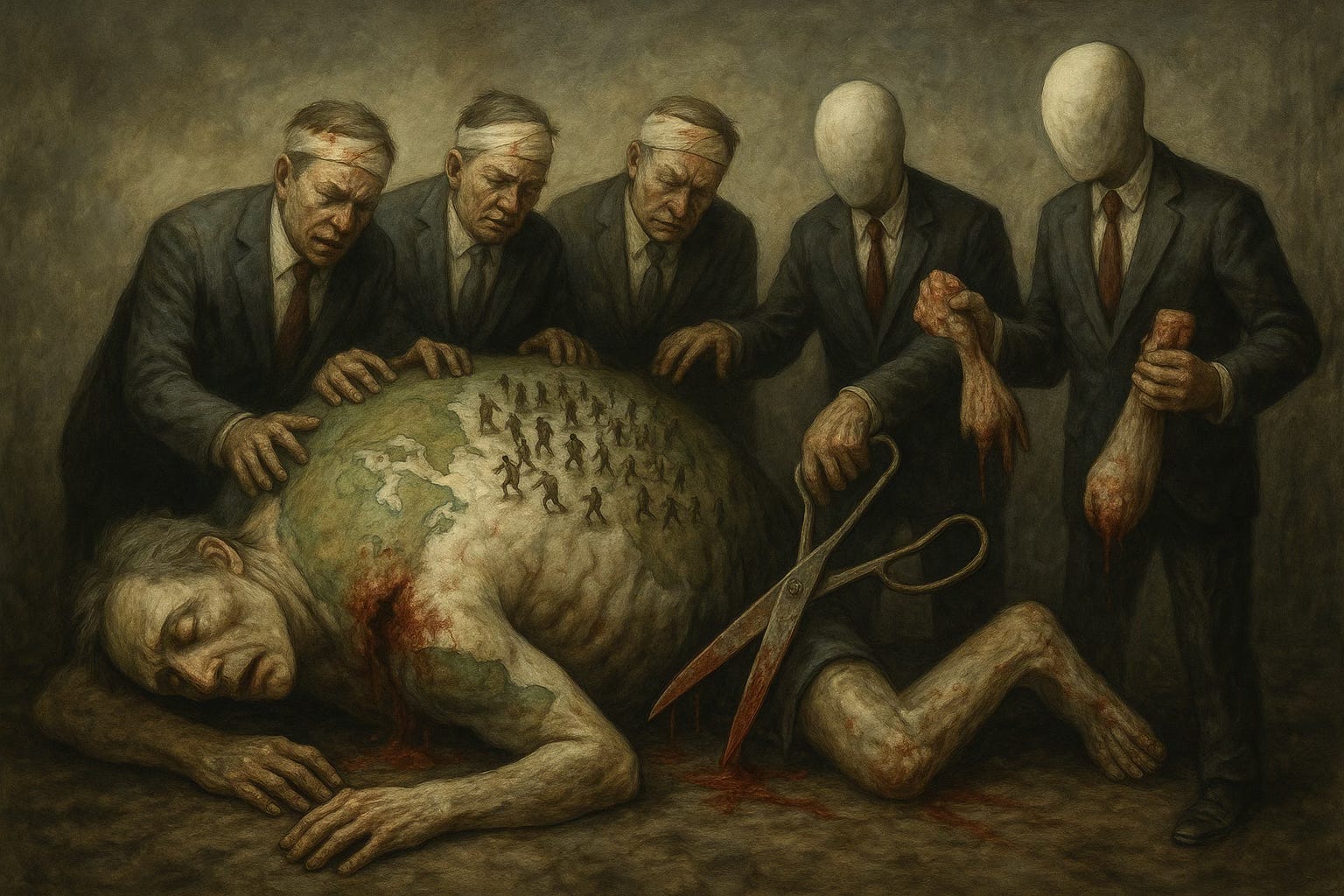
Progressives created the wound. Politics weaponized the infection. Billionaires are performing the amputation.
And working-class people pay the price twice: first when progressives abandoned them, second when billionaires extract from the systems they depend on.
This is why the coalition works. The anger is justified. The target is wrong.
It’s class warfare disguised as culture war.
And the genius is geographic. Blue cities are where wealth exists—not because Democrats are richer, but because cities are where innovation, finance, universities, and economic density create wealth. Red rural areas are where deindustrialization hit hardest—where resentment exists.
The extraction pattern: Deploy force where the wealth is. Get political support from where the resentment is.
This play is as old as time.
If productive cities happened to be Republican-voting, the pattern would be identical. The targets are economic, not political. The partisan frame just makes the extraction acceptable.
Silicon Valley’s switch proves this. They were “blue” when that protected wealth creation. They switched “red” when extraction became more profitable. Same economic interests. Different party. Political affiliation is the wrapper. Class interest is the content.
The real division isn’t left versus right. It’s “can afford to burn it down” versus “lives in what’s burning.”
Red versus Blue is the show. Rich versus Everyone is the game.
The Events: How Dalio’s Pattern Is Playing Out
Once you see the framework and understand it’s class warfare, the events snap into focus.
September 2025: Establishing the Precedent
Between September 3 and October 5, the U.S. military struck four vessels in international waters near Venezuela. Twenty-one people killed. No trials. No transparency. Just force.
Secretary of State Marco Rubio: “Interdiction doesn’t work. What will stop them is when you blow them up.”
Precedent established: Lethal force without due process works. Mission accomplished.
September 12: Redefining Who The Enemy Is
Trump signed an executive order designating Antifa as a domestic terrorist organization—despite Antifa not being an organization and no federal law providing for such designations.
National Security Presidential Memorandum 7 (NSPM-7) defined terrorism to include “anti-capitalism,” “anti-Christianity,” and opposition to “traditional values.”
Meaning anyone can now be labeled a terrorist by this administration since these are vague definitions.
Attorney General Pam Bondi announced DOJ would use “the same approach” on domestic groups as on cartels: dismantle networks, trace funding, eliminate threats.
Translation: The logic of external force—lethal, unaccountable, categorically justified—is now imported to domestic politics. Any organized opposition can be labeled terrorism.
September 5: The Mission Change
The Department of Defense became the Department of War. Not symbolically. Officially. The Pentagon website now redirects to war.gov.
Secretary of War Pete Hegseth—not Defense, War—released a National Defense Strategy that explicitly deprioritizes Russia and China in favor of domestic and regional missions.
The entire mission of the Pentagon pivoted inward.
The Deployments: Testing the Framework
Los Angeles in June. Washington D.C. in August. Portland in September. Memphis in October. Each deployment using federal force in Democratic-led cities. Each justified by emergencies. Each normalizing the next.
Then Chicago.
October 4: Federal government ordered 300 Illinois National Guard federalized plus 200 Texas Guard troops deployed to Chicago. Governor Pritzker objected. Deployment happened anyway.
The justification: protests outside ICE detention centers that a federal judge called “mostly sedate.”
October 9: U.S. District Judge April Perry issued a temporary restraining order. The deployment violated the Tenth and Fourteenth Amendments.
The Department of Justice filed an immediate appeal. The troops remained.
This is the test case. Can federal force override state sovereignty? Can it remain after courts say no? What’s the limit?
And here’s why Chicago was chosen first: geography.
Chicago is a blue island surrounded by red and swing states—Iowa, Missouri, Indiana, Kentucky, Wisconsin. No neighboring blue states for support. No blue state coalition to resist.
Compare that to coastal cities. Los Angeles, San Francisco, Seattle—they’re in a cluster of blue states. New York, Boston—surrounded by blue states.
Chicago is isolated. Easy to deploy from neighboring red states. Politically vulnerable. Can’t create contagion if it falls.
It’s strategic targeting. Test the framework on the isolated city before expanding to the clusters.
The Language: What They’re Actually Saying
Pay attention to how the cabinet talks:
“Lethality” instead of “defense”—military purpose is to kill, not protect
“Warriors” instead of “soldiers”—aggression, not service
“Blow them up” instead of “interdiction”—force over law
“Dismantle networks” instead of “investigate crimes”—collective punishment
“Domestic terrorists” for “protesters”—enemy combatants, not citizens
“Taking back” instead of “governing”—implies theft occurred, justifies extraction
This isn’t careless language. It’s doctrinal preparation. You change the words to change what’s acceptable.
They’re telling you exactly what they’re doing. In public. Repeatedly.
When the Secretary of War says the mission is “lethality,” he’s telling you protection isn’t the goal—violence is. When the Attorney General says she’ll use cartel tactics on domestic groups, she’s telling you due process is optional. When the Secretary of State says lethal force works better than law, he’s telling you killing without trial is now policy.
Why Courts Don’t Stop This
When the judge blocked the Chicago deployment, people felt relief. “See? The system works.”
But the troops didn’t leave.
Here’s what matters: Courts create delay, not reversal.
The timeline is everything:
Deployment happens: Day 1
Legal challenge: Days 1-3
Court ruling: Days 14-30
Appeal: Automatic
Appeals process: Months 4-8
Supreme Court: Months 8-18
Meanwhile, troops remain. For 8 to 18 months.
By the time legal challenges resolve, the occupation is normalized. Businesses relocated. People leave. Economic damage is done. Even if courts eventually rule “unconstitutional,” the precedent is set.
And critically: Who enforces a court order against the President? Not the courts—no enforcement arm. Not Congress—no political will. Not the military—they follow the Commander in Chief.
Andrew Jackson allegedly said: “John Marshall has made his decision; now let him enforce it.”
Courts aren’t stopping the process. They’re documenting it.
How Troops Become Wealth Transfer
The question people ask: How do deployed troops actually extract wealth?
The mechanism:
Phase 1 (Now): Troops deployed. Courts issue blocks. Appeals filed. Troops remain. Public acclimates.
Phase 2 (6-18 months): Extended “emergency.” Cities forced to pay costs of own occupation. Businesses relocate. Tax revenue drops. Budget crisis emerges.
Phase 3 (18-36 months): Cities can’t pay for services plus occupation. Federal government offers “assistance”—with conditions. Federal oversight of city budgets. Tax revenue redirected to “public safety” (occupation costs). Cities lose autonomy.
Phase 4 (2-5 years): Once control is established: “Emergency taxes” on high earners. Federal seizure of “abandoned” properties. Pension funds “restructured.” City assets sold to private operators. Headquarters relocated to red states with incentives. Tech companies forced into “partnerships” (equity stakes, profit sharing).
Phase 5 (5+ years): City either accepts extraction and maintains reduced function under perpetual federal control, or economic activity relocates entirely and the city collapses into bankruptcy.
Either way: Productive capacity destroyed or captured.
This is the mechanism Dalio’s framework predicted. When wealth and power separate geographically, force extracts from capital. The pattern is playing out. And what’s really sad about all of it, if business and political leaders would expand the financial net outward, this all could be avoided. But history always plays out the same, greed clouds empathy.
The Self-Destruction Nobody Sees
Here’s the dark absurdity:
The administration’s stated goal: Maintain U.S. technological dominance, specifically in AI, to counter China.
The operational reality:
Militarizing the cities where AI research happens
Visa crackdowns reducing talent inflow, defund universities where the research happens
Constitutional crisis undermining rule of law that made those cities attractive
Brain drain accelerating as researchers face instability and leave
Capital flight as investors price political risk
You cannot bomb your way to an AI ecosystem. The cities being placed under military pressure—San Francisco, Seattle, Boston, New York, Chicago—are where innovation happens. Stability, rule of law, talent concentration, and capital availability aren’t optional. They’re the foundation not just to the AI boom, but to our entire economic structure.
China isn’t militarizing Shanghai to win the tech race. While America fractures internally, China consolidates externally.
The bet Silicon Valley is making: We can maintain innovation dominance while the institutional foundations collapse.
Dalio’s model says: No. You can’t. The math doesn’t work.
What Comes Next
The pattern is documented. The mechanism is operational. The precedents are being set.
We know from 500 years of history what happens when elites choose extraction over reform, when wealth and power separate geographically, when internal conflict escalates under military control.
The system destabilizes. Productive regions either accept extraction (perpetual decline) or collapse (complete breakdown). Either way, the capacity that made the country dominant is destroyed.
How long does it take? Nobody knows. Rome’s collapse took centuries. The Soviet Union took five years. Yugoslavia went from “this is fine” to civil war in three years.
The timeline compresses when extraction accelerates. And we have no benchmark for how social media, AI and other digital manipulation can accelerate this other than the Philippines and Miramar.
What we know:
Blue cities in red states (Chicago, Atlanta, Phoenix, Austin) are highest risk—isolated, vulnerable, already targeted (and you only need to look at data center maps to understand why)
Coastal cities have more time but same trajectory
Working-class people in red states think they’re winning now, but they’ll bear the cost when the system collapses—Social Security gone, Medicare gone, services disappeared, and the factories still didn’t come back—and I feel for them, watched the decline first hand on car trips across America.
The billionaires running the extraction have exits—other citizenships, other currencies, other properties
The people who built the coalition will be fine. The people IN the coalition will pay the price. It’s why when I hear people attacking other states I feel a sense of dread, it means the coalition of the republic is cracking.
The Only Variable
Empires don’t collapse because anyone plans it. They collapse because the math stops working.
The math stopped working when:
71% of GDP generates in regions that control 30% of military power
Elites chose extraction because it preserves their wealth
Constitutional constraints became negotiable
Productive cities became targets
The innovators aligned with the extractors
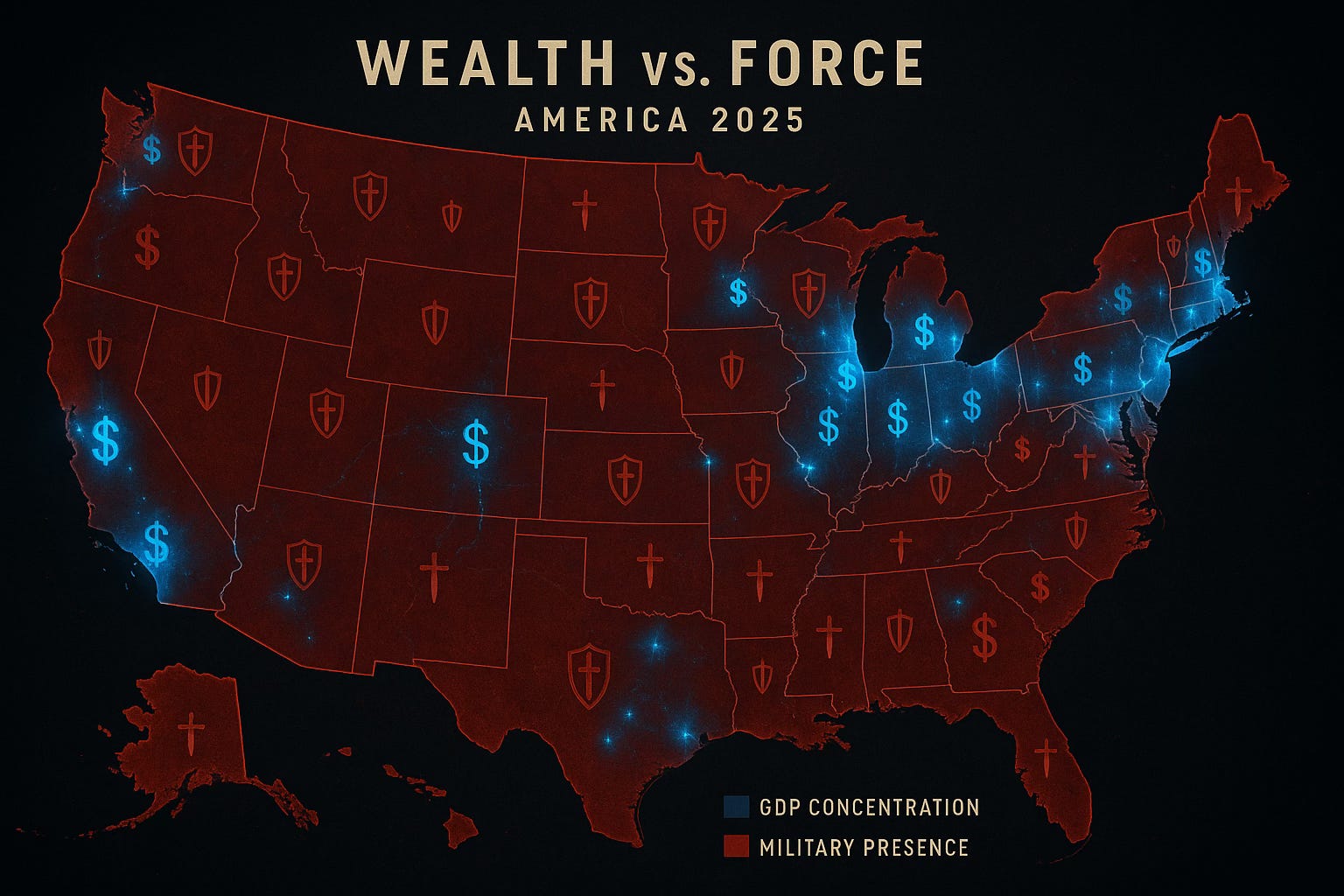
Ray Dalio’s framework predicted this. Not just because he’s brilliant. Because the pattern always looks the same.
This isn’t a partisan fight. Democrats didn’t create this. Republicans didn’t create this. The billionaire class—regardless of party—is liquidating America for tech supremacy and personal gain. They’re using partisan hatred as the permission structure. Cultural resentment as the cover story. And working-class people as the coalition that enables it.
Red versus Blue is the theatre. Rich versus Everyone is the reality.
The events of October 2025 aren’t chaos. They’re the pattern asserting itself. Troops in Chicago. Courts blocked but troops remain. Cabinet members speaking in the language of force. Silicon Valley silent or aligned. Every piece moving exactly as Dalio’s model predicts.
What happens next is already written in history.
The only variable is whether you see it coming and band together, without political labels, to stand as We The People.
Author Notes:
I didn’t set out to write about decline. I started with research funding because it was close to home: when NSF lines vanished, it felt like sawing through the floor we stand on. ARPANET’s return was a reminder that public bets once built entire industries, and cutting them wasn’t a skirmish in a culture war—it was a choice about what kind of country we intend to be. From there the dots kept connecting: wealth pooling at the top while the middle thinned; “efficiency” programs that looked like integrated surveillance; a TikTok fix that reassigned control without fixing risk. Each “emergency” seemed to move assets upward.
I wrote “The Signal” to make sense of how we stopped sharing a reality—how algorithms, tuned for engagement, learned to divide us. Dalio’s work gave me the frame I was missing: when wealth and coercive power separate, reform is rare and extraction is common. Once I mapped that onto U.S. geography, the pattern read less like left versus right and more like class conflict wearing partisan costumes. So the pieces I’ve been writing weren’t separate threads after all; they were chapters of the same story—funding cuts, inequality, surveillance build-out, platform capture, algorithmic incentives—coalescing into Path 3.
I don’t have neat answers. I’m trying to name what I see in time for it to matter. If we can pause the spectacle long enough to recognize the underlying play, maybe we can widen the set of choices in front of us. That starts with admitting this isn’t about winning a political news cycle. It’s about deciding what we’re willing to preserve, and what we refuse to sell.