
The War They Always Wanted
When the Spectacle of War Abroad Fades, Leaders Manufacture It at Home

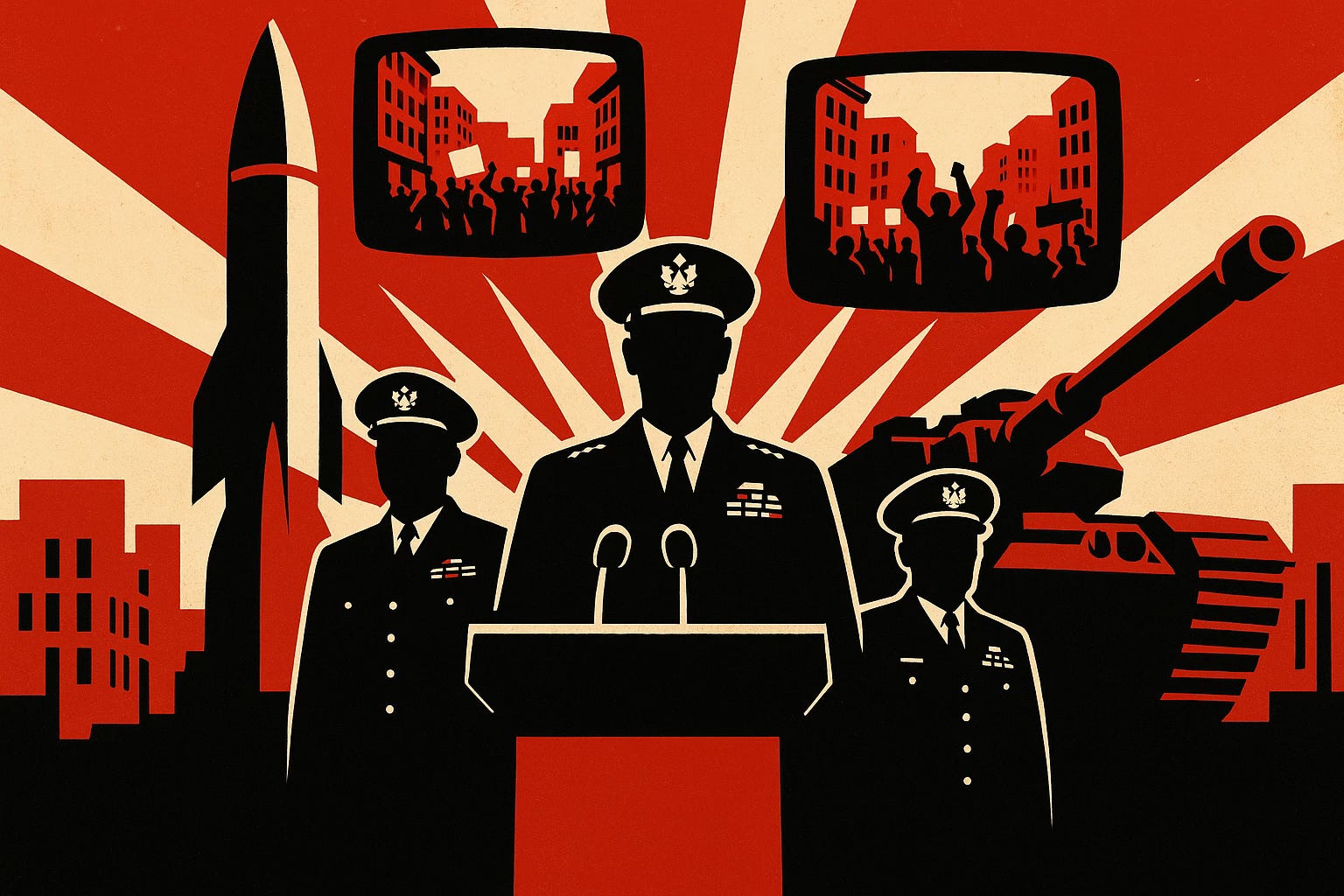
Quantico as the Line in the Sand
On September 30, 2025, Donald Trump stood before an unprecedented gathering of generals and admirals at Marine Corps Base Quantico and told them America faced a “war from within.” His exact words:
“It’s going to be a big thing for the people in this room because it’s the enemy from within, and we have to handle it before it gets out of control.” [17]
The room went silent. No applause. No nods. Just stillness [8][9][10].
In military culture, silence speaks. These were officers trained from their first days at West Point and Annapolis to stay apolitical, to serve the Constitution rather than any individual. Their silence at Quantico was the only protest available that wouldn’t cross into insubordination. Whether it meant disapproval, professionalism, or agreement, we cannot know. But we can observe what didn’t happen: no one stood up, no one spoke out, no one drew the line.
This should have been that line. When Andrew Johnson violated the Tenure of Office Act, Congress impeached him to preserve civilian control. When Nixon corrupted executive power, bipartisan hearings forced his resignation. After Vietnam’s executive overreach, Congress passed the War Powers Act. When Truman seized steel mills, the Supreme Court stopped him cold. These were the moments when democracy proved it could self-correct, when institutions showed they were stronger than individuals.
At Quantico, a president declared war on Americans to America’s warriors. And the institutions that once would have roared stayed silent.
The Cold War Generation’s Last Act
Trump was sixteen during the Cuban Missile Crisis. Old enough to understand annihilation, young enough to be thrilled by breath of it. His generation—the Boomers who came of age in the 1950s and 60s—inherited a peculiar duality: their parents’ victory in World War II, endlessly replayed in movies like The Longest Day and Patton, and their own daily rehearsals for nuclear death. Duck-and-cover drills. Fallout shelter signs. The Emergency Broadcast System’s electronic scream. They were extras in a movie about the end of the world that never quite started filming.
Psychologists call it the “reminiscence bump”—the cognitive phenomenon where memories from ages 10–30 remain most vivid throughout life, disproportionately shaping how we interpret the present [5][6][7]. For this generation, those memories are dominated by mushroom clouds and military might, by leaders who spoke in tonnage and throw-weight, by a world where strength meant the capacity to end civilization and restraint meant choosing not to.
Not all Boomers carry this nostalgia. Millions protested Vietnam, marched for disarmament, built the peace movement. But for those who absorbed the spectacle without the sacrifice, the Cold War remains a golden age of clarity. Good versus evil. Democracy versus communism. A stage big enough for destiny.
And now, in old age, they are desperate for one last performance.
When War Became Invisible
The Cold War was nothing if not theatrical. When the Soviets detonated the Tsar Bomba in 1961, its flash was visible for 600 miles—a second sun blooming over the Arctic [3][4]. The Americans answered with Operation Dominic, turning Pacific atolls into glass. These weren’t just weapons; they were spectacles. B-52 bombers lumbered across continents like airborne cathedrals. Missile silos dotted the prairie like monuments. Even the secrets were cinematic—grainy U-2 photos, whispered briefings, hints that somewhere, under ice or mountain, a doomsday machine waited.
Today’s wars are mostly invisible. A ransomware attack doesn’t roar. Malware stealing state secrets doesn’t glow. Election interference happens in server farms, not tank formations. The new cold war with China plays out in fabs, fiber, and shipping lanes.
For leaders who learned to equate power with spectacle—the reviewed troops, the rising missiles, the maps with arrows—modern conflict offers nothing to hold. Where is the glory in preventing a cyberattack no one sees? Where is the legacy in a war that never photographs well? The machinery of modern conflict doesn’t make your heart race or your flag wave. It makes spreadsheets and logs.
And so the temptation emerges: if war abroad no longer delivers spectacle, then war at home must.
The Substitute War
Trump has always been frank about his appetites. In 2016, he asked security officials why America couldn’t use its nuclear weapons if it had them [12]. He promised he would “never, ever rule it out” [13]. By 2017, he was threatening North Korea with “fire and fury like the world has never seen” [14]. At Quantico in 2025, he joked about “two N-words”—nuclear weapons and a racial slur—as transgressions that proved his power [15].
But Trump is also a brander. A real nuclear exchange would flatten not just cities but the Trump empire. So he substitutes. Immigrants become “invaders.” Protesters become “terrorists.” Political opponents become “enemies of the state.” The existential language of foreign war gets mapped onto domestic politics. The battlefield shifts from foreign shores to American streets.
Pete Hegseth brings the warrior’s creed without the warrior’s constraints. His service was real—Bronze Stars, combat tours, an RPG that failed to detonate. But his rhetoric transcends his experience. At Quantico, while standing beside Trump as they discussed domestic enemies, Hegseth declared:
“We untie the hands of our warfighters to intimidate, demoralize, hunt and kill the enemies of our country.” [19]
He demanded “maximum lethality” [19]. He mocked “stupid rules of engagement” as shackles [19].
The context matters more than the words. Lethality was not being demanded for a battlefield abroad. It was being spoken into the frame of America itself.
Reality Through a Screen
Trump has never hidden his method. Just this past weekend, while declaring sending troops to Portland, he told reporters he trusted television over his own intelligence agencies:
“I spoke to the governor, she was very nice. But I said, ‘Well wait a minute, am I watching things on television that are different from what’s happening?’” [17][18]
About protesters, he said:
“When I watched television last night… I’m very good at this stuff — these are paid agitators.”
This isn’t just preference; it’s epistemology. Reality is what plays on screen. Fires on Fox become cities burning. Protesters on cable become insurrections. The feedback loop is perfect: television shapes perception, perception drives decision, decision creates footage, footage becomes reality. The Cold War at least required actual missiles in actual silos. This war needs only cameras and screens.
The danger is not that Trump and Hegseth secretly plan domestic war—we cannot read their minds or hearts. The danger is that rhetoric, repeated often enough, creates its own logic. Domestic enemies, once named, must be confronted. Military solutions, once normalized, become default. Democratic norms, once crossed, are hard to restore. They may not intend to destroy American democracy. They may simply find it in their way.
The Escalation Ladder
Democracies rarely collapse in one blow. They slide down ladders of escalation. Emergency powers claimed for one crisis expand to others. Surveillance authorized for foreign threats turns inward. Military tools built for terrorism get used against citizens. America already has the scaffolding: the Insurrection Act, emergency declarations, the 1033 program that militarized police.
Once “enemy from within” enters official vocabulary, the sequence is almost mechanical. First surveillance. Then preventive detention. Then National Guard deployments. Then active-duty troops for “stability.” Each justified by the last. Each normalized before the next.
This is not prophecy. It’s pattern recognition. Every democracy that has fallen followed a version of this arc—Weimar, Chile, Turkey, Hungary. The specific steps vary, but the direction remains constant: from rhetoric to policy, from exception to norm, from outside enemy to inside threat.
The Missing Resistance
What remains most troubling about Quantico is not what was said but what wasn’t done. In past moments of executive overreach, American democracy’s immune system activated. Congressional hearings. Court injunctions. Military officers resigning rather than complying. Media investigations. Mass protests. The machinery of accountability grinding into motion.
Today, that machinery sits idle. The generals stayed silent. Congress issued no subpoenas. Courts set no limits. The media covered it as one more outrage in an endless stream, forgotten by the next cycle. The antibodies that once would have swarmed are barely stirring.
Perhaps we’re exhausted. Perhaps we’re numb. Perhaps we believe it can’t really happen here. But history’s lesson is crushing in its consistency: it can happen anywhere, to anyone, if the guardians stop guarding.
Silence in this context is not neutrality. It is complicity.
The War They Always Wanted
Every generation gets the war it was promised. The Greatest Generation got their crusade against fascism. The Silent Generation got Korea’s frozen stalemate. Boomers got Vietnam’s televised horror. Gen X got the Gulf War’s video-game precision. Millennials got the War on Terror’s endless recursion.
But Trump’s cohort—the Boomers who came of age rehearsing for nuclear war—never got their apocalypse. The missiles never flew. The bombers never scrambled. All that preparation, all that investment in the psychology of annihilation, never paid off. The war they trained for, dreamed of, built their identities around, simply never arrived.
Now, in their final act of power, they’ve found a solution. If the foreign enemy won’t cooperate by providing an existential threat, then the domestic enemy will have to suffice. If nuclear war would destroy the world they want to rule, civil conflict will have to provide the meaning they crave. The war they always wanted is here at last. The only difference is the battlefield.
At Quantico, Trump told his generals that America faced an enemy from within. Hegseth told them to prepare for maximum lethality. The generals stayed silent. Congress stayed silent. The courts stayed silent. In that silence, something fundamental shifted. A boundary was crossed. A precedent was set.
The war they always wanted isn’t coming. It’s already begun. The only question is how far it will be allowed to go.
Sources
[1] Robert Jervis, Perception and Misperception in International Politics.
[2] H-Diplo/ISSF Roundtable on Jervis.
[3] Tsar Bomba test records (1961).
[4] Declassified U.S./Soviet atmospheric tests.
[5] Rubin & Berntsen, “Reminiscence Bump.”
[6] Glück & Bluck, “Life story account of the reminiscence bump.”
[7] Cuervo-Lombard et al., “Reminiscence bump distributions” (2024).
[8] Washington Post, “Trump tells a roomful of silent generals to join a ‘war from within’,” Sept 30, 2025.
[9] Washington Post, “Trump defends using troops to police U.S. cities,” Sept 30, 2025.
[10] Washington Post, “Trump, Hegseth lecture military leaders in rare summit,” Sept 30, 2025.
[11] Washington Post, “Trump and Hegseth’s backward-facing message,” Oct 2025.
[12] NBC News reporting, 2016: Trump asked, “If we have them, why can’t we use them?”
[13] Trump 2016 campaign: “I will never, ever rule it out.”
[14] Trump 2017: “Fire and fury like the world has never seen”; nukes as “monsters.”
[15] Trump Quantico remarks, 2025: “two N-words.”
[16] Pete Hegseth, The War on Warriors (2023).
[17] KGW/NBC Portland, Sept 2025: Trump remarks on TV vs reality (“fires all over the place”).
[18] Press Watchers, Sept 2025: Transcript of Trump’s comments on watching TV vs intelligence reports.
[19] Fox News, Sept 30, 2025: Hegseth Quantico address on lethality, rules of engagement, and war vs defense.