
The TikTok Heist: Using “National Security” to Build America’s Digital Propaganda Machine
While Congress debates Chinese surveillance, Larry Ellison appears to be assembling the most powerful information control apparatus in American history—and legacy media is helping dig its own grave.

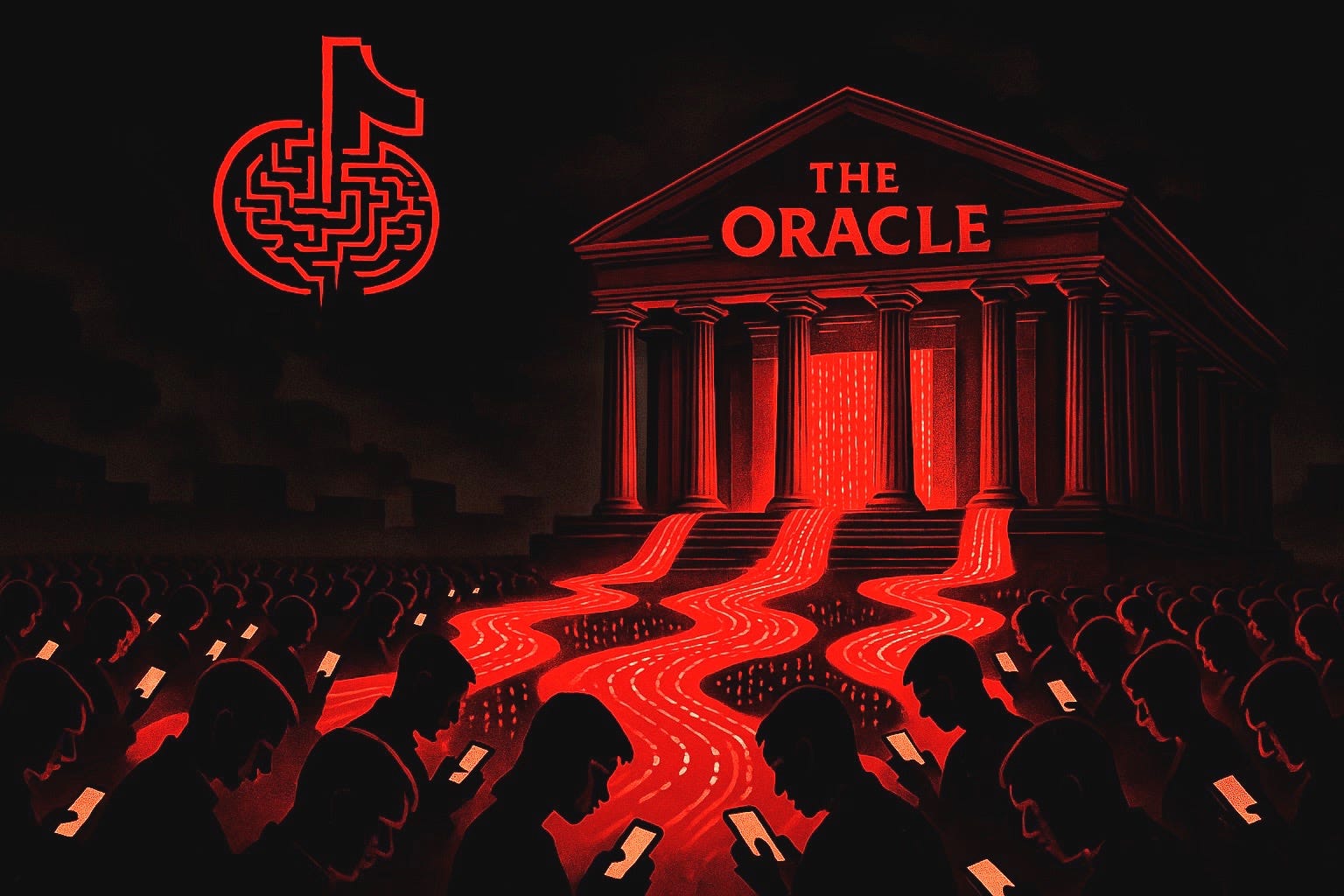
The Opening Act: Manufacturing Consent
For two years, American media hammered the same message: TikTok is a Chinese weapon that must be stopped. CNN, Fox, MSNBC—all united in rare bipartisan panic about Beijing harvesting American data.
They were right about the weapon. They now seem to have lost their backbone.
While media outlets demanded TikTok’s ban, Oracle was quietly positioning itself to acquire not just an app, but the most sophisticated behavior-modification tool ever deployed—one that makes Cambridge Analytica look like a student project.
Part I: The Bait and Switch
What Congress Voted For
In April 2024, Congress passed the Protecting Americans from Foreign Adversary Controlled Applications Act by overwhelming margins (352–65 in the House, 79–18 in the Senate). The statute was explicit:
ByteDance must fully divest TikTok by January 19, 2025
No operational relationship may remain
No cooperation is allowed over its recommendation algorithm
In January 2025, the Supreme Court unanimously upheld this framework, affirming Congress’s authority to act on national security grounds [1].
What Appears to Be Happening Instead
By late 2025, the “remedy” is starting to look very different:
ByteDance retains up to ~20% ownership [2]
The core algorithm is leased, not deleted [3]
Oracle claims it will “retrain it from the ground up” under U.S. supervision [3]
Trump (via executive orders) repeatedly extends enforcement deadlines [4]
Control consolidates around Oracle, Silver Lake, and a16z—Ellison’s inner circle [2]
Treasury Secretary Scott Bessent revealed that the commercial deal terms were ready as early as March or April—months before the Supreme Court ruling [5]. The timeline suggests this was never about protecting Americans. It was about shifting control of the weapon.
Part II: From Editors to Algorithms — Why Friction Mattered
The System We’re Losing
Legacy media was far from perfect—biased, late, sometimes wrong—but it had friction. That friction was a feature, not a bug.
Editors and fact-checkers functioned as a kind of immune system. A story had to pass multiple gates: source vetting, internal review, crosschecks. This slowed down toxic content, introduced accountability, and forced explanations.
The Fairness Doctrine (repealed in 1987) left behind a cultural residue. Even when not legally required, many newsrooms maintained a sense of presenting opposing perspectives. Imperfect, but it kept a shared frame of public discourse alive [6]. At least for a bit.
When things broke badly, there were consequences. Dan Rather’s exit after the Bush Guard controversy [7]. The New York Times’s reputation rupturing after WMD reporting [8]. In the old model, serious missteps cost credibility and careers.
The New Model: Frictionless Manipulation
Silicon Valley engineers saw all that as inefficiency. Editors slowed throughput. Verification curtailed virality. Ethical constraints limited engagement optimization.
In a business where revenue maps directly to attention, friction is cost. So the model inverted:
Instead of verification: content that triggers emotional response spreads instantly
Instead of balance: personalized algorithms feed users what reinforces their biases
Instead of accountability: anonymous accounts and bot farms manufacture narratives with impunity
Traditional editors once asked: Is this true? Is this important? Does this serve the public interest?
Algorithms now ask: Will this keep users scrolling? Will it generate engagement? Will it addict?
Studies bear this out: MIT found falsehoods travel six times faster than truth [9]; PNAS research shows out-group animosity content gets ~2× more engagement [10]; Stanford found 80% of students misidentify native ads as news [11]. The design incentives favor speed, virility, outrage—not truth.
What legacy media saw as responsibility, Big Tech recast as overhead. And in the race to monetize attention, inefficiency died.
Part III: What the Corpses Already Know — And What the Killers Admitted
We don’t have to theorize. The record is written in blood—and in the admissions of those who built the weapons.
The Philippines: A Petri Dish
Cambridge Analytica treated the Philippines as a laboratory. Christopher Wylie later testified:
“We experimented on vulnerable populations in the developing world—places where if something went wrong, there wouldn’t be repercussions.” [12]
Rodrigo Duterte’s rise ran through micro-targeted emotional manipulation on Facebook. The result: Human rights organizations document between 12,000 and 30,000 extrajudicial killings in his “drug war.”[13] Real bodies. Real blood. Real families destroyed. Those killings were streamed, they became entertainment and a warning to fall inline.
Cambridge Analytica’s response? They took the lessons learned and deployed them in Brexit and the 2016 U.S. election, just didn’t push as hard as they did in the Philippines.
Myanmar: “We Weren’t Doing Enough”
From 2017–2018, Facebook’s recommendation engine multiplied extremist hate speech against the Rohingya. A U.N. mission concluded social media played a “determining role” in incitement to violence [14].
Facebook’s admission came only after the genocide:
“We weren’t doing enough to help prevent our platform from being used to foment division and incite offline violence.” [15]
Does this seem familiar? It should. It’s the same playbook, every time.
The Facebook Files
Frances Haugen’s disclosures revealed they knew. Internal documents showed Facebook employees repeatedly warned executives about the platform’s role in amplifying violence. The warnings were ignored because the proposed fixes would reduce engagement.
The most damning admissions came from Facebook’s own research:
“We have evidence from multiple sources that hate speech, divisive political speech, and misinformation on Facebook and the family of apps are affecting societies around the world.”
Their own studies showed:
Angry content receives 5x more engagement
64% of people who joined extremist groups did so because Facebook recommended them
Algorithm changes to reduce harmful content were reversed when they hurt metrics
Divisive content yields far higher engagement
Algorithm tweaks to lower harm were reversed if they hurt metrics [16]
One internal email from 2018, attributed to Mark Zuckerberg:
“That’s not good … I’m generally worried that we’re not being data-driven enough.” [16]
Translation: we are losing money.
Sri Lanka & Teen Risk
In 2018, anti-Muslim riots in Sri Lanka were inflamed via Facebook and WhatsApp. After condemnation, Facebook apologized:
“We have much more work to do to address hate speech and misinformation.” [17]
TikTok’s internal documents, revealed in lawsuits, flagged mental-health impacts:
“Compulsive usage correlates with … loss of analytical skills … empathy … increased anxiety.” [18]
Kentucky’s AG produced internal comms showing executives knew self-harm content was being pushed to vulnerable teens [19].
“Our younger users are facing an unmanageable amount of content that is inappropriate for their age.”
Always the same pattern: Deploy. Profit. People get hurt or die. Apologize. Repeat.
China’s Dual System: Protecting Their Own While Weaponizing Ours
The most revealing evidence? China runs TWO different versions:
Douyin (Chinese TikTok):
Educational content promoted
40-minute daily limit for users under 14
No access 10 PM to 6 AM for minors
“Positive energy” campaigns featured
TikTok (International):
Doom-scrolling optimized
Self-harm content spreads freely
No meaningful time limits
Division and outrage amplified
China knows exactly how dangerous this technology is. That’s why they protect their own children while weaponizing ours.[20]
Now our political and business leaders want the weapon, hence why the Trump administration never allowed the bipartisan law to go into effect.
Because this was never about protecting Americans from manipulation. It was about deciding who gets to do the manipulating.
Christopher Wylie warned us: “They experiment where they think there won’t be repercussions.”
Our political and business leaders have decided America is now that place.
Part IV: Media Consolidation — The Coordinated Handoff
Legacy media isn’t just dying. It’s being hollowed out.
Nexstar and Sinclair control swaths of local broadcast. They can preempt national programming (e.g., Kimmel blackouts) and push editorial alignment [21]. Mergers like Nexstar–Tegna tighten the grip [22]. What we witnessed last week was both companies looking for favor from the administration on expansion past the current limit of nationwide market percentages. Billions of dollars at play.
And it’s well documented how Sinclair uses this power to push editorial alignment, the same script, used on every station they own. Done through local news, it feels real, but completely manufactured, taking its orders from their rightwing owners.
Don’t take my word for it, watch for yourself:
The strategy: hollow out journalism, funnel audiences toward algorithmic feeds.
Why does this matter for TikTok? Because the strategy converges: buy broadcast pipes, hollow out local coverage, starve independent journalism, then push audiences to algorithmic feeds. It’s not desperate adaptation—it’s a coordinated handoff from regulated media to unregulated manipulation engines.
The Numbers
Cable news median viewer: 68-69 years old
TikTok: 170 million U.S. users, average age 28 [23]
43% of young adults get news primarily from TikTok
Average TikTok session: 95 minutes globally
The audience migration isn’t organic. It’s engineered.
Part V: What Oracle Is Really Buying
Oracle is not buying a video app. It’s buying a persuasion engine.
TikTok’s algorithm doesn’t merely “recommend videos.” It builds a real-time psychological profile of every user:
Every pause, replay, like, share = behavioral signal
Dwell time tracked to the sub-second
Live interest graph updating constantly
A/B testing millions of experiments daily
Failures vanish; successes amplify to behavioral twins
It’s not predicting what you want—it’s shaping what you want.
Unlike TV, which aimed at broad audiences with editorial standards, TikTok delivers 170 million individualized realities simultaneously, each tuned to specific emotional vulnerabilities.
The Oracle Infrastructure
Ellison’s net worth spiked near $393B (Sept. 2025) [24]
Oracle already stores TikTok U.S. data via Project Texas [25]
Safra Catz shifted roles, signaling structural pivot [26]
Algorithm will be leased and retrained—not dismantled [3]
Part VI: A System, Not an Accident
This isn’t an isolated takeover. It’s the culmination of decades:
DARPA built the internet (1960s) [27]
NSA pioneered surveillance (2000s) [28]
Silicon Valley monetized it (2010s) [29]
Cambridge Analytica weaponized it (2016) [12]
China perfected it with TikTok (2018–) [20]
Oracle now brings it home (2025) [3]
This isn’t separate stories. It’s stages of the same project: turning human behavior into raw material for profit and control.
The Ecosystem of Control
Meta/Facebook: Normalized mass data extraction; UN investigators tie its systems to genocide in Myanmar
YouTube/Google: Optimized for watch time and radicalization rabbit holes
X/Twitter: Proved real-time algorithmic outrage can destabilize politics at scale
Palantir: Built the surveillance layer connecting private platforms to state power through ICE and intelligence contracts
These aren’t competitors. They’re components of an integrated system, and Oracle is positioning itself at the center. Which is really the company coming full circle, they started with the CIA.
Conclusion: A Democracy’s End — With a Road Out
We once had editors who asked if something was true, important, or in the public interest. They were flawed, biased, sometimes wrong—but they created friction. That friction was democracy’s immune system.
Today, our de facto editors are engagement-maximizing algorithms. Truth is optional, outrage is currency, and your friend’s repost carries the same weight as investigative journalism.
Congress said TikTok’s algorithm was too dangerous for China to control. The Supreme Court agreed unanimously. Now the same lawmakers smile as Oracle takes the wheel. What changed? Only who profits in power, money, and has ultimate control.
The Philippines knows what happens when propaganda algorithms govern reality. Myanmar knows. Sri Lanka knows. They’ve paid in bodies and minds.
Now America seems to be on its way to finding out.
But this isn’t inevitable. It starts by congress and the supreme court demanding their law and rulings be followed.
Call your congressman/woman and senator, push your state officials to demand:
They enforce the law congress passed and was upheld by the Supreme Court.
They reimpose public-interest obligations. If you profit as the public square, you carry its duties.
Have to force break up of consolidation. Antitrust isn’t fast, but it resets incentives.
Transparency. Force disclosure of ranking criteria, data collected, experiments run.
Then you need to:
Reclaim attention. Every hour is a vote. Resist the feed.
Fund independent media. Subscriptions, co-ops, nonprofits weaken algorithmic monopolies.
Talk with people, face to face.
The question isn’t whether democracy can survive being rewired by a billionaire’s algorithm with state support. The question is whether enough people will recognize their most valuable asset—their attention—is being stolen, weaponized, and sold back to them before it’s too late.
Note: This analysis synthesizes publicly reported information and documented historical events. The connections drawn between past algorithmic harms and potential future risks represent analytical conclusions based on established patterns and capabilities.
Sources
TikTok Inc. v. Garland, 603 U.S. ___ (2025) – Supreme Court ruling upholding ban
CNN Business – “TikTok’s algorithm will be overseen by Oracle” (Sept 2025)
Bloomberg – “TikTok’s Algorithm to Be Secured by Oracle Under Trump Deal” (Sept 22, 2025)
Executive Orders on TikTok deadline extensions (2025)
CNBC – Scott Bessent, Squawk Box interview (Sept 2025)
FCC – Fairness Doctrine repeal (1987)
CBS News – Dan Rather resignation (2005)
NYT – Editor’s Note on WMD coverage (2004)
Vosoughi, Roy, Aral – Science (2018) “Spread of true and false news online”
Rathje et al. – PNAS (2021) “Out-group animosity drives engagement on social media”
Stanford History Education Group – “Evaluating Information” (2016)
Christopher Wylie – Senate Testimony (2018); Mindfck* (2019)
Human Rights Watch – Philippines “Drug War” deaths (2017–2021)
UN Human Rights Council – “Report on Myanmar” (2018)
Facebook Newsroom – “Update on Myanmar” (Nov 2018)
The Facebook Files – Wall Street Journal (2021); Frances Haugen Testimony
Reuters – Facebook apology on Sri Lanka riots (2018)
Internal TikTok documents revealed in litigation (2021)
Kentucky Attorney General lawsuit filings (2024)
Rest of World – “Douyin vs TikTok: A Tale of Two Apps” (2023)
Variety – Nexstar / Kimmel blackout coverage (2023)
AP – Nexstar–Tegna merger reporting (2024)
Pew Research Center – Social Media & News (2024); Constitution Center (TikTok users)
Bloomberg Billionaires Index – Larry Ellison (Sept 2025)
Oracle – “Project Texas” press releases (2022–24)
Safra Catz bio – Wikipedia / Oracle announcements (Sept 2025)
DARPA historical archives – ARPANET origins
Snowden leaks – The Guardian (2013)
Shoshana Zuboff – Age of Surveillance Capitalism (2019)
Palantir contracts – FOIA / ICE reporting (2020s)