
The Stagnation We Don't Talk About
How We Traded Apollo's Shared Triumph for Silicon Valley's Private Gain

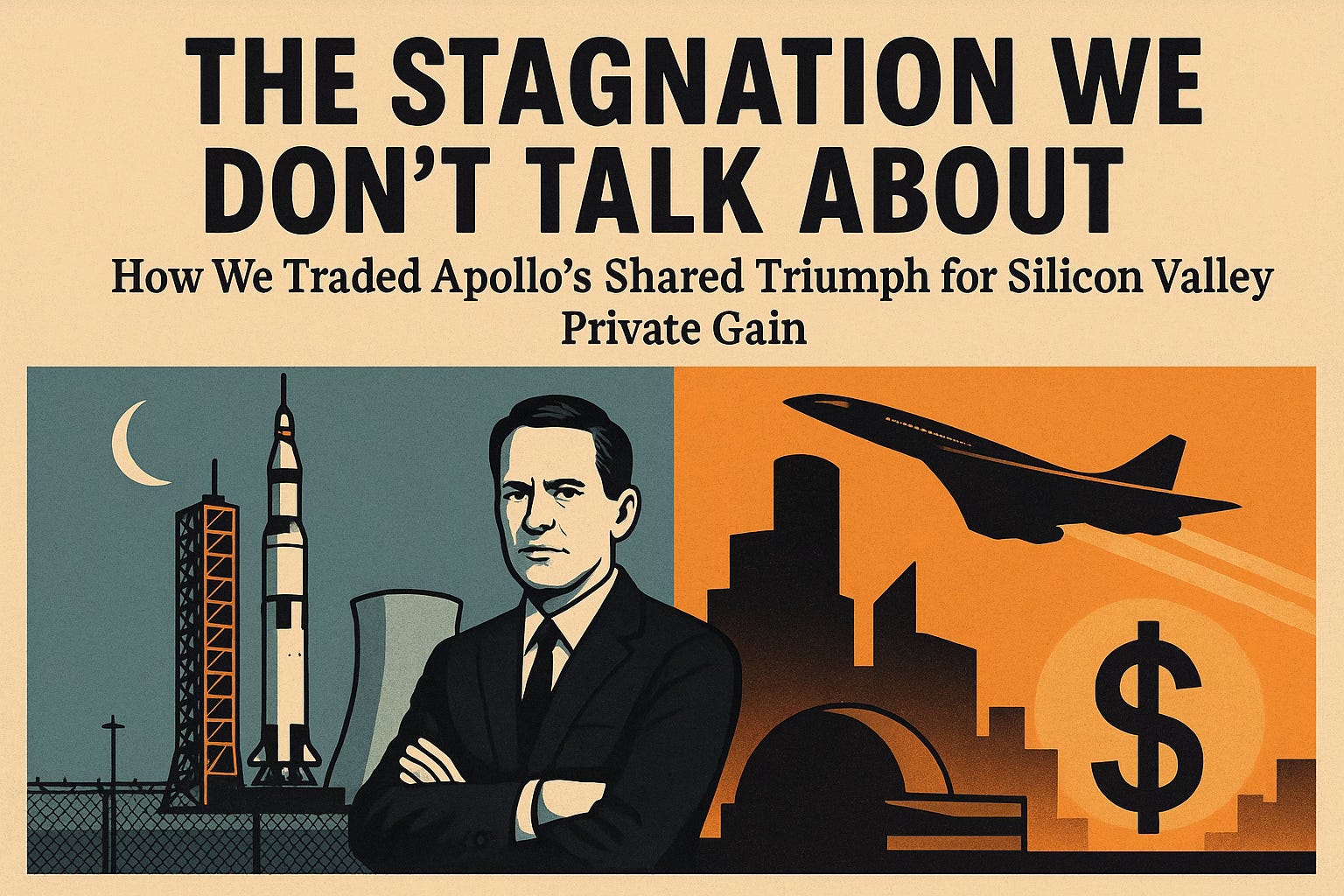
I’ve been watching a few interviews that include Peter Thiel and Eric Weinstein. What stood out was the use of the word: “stagnation”. Over and over. Are they right that we have stagnated, that we are not pushing to break the bounds of our current reality?
One of the ways to view this is what’s so different from the 1970’s until now, and when you look really closely, not much in the form of awe inspiring progress. People don’t even find the landing of a rocket booster on a drone platform in the ocean all that exciting, but it really is from an engineering prospective. But in terms of ground breaking new ideas, it’s also really not, it’s based on old research.
So Peter Thiel and Eric Weinstein are right—we've stagnated. We don’t build updated nuclear plants or supersonic jets. Where are the flying cars? The space elevators? The moon colonies? Even our medical breakthroughs feel incremental compared to wiping out polio or mapping the human genome. We’ve regulated ourselves into paralysis and call marginal improvements “disruption.”
But here’s the problem: their diagnosis is convenient for them.
If regulation is the only villain, then billionaires are the heroes. And in their telling, the only measure of success is how fast they can move and how much they can own.
They never ask who owns what gets built. Or who profits when it works.
That silence isn’t oversight — it’s strategy.
The Model We Lost
Apollo: When Achievement Meant Ownership
Apollo wasn't just a moon shot. It was the peak of democratic innovation.
The numbers tell one story: NASA's budget hit 4.4% of federal spending in 1966. $280 billion in today's dollars. 400,000 people working on it. But the structure tells the real story.
Every state housed Apollo contractors. Huntsville, Alabama became "Rocket City." Flagstaff, Arizona got a new astrogeology branch. MIT received millions for guidance systems. Seattle's Boeing, Long Island's Grumman, California's North American Aviation—each became part of a continental supply chain.
This wasn't job creation. It was capability distribution. Machinists in Milwaukee learned to work with new alloys. Engineers in Florida pioneered cryogenic systems. Towns that had never heard of aerospace suddenly had aerospace facilities.
The intellectual property followed the same pattern. NASA retained rights to contractor innovations. The agency published detailed technical reports—over 6,000 by project's end. Technologies flowed into the public domain or were licensed broadly: miniaturized electronics that enabled personal computers, materials science that revolutionized manufacturing, project management techniques that transformed complex industries.
No Apollo contractor became a trillion-dollar company. No engineer became a billionaire. The program created steady prosperity—good jobs, strong companies, technological diffusion—rather than extreme concentration.
When Americans said "we went to the Moon," the "we" had economic meaning. Your tax dollars, your factory, your share of the achievement.
Manhattan Project: The Economic Stake Model
The Manhattan Project, shrouded in wartime secrecy, demonstrated this principle in the most dramatic way.
Oak Ridge, Tennessee grew from farmland to the fifth-largest city in the state. Hanford, Washington became a boom town. Los Alamos created an entire scientific community from scratch. Workers knew they were part of something significant even if they didn't know what. They drew good wages, developed new skills, saw their communities transformed.
The project cost $28 billion in today's dollars, but that money circulated through the American economy, creating capabilities that persisted after the war. When the atomic age arrived, it came with a distributed industrial base, not a handful of private fortunes.
But here's what Weinstein gets right: after the bomb, the government locked down physics. The Atomic Energy Act of 1946 classified entire fields of research. Nuclear physics became a government monopoly. The very scientists who'd made the breakthroughs couldn't publish their work or move freely between institutions.
The lesson the government took from Manhattan wasn't about economic distribution—it was about control. They'd seen what collective effort could achieve, and their response was to cage it. That set the template: public investment would continue, but increasingly under terms that concentrated power rather than spreading capability.
We know this model. We've done it before. We just stopped doing the parts that worked for everyone.
How We Gave It Away
The transformation happened through a thousand small surrenders, each defensible in isolation, that collectively restructured the relationship between public investment and private gain.
The Quiet Policy Revolution
The Bayh-Dole Act (1980) was the pivot point. Marketed as a way to accelerate commercialization of federally-funded research, it allowed universities and contractors to patent discoveries made with government grants. Suddenly, taxpayer-funded research could become private intellectual property. What had been a commons became a marketplace.
Reagan-era privatization accelerated the shift. Government labs were encouraged to "partner" with industry. Military contractors gained more control over their innovations. The ideology was explicit: private ownership would drive efficiency and innovation faster than public management ever could.
By the 1990s, the model had completely inverted. Where NASA once retained rights to contractor innovations, now contractors retained rights to NASA-funded work. Where defense research once enriched the public domain, now it enriched patent portfolios.
The Human Genome Project—funded largely by taxpayers—saw many of its discoveries patented by private companies who contributed marginally to the research. We paid for the map, they own the treasure.
Following the Money
The numbers are all public. Anyone can trace them:
Google began as a National Science Foundation grant to Stanford. Larry Page and Sergey Brin developed PageRank under federal funding. Stanford claimed the patent, licensed it back to Google for 1.8 million shares, later sold for $336 million. The NSF, and by extension the taxpayers who funded the original research, captured zero.
Tesla received a $465 million Department of Energy loan in 2010—critical to its survival during the financial crisis. That loan was repaid with interest, a talking point Musk frequently cites. What he doesn't mention: if the government had taken equity instead of debt, taxpayers would have captured over $100 billion in value appreciation.
SpaceX built its business on NASA contracts—$5.5 billion through 2018 alone. Those contracts didn't just provide revenue; they provided credibility that attracted private investment. The company is now valued at $180 billion. The public's share of that value creation: zero.
Pharmaceutical companies receive over $40 billion annually in NIH grants. A UCLA study found that every one of the 210 drugs approved from 2010-2016 relied on NIH-funded research. Yet drug companies capture all profits, claiming they take all the risks, while NIH takes no equity stakes and negotiates no price controls.
The COVID vaccines depended on decades of NIH-funded research into mRNA technology. Moderna's vaccine was literally designed by NIH scientists. The company is now worth $40 billion. Public equity stake: zero.
This pattern is everywhere once you look. DARPA created the internet protocols, GPS, and voice recognition technology. The Department of Energy funded the fracking revolution. In each case, public investment created the foundation, private companies captured the profits, and taxpayers got, at best, the privilege of buying back what they funded.
The Thiel Paradox
Thiel's answer to stagnation—strip public oversight, accelerate private control—isn't just a philosophical position. It's a business model.
Take Palantir, the company Thiel co-founded in 2003. Its seed funding came from the CIA's venture arm, In-Q-Tel—taxpayer money. Early contracts with the CIA, FBI, NSA, and Department of Homeland Security didn't just keep the lights on; they built the company's core product. By 2023, more than half of Palantir's revenue still came from government contracts.
The public paid to build the system. The public pays to operate the system. And in many cases, the public is the target of the system. (more about that here)
Palantir went public at a $15 billion valuation, now worth over $40 billion. Thiel's stake is worth billions. The profits are private. The code is private. The infrastructure is private. But the risk, the cost, and the surveillance are all public.
We funded the creation of these tools, we fund their operation, and we live under their gaze—but we hold no stake in them. We are not shareholders in Palantir's success; we are subjects of its reach.
This is the perfect inversion of the Apollo model: a publicly funded, privately captured project where the "mission" isn't exploration or discovery—it's control. And the person profiting from this arrangement is the same one telling us that government is the problem.
The Felt Stagnation
When Thiel talks about stagnation, he's talking about atoms—why we stopped building in the physical world. When Weinstein talks about it, he's lamenting that we left physics behind for bits.
But there's another stagnation hiding in plain sight: we've stopped spreading the gains.
Geographic Stagnation
During Apollo, innovation jobs spread across all 50 states. Today, they concentrate in six metro areas. When SpaceX launches a rocket, Hawthorne, California benefits, but Huntsville doesn't. When a biotech company goes public based on NIH research, Cambridge, Massachusetts wins, but Cleveland doesn't.
Congressional districts without innovation jobs don't support innovation funding. Why would they?
Wealth Stagnation
Apollo created a middle-class workforce. Engineers earned good salaries, not stock options. Contractors made steady profits, not exponential returns.
Today's model creates extremes. Founders and early employees get rich. Everyone else—including the taxpayers who funded the underlying research—gets nothing. We've replaced an innovation middle class with an innovation aristocracy.
Technological Stagnation
Here's the paradox: privatization was supposed to accelerate innovation, but it may be slowing it down.
Drug companies increasingly focus on minor variations of existing drugs rather than breakthrough research. Why? Because incremental improvements to blockbuster drugs are more profitable than risky basic research. The public funds the risky research through NIH, companies capture the profitable applications, and genuinely transformative medicines remain underdeveloped.
SpaceX deserves credit for reducing launch costs, but its innovations are largely engineering improvements on decades-old NASA research. Meanwhile, NASA's budget for breakthrough propulsion research—the kind that might actually get us to Mars quickly—has been slashed. Private space companies aren't interested in that research; it's too far from profitability.
We're not just moving slower—we're aiming lower.
Defunding the Future
The shift from public to private isn't slowing—it's accelerating. Current proposals target open research while maintaining spending on private contractors.
When public R&D shrinks, two predictable things happen:
First, the pace of open science slows. Universities cancel long-term studies. Graduate students abandon research for industry jobs. Fields requiring patient capital—fusion energy, climate modeling, deep-space propulsion—stall or vanish.
Second, private companies fill the gap—on their own terms. Instead of discoveries entering the public domain, they're locked behind patents and paywalls. The public still pays through contracts, subsidies, and monopoly pricing, but never regains ownership.
This is the Reagan playbook, updated. In the 1980s, federal R&D dropped from 1.2% to 0.7% of GDP while private R&D grew—but that private research was narrower, more applied, less transformative. We're still living with the consequences: slower productivity growth, less breakthrough innovation, more rent-seeking.
The cuts target open research—university grants, basic science, public domain discoveries. But spending on private contractors continues. Palantir still gets its billions. SpaceX still gets its contracts.
They're not eliminating government's role in innovation—they're changing it from investor to customer. From owner to renter. From participant to purchaser.
Meanwhile, China is doing the opposite. Their basic research spending has grown 400% since 2010. They studied our Apollo model while we abandoned it.
The timing is perverse. AI, quantum computing, and biotech are hitting inflection points—exactly when public research could make the biggest difference. The basic science done today will determine who dominates the industries of 2040.
This isn't about fiscal responsibility. The entire NSF budget is less than half of one F-35 program cost overrun. It's about changing who owns the future.
What Other Countries Already Know
While we argue about whether government can do anything right, other countries are capturing public value from public investment.
Norway's Government Pension Fund Global owns average stakes of 1.5% in over 9,000 companies worldwide, worth over $1.4 trillion. They didn't nationalize their industry. They just ensured that when Norwegian resources created value, Norwegians captured some of it.
Singapore's Temasek Holdings has generated 14% annual returns since 1974 while maintaining significant stakes in strategic industries. Singapore remains aggressively capitalist—but public investment generates public returns.
Israel's Yozma program helped create their venture capital industry in the 1990s. The government co-invested with private VCs but retained equity stakes. The program returned billions to taxpayers while creating one of the world's most dynamic tech sectors.
These aren't socialist countries. They're capitalist economies that understand a basic principle: public investment should generate public returns.
We're the only ones giving it away, for free, at this scale while piling up debt.
The American Solution
If the public funds innovation, the public should get equity. Like any other investor.
The Innovation Trust
A sovereign wealth fund that automatically receives small equity stakes (1-5%) whenever public funds support private innovation:
$10-50 million in federal funding = 1% equity
$50-100 million = 2% equity
$100-500 million = 3% equity
$500 million+ = 5% equity
Structure it like the Federal Reserve—independent, professional, transparent. Can't sell stakes for 10 years to ensure long-term alignment.
Had this system existed for the last 40 years, the trust would now hold stakes in Google, Amazon, Apple, Microsoft, Tesla, SpaceX, Moderna, and every other significant company built on public research. Conservative estimates: $2-3 trillion in assets.
Beyond Equity
Innovation Dividends: Alaska pays every resident an annual dividend from oil revenues. An Innovation Trust could do the same. Every American gets a check from the companies their tax dollars helped build.
Geographic Distribution: Companies receiving over $100 million in public funding must distribute at least 30% of jobs and contracts across multiple states.
Public Interest Licensing: Drugs developed with NIH funding come with price constraints. Technologies critical to national security come with domestic production requirements.
These aren't radical ideas. They're what any investor would demand. The radical thing is that we don't do it.
What This Is Really About
This isn't just about money, though trillions in public value have been transferred to private hands.
It's about political sustainability. When the public doesn't see returns on public investment, support for that investment erodes. Why should Ohio taxpayers fund the NIH if drug prices keep soaring? Why should they support NASA contracts if billionaires capture all the benefits?
It's about legitimacy. When publicly-funded innovation creates private oligarchs, it undermines faith in both democracy and capitalism. People correctly perceive the system is rigged.
It's about participation versus spectatorship. When Americans watched Apollo 11, they weren't just spectators—they were stakeholders. Their taxes, their factories, their engineers had built that rocket. The 1965 machinist in Milwaukee learned to work with titanium for Apollo. His kids went to college on that job. That sense of genuine participation is impossible when the achievements belong to billionaires.
The Next Wave
The next breakthrough in AI, quantum computing, or biotech will build on decades of public research. Most of the AI research happened in university settings starting in the 1950’s. Taxpayers will have funded the hard parts—the basic science, the failed experiments, the slow accumulation of knowledge.
The only question is who will own it.
If we follow the current model, some founder will capture hundreds of billions in value. They'll tell a story about their vision and risk-taking. The public investment will be footnoted if mentioned at all.
Or we could remember what worked: transformative achievements creating broad prosperity, not just narrow fortunes.
The stagnation Thiel and Weinstein diagnose is real. But it won't be solved by unleashing private capital. It'll be solved by recognizing that innovation is a collective enterprise that should deliver collective returns.
The public knows the system is broken. They've stopped cheering for breakthroughs because they've learned breakthroughs aren't for them.
Want them to care about innovation again? Give them a piece of the action.
Want them to believe in the future? Make sure they own part of it.
Because if we don't fix this, we're not curing stagnation—we're just managing decline while a few people get very, very rich.
And calling it progress.