
The South Rises Again
Really, Its Story Never Stopped

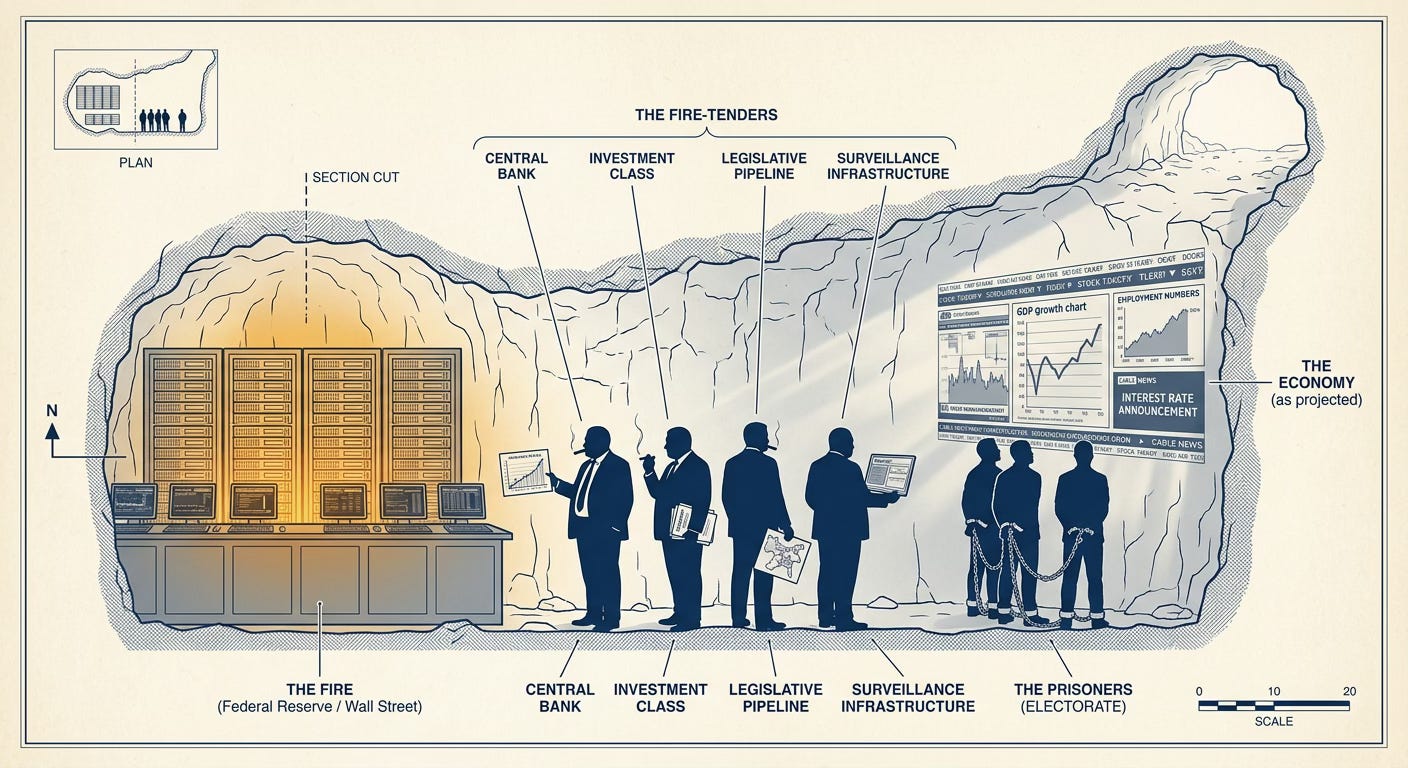
Plato imagined a cave.
Prisoners chained facing a wall. Behind them, a fire burns. Between the fire and the prisoners, people walk past holding shapes and objects. The prisoners can only see the shadows those objects cast on the wall. They can’t see the fire. They can’t see the people holding the objects. They believe the shadows are reality.
Most people stop there. The metaphor is about media, or perception, or something they half-remember from philosophy class.
Push the question one step further. Who tends the fire?
Not the prisoners. Not the shapes they’re watching. The fire-tenders. Wall Street. The Federal Reserve. The people who set exchange rates, control money creation, and make the global economy legible. The shadows they project have names: interest rates, employment numbers, GDP growth, the value of your savings account. When those shadows tell a coherent story, the economy is growing, opportunity is available, the game is basically fair, most people believe the shadows are real.
The fire-tenders don’t need you to be happy. They need you to believe the shadows make sense.
And when enough people stop believing the shadows, the system has to become more authoritarian to hold.
This week, in four Southern state legislatures, the system got more authoritarian. And the speed tells you exactly how long this has been coming.
The Gun Went Off Thursday
Four states called special legislative sessions within the same week. Alabama. Tennessee. Louisiana. Mississippi. All moving to redraw congressional maps within days of the Supreme Court’s ruling in Louisiana v. Callais. Louisiana’s Governor Jeff Landry suspended primary elections outright after voting already started. Four legislatures moved within days because the plan was already written.
And how do we know it was all planned in advance, Virginia and Florida moved two weeks before the ruling dropped.
You don’t do that unless the architecture is already yours. The justices, the clerks, the legal pipeline. When you’ve built all of that, you don’t predict the ruling. The model legislation was sitting in state legislative pipelines written by ALEC, the American Legislative Exchange Council, waiting for the starting pistol. When the gun went off on Thursday, four states were already at the blocks.
That speed is the tell. Everything that follows explains what it’s a tell of.
What the Court Actually Did
Louisiana’s 2024 congressional map, the one that just got struck down, was created because the previous map was found to likely violate Section 2 of the Voting Rights Act. Lower courts said a single majority-Black district in a state where Black residents are a third of the population wasn’t sufficient. Louisiana drew a second majority-Black district as a remedy.
The Supreme Court struck down the remedy.
By a 6-3 vote, the court ruled that the corrective response to documented racial discrimination was itself unconstitutional. They also waived the standard 32-day waiting period to put it in immediate effect, specifically to clear the path before the 2026 midterms.
Justice Ketanji Brown Jackson, in dissent, said the ruling “has spawned chaos in the State of Louisiana.” Justice Samuel Alito called her concerns “baseless and insulting.”
Alito has six votes. Jackson has three.
This didn’t happen suddenly. It happened at the end of a very long road:
1965 — The Voting Rights Act passes. Ends systematic voter suppression across the South.
2013 — Shelby County v. Holder guts the preclearance requirement. States with a documented history of discrimination no longer need federal approval to change their voting laws.
2021 — Brnovich v. DNC weakens Section 2, making challenges to voting restrictions nearly impossible to win.
2026 — Louisiana v. Callais ends race-conscious remediation entirely.
That’s not judicial drift. That’s a project on a timeline.
PBS NewsHour’s Lisa Desjardins put it plainly: “It is highly likely that we’d see fewer Black and brown members of Congress next year.” The voting-age population hasn’t changed. The registration numbers haven’t changed. What’s changing is the architecture, the lines drawn around communities that determine whether your votes aggregate into representation or dissolve into irrelevance.
One more element from the same week. The 2025 National Defense Authorization Act expanded automatic draft registration for all American males 18-24, taking effect in December. The generation whose political representation is being architecturally eliminated is the same generation being enrolled to defend the political system eliminating it.
The Project That Never Died
To understand what’s happened last week, you have to go back further than the Federalist Society. And then further still.
Start with the Confederacy’s actual argument. Not the moral one, no serious person defends that. The structural one.
The Confederate planter class wasn’t defending slavery as a moral argument. They were defending a political economy built on concentrated asset ownership against the threat of democratic redistribution. Twelve hundred families owned most of the arable land in the South and the human beings who worked it. Their political project was ensuring that democratic majorities, whether Northern abolitionists or eventually the freedmen themselves, could not use the machinery of government to move those assets or the power that came with them.
They lost the war. They did not lose the project. The assets for those at the top, status for those who helped enforce their will, printed money to make the system move.
The Trick That Made It Work
Twelve hundred planter families couldn’t run the South alone. They needed an enforcement layer, poor whites who would police the borders of the system, vote the right way, and never question why they owned so little while the planters owned everything. The offer wasn’t money. It was something more portable: whiteness. You may be poor. You may never own land. But you are not Black. That is your stake.
W.E.B. Du Bois named it in 1935. The “psychological wage” of whiteness. Working-class whites accepted materially worse conditions in exchange for racial status. The thing that prevented the one coalition that would have broken the project, poor whites and freed Black workers recognizing that the planter class was extracting from both of them.
The category expanded as the project needed more people. Southern Italians arrived in America as non-white. Even lynched in New Orleans in 1891, denied rights, treated as a separate race. Over decades they were absorbed into whiteness, by distancing from Black communities and demonstrating loyalty to the hierarchy. Same arc for the Irish, Eastern Europeans, every immigrant group that needed to join the coalition. The price of admission never changed: accept the hierarchy.
Direct your resentment sideways and down. Never up.
This is why the voting rights story and the economic story are the same story. The architecture doesn’t just need to remove Black and Brown voters from Congress. It needs the people being economically extracted from, the bottom 50% whose wealth share has been in free fall since Reagan, to believe their problem is immigrants, urban liberals, and minority communities. Not the narrow class of 10% of people who own the political architecture fueled by their absorbent share of all the assets.
The top 1% is 1.3 million people. The bottom 50% is 165 million. The 1% controls 10 to 20 times the wealth of the bottom 50% combined. That ratio was built deliberately, policy decision by policy decision, from the Powell memo forward. And it is protected by a coalition that includes tens of millions of people who live inside the bottom 50%.
The fire-tenders don’t need the coalition to love them. They just need it to aim at the wrong people.
The Long Game
Democratic systems are not built to defend against a 75-year institutional project. The believers patiently executed across three generations, that works precisely because no single election can undo it.
You can win an election. You can pass a law. You can ratify a constitutional amendment. What you can’t do is maintain sustained, coordinated institutional pressure across three generations while the other side quietly captures the courts, writes the model legislation, and trains the lawyers.
This is what has happened.
It runs through James McGill Buchanan, a Virginia economist who won the Nobel Prize in 1986. Buchanan built “public choice theory”, the idea that the solution to government overreach isn’t better government, it’s constitutional constraints that make redistribution structurally impossible. Not harder. Impossible. Lock it into the constitutional architecture so no future election can undo it. A Virginia planter’s argument, dressed in Nobel-caliber math. Same project.
The project runs through Lewis Powell’s 1971 memo to the U.S. Chamber of Commerce. Powell, a Virginia corporate lawyer, later a Supreme Court justice, looked at the postwar liberal consensus and laid out a blueprint: build the institutions. Law schools, think tanks, media organizations, legislative pipelines. Fifty years of systematic work to shift the ideological center of gravity.
It runs through Charles and David Koch, who took Powell’s blueprint and funded it at scale. By 2016, the Koch network was spending approximately $750 million per election cycle through an archipelago of roughly 700 organizations. Heritage Foundation. ALEC. The Cato Institute. Americans for Prosperity. And the Federalist Society, the legal training pipeline that produced the majority of the current Supreme Court.
The courts and legislation were the public story. The economy was the quieter one.
In 1980, the top marginal income tax rate was 70%. By 1988, it was 28%. The estate tax, the mechanism that prevented extreme wealth from compounding across generations without friction, fell alongside it. The postwar working class had it good for thirty years not because markets are generous but because specific policy tools constrained how fast wealth concentrated. Cut those tools and the compound clock starts. The effects take a generation to register. The parents of the generation receiving draft notices this December bought houses on a husband’s working-class salary. Their children discovered the architecture that made that possible was dismantled before they arrived.
Citizens United (2010) connected the two stories. When the court ruled that money is speech, the project stopped needing patience. Top 1% wealth share was already climbing from the postwar floor of 20% back toward 40%. After Citizens United, it went vertical. Once money was speech, they bought the speech that expanded their wealth and locked everyone else out. The think tanks had the philosophy. The unlimited money let them deploy it at scale.
Four states called special sessions within the same week. Virginia and Florida moved before the ruling dropped. ALEC’s model legislation was ready. The FedSoc justices delivered.
Representative Terri Sewell of Alabama: these changes will “suppress minority votes in the halls of Congress” and “erode minority representation” across all levels of government. Majority-minority congressional districts, many held by sitting Black members of Congress, disappear under the new maps. Not because the partisan balance changed. Because the maps are being redrawn to dilute specific communities.
Your vote didn’t change. The lines around it did. The fire was tended. And those who helped make it happen, the same poor whites, or the minority groups thinking they were demonstrating their loyalty to the hierarchy, getting their turn at whiteness.
And as soon as the Southern model was elected this past cycle, they dropped any pretense of not showing they were the elite ruling class. Power, money, accelerated wealth generation, all the things they said they were fighting against to win that election.
The Fracture
A system that loses legitimacy has to become more authoritarian to hold. More authoritarianism generates more resistance. The cycle accelerates until something breaks.
The tell isn’t what the system takes from you. It’s what it asks of you after.
That generation enrolled in December is being asked to fight for a democracy it can no longer meaningfully participate in. To discharge a civic obligation to a social contract the system has already broken.
Compare this moment to 1968. In 1968, there was civic infrastructure, newspapers, labor unions, Democratic party machines, universities as genuine public forums, capable of channeling mass political energy into legitimate expression. That infrastructure was systematically dismantled over the same 75-year period we’ve been tracking. The energy has fewer legitimate channels now. The institutions that caught the country then are gone.
The shock absorption is gone with them.
The fire-tenders need you to believe the shadows. When too many people stop believing, the cave doesn’t hold.
New Management, Same Cave
The 75-year project needed three things to execute: intellectual capture, institutional capture, and control infrastructure. The first two are done.
Meet them: Larry Ellison. Operation Stargate. Palantir.
Palantir holds $900 million in federal contracts, including $30 million specifically for “ImmigrationOS,” a system that aggregates passport records, Social Security files, IRS tax data, and license-plate reader data to give enforcement agents near-real-time visibility into individual movement. That’s not immigration policy. That’s the prototype. Georgetown Law’s American Dragnet project documented what ICE surveillance already covers without ImmigrationOS: driver’s license photos of nearly a third of American adults; access to license data for 74% of the adult population; movement tracking in cities where 70% of adults live. The enforcement system built to target undocumented people already has near-total visibility into documented ones. Nothing in the architecture limits it to immigrants, and it already doesn’t.
In a 2023 Oracle earnings call, remarks that circulated widely after Stargate’s announcement, Larry Ellison described the endpoint: continuous AI-synthesized surveillance, cameras everywhere, a permanent behavioral record for every citizen. Add digital identity infrastructure and you have a system that doesn’t need to keep people from the polls because it’s already shaped what they believe. That model isn’t theoretical, it’s been running in China for a decade. The procurement contracts here are building toward it.
The connection to the preceding 75 years isn’t personnel. Ellison and Charles Koch weren’t partners, and the Federalist Society didn’t write Palantir’s government contracts. It’s architecture and objective. The Koch/FedSoc project built legal and legislative infrastructure that protected concentrated wealth from democratic redistribution. The Stargate cohort is building enforcement infrastructure that makes that protection operational: identifying who organizes, who agitates, who needs to be reached before the vote forms. Same fundamental goal, prevent democratic majorities from directing the machinery of government at concentrated assets. Sequential tools.
Each prior suppression tool worked by controlling access to a chokepoint: the courthouse for poll taxes, the district line for gerrymandering. The behavioral surveillance layer doesn’t need a chokepoint. It identifies who is politically active, who is susceptible to which message, who can be legally reached by enforcement. It operates not at the ballot box but upstream of it — before the vote, before the organizing, before the moment of mobilization. You don’t suppress a community. You preempt it.
The old fire-tenders, Wall Street, the Federal Reserve, the financial architecture that managed the postwar order, needed the prisoners watching the wall. The new ones need something different: not shadows to believe, but a map of who’s about to stop believing. Manufactured ignorance gave way to total visibility. Same cave. Different instrument.
The maps being redrawn this week are the last generation of an analog suppression tool. Poll taxes managed who could vote with courthouse bureaucracy. ALEC manages it with gerrymandered districts. What comes next manages it with predictive behavioral systems that operate upstream of the vote entirely.
The Confederate project’s fundamental goal, preventing democratic majorities from directing the machinery of government at concentrated wealth, required analog tools when it was executed by planters. Legislative tools when it was executed by the Koch network. Digital infrastructure when it’s executed by the Stargate cohort.
The concentration of power isn’t being challenged. New operators, same architecture with better tools.
The Southern model isn’t just rising. It hired new management.
The Execution Phase
The institutions Powell called for in 1971 had spent fifty years getting ready. Project 2025 was 900 pages of operational blueprints. Not policy preferences, implementation guides. Heritage Foundation President Kevin Roberts called it a “second American Revolution” that would remain bloodless “if the left allows it to be.” In January 2025, they stopped planning and started executing. Zero to 2,300 armed troops in Washington D.C. in fourteen days. The Joint Chiefs fired in a single night. The lawyers whose job was to say “that order is illegal” replaced in the same sweep.
Four state legislatures called special sessions this week. Louisiana suspended its elections. In December, a generation of 18-24 year olds will be registered for the draft, enrolled in a system their votes increasingly cannot change. Registration isn’t activation. But a system shedding democratic legitimacy while hardening its enforcement apparatus has historically reached for that instrument. The architecture for it is already built.
In Plato’s cave, the prisoners who start questioning the shadows get ridiculed by the other prisoners. The people who have adapted to the shadows don’t want to be told they aren’t real. The fire has been tended for seventy-five years. The shadows look like home.
That’s always how it works, until the prisoners start turning around.
The project that began in Southern cotton fields is executing now in congressional redistricting chambers, Palantir server farms, and Supreme Court oral arguments. The South is a place. The model running through it is older than the nation.
The Confederacy chose concentration. Lost the war. Chose the longer game instead.
We are living in the execution phase.
Sources
The ruling
The special sessions
Louisiana suspends elections
Florida before the ruling
Lisa Desjardins quote
Terri Sewell
Draft registration
Du Bois / psychological wage
Black Reconstruction in America, 1935 — Internet Archive (Chapter 2: “The Black Worker”)
Buchanan / public choice theory
Lewis Powell memo
Koch network
Koch-controlled orgs spent $1.1B in 2020 — ExposedByCMD (Note: $750M was the 2016 cycle pledge; actual spending has grown since)
Reagan tax rates
Top 1% / bottom 50% wealth
Citizens United
Palantir / ImmigrationOS
Georgetown Law / American Dragnet
Ellison surveillance remarks (September 2024)
Kevin Roberts / “second American Revolution”
The Hill — Heritage faces blowback after bloodless revolution comment
Media Matters — “We are in the process of the second American Revolution”
Joint Chiefs fired