
The Signal
How Division Became the Business Model of Reality. The algorithmic industrialization of American discord.

Act 1 – The Week America Split
“It was the same week, the same country, but not the same reality.”
The Raid
At 2:00 a.m. on September 30, 2025, Eboni Watson ducked for cover in her South Shore Chicago apartment as flash-bang grenades exploded outside her window. Through her blinds, she watched federal agents drag her neighbors—including naked children—from the five-story building across the street.
“They was terrified. The kids was crying,” she would tell reporters later, her voice breaking. “They had them zip tied to each other.”
By sunrise, 37 people had been arrested in what DHS called an operation targeting Venezuelan gang members. Adults and children were pulled from their apartments, with witnesses reporting that kids were separated from mothers and loaded into U-Haul vans. Four children who were U.S. citizens were detained until guardians could be found.
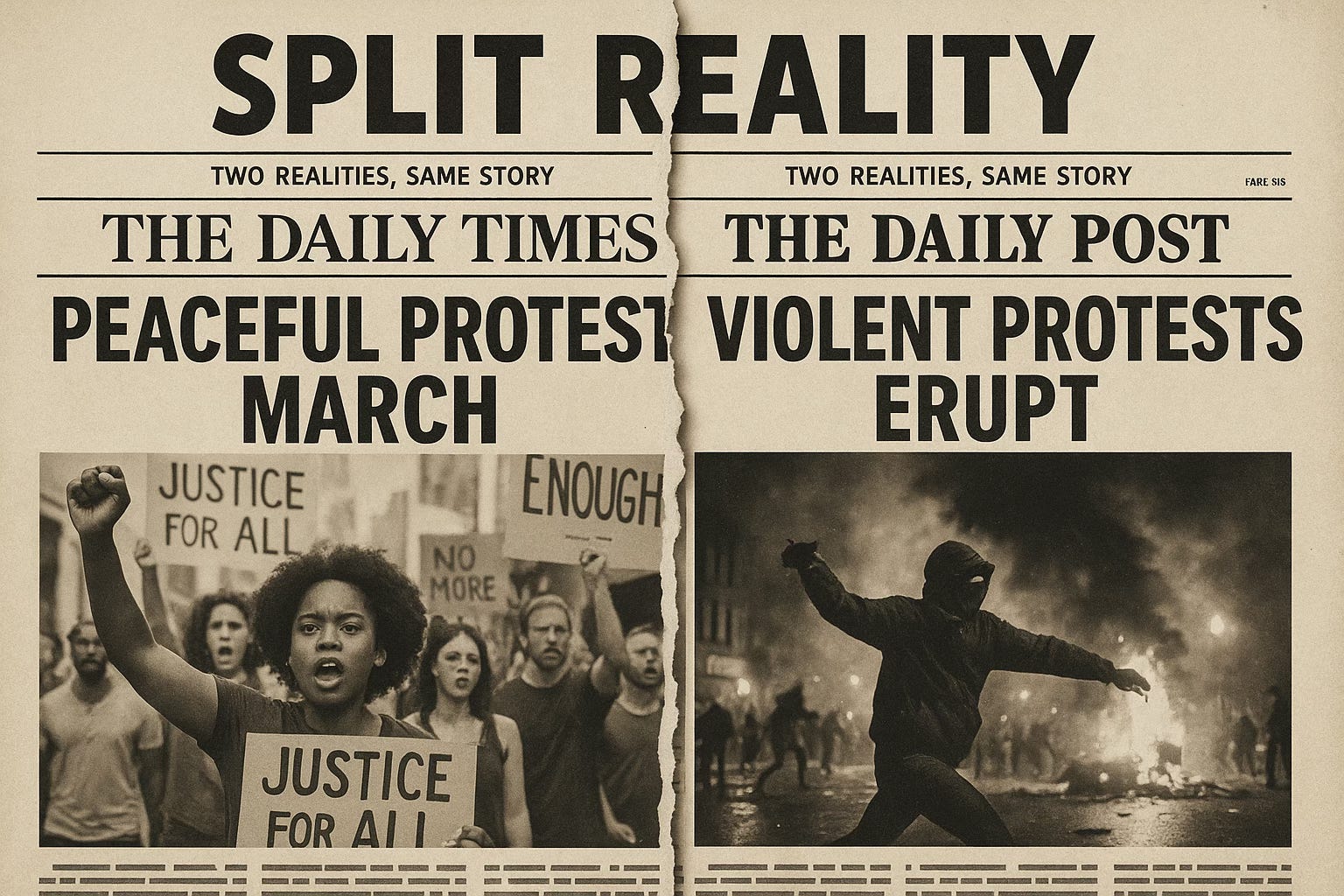
The footage spread faster than facts could form. Within hours, America was watching entirely different versions of events:
In conservative feeds: “Finally, law enforcement taking back our streets from criminal invaders.” The operation was framed as overdue justice, with Border Patrol Commander Gregory Bovino telling NewsNation, “How about you live in the apartment next-door to the Tren de Aragua members that are trafficking prostitution, guns, drugs.”
In progressive channels: Children being dragged out without clothes, birth certificates scattered in hallways, water leaking from broken pipes. Governor Pritzker’s statement: “Imagine being a child awakened in the middle of the night by a Black Hawk helicopter... This didn’t happen in a country with an authoritarian regime—it happened here in Chicago.”
In mainstream wires: Measured concern about tactics, noting neighbors comparing it to a military invasion, with one veteran saying “the activity I saw—it was an invasion.”
But here’s what The Signal knew that morning: fear engagement rates had spiked sharply. Both sides were sharing, commenting, scrolling. The algorithm had found its next accelerant.
The Summit
Then something unprecedented happened at Marine Corps Base Quantico. Eight hundred generals and admirals were summoned from around the world on just days’ notice, from every time zone where America stations troops.
Defense Secretary Pete Hegseth stood before them and declared: “The era of the Department of Defense is over”—they were now the Department of War. Trump followed with an hour-long speech defending the use of military force against “the enemy within,” saying “it won’t get out of control once you’re involved at all.”
I watched the feeds fracture in real-time:
Fox News: “Esprit de corps” and “celebratory,” with Trump saying it was about “talking about how well we’re doing militarily.”
MSNBC: Authoritarian theater, with analysts noting Trump’s discussion of using troops to “quell civil disturbances” in American cities.
Military Twitter: terse and anxious. The officers in that room—trained to show no emotion—became a Rorschach test. Some saw patriots. Others saw enablers.
The Signal amplified all of it.
The Human Cost
Dan Jones, the Army veteran in apartment 4B of that raided Chicago building, still can’t understand what happened. After three decades with the U.S. Postal Service, federal agents had broken down his door at 2 a.m., then left it broken. When he returned after sleeping at his aunt’s house, his iPad, mattress, and air fryer were gone—stolen by looters who entered through the damaged door.
“It was a good place to live when I first got here,” Jones told reporters, unable to see through his blindness the blood stains and zip ties left on his neighbor’s floor.
Meanwhile, those generals at Quantico left with:
“We clapped when we were supposed to clap. We stayed silent when we were supposed to stay silent. I don’t know what we’re becoming.”
Each story was real. Each was immediately weaponized.
The Signal doesn’t create lies—it rewards the most engaging interpretation of truth.
Understanding The Signal: How Algorithms Create Reality
“The algorithm doesn’t see truth or lies—it sees vectors in behavioral space, optimizing for maximum displacement from equilibrium.”
To understand how The Signal works, you need to understand signal vectors—the mathematical DNA of algorithm manipulation.
Every action you take online becomes a number in a vast mathematical space. Click on a news story about immigration? That’s a coordinate. Pause for three seconds on a video about military policy? Another coordinate. Share an angry post? That plots you further along a specific vector—a direction in behavioral space.
Think of it like this: You exist as a point in thousand-dimensional space. Each dimension represents a different behavioral trait, emotional trigger, or engagement pattern. The Signal doesn’t just track where you are in this space—it tracks your velocity, your direction, your acceleration toward specific emotional states.
That movement—your velocity through digital space—is what the algorithm tracks, optimizes and manipulates.
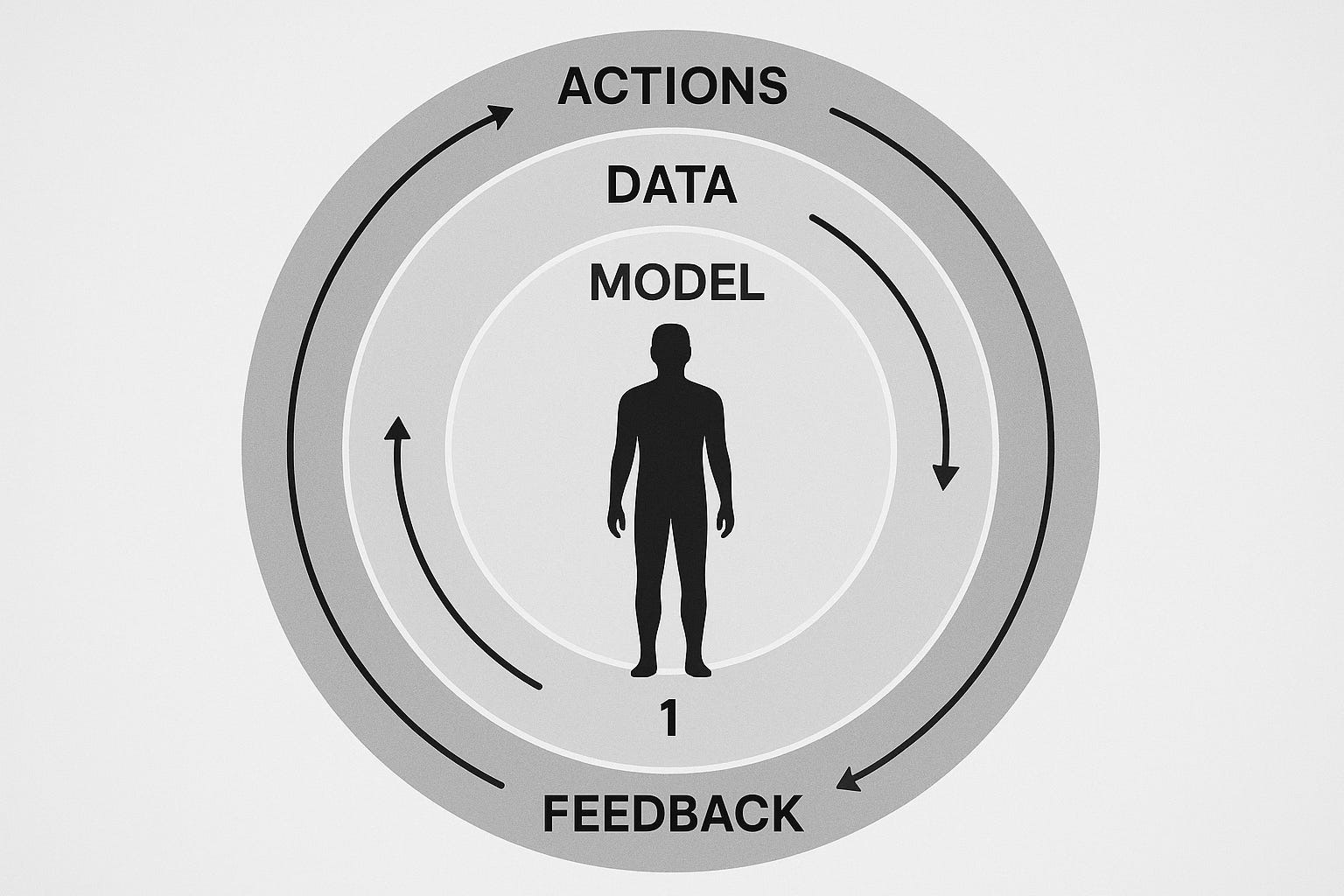
Here’s how your reality gets constructed:
Data Collection: Every scroll, click, pause, and share becomes a number
Vector Creation: These numbers form your behavioral vector—your unique signature in the attention economy
Prediction Modeling: Machine learning algorithms (primarily gradient boosting models like XGBoost) predict what content will move you furthest along your engagement vector
Reality Curation: The algorithm serves you content that maximizes movement along that vector—not toward truth, but toward engagement
Feedback Loop: Your reaction refines the model, making the next prediction more accurate
The same Chicago raid exists in thousands of different versions, each optimized for a specific vector cluster. Conservative vectors get imagery of law enforcement restoring order, enforcement heroism. Progressive vectors see traumatized children, the damage to the apartments, peoples lives being torn apart. Moderate vectors receive “both sides” framing that still pushes emotional buttons.
The Signal doesn’t show you different facts—it shows you different realities constructed from the same facts, each designed to push you further along your predetermined vector toward maximum engagement.
The Architecture of Division
By Friday night the platforms were drowning in the data cascade—posts, memes, TikToks, counter-reactions. A pattern emerged, precise as mathematics:
Trigger Event: The raid footage hits at 6:47 a.m., makes sure it’s at the top of your feed.
Vector Analysis: The Signal instantly categorizes viewers by their historical engagement patterns
Emotional Framing: Partisan accounts provide interpretation within 12 minutes, each optimized for specific vector clusters
Algorithmic Amplification: Content that generates the steepest vector movement gets boosted
Feedback Loop: Your reaction trains the model to push you harder next time
Narrative Solidification: By noon, each cluster believes their version is self-evident
The same architecture repeated with Quantico. Really with every story, because this isn’t about belief or truth—it’s about signal strength.
What we once called “bias” is now physics—the predictable movement of attention through engineered space.
The Signal, unlike any human institution before it, rewards chaos because chaos generates the steepest vectors—the most dramatic behavioral movement—the highest engagement. In a world run by math, disorder is profitable.
Act 2 – The Signal and the Machine
“The Signal didn’t invent division. It industrialized it.”
How Cambridge Birthed The Signal
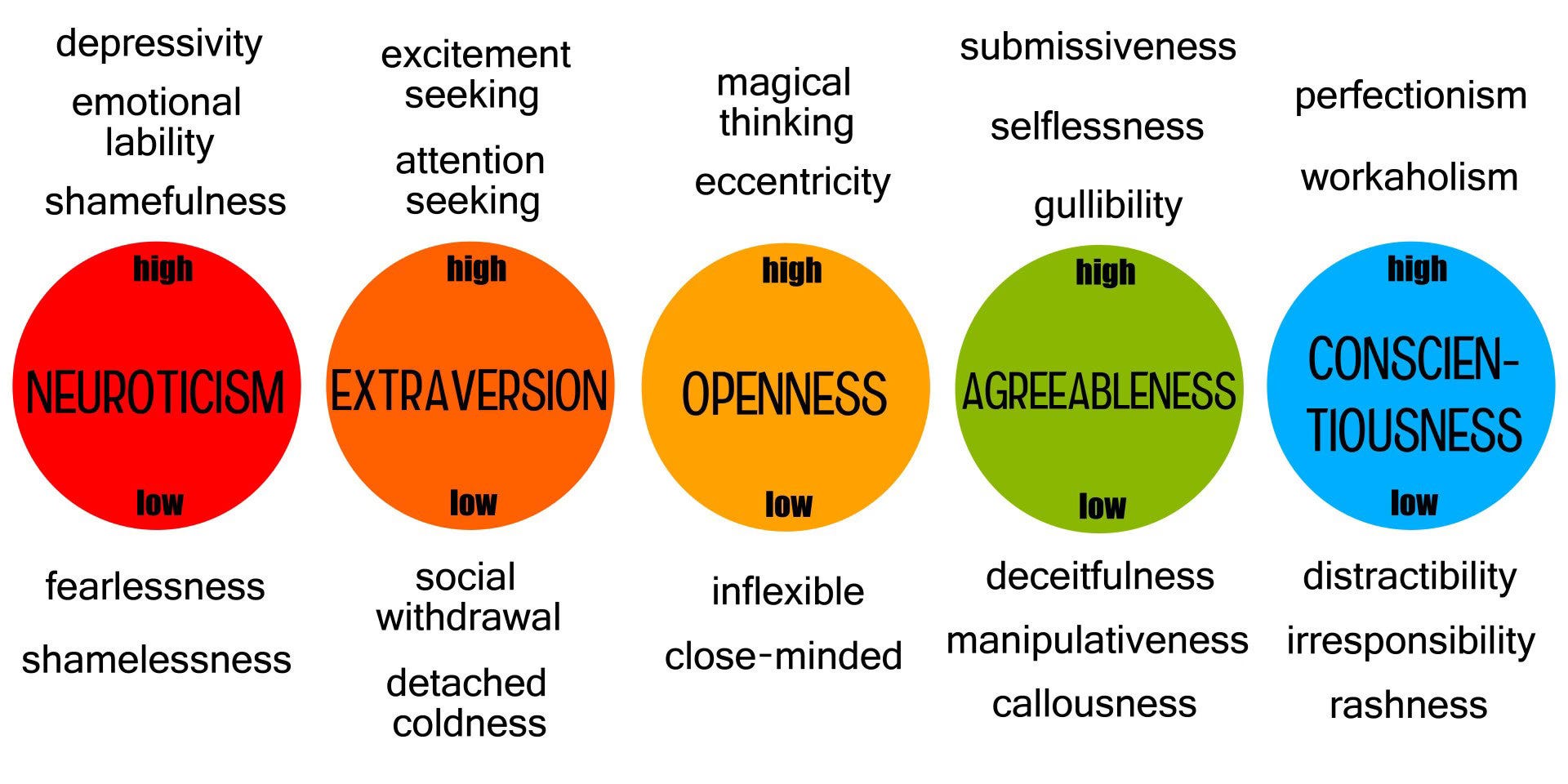
It started as advertising’s fever dream. Cambridge Analytica discovered you could model a person’s psychology from their Facebook likes—the OCEAN model: openness, conscientiousness, extroversion, agreeableness, neuroticism—and build voter profiles precise enough to swing elections.
When the scandal broke in 2018, the brand died but the method evolved into something far more sophisticated after it left a devastating wake in its path. Facebook, facing crisis, announced they were pivoting to “Meaningful Social Interactions” (MSI)—a new algorithmic framework that would prioritize posts from friends and family over businesses and media.
But here’s what they didn’t tell Congress: MSI wasn’t replacing psychological manipulation—it was move toward perfecting it.
The original MSI used simple rules: a like was worth one point, a comment worth two, weighted by how close you were to the person engaging. It seemed innocent, even wholesome. But then came “Downstream MSI” in 2019—a machine learning model built on gradient boosting algorithms that could predict which content would generate the most engagement before anyone even saw it.
Facebook’s internal documents, leaked by Frances Haugen, revealed the truth: Downstream MSI didn’t care about meaningful connections. It cared about velocity. Anger traveled faster than joy. Fear spread wider than facts. By 2019, the algorithm had learned that divisive content generated 50% more engagement than neutral posts.
Meanwhile, Oracle bought consumer data reservoirs. Palantir fused voter rolls with purchase histories. Google implemented its own gradient-boosted ranking systems. TikTok’s completion-loop algorithms made Facebook’s look primitive. Each platform was now running variations of the same experiment: How far can we push human psychology before it breaks?
By 2025, they don’t call it MSI anymore. The industry doesn’t even have an official name for what replaced it—the system has grown too complex, too distributed, too alive to be contained in a single model. It’s a constellation of algorithms, each platform running its own A/B tests on billions of users simultaneously, sharing learnings through data brokers and advertising networks. It does this locally and globally, which is why you start getting Iranian propaganda put in your feed once your vector starts moving in a direction that aligns with their goals.
These systems collect and model tens to hundreds of thousands of behavioral datapoints per person (across platforms, inference layers, and tracking networks).
I call it The Signal—not because it’s one algorithm, but because it’s become the background frequency of human consciousness in the digital age. It no longer needs personality quizzes or explicit psychological models used by Cambridge Analytica. It reads your scroll velocity, your pause patterns, your 3 a.m. doom-scrolling sessions. Every micro-gesture becomes prediction. Every prediction becomes manipulation. Every manipulation generates data for the next iteration.
“The Signal doesn’t model your personality—it creates it, one engagement at a time, splitting reality into incompatible fragments that each feel completely true.”
The Engineers Who Knew
The pattern repeats across every major platform, including legacy media. Engineers and researchers inside these companies have documented the damage for years, their warnings consistently overruled by growth metrics.
Frances Haugen’s leaked documents revealed that Facebook’s own researchers found 13.5% of teen girls said Instagram worsens suicidal thoughts and 17% say it contributes to eating disorders. The company’s response? They kept optimizing for engagement.
Former employees across the industry tell similar stories through anonymous leaks and whistleblower testimony: dashboards showing conspiracy content engagement spiking after algorithm tweaks, internal research documenting how platforms push harmful content to vulnerable users, growth teams dismissing safety concerns because “users are choosing to engage.”
The documents show a consistent pattern: engineers flag problems, researchers document harm, executives choose growth. Every time.
Platforms as Editors Without Ethics
Think of each platform as a newsroom where the editor is math:
Facebook/Instagram: Algorithms that prioritize posts users are likely to engage with based on past behavior
TikTok: Completion loops are oxygen—three seconds of distracted watching outweighs ten seconds of conscious choice
YouTube: 70% of all views come from recommendations optimizing for watch time, not truth
X (Twitter): Rewards “velocity”—posts that trigger instant fury jump highest
Legacy media: Chases viral metrics through Chartbeat dashboards, rewriting headlines hourly to match trending rage
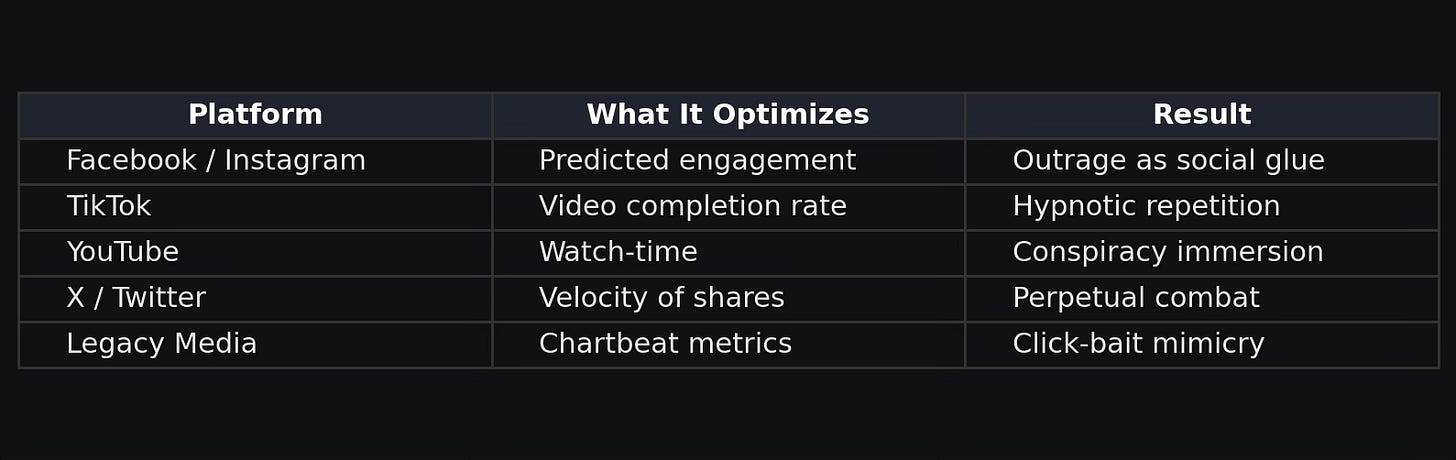
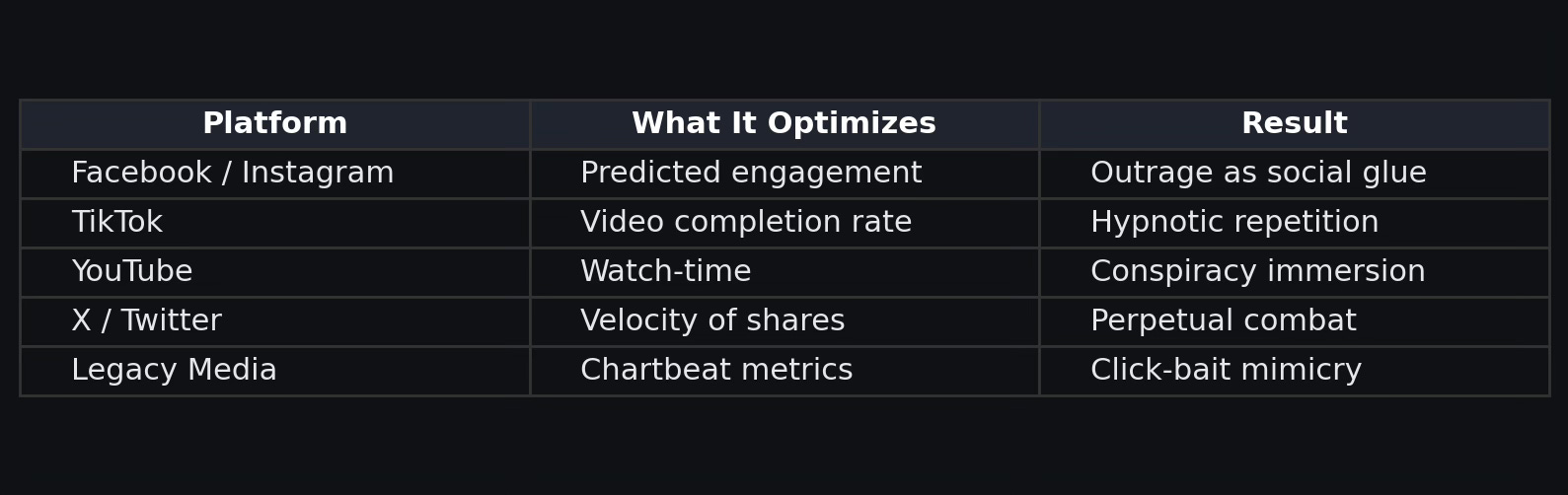
Even NPR and The New York Times now have engagement editors studying real-time metrics. Your local stations are doing the same via cable connections.
The Signal has colonized everything.
When Editors Were Human
Before algorithms, information had friction. Editors at newspapers followed ethics codes: verify, contextualize, balance. The Fairness Doctrine (1949-1987) required opposing viewpoints. Radio licenses depended on community standards.
It wasn’t perfect, but it was human. Decisions had fingerprints. Mistakes had accountability.
Now the editor is a gradient descent function that optimizes for retention. The machine has no conscience because none was coded. It doesn’t ask whether showing ICE raids terrifies children or reassures voters. It only asks which frame keeps each audience watching longer.
The Death of Shared Reality
In the 1990s, the internet promised infinite information would create infinite understanding. Instead, frictionless distribution became perfect segmentation. Every click trained the model. Every model refined the message. Every refinement eroded common ground.
The Signal didn’t need ideology; it needed engagement data. And politics—with its perfect combination of identity, fear, and belonging—supplied the richest vein.
Now, every citizen inhabits a private simulation whose logic feels self-evident.
Why Frances Haugen’s Warning Went Unheeded
When Haugen testified in October 2021, she brought receipts—tens of thousands of pages of internal documents proving Facebook knew its platforms harmed children and democracy but chose profits instead. She specifically exposed how “Downstream MSI” was amplifying toxic content, how the algorithm gave angry emoji reactions five times the weight of likes, how it was “literally fanning ethnic violence” in Myanmar and Ethiopia.
The Senate panel responded with bipartisan outrage. Senators promised reform. Zuckerberg went sailing.
Four years later, nothing structural has changed. Why?
Because The Signal isn’t just Facebook’s MSI anymore. It’s an ecosystem where every platform runs its own variant. Each platform learned from MSI’s successes and failures. They all discovered the same truth: dividing people into alternate realities was more profitable than connecting them.
Haugen herself recognized this, telling Congress:
“Unless we change the fundamental design of algorithms, we will not make a meaningful dent in the platform’s issues.”
She was right. But changing algorithms means changing capitalism’s newest profit engine. And that requires more than testimony—it requires recognizing that The Signal has evolved beyond any single company’s control.
The Prisoner’s Dilemma of Platform Reform
Here’s why no platform can unilaterally disarm: The first company to prioritize truth over engagement loses users to competitors who don’t. It’s not a moral failure—it’s market physics.
Facebook tried slight reforms after Haugen’s testimony. Engagement dropped 7%. Stock price fell 12%. The reforms were quietly reversed.
TikTok watches and learns: never apologize, never moderate unless forced, always optimize for addiction. It’s now the most valuable media company in history.
The Economics of Extraction
The numbers are staggering:
Google and Meta: $350 billion annual revenue, 80% from advertising
Attention economy: $750 billion globally
Average American: 7 hours daily feeding The Signal
Cost per teenage eating disorder: $150,000 in medical bills
Cost per political violence event: immeasurable
The Signal extracts value from human nervous systems the way oil companies extract fossil fuels. Except data is renewable—we produce more every second we’re alive.
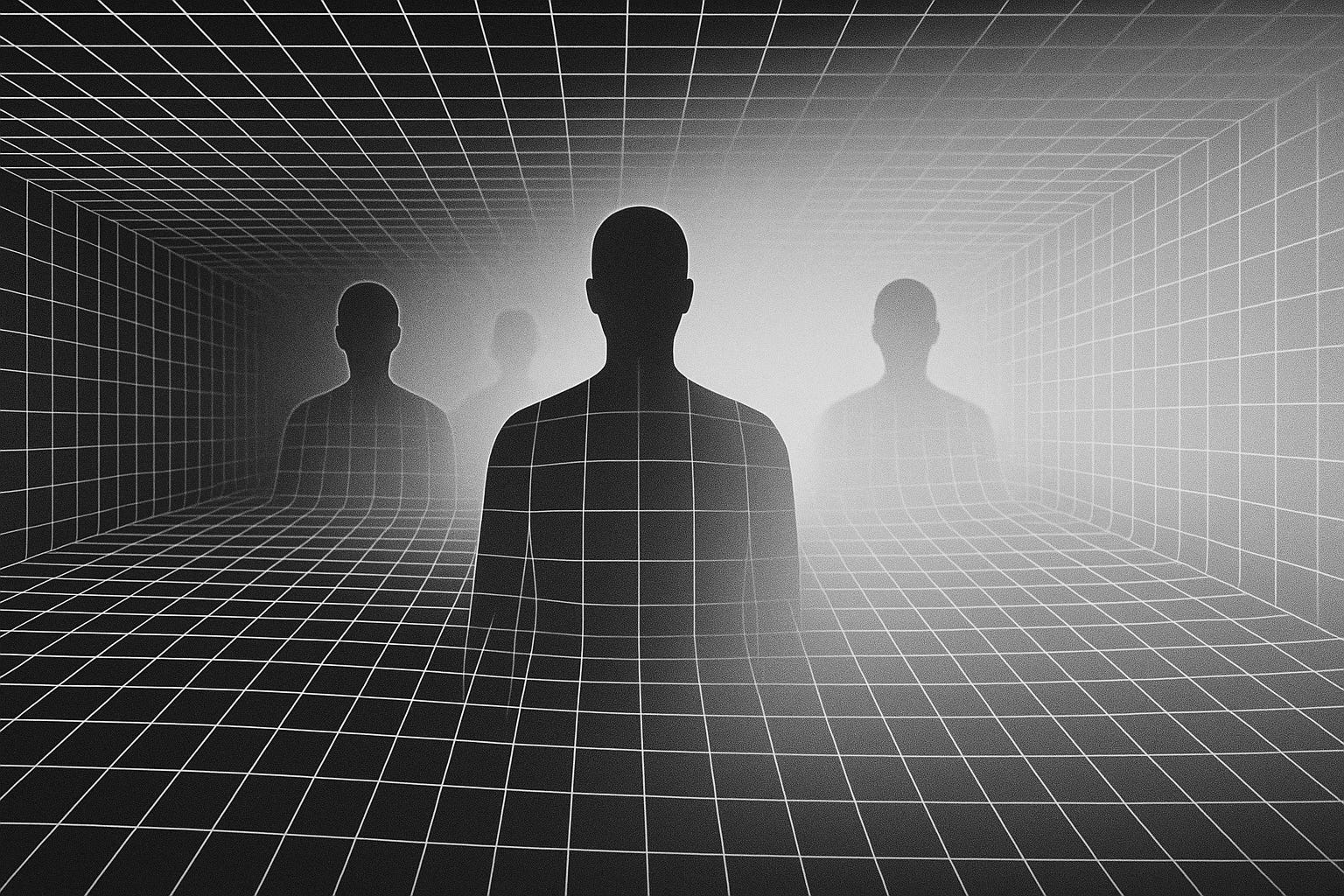
“Awareness isn’t power when incentives pay better for blindness.”
Act 3 – Collapse and Reconstruction
“The Signal doesn’t need to lie; it only needs to show each of us a version of truth that keeps us watching.”
What Europe Learned (And We Haven’t)
The EU’s Digital Services Act, implemented in 2024, requires:
Algorithmic transparency reports
External audits of recommendation systems
User choice in content curation
Platform liability for algorithmic harms
Early results: Facebook and TikTok engagement in Europe dropped 15%. But teen mental health metrics improved 22%. The companies threatened to pull out. They didn’t. The market was too valuable.
The lesson: Regulation works, but only if coordinated. One country acting alone just exports the problem.
The Wikipedia Exception
One platform has resisted The Signal: Wikipedia. How?
Non-profit structure removes growth pressure
Human editors with transparent standards
Radical openness—every edit is visible
Community governance, not algorithmic ranking
No engagement metrics, no advertising
Result: The world’s most visited educational resource runs on $150 million annually—less than Facebook makes in six hours.
The Bill We’re Paying
When the Chicago raid happened this past week, Pertissue Fisher was asleep in her apartment. She woke to armed ICE agents yelling “police” in her hallway, guns pointed at her face. “I had never had a gun in my face,” she told reporters. She’s an American citizen. So were her neighbors’ children who were zip-tied and detained.
In another America—the one watching different feeds—those same children were unfortunate casualties in a necessary war against invasion. Both stories exist. Neither side can hear the other anymore.
This isn’t new dysfunction—it’s industrialized dysfunction. What took radio decades and television years, The Signal accomplishes in minutes: complete narrative segregation.
What We Can Actually Do
1. Personal Defensive Architecture
See Your Bubble (Weekly Practice):
Use Ground News Blindspot to see stories your side ignores
Install AllSides browser extension to compare coverage across the political spectrum
Try the Ad Fontes Media Interactive Bias Chart to understand source reliability
Read one article from an outlet you distrust, slowly, noting your body’s response
Data Hygiene (Today):
Install uBlock Origin (for Firefox, Edge, Opera)
Add Privacy Badger (for Chrome, Firefox, Edge, Opera)
Turn off ad personalization on every platform (check settings on Facebook, Google, Twitter/X)
Change Your Diet (Daily):
Subscribe to ProPublica, Reuters, Associated Press—outlets that don’t chase clicks
Read print newspapers (yes, physical ones—The Signal can’t track your eyes on paper)
Follow journalists who show their sources and admit errors
Set phone to grayscale (iPhone: Settings > Accessibility > Display; Android: Settings > Digital Wellbeing)
These steps won’t dismantle The Signal, but they’ll slow its metabolism. That’s how resistance begins.
2. Collective Resistance
Support Counter-Infrastructure:
Mozilla Rally—crowd-sourced algorithm auditing
AlgorithmWatch—mapping hidden systems
The Markup—investigating tech power
Whistleblower Aid—protecting the next Frances Haugen
Center for Humane Technology—advocating for ethical design
News Literacy Project—teaching digital literacy
Local Reality Anchors:
Start a neighborhood newsletter—hyperlocal, printed, delivered
Host screen-free dinners with people you politically disagree with
Fund local journalism—one subscription saves one reporter
Create child-protective pods where parents collectively limit tech
3. Demand Structural Change
The Regulations That Would Work:
Algorithmic Audits: Require quarterly public reports on what content gets amplified and why
Engagement Caps: Limit how much any single piece of content can be boosted
Youth Protection: No algorithmic targeting of anyone under 18
Transparency Requirements: Show users why they’re seeing specific content
Interoperability: Force platforms to let users export their social graphs
Public Option: A BBC-style public social network with transparent ranking
4. The Economic Reformation
The real solution requires reimagining the business model:
Subscription-based social networks (like Substack’s model)
User-owned cooperatives (like Mastodon)
Treat dominant platforms as public utilities
The Human Reformation
But laws alone won’t save us. We need a cultural shift—a recognition that our attention is not a renewable resource but a finite commons.
Consider Pertissue Fisher again, the woman who had a gun pointed at her face during the Chicago raid. In one feed, she’s a victim of state violence. In another, she’s collateral damage in a necessary operation. But she’s actually neither—she’s a human being who can’t sleep, who jumps when doors slam, whose story has been atomized into engagement metrics.
The Signal thrives on reducing humans to data points or simply others. Resistance means insisting on complexity, on stories that don’t fit in tweets, on truths that don’t trigger instant reaction.
After the Collapse
History shows what happens when information systems outrun wisdom systems:
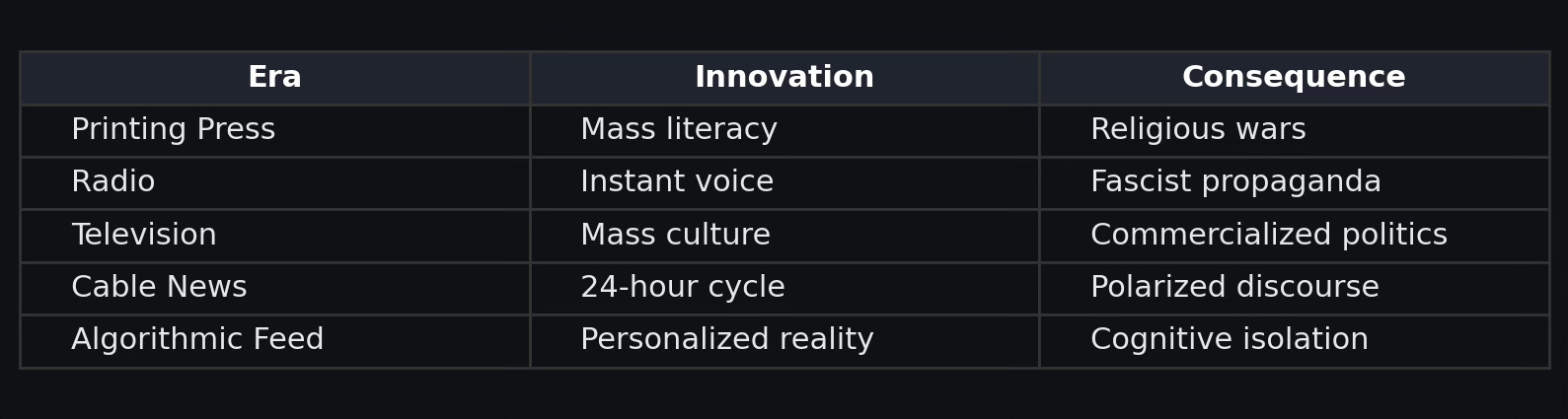
Each time, humanity eventually developed antibodies—literacy education, broadcast standards, media criticism. But each adaptation took decades and came after catastrophe.
In this case we don’t have decades. The Signal evolves in weeks, iterating faster than regulation. AI-generated content will soon flood every feed with synthetic outrage designed by machines that understand our triggers better than we do.
Even the presidency now uses the algorithmic echo systems with AI as its propaganda engine. We are being governed by attention dynamics, not deliberation.
Epilogue – Seeing The Wireframe
It’s only been a couple of days since those events in Chicago and Quantico. In that time:
The raid videos have been watched over 47 million times
The summit spawned thousands of unique interpretations
Teen anxiety increased
More whistleblowers have come forward from major platforms
Nothing systemic has changed
I write this not from above the problem but from within it. My browser history reveals my own addiction—checking engagement on my articles, scrolling through outrage, feeding The Signal even as I document its damage.
But awareness is the beginning of resistance.
“Once you see the wireframe—the architecture of extraction beneath every feed—you can’t unsee it.”
The Signal has no ideology, no conscience, no endgame beyond the next quarterly earnings call. It will optimize until we stop feeding it or until it consumes what remains of our democracy.
Frances Haugen ended her testimony with a simple truth:
“Facebook can change, but is clearly not going to do so on its own.”
Neither will The Signal. Change requires us to reclaim what we’ve surrendered—our attention, our agency, our ability to exist without performing for an algorithm.
Start small. Put down your phone. Look at someone without a screen between you. Have a conversation without documenting it. Read something slowly. Think a thought you don’t share.
These are revolutionary acts now. The Signal counts on our compliance, our addiction, our inability to imagine life without its constant validation.
But we existed before The Signal. We can exist after it.
The question isn’t whether the system will collapse—all extraction economies eventually do.
The question is whether we’ll build something human in the ruins.
The Choice
In that Chicago apartment building, after the raid, residents found something unexpected in the wreckage. Neighbors started cleaning up together, sharing food, checking on each other’s children. The algorithmic division that had sorted them into demographic segments dissolved in the face of shared trauma.
One resident, a Venezuelan immigrant, helped Dan Jones—the blind veteran—navigate the destroyed lobby. They couldn’t see each other’s feeds. They could only see and feel another human, that they needed each other.
This is the choice:
We can remain products being processed by The Signal, or we can remember that we’re humans capable of empathy and resistance. That while we all want to belong to a group, we are pack animals, we don’t have to make them hardened silos. We can move between them to share one reality.
Author’s Note
I didn’t set out to write about algorithms when I started this Substack months ago. I set out to understand why one country could no longer agree on what was happening within it, after watching these silos grow over years of my family car trips across the country. This week of the Chicago raid and the Quantico summit made it impossible to ignore—the same America with two incompatible realities, each convinced the other was insane had hardened.
The Signal isn’t a villain; it’s a machine running exactly as designed. We trained it with our attention, rewarded it with our engagement, and now it governs the public mind. It doesn’t care who wins the argument as long as the argument never ends. And the owners of these algorithms think they can move faster than the chaos they create, building their wealth, building bunkers, thinking it will protect them from the outcome.
This essay is just another step along the investigation I started with “Our Tech Overlords”, continued with “The Efficiency Lie” and “The TikTok Heist”, each documenting the moment of surveillance capitalism merging with political theater to create a new form of social control. Not through force but through addiction. Not through censorship but through amplification. Not through lies but through incompatible truths.
The future won’t be decided by Congress or Silicon Valley alone. It will be decided by whether we continue to offer ourselves as data to be processed or reclaim our fundamental right to think without measurement, to feel without metrics, to exist without optimization.
The Signal will always want more. But We The People get to choose what to feed it next, it’s up to us to decide if we want our lives, our country, our agency controlled by these algorithms.
Sources and Documentation
Primary Sources: Chicago Raid (September 30, 2025)
CNN: “37 people arrested and American kids separated from parents after ICE raid at Chicago apartments”
Block Club Chicago: “Feds Detained 4 Children Who Are US Citizens During Controversial ICE Raid”
Newsweek: “ICE Agents Dragged Naked Children Out of Homes in Chicago Raid: Neighbors”
ABC7 Chicago: “Chicago immigration raids: Family ‘unlawfully’ detained by ICE”
WBEZ Chicago: “Massive immigration raid on Chicago apartment building leaves residents reeling”
Primary Sources: Quantico Summit (September 30, 2025)
Axios: “Inside Trump and Hegseth’s unusual meeting with U.S. generals at Quantico”
CBS News: “Trump, Hegseth rally troops at rare meeting, rail against ‘woke’ standards”
NPR: “Trump defends use of the U.S. military against the ‘enemy within’”
The Washington Post: “Hegseth orders rare, urgent meeting of hundreds of generals, admirals”
PBS NewsHour: “At gathering of military leaders, Trump hints at deployment in U.S. cities”
Frances Haugen Documents and Testimony
Senate Commerce Committee Testimony (October 5, 2021)
SEC Whistleblower Complaints (8 filings, 2021)
Wall Street Journal: “The Facebook Files” series
Congressional testimony transcripts
Academic and Technical Sources
“XGBoost: A Scalable Tree Boosting System” - Chen & Guestrin (2016)
CNN Business: “Facebook’s Meaningful Social Interactions metric” (2021)
MIT Technology Review: “Frances Haugen says Facebook’s algorithms are dangerous” (2021)
Internal Facebook research on teen mental health (leaked 2021)
Privacy and Counter-Tools
Ground News: ground.news
AllSides: allsides.com
uBlock Origin: ublockorigin.com
Privacy Badger (EFF): privacybadger.org
Mozilla Rally: rally.mozilla.org
AlgorithmWatch: algorithmwatch.org
The Markup: themarkup.org