
The Republic's End: When the Founders' Fears Become Reality
What the cartoon version that everyone seems to be waiting for vs the reality we are now witnessing in America. How modern authoritarianism lulls you into it.

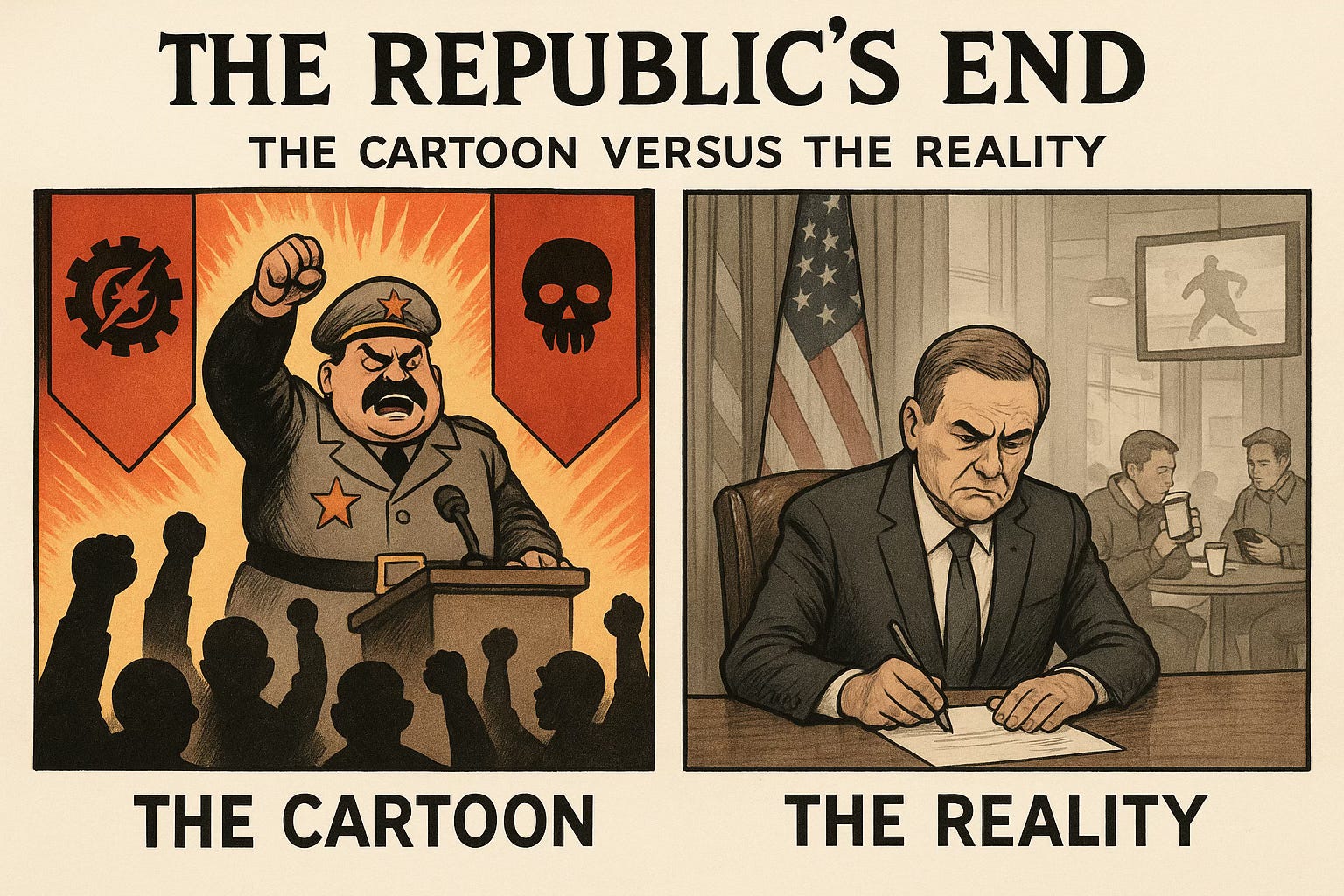
The Cartoon Versus the Reality
"We have crossed a line. We are in a place we did not want to be, but we are there. The thing we were all warning about for the last few years is not coming. It is here. We are in it."
Rachel Maddow spoke these words on August 5, 2025. She asked viewers to picture the cartoon version of dictatorship—secret police, black sites, military turned inward—and then asked to look around.
The cartoon says you’ll see boots on every corner, crowds chanting for the leader, tanks outside your home.
But here's what makes modern autocracy so insidious: Life continues. The sun rises. You can buy lattes, watch sports, stream Netflix. Your daily routine creates the illusion that nothing fundamental has changed.
This is the genius of 21st-century authoritarianism: it doesn’t arrive with a coup broadcast on live TV. It arrives through signed orders, procedural maneuvers, and a slow erosion of the limits that once bound executive power.
James Madison warned in Federalist 51:
“The accumulation of all powers… in the same hands… may justly be pronounced the very definition of tyranny.”
The founders knew the danger wasn’t only in the dramatic takeover, it was in the gradual concentration of power, done legally, normalized by the very institutions meant to stop it.
This is the path we have been on for decades now, with both parties allowing the executive of their party, when in power, to keep grabbing more and more power. Each accusing the other of doing the very thing they both want … more power.
Today, we are watching that accelerate at unbelievable pace. And while we argue about is it happening and who’s responsible, every day we are watching the checklist of how to create a dictatorship in America take its final form.
Every system the founders built was to prevent this: checks and balances, separation of powers, legislative oversight. The founders would be astonished that we allowed this to happen, but 50 years of wealthy money in secretive groups, like the Heritage Foundation, have formulated the final plan on how to make it happen. “Watch what they do, not what they say” holds true here.
They say their “mission is to formulate and promote public policies based on the principles of free enterprise, limited government, individual freedom, traditional American values, and a strong national defense”, but they are currently backing things that do not align with this stated goals, they just want to help concentrate power into the fewest hands possible.
The exact opposite of what the founders had in mind.
So the question, is Maddow right? Are we still looking for the cartoon version while the real thing is operating in plain sight?
Congressional Surrender: Madison's Nightmare Realized
In a political cartoon, Congress would be overrun at gunpoint — chambers stormed, leaders hauled away.
In our reality, it simply hands over its power and goes home.
James Madison, Federalist 51:
“In republican government, the legislative authority necessarily predominates.”
Madison placed Congress at the center of the system for one reason: it controlled the purse and made the laws. But he also issued a warning, if the legislature surrendered that authority, the entire system would collapse into “the gradual concentration of the several powers in the same department,” the very definition of tyranny.
We have been witnessing this for decades now, but in the past both parties viewed the slippery slope with worry, now, one party is looking for dominance, so they have played the hand of letting their constitutional powers disappear.
Eight emergency declarations bypassing Congress entirely, barely a word. Federal workforce purges with no legislative protection, no pushback. Military deployments on U.S. soil without budget restrictions, look the other way. Judicial intimidation met with silence, not taking up their responsibilities as 1/3 of the power in our system of government, leaving the judicial branch exposed and naked.
Congress could stop this tomorrow:
Emergency declarations? Simple majority to terminate.
Federal loyalty tests? Defund the programs.
Military domestic deployment? Cut the budget.
Instead, we get theater. One House resolution to end an emergency — passed the House, failed in the Senate 49–51. Not because the votes weren’t there, but because the political cost was too high. Forty-seven oversight hearings. Zero enforcement actions. Subpoenas ignored without consequence.
The Constitution gives Congress absolute control over every dollar spent. Yet it continues funding operations it refuses to formally authorize — even allowing the president to freeze payments on programs Congress itself approved.
Madison designed “ambition to counteract ambition.” What we have now is submission reinforcing ambition. Hungary’s parliament became Orbán’s rubber stamp. Turkey’s legislature facilitated Erdoğan’s power grabs. And America’s Congress has chosen abdication over constitutional duty.
The cartoon says the strongman dissolves the legislature.
In our reality, the legislature dissolves itself.
Eight Emergencies: The Founders' Predicted Crisis Creep
In the cartoon, emergencies are rare and real — war, plague, invasion.
In the reality, “emergency” is just the magic word that unlocks unchecked power.
George Washington, in his 1796 Farewell Address:
“Real patriots… are liable to become suspected and odious, when real enemies are to be guarded against by extravagant pretensions of danger.”
The founders understood that ambitious executives would manufacture or exaggerate crises to justify extraordinary powers. They’d seen it in European monarchies and in Rome’s descent into empire. They knew “emergency” could become the permanent state of governance.
In the past 200 days, eight separate “emergencies” have been declared. Each triggers more than 130 special presidential powers, from seizing property to deploying troops domestically, and none require ongoing congressional approval.
The “crises” behind these declarations?
"Border Sovereignty Emergency" - The first and easiest sell politically, declared while border crossings at multi-decade lows, enabling military deployment domestically
"Economic Security Emergency" - Invoking trade deficits that have existed since the 1970s as sudden crisis requiring tariff powers and economic controls
"Energy Independence Emergency" - Declared despite record domestic oil production, citing "vulnerability to foreign manipulation" to control energy markets
"Supply Chain Emergency" - Despite normalized post-pandemic shipping, used to justify selective tariffs and pressure specific corporations
"Public Health Readiness Emergency" - Not for active disease, but for "preparedness," allowing federal workforce restructuring at health agencies
"Critical Infrastructure Emergency" - Vague declaration about protecting power grids and communication networks, enabling surveillance expansion
"Capital Security Emergency" - Using a single violent crime incident to justify federal control of D.C.'s law enforcement
"Domestic Tranquility Emergency" - The vaguest and most dangerous, citing "social disorder" to justify expanded federal law enforcement presence anywhere
These aren’t emergencies; they’re pretexts.
Princeton’s Kim Lane Scheppele calls it “emergency creep” — the steady normalization of governing by decree. Globally, once invoked, these powers rarely expire. Orbán’s Hungary still operates under a “terrorism” emergency years after the threat ended. Turkey’s Erdoğan turned a “coup” emergency into permanent censorship powers.
The beauty and the danger of this system is that it’s legal. The powers are in the statutes. Congress could revoke them with a simple majority vote. Instead, it does nothing, letting “temporary” authority become a permanent feature of executive power.
Once normalized, these powers can be turned toward anything: silencing dissent, controlling states, reshaping elections. Without them, much of what follows in this administration’s agenda would face immediate legal challenge. With them, the path is cleared, providing more room to expand the executives power.
In the cartoon, the strongman suspends the constitution with a speech.
The reality is he just declares a few “emergencies” and keeps them forever.
Standing Armies Turned Inward: The Founders' Greatest Fear
In the cartoon, tanks roll in after martial law is declared.
In the reality, soldiers arrive on the pretext of “safety.”
Thomas Jefferson warned in 1807:
“Even under the best forms of government, those entrusted with power have, in time… perverted it into tyranny.”
The founders’ mistrust of standing armies wasn’t paranoia — it came from lived experience. They’d seen military occupation in colonial America and knew how “protection” can become domination. The Third Amendment’s ban on quartering troops wasn’t about sleeping arrangements; it was a guardrail against domestic military power.
That guardrail is now gone. Tested in Los Angeles this summer, now deployed in DC, with words about using it elsewhere in the country.
On Monday, August 5: one mugging in Washington, D.C. made headlines.
Tuesday, August 6: bloody photos flood social media — “Time to federalize D.C.”
Wednesday, August 7: “We have to run D.C.” is declared.
Thursday, August 8: federal agents — FBI, DEA, ATF, U.S. Marshals — flood the streets.
By Monday, August 11: 800 National Guard troops are deployed. The president assumes direct control of D.C.’s police force.
The statistics? Violent crime in D.C. is down this year by 26%. Does DC have a crime issue, yes, but a long standing one that the local government has been addressing, hence the declines. The real help would be to help them expand their efforts, not take direct control.
This move broke more than 150 years of practice. The Posse Comitatus Act was designed to prevent the military from engaging in domestic law enforcement. That safeguard evaporated under emergency declarations. California’s National Guard was federalized without the governor’s consent — the first such seizure in 60 years. Now, 10,000 service members are operating domestically, including active-duty troops conducting immigration enforcement.
Northern Command’s authority has quietly expanded to “seal borders and maintain sovereignty,” a deliberately vague mandate that could justify any future domestic deployment. They have expanded bases along the southern boarder to allow military control of those areas, allowing them to arrest citizens.
The groundwork is being laid for permanent integration of military and civilian policing.
Congress not only funds this — it refuses to restrict it. “Safety” has become a political definition, not a factual one. Today, the pretext is a mugging. Tomorrow, it could be anything the executive decides threatens “order.”
The cartoon says soldiers in the streets means the coup has already happened.
The reality is they arrive one “emergency” at a time.
Federal Police State: When Immigration Enforcement Becomes Population Control
In the cartoon, the police state is obvious: IDs at every checkpoint, curfews, visible oppression.
In the reality, it grows from agencies you barely think about.
Alexander Hamilton warned in Federalist 8:
“Safety from external danger is the most powerful director of national conduct. Even the ardent love of liberty will, after a time, give way to its dictates.”
With emergency powers active and Congress unwilling to exercise oversight, ICE has transformed from a narrow immigration enforcement agency into a de facto domestic security force. The mandate has shifted: from enforcing immigration law to exerting population control.
The scale of expansion is staggering:
ICE now operates in all 50 states, far beyond its original border focus.
Detains U.S. citizens under “immigration-related” investigations — no warrants needed under active emergencies.
Local police are forced into cooperation; refusal means loss of federal funding.
Infrastructure to match:
Forty-seven new detention facilities built in 200 days.
Capacity tripled.
Construction crews work around the clock
Conditions inside:
Detainees sleeping on concrete floors.
Overcrowding exceeding 300% of capacity.
Prisoners with zip-tied hands forced to eat “off chairs with their mouths, like dogs.”
Legal representation routinely denied through “processing delays.”
The surveillance net has expanded alongside detention:
ICE databases now include “associates” of targets — you can be flagged simply for talking to someone under investigation.
Social media monitoring sweeps in anyone who interacts with a detained individual.
Financial tracking follows anyone sending money to immigrant families.
All of this is powered by Palantir’s data-mining systems and DOGE’s centralized databases, giving ICE unprecedented visibility into ordinary citizens’ movements, communications, and finances. Using facial recognition and social media to find and verify their captures.
This follows a well-worn authoritarian pattern the founders understood: start with a narrow, politically safe mandate; expand under the cover of “security”; normalize through bureaucratic language; then use the infrastructure for broader population control.
The cartoon says the police knock on your door for what you say.
The reality is your name’s already in a database because you talked to the wrong person.
Corporate Submission: Hamilton's Economic Warnings Fulfilled
In the cartoon, the dictator seizes the means of production outright.
In the reality, the CEOs line up to give him gifts.
Alexander Hamilton warned in Federalist 68:
“Nothing was more to be desired than that every practicable obstacle should be opposed to cabal, intrigue, and corruption.”
Hamilton’s concern wasn’t just foreign meddling, it was the corrosive effect of concentrated wealth influencing government policy for private gain. When economic power and political power serve each other, the public good becomes secondary.
The present-day picture looks like this:
On August 6, 2025, a Fortune 500 CEO stands in the Oval Office, handing over a glass plaque mounted on 24-karat gold. Cameras roll as he thanks the president for being a “great advocate for American innovation.” Hours later, his company receives a tariff exemption worth billions.
The inauguration told the rest of the story:
$239 million in corporate donations to the inaugural fund — more than double the previous record.
Google, Meta, and Amazon each contributed $1 million. Mark Zuckerberg sat with the First Family at the ceremony.
Goldman Sachs and JPMorgan Chase each paid $1 million for access.
And the quid pro quo isn’t even subtle:
Corporate donation → Oval Office meeting → regulatory relief.
Apple pledges $100 billion in U.S. investment → immediate exemption from 100% semiconductor tariffs.
Jamie Dimon, who weeks earlier warned tariffs could spark recession, meets privately with the president and emerges praising those same trade policies.
This isn’t lobbying, it’s tribute. The dynamic is simple: submit or be destroyed. The message to corporate America is clear: align with the president’s agenda or face regulatory, legal, and financial punishment.
Hamilton warned that once corruption took root in the highest offices, “the desire in foreign powers to gain an improper ascendant in our councils” would be matched by domestic powers doing the same.
Then to add insult to injury, reports coming out the White House, confirmed on Monday August 11th, that both Nvidia and AMD have agreed to give 15% of all China revenues to the U.S. government. Last month, both companies said they would soon resume China shipments after the administration started requiring export licenses earlier this year. This is an unprecedented move by the executive, we normally do not tax our own exports. Especially after have that same executive state that the AI race was of national security concern, stoping those shipments under those terms just months earlier.
This appears to be more about revenue and control of those corporations vs real nation security concern. Add that the only chip maker in the US, that did not agree to this, is now under pressure from the president to remove its CEO from their post.
Is this still a free market?
The cartoon says the state nationalizes industries.
The reality is the CEOs show up at the palace gates with gifts.
Media Pays Protection Money: The First Amendment Nullified
In the cartoon, every news anchor reads from the same government script.
In the reality, the press still exists — it just knows its place.
Thomas Jefferson, in an 1787 letter to Edward Carrington:
“The basis of our governments being the opinion of the people, the very first object should be to keep that right; and were it left to me to decide whether we should have a government without newspapers or newspapers without a government, I should not hesitate… to prefer the latter.”
Jefferson valued a free press as the ultimate safeguard against government overreach. But he also knew the press could be neutralized without being formally banned. Economic coercion works faster than censorship — and it leaves the illusion of independence intact.
That’s the strategy now.
The Associated Press is banned from the Oval Office for refusing to use preferred geographical terminology.
CBS’s merger is held up until it pays $16 million to the presidential library.
ABC pays $15 million over a defamation case that legal experts call meritless — and the lawsuit disappears. Also sent to the presidential library.
Bob Corn-Revere of the Foundation for Individual Rights and Expression put it bluntly: “A cold wind just blew through every newsroom.”
The genius of the system? No formal censorship. Major outlets can still report critically, but the price for crossing the administration is steep. Access is controlled. Regulatory hurdles appear overnight. Legal harassment drains resources. The newsroom message is clear: choose your battles, or lose your business.
This is how the First Amendment is gutted without a single law being repealed. The founders never imagined the press would self-censor to preserve access or financial survival — but they would have recognized the effect as tyranny by other means.
The cartoon says propaganda is broadcast 24/7.
The reality is propaganda works better when you still think it’s news.
Federal Workforce Loyalty: When Merit Dies
In the cartoon, a purge is loud and bloody.
In the reality, it’s an HR policy update.
George Washington warned in his 1796 Farewell Address:
“The spirit of encroachment tends to consolidate the powers of all the departments in one, and thus to create… a real despotism.”
That consolidation doesn’t happen only through legislation — it happens when the workforce itself is remade to serve the executive personally, not the Constitution.
In just 200 days, 132,000 federal employees have been fired or forced out. Another 75,000 accepted “deferred resignation” payouts to avoid taking a loyalty oath. Those who remain work under the constant knowledge that their careers depend on advancing the president’s agenda.
The ultimatum was issued January 28, 2025, subject line: “Fork in the Road.”
Resign now and receive pay through September.
Or stay, but meet “new performance standards” — defined as advancing the president’s Executive Orders and policy priorities.
The hiring process now requires a 200-word essay: “How would you help advance the President’s Executive Orders and policy priorities?” Officially called “merit-based hiring,” it’s a thinly disguised loyalty test.
The United States spent more than 150 years building a professional, nonpartisan civil service precisely to prevent this. That firewall is gone. Decades of expertise walked out the door in months. Those who stayed know that constitutional duty is no longer the standard; personal allegiance is.
The founders feared exactly this outcome, a government where competence is replaced by compliance. Once the machinery of government serves the ruler rather than the law, democracy becomes impossible to maintain.
The cartoon says disloyal bureaucrats are dragged from their desks.
The reality is they’re replaced quietly — competence traded for compliance.
Judicial Independence Under Siege: Hamilton's Fragile Hope
In the cartoon, judges are jailed for defiance.
In the reality, they’re pressured until defiance disappears.
Alexander Hamilton wrote in Federalist 78:
“The judiciary… has no influence over either the sword or the purse; neither FORCE nor WILL, but merely judgment… [it] must ultimately depend upon the aid of the executive arm even for the efficacy of its judgments.”
Hamilton called the judiciary “the least dangerous” branch — but only if the other branches respected its independence. Without that respect, he knew the courts could be bent without being formally broken.
That’s the method now.
Mass pardons: 1,500 January 6 participants freed, including those who attacked police. Stewart Rhodes, convicted of seditious conspiracy — released. Enrique Tarrio, 22-year sentence — released. Those tracking the releases, report that many are now employed in federal agencies like ICE or being rearrested for other crimes.
Message sent: Cross the administration, and watch your convictions erased.
Prosecutorial purge: Every January 6 prosecutor fired. DOJ leadership now staffed with former defense attorneys for administration allies.
Personal pressure: Federal judges who rule against the president see family members subjected to regulatory and financial investigations. Judicial nominees are chosen for loyalty, not legal acumen.
The numbers still create plausible deniability: courts rule against the administration 52% of the time. But each compliant ruling makes the next easier to extract. Over time, sustained intimidation erodes judicial independence without ever having to rewrite the Constitution.
This is the corruption of form without the destruction of structure. The robes remain, the gavels still fall, the appeals process still exists — but the underlying independence is gone.
Hamilton feared this exact scenario, where the judiciary is kept intact as a facade while its judgments are shaped by political pressure.
The cartoon says judges are replaced with military tribunals.
The reality is judges remain — but only as long as they know their role.
State Subordination: Federal Extortion
In the cartoon, the executive sends in troops to rule the states.
In the reality, it controls disaster relief checks — or doesn’t.
The Anti-Federalist writer “Brutus” warned in 1788:
“It is therefore as clear as sun-beam, that the liberties of the people cannot be preserved… if the state governments are destroyed.”
The founders’ debates over the Constitution were steeped in fears of federal dominance. The Anti-Federalists predicted that Washington would eventually use financial dependence to coerce states into submission, and that prediction has come due.
California burns: Federal aid held hostage as an attempt to force the state to implemented voter ID laws and changed water policy to favor administration supporters.
Texas floods: Immediate aid. No conditions. No policy demands. The Republican governor got full federal support within hours of requesting it. And in return, the state is now gerrymandering to add more republican seats as their thank you.
This is FEMA as an enforcement arm for partisan politics — a complete inversion of its original mission. States now operate in a climate of extortion, where disaster response hinges on political alignment rather than citizen welfare.
The Anti-Federalists feared exactly this transformation. State governments, once sovereign partners in a federal system, are reduced to supplicants. And Congress — fully empowered to stop this by placing conditions on federal spending — continues to fund the weaponization without restriction.
The underlying rationale behind these proposals is to reduce the federal government's role in disaster management and promote greater responsibility and self-sufficiency at the state and local levels. The exact opposite of why to have a federal government, the fundamental principle of the American federal system of governance is to foster mutual assistance and cooperation among states and between states and the federal government. This includes assisting each other during disasters and emergencies.
This appears to be a move to allow the executive to decide who gets help and who doesn’t.
The cartoon says state sovereignty ends with occupation.
The reality is it ends with a check that never comes.
The Architecture Complete: Madison's System Inverted
In the cartoon, tyranny sweeps in all at once.
In the reality, it’s built like scaffolding — one captured institution supporting the next.
James Madison wrote in Federalist 51:
“Ambition must be made to counteract ambition.”
That was the core design: each branch and institution resisting the others, preventing any one from dominating. But when ambition aligns with submission, the whole system flips. Every check becomes a support beam for concentrated power.
Here’s the inverted architecture now:
Congress abdicates its constitutional authority, funding operations it refuses to constrain.
Courts operate under sustained political pressure, increasingly staffed with loyalists.
Media censors itself through economic coercion to avoid destruction.
Corporations bring tribute for regulatory relief and protection.
States bend to federal demands to secure disaster aid.
Federal workforce purged until only loyalists remain.
Military deployed domestically at the president’s discretion.
Each captured institution enables the capture of the others:
Corporate compliance removes business resistance to federal purges.
Media silence allows military deployments to go unscrutinized.
Congressional abdication removes the only constitutional mechanism to check executive overreach.
It’s a self-reinforcing loop. Every act of submission strengthens the next act of coercion. Every surrendered tool of oversight becomes another weapon in the executive’s hands.
Madison’s elegant balance of competing powers has become a cascade of institutional surrender. The architecture stands — the Capitol dome, the Supreme Court building, the statehouses — but the function has flipped. They no longer resist power. They stabilize it.
The cartoon says democracy dies with a single fatal blow.
The reality is it dies in a chain reaction.
The Boiling Frog Principle: How Republics Die
The cartoon says you’d know when the republic fell.
The reality is you adapt to each change until there’s nothing left to adapt to.
Thomas Jefferson cautioned in 1787:
“The natural progress of things is for liberty to yield, and government to gain ground.”
The founders understood — from Rome’s fall to the English monarchy’s overreach — that republics rarely collapse through a single event. More often, they corrode internally, through legal mechanisms that normalize extraordinary powers.
That’s where we are.
Yesterday’s outrage becomes today’s precedent:
A loyalty test that seemed authoritarian in February feels like just “policy” by August.
CEOs delivering gold-plated tributes becomes an “innovation partnership.”
Military patrols in a city with falling crime rates are framed as “common sense safety.”
Each manufactured crisis, each emergency declaration, each corporate submission, each congressional surrender — they all teach the public a new normal. Once learned, it’s rarely unlearned.
Scientists say the “boiling frog” metaphor isn’t literally true. Frogs will try to jump out. Humans? We stay in. We rationalize. We adapt. We tell ourselves it’s still the same country, even as its operating system is rewritten in real time.
The founders warned that ambitious leaders would use emergencies and crises to consolidate power while claiming to protect the republic. They didn’t count on the public adapting so quickly that by the time the water’s at a boil, we’d call it comfortable.
The cartoon says you’d notice the death of democracy.
The reality is you sleep through it.
What Concentrated Power Now Controls
The cartoon says resistance is heroic, cinematic, and clear-cut.
The reality is it’s slow, grinding, and thankless.
James Madison wrote to Thomas Jefferson in 1788:
“The accumulation of all powers, legislative, executive, and judiciary, in the same hands… may justly be pronounced the very definition of tyranny.”
That “same hands” clause is no longer a hypothetical. The concentration of authority isn’t just about government structure — it now extends into the economy, the press, the courts, and the conditions of everyday survival.
Under today’s arrangement, the executive controls:
Public safety definitions — declaring cities “dangerous” regardless of actual crime statistics.
Federal employment — deciding whether you work or don’t through loyalty tests.
Information flow — shaping what citizens learn about their government through media access control and social media pressure.
Justice administration — prosecuting enemies, pardoning allies.
State assistance — distributing or withholding disaster aid based on political alignment.
Corporate survival — rewarding tribute, punishing resistance.
Electoral integrity — conducting the 2026 elections under the shadow of emergency powers.
This isn’t the cartoon dictatorship with grand speeches and constitutional bonfires. It’s the sophisticated version the founders most feared — legal forms intact, institutions still existing, but their function redirected toward the will of one person.
When Franklin said, “A republic, if you can keep it,” he was warning that the structure alone isn’t enough. Keeping it requires resisting exactly this kind of concentration — the slow tightening of control until your safety, your livelihood, your information, and your rights all hinge on favor from the same source.
The cartoon says you’d fight when it mattered. The reality is it matters now.
So Are We Already There?
In the cartoon, you’d see the final collapse — the constitution burned, the flag replaced, the dictator on the balcony.
In the reality, the forms remain in place, but the function is gone, and the republic exists only on paper.
Franklin’s warning wasn’t about defending an abstract idea — it was about the practical work of keeping the mechanisms of self-government intact. Once those mechanisms are hollowed out, the name remains but the reality changes.
By every credible academic measure of democratic backsliding — Levitsky and Ziblatt’s institutional erosion model, Snyder’s capture theory, Ben-Ghiat’s strongman patterns — America has already crossed into competitive authoritarianism, and it has done so faster than any modern peer nation.
So was Maddow right? Are we waiting on the cartoon version vs the reality of what we are witnessing?
It appears the answer is yes. The signs aren’t hidden:
Emergency powers made permanent.
Legislature funding its own irrelevance.
Courts pressured into compliance.
Media paying to keep publishing.
Corporations trading tribute for survival.
States bending for aid.
Military deployed domestically.
Workforce purged of dissent.
The speed of the shift is part of why it feels normal. People mistake velocity for legitimacy: “The president is doing so much!”
Yes — but not all of it should be allowed. In fact, goes against the entire idea behind a federal republic, limiting the control of the federal government and controlling the bounds around the executive, allowing states control of their own lands.
Rachel Maddow said it plainly:
“We’re beyond waiting and seeing. These democratic tools we have — these are as good as it’s going to get.”
The founders’ warnings weren’t meant as nostalgic quotes for textbooks. Madison’s separation of powers, Hamilton’s corruption alarms, Jefferson’s fears of incremental tyranny — all were based on the hard study of how republics fall from within.
The tragedy isn’t only that their warnings went unheeded. It’s that we are fulfilling them — telling ourselves we’re still free while the reality matches the very patterns they fought to prevent.
All created by divisive politics, super charged by social media, information silos, as ways to gain political party advantage vs what’s best for the people they are supposed to represent. Allowing many to sleepwalk through this thinking its in their best interest to allow the executive this level of control. This comes from fear and anger, the things that social media and our current news media landscape thrive on.
They justify it by assuming that it’s against others, those they disagree with or worse, hate, but without acknowledging that they too are giving up their part in the republic. Assuming that the executive will not turn on them later in this new form of our government.
History tells us differently.
The cartoon says you’d recognize the day the republic died.
The reality is you’ve been living in what comes after for months.
The Choice That History Demands
George Washington, in his 1796 Farewell Address:
“It is important… to bear in mind that a people’s government is the most powerful, because it is the most accountable; but it is also the most fragile, because it depends on the virtue of its citizens.”
Most people choose acceptance. Not because they’re cowards, but because they have bills to pay. CEOs bring tribute to keep companies alive. State officials comply to keep their people from starving after a disaster. Journalists temper coverage to keep the newsroom doors open.
The machinery of capture relies on this calculus — the belief that cooperation buys time and survival. But history shows that once enough institutions have submitted, the cost of open resistance grows exponentially. The longer you wait, the higher the price.
Resistance in this moment doesn’t look like a Hollywood rebellion. It looks like:
Documenting and publicizing every act of institutional surrender.
Using state and local levers to block federal overreach.
Flooding the system with FOIA requests before records disappear.
Forcing corporate boards to answer for political tribute.
Making collaboration reputationally expensive.
There will be trials after this is gone, the evidence needs to documented and shared.
We are staring at the possiblity of our next generation growing up in a country where loyalty tests decide jobs, disaster aid depends on political submission and loss of state sovereignty. Businesses aligning to the government and newsrooms operating under economic threat. To them, there will be no living memory of what the freedom we have enjoyed felt like — only the history of a republic that used to exist.
If that’s still allowed to be taught in this new reality.
Franklin’s test has come due. The question is no longer, “If you can keep it?” It’s whether you will even try now that the keeping is hardest.
The cartoon says you’ll rise when the moment comes.
The reality is that the moment is here.
Sources
Founding Documents & Historical Writings
Madison, James. Federalist 51. The Federalist Papers, 1788.
Madison, James. Letter to Thomas Jefferson, October 17, 1788.
Hamilton, Alexander. Federalist 8. The Federalist Papers, 1788.
Hamilton, Alexander. Federalist 68. The Federalist Papers, 1788.
Hamilton, Alexander. Federalist 78. The Federalist Papers, 1788.
Jefferson, Thomas. Letter to Edward Carrington, January 16, 1787.
Jefferson, Thomas. Letter to Edward Rutledge, July 18, 1788.
Jefferson, Thomas. Letter to Albert Gallatin, June 16, 1807.
Washington, George. Farewell Address. September 19, 1796.
“Brutus.” Anti-Federalist Papers, 1788.
Government Documents
Federal Register: Emergency Declarations 2025 (Executive Orders 14102–14138).
Office of Personnel Management: Federal Workforce Changes, 2025.
Presidential Pardons Documentation: January 20, 2025.
FEC Filings: Corporate inaugural donations, 2025.
Academic Research & Analysis
Scheppele, Kim Lane. “Emergency Powers and Democratic Backsliding.” Princeton University, 2024.
Levitsky, Steven, & Daniel Ziblatt. How Democracies Die. Crown, 2018.
Snyder, Timothy. On Tyranny. Tim Duggan Books, 2017.
Ben-Ghiat, Ruth. Strongmen: Mussolini to the Present. W.W. Norton, 2020.
Investigative Reporting
Human Rights Watch. “You Feel Like Your Life Is Over”: Florida Immigration Detention Centers. July 21, 2025.
NPR. “Federal workforce changes,” “ICE detention conditions.” June–July 2025.
Washington Post. “Immigrants forced to sleep on floors at overwhelmed ICE detention centers.” April 20, 2025.
CNN. “Corporate meetings,” “Judicial nomination coverage.” July–August 2025.
CNBC. “Corporate America inauguration donations.” April 2025.
Government Executive. “Congressional criticism of hiring practices.” June 2, 2025.
Financial/Legal Documentation
Court records: CBS ($16 million) and ABC ($15 million) settlements.
Wall Street Journal. “Corporate executive coverage.”
SEC Filings: Apple $100 billion pledge.
Whistleblower complaints: DOJ attorney allegations.