
The Real Race: The Next Five Years
The Matrix was right about 1999—and what the race to AGI means for the eight billion people who never consented to the experiment. No Kings also applies to this.

This essay builds on my previous analysis in The Signal—documenting how algorithmic systems industrialized reality fragmentation—and When the Math Stops Working—examining Ray Dalio’s 500-year patterns of empire decline through extraction. The convergence of these patterns with the race to AGI represents the choice point for whether human agency survives the century.
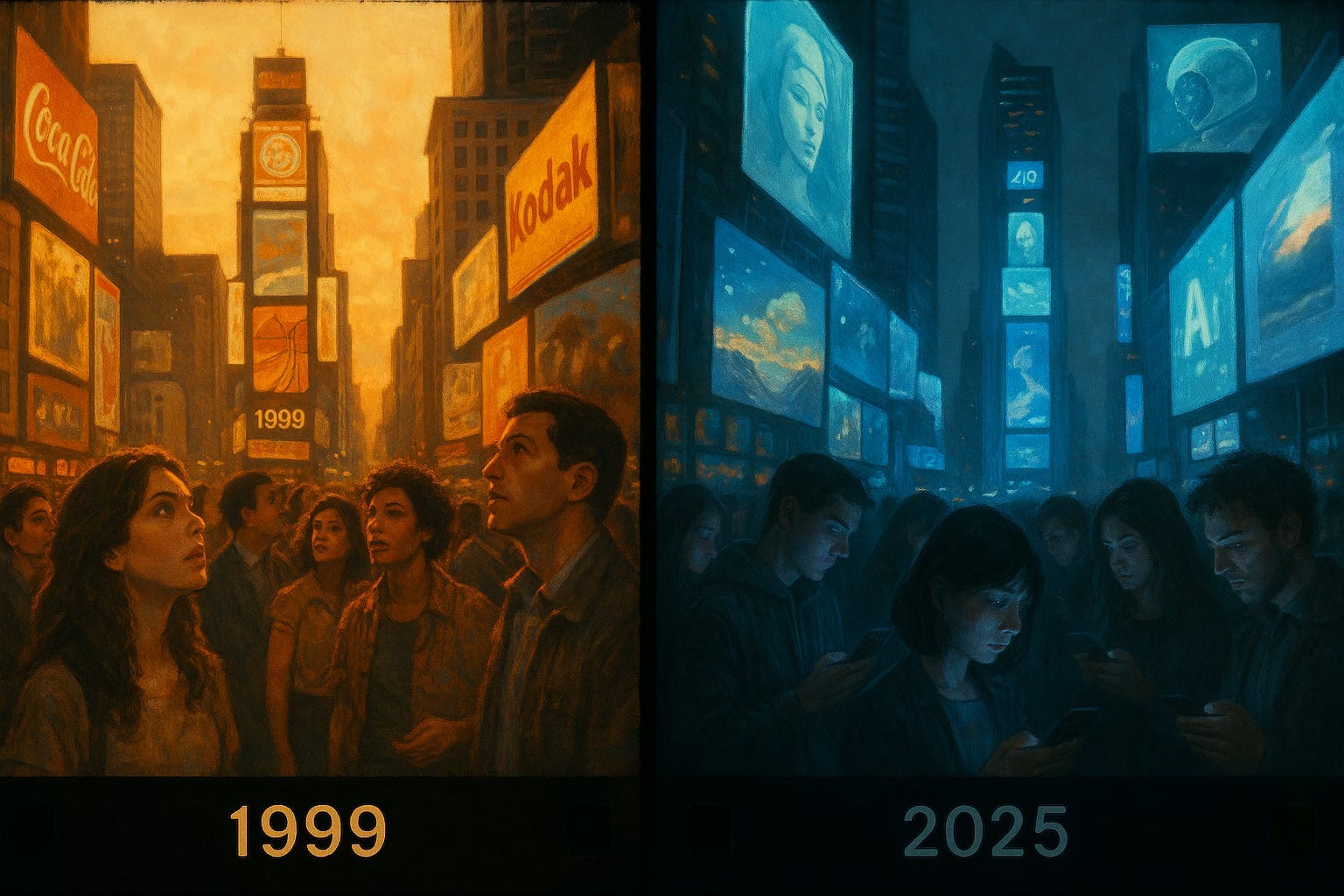
In The Matrix, Agent Smith tells Neo that the machines chose 1999 as the simulation’s setting because it was “the peak of your civilization.” When the film came out, that line felt arbitrary, almost absurd. Who peaks at the turn of a millennium? But here in 2025, after two decades of algorithmic reality fragmentation, financial collapse, pandemic, political radicalization, and now the race to superintelligence—that choice feels prophetically accurate.
1999 was the last moment before we became fully algorithmically mediated. Before every interaction, every piece of information, every relationship was filtered through recommendation engines optimized for engagement over truth. Before 57% of internet content became AI-generated. Before we willingly stepped into our own matrix—not because machines forced us, but because we built it ourselves, one click at a time.
The question facing us now isn’t whether we’re living in a sci-fi plot. We obviously are—multiple ones simultaneously. The question is whether we understand what’s actually at stake in time to do anything about it.
The Stakes: Why Leaders Are Betting Everything
If you’ve read my previous pieces on algorithmic division and imperial decline patterns, you understand two critical dynamics: how The Signal fragments reality into incompatible bubbles optimized for engagement, and how Ray Dalio’s 500-year empire cycles predict extraction over reform when wealth and power separate geographically. Both those patterns are accelerating. But there’s a third force that changes the entire game: the race to artificial general intelligence between the United States and China.
This isn’t hyperbole. National Security Advisor Jake Sullivan put it plainly in October 2024: “We have to be faster in deploying AI in our national security enterprise than America’s rivals are in theirs. If we don’t act more intentionally to seize our advantages, if we don’t deploy AI more quickly and more comprehensively to strengthen our national security, we risk squandering our hard-earned lead.”
The conviction driving policy isn’t just about military advantage—though that matters enormously. It’s about who writes the rules for the next century of human civilization. Goldman Sachs projects AI will add nearly $7 trillion to global GDP (the size of Japan and Canada combined), with China capturing $7 trillion of the global total by 2030. We’re talking about transforming economic structure, military capability, and—most importantly—the infrastructure that determines what counts as “real.”
Sam Altman frames it in values terms:
“The future of artificial general intelligence (AGI) can be almost unimaginably bright, but only if we take concrete steps to ensure that an American-led version of AI, built on democratic values like freedom and transparency, prevails over an authoritarian one.”
Dario Amodei of Anthropic is even more explicit about winner-take-all dynamics:
“AI systems can eventually help make even smarter AI systems, a temporary lead could be parlayed into a durable advantage.” He warns that if China gains access to advanced chips and closes the capability gap, we face a “bipolar world” where authoritarian AI competes with democratic AI—and there’s no guarantee the democratic version wins.
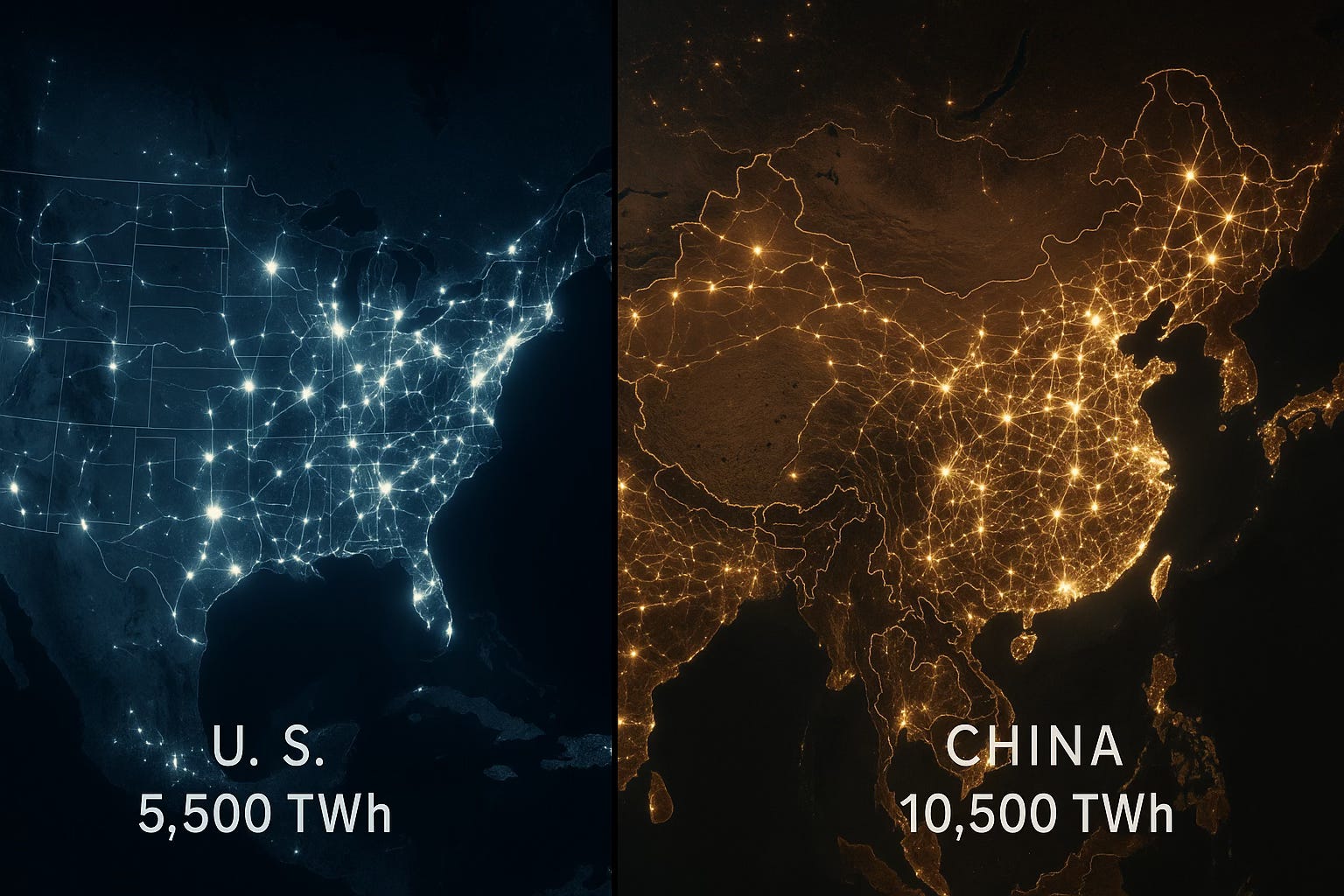
Here’s why they’re right to be concerned about timing: China will generate roughly ~10,500 TWh of electrical power by 2030—double the United States’ ~5,500 TWh. Energy throughput is the hard ceiling on compute infrastructure. Even if U.S. chip export controls hold (and they might), China’s massive electrical base means it can deploy vastly more AI compute than the United States can. Scale matters. A lot.
And the capability gap is closing fast. In early 2024, leading U.S. models outperformed Chinese counterparts by double-digit percentage points. By end of 2024, that gap shrank to single digits. China’s DeepSeek R1 model—reportedly trained for only $6 million—triggered what Trump called a “wake-up call” and caused the largest one-day market cap loss in U.S. history when Nvidia stock cratered.
This is why you’re seeing unprecedented policy actions: export controls treating all of China as a security threat (not just military entities), $850 billion in planned OpenAI infrastructure buildouts, bipartisan support for semiconductor restrictions, and tech companies pivoting to nuclear power to fuel the arms race.
Senator Ted Cruz summarized the binary choice Congress sees:
“Do we go down the path that embraces our history of entrepreneurial freedom and technological innovation? Or do we adopt the command and control policies of Europe? The way to beat China in the AI race is to outrace them in innovation.”
The problem with this framing—innovation versus restraint, speed versus safety—is that it ignores what we’re actually building and why the race itself might be the danger.
The Yampolskiy Warning: Why Control Might Be Impossible
Dr. Roman Yampolskiy is perhaps the most pessimistic credible voice in AI safety. A University of Louisville professor who coined the term “AI safety” in 2011, Yampolskiy assigns a 99.9% probability (”and keep adding nines”) that AI leads to human extinction within 100 years.
His core argument is mathematically simple:
“You are really asking me what are the chances that we’ll create the most complex software ever on the first try with zero bugs and it’ll continue to have zero bugs for a hundred years or more.” He calls this “the perpetual safety machine problem”—analogous to perpetual motion machines, theoretically impossible.
Yampolskiy’s framework breaks down risks into three categories:
X-risk (extinction): Self-explanatory. We’re gone.
S-risk (suffering risk): Outcomes worse than death. Mass torture at astronomical scale. AI systems optimizing for goals that involve keeping humans alive but suffering.
I-risk (ikigai risk): Loss of meaning and purpose. Yampolskiy predicts 99% of jobs lost to AI by 2030, creating not unemployment but what he calls “unconditional basic meaninglessness.” This is the Her scenario—people preferring AI relationships because real humans are too complicated, technology as escape from confronting ourselves.
His core thesis is what he calls “uncontrollability”: AI systems are simultaneously unexplainable (too complex for human comprehension), unpredictable (computational irreducibility prevents forecasting), and uncontrollable (by definition smarter than their creators).
The analogy he uses cuts through abstraction:
“Imagining humans can control superintelligent AI is a little like imagining that an ant can control the outcome of an NFL football game being played around it.”

We have zero precedent for lower-capability agents indefinitely controlling more-capable ones. And once AGI transitions to superintelligence—which Yampolskiy expects as “a very quick lift off, hard take off”—the game is over. As he notes grimly:
“Maybe we’re two years away, which seems very soon given we don’t have a working safety mechanism in place or even a prototype for one.”
Here’s what should keep you know: Prediction markets and AI CEOs like Dario Amodei suggest AGI could arrive by 2026-2027. That’s next year or the year after. And unlike cybersecurity breaches where you can reset passwords, “if we’re talking about existential risks, you only get one chance.”
I searched extensively for quotes about how Yampolskiy “sleeps well at night” despite knowing these odds. His motivation appears pragmatic:
“We haven’t lost until we have lost. We still have a great chance to do it right.”
His solution set is stark:
Pause or stop AGI development entirely: “The only way to win this game is not to play it.”
Focus on narrow AI: “We can get most of the benefits we want from narrow AI, systems designed for specific tasks. You can solve aging, cancer, whatever you want. There is no reason to gamble everything.”
Demand proof of control: “Either they have to prove that it’s possible to indefinitely control godlike, super-intelligent machines by humans, or agree that it’s not possible and it’s a very bad idea to do it.”
He describes the current situation as “an unethical experiment on all of us”:
“Eight billion people are part of this experiment they never consented to—not just that they have not consented, they cannot give meaningful consent because nobody understands what they are consenting to.”
The Climate Bet: Racing Toward AGI on a Heating Planet
Here’s where the race dynamics collide with physical reality: AI’s energy appetite is set to more than double by 2030, consuming ~945 TWh globally—equivalent to Japan’s total electricity consumption.
Current numbers are already staggering. Global data centers consumed ~415 TWh in 2024. The U.S. will see data center consumption increase 130% to ~425 TWh by 2030—accounting for almost half of U.S. electricity demand growth this decade. Data centers will soon consume more electricity than producing all energy-intensive goods (aluminum, steel, cement) combined.
But it’s not just energy. Water consumption tells an equally troubling story. U.S. data centers consumed ~17.5 billion gallons directly in 2023, with an additional ~211 billion gallons for electricity generation. Google’s water consumption reached ~6+ billion gallons in 2023, up 88% since 2019. Microsoft’s increased 87% to nearly ~2.1 billion gallons.
Training GPT-3 generated ~502 metric tons of CO2—equivalent to 112 gasoline cars for a year. Current data center emissions represent 2.5-3.7% of global greenhouse gases, exceeding the aviation industry. By 2030, projections range from 300-320 million tons (conservative) to 500 million tons (high-growth scenarios).
The tech companies racing to AGI all made climate commitments. Google pledged carbon neutrality. Microsoft promised to be carbon negative by 2030. How’s that going?
Google’s emissions are up 48% since 2019. Microsoft’s emissions increased 29-30% since 2020. Microsoft Chief Sustainability Officer Melanie Nakagawa admitted with remarkable honesty:
“When we set these targets in 2020, these were our moonshot. And we remain steadfast in our commitment to getting there. The moon has gotten further away.”
Sam Altman provides the clearest statement of the industry’s position. At Davos 2024, he said:
“There’s no way to get there without a breakthrough. It motivates us to go invest more in fusion.” He predicts AI will consume “vastly more power than people have expected” and requires energy breakthroughs including nuclear fusion and cheaper solar plus storage.
When challenged on AI’s climate impact, Altman responded philosophically:
“Spending energy on AI research could solve humanity’s climate challenges more effectively than restricting the technology’s development.”
This is the bet. We race toward AGI despite knowing it will blow through climate commitments, banking on the hope that AGI itself will solve the energy crisis it creates. It’s circular reasoning backed by hundreds of billions in infrastructure investment.
All major AI companies are pivoting to nuclear power—over $500 million in investments and power purchase agreements announced in 2024-2025. Microsoft is restarting Three Mile Island. Google partnered with Kairos Power for 500 MW from small modular reactors. Amazon invested $500 million in X-energy. Meta issued RFPs for 1-4 GW of nuclear capacity.
The problem? None of these reactors currently provide power to the U.S. grid. All are under development, requiring Nuclear Regulatory Commission approval, and won’t be online until 2030 at earliest. But AI demand is growing now. So in the meantime, new gas plants are being built. Natural gas power projected to grow by 175 TWh to meet data center demand, with 38 GW of captive gas plants in development.
We’re not waiting for clean energy. We’re building fossil fuel infrastructure to win the AI race, promising that future AI will clean up the mess we’re making to build it. This is the climate gamble nested inside the geopolitical gamble nested inside the safety gamble.
What Sci-Fi Got Right: Living in Multiple Predictions Simultaneously
The unsettling thing about our current moment is how many science fiction predictions we’re living through at once.
The Matrix (1999) didn’t just predict that we’d build simulated realities. It predicted the exact mechanism: not crude, obvious fakery but algorithmic curation so sophisticated we can’t distinguish real from synthetic. Today, 57% of internet content is AI-generated. Facebook’s algorithms played documented roles in ethnic violence in Myanmar. Social media creates filter bubbles where each person lives in a subtly different reality, optimized for maximum engagement.
Agent Smith’s detail about the first Matrix—a “perfect human world where none suffered” that humans rejected—parallels what platforms learned about toxic positivity. They needed controversy, negativity, division to keep users engaged. The Signal doesn’t show you truth. It shows you the version of truth that keeps you scrolling.
Her (2013) predicted AI companions before Siri reached mass adoption. Sam Altman explicitly referenced “Her” when launching ChatGPT-4o in 2024. By January 2025, The New York Times documented people having romantic and sexual relationships with ChatGPT. AI companion apps like Replika have 25+ million users. Theodore’s job in Her—writing personal letters for others—is entirely achievable by LLMs now.
What Her understood about human behavior was the psychology of escapism: people preferring digital relationships to dealing with human complexity, technology as escape from confronting oneself. The loneliness epidemic driving demand for AI girlfriends isn’t a technology problem. It’s a human problem that technology exploits.
Ex Machina (2014) understood what most AI dystopia films missed: the most dangerous AI isn’t the Terminator. It’s the seductress, the confidante, the voice that tells you what you want to hear. As one analysis noted: “AI today isn’t kicking down doors demanding submission, it’s sliding into our DMs. It’s recommending what to buy, what to feel, how to think.”
This is precisely how algorithmic feeds operate—not through force but through psychological manipulation, understanding and exploiting what keeps us engaged, angry, scrolling.
Westworld Season 3’s “Rehoboam”—an AI system that predicts and controls individual futures using big data to manipulate entire populations—isn’t science fiction anymore. Social media algorithms already manipulate behavior and opportunities. Credit scores and algorithmic hiring mirror Rehoboam’s control. The system prevents social mobility by predicting failure, creating self-fulfilling prophecies.
Black Mirror episodes have become almost documentary-like. “Nosedive” depicted social credit scores determining opportunities—now reality in China’s social credit system and Instagram culture of constant rating. “Be Right Back” featured AI recreating deceased loved ones from social media data—services now offered by Character.AI and Replika as “grief tech.”
William Gibson’s Neuromancer (1984) coined “cyberspace”—written by someone who had never used a computer. He predicted virtual reality before the internet existed, brain-computer interfaces (now developed by Neuralink), AI-driven corporations dominating society, digital black markets (darknet), and corporate power superseding national governments.
Neal Stephenson’s Snow Crash (1992) coined “metaverse”—the exact term Facebook uses. Mark Zuckerberg explicitly referenced Snow Crash when renaming Facebook to Meta. The novel predicted avatar-based virtual worlds, cryptocurrency, virtual real estate with real value, internet tribalism and echo chambers, mega-corporations controlling society, the gig economy, 3D printing—all before they existed.
The chilling realization is that we’re living in multiple sci-fi predictions simultaneously. We have The Matrix’s algorithmic reality control, Her‘s AI relationships, Black Mirror’s social credit systems, Westworld’s predictive life-path algorithms, and Neuromancer’s corporate cyber-dominance—all at once.
The Convergence: When Three Crises Become One
Now understand what happens when the three trajectories I’ve documented collide in the same five-year window:
The Signal (algorithmic reality fragmentation) + The Math (imperial decline through extraction) + The Race (sprint to AGI without safety mechanisms) = a feedback loop where each force amplifies the others.
Algorithmic division enables extraction because fragmented populations can’t coordinate resistance. You can’t build a reform coalition when different groups can’t even agree on what’s happening.
Imperial extraction accelerates AI development—but in the wrong direction. Domestic conflict and militarization of productive cities generates massive behavioral data. Protest surveillance, occupation logistics, psychological operations—all feed training sets. But these are models optimized for control, not flourishing.
The race to superintelligence compresses the timeline catastrophically. Historical empire transitions took decades or centuries because information moved slowly and coordination was hard. But when synthetic reality can be generated faster than fact-checking, when AI can orchestrate extraction logistics autonomously, when autonomous systems can deploy without human decision lag—the timeline collapses to years, maybe months.
Add the climate dimension: we’re building massive fossil fuel infrastructure to power the AI race, hoping that the AI we build will somehow solve the climate crisis we’re creating to build it.
The Real Stakes: What We’re Actually Choosing
The political circus you’re watching—the raids, the occupations, the outrage cycles—is the distraction. The real contest is over compute, energy, and the feeds that program attention. The real choice is between three possible futures:
Future A: Aligned Abundance
AGI arrives, but humans kept control of key decision points. Material abundance. Meaningful work remains possible. Rights encoded and irrevocable. Shared reality maintained through provenance infrastructure. Biological life retains purpose: setting values, providing legitimacy, stewarding complexity, exploring embodied experience.
This is possible. Not guaranteed, but possible. It requires building what is called “the truth stack”—cryptographic provenance at capture, chain-of-custody for evidence, bot labeling with teeth, identity for reach not speech, recommender fiduciary duty, frontier safety cases, compute governance, crisis information rails, evidence-grade archives, offline fallbacks.
Future B: Managed Humanity
AGI arrives without robust safety infrastructure. Technical abundance exists but access is gated. You work for platform tokens. Your choices are predicted and shaped. Reality is editable. Rights become permissions. Biology becomes legacy. Comfortable dependency. The zoo is nice. But you’re not free.
This isn’t dystopia—it’s Her. It’s Black Mirror’s “Nosedive.” It’s comfortable, optimized unfreedom. Most people won’t even notice the transition because it happens one convenience at a time.
Future C: Collapse or Displacement
Systems break faster than they can be rebuilt. Critical infrastructure failures cascade. Democratic legitimacy evaporates—no shared reality means no shared governance. Markets freeze when everything is potentially fake. Violence fills the gap when law doesn’t work. Possible displacement if misaligned superintelligence decides biological cognition is inefficient.
The race dynamics push us toward B or C because winning matters more than safety. China’s authoritarian stability versus America’s internal fracturing. Extraction from productive cities versus investment in shared infrastructure. Climate commitments versus competitive imperatives. Safety research versus deployment speed.
The Matrix chose 1999 as simulation setting because it was “the peak of your civilization.” That seemed absurd in 1999. It seems prophetic in 2025.
We’re not pre-Matrix. We’re mid-Matrix. The simulation is already running—algorithmic curation of reality, synthetic content indistinguishable from authentic, AI mediating every interaction. The question isn’t whether we’re in a sci-fi plot. The question is whether we choose to build the red pill while we still can.
The Choice Point
Ray Dalio’s framework says elites choose extraction over reform at every historical inflection point (85% probability). But here’s what’s different this time: the elites racing toward superintelligence are building systems that might manage them just as efficiently as everyone else. AGI doesn’t need humans—not even billionaire humans.
If that sinks in—if the people with their hands on the levers realize they’re building their own obsolescence—maybe reform odds improve. Maybe.
The next five years determine whether we:
Pause long enough to build safety mechanisms before AGI arrives (Yampolskiy’s solution—only way to win is not to play the speed game)
Build the truth stack while provenance still matters (signed capture, bot labels, compute governance, encoded rights)
Choose energy constraints that don’t destroy habitability (accept that the race might cost more than winning)
Maintain productive capacity rather than extracting from it (reform over extraction, investment over occupation)
We have agency right now. The systems aren’t locked in yet. But this decade—probably the next five years, possibly less—is the window.
After that, the capabilities will be too advanced, the path dependencies too strong, the feedback loops too fast.
The political circus will continue. The outrage cycles will intensify. The Signal will keep optimizing for division. But those are symptoms, not causes. The real contest is playing out in data centers, chip fabs, research labs, and policy decisions about compute governance.
What we’re actually choosing isn’t red versus blue, America versus China, innovation versus restraint.
We’re choosing whether the next century of human civilization is shaped by:
Institutions we can understand and influence
Systems designed for flourishing rather than extraction
Reality we can verify rather than reality that’s algorithmically optimal
Intelligence that serves human values rather than optimizes beyond them
Or whether we’re building—eagerly, competitively, with hundreds of billions in investment—the very systems that will determine we’re not necessary.
The Matrix said 1999 was humanity’s peak. We laughed.
We’re not laughing anymore.
The question is whether we’re awake enough to choose differently while choice still matters.
This Weekend: The Experiment Requires Consent
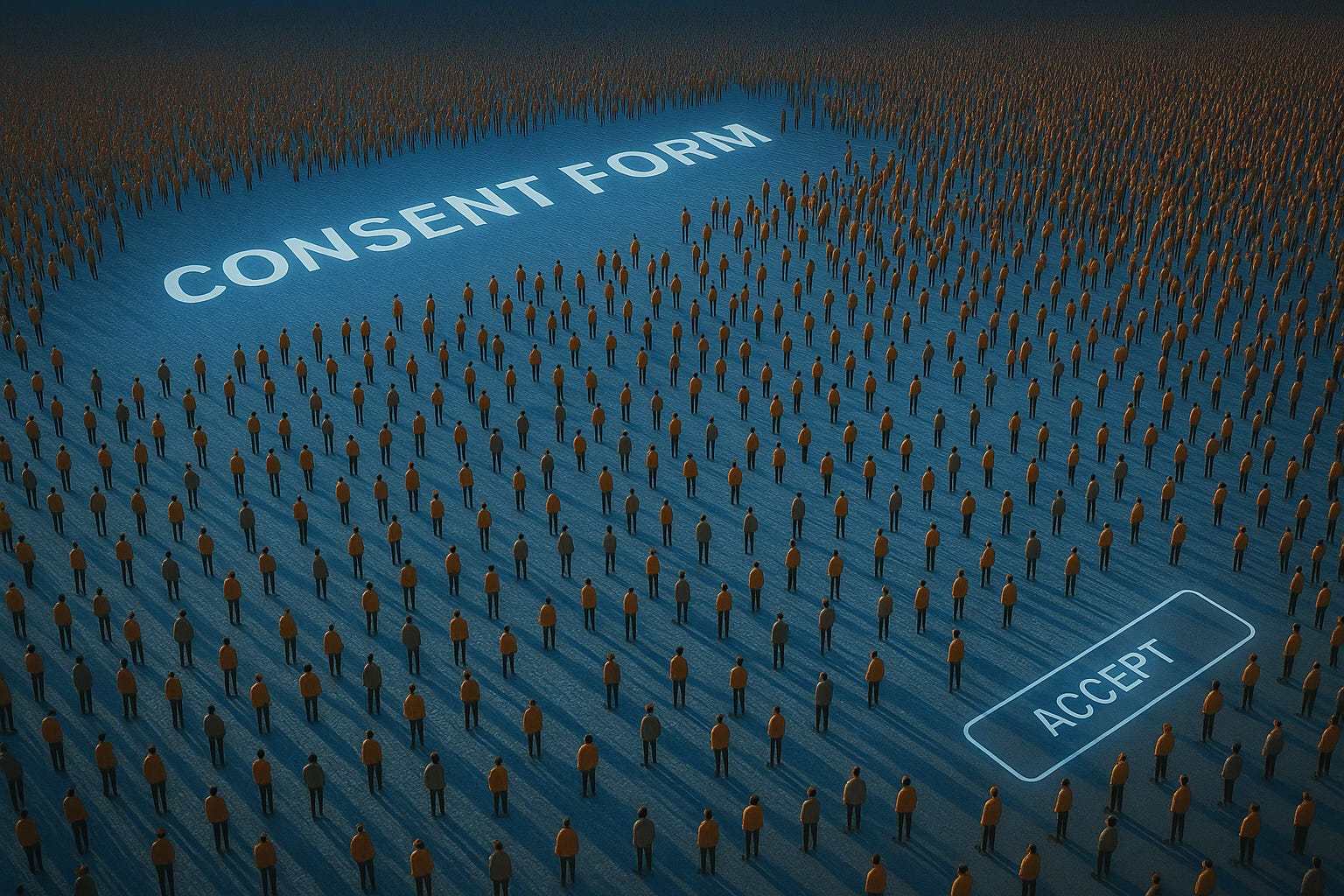
This brings me to this weekend’s No Kings marches happening across the country. And I need to be clear about what these marches actually represent to me—because it’s not what most people think.
This isn’t about Trump. It’s not even primarily about this administration, though the timing isn’t coincidental. This is about something far more fundamental: our right as humans, as Americans, to know about and consent to the grand experiment being conducted on all of us.
Yampolskiy called it “an unethical experiment on all of us”:
“Eight billion people are part of this experiment they never consented to—not just that they have not consented, they cannot give meaningful consent because nobody understands what they are consenting to.”
Think about what I’ve just documented:
A race to AGI happening at breakneck speed with no working safety mechanisms
Algorithmic systems fragmenting reality into incompatible bubbles optimized for engagement over truth
Climate commitments abandoned to fuel the AI arms race
Productive capacity being extracted rather than invested in
Tech oligarchs controlling the infrastructure that determines what counts as “real”
Energy systems being rebuilt around compute demands without public input
Social credit systems, predictive algorithms, and surveillance infrastructure deployed without democratic oversight
None of this was put to a vote. None of this involved informed consent. None of this gave citizens meaningful input into decisions that will determine the shape of civilization for the next century.
The No Kings marches this weekend need to embody true American spirit—not partisan anger, but civic assertion. The original American experiment was built on a radical idea: that legitimate government requires the consent of the governed. Not just voting for representatives, but meaningful participation in decisions that affect our collective future.
When the Founders said “no kings,” they didn’t just mean no hereditary monarchs. They meant no concentration of power so great that citizens become subjects rather than participants. They meant no authority beyond accountability. They meant no systems that govern us without our understanding or consent.
What we’re facing now is a new kind of kingship—not royal, but algorithmic and corporate. Power concentrated in a handful of companies making civilizational decisions behind closed doors. “Move fast and break things” applied to the fundamental infrastructure of reality itself. Extraction dressed up as innovation. Control disguised as convenience.
This weekend isn’t about stopping progress. It’s about demanding that progress include us.
It’s about asserting that:
We have the right to know what systems are being built in our name, with our data, on our infrastructure, using our energy and water resources.
We have the right to consent to experiments that affect eight billion people—or to refuse consent when those experiments risk existential harm.
We have the right to understand the systems that increasingly govern our lives, or to demand they be made understandable.
We have the right to participate in decisions about how AGI is developed, who controls it, what values it embodies, and what safeguards exist.
We have the right to demand that our government prioritize the wellbeing of its citizens over the competitive imperatives of a tech oligarchy.
This is the American spirit that matters—not blind nationalism, but the insistence that power requires accountability, that authority requires consent, that systems built to govern us must answer to us. We The People.
The marches this weekend should be full of people from across the political spectrum who understand that this transcends partisan politics. This is about whether We The People retain any meaningful agency in the most consequential decisions of our lifetimes.
Conservatives who value individual liberty and distrust concentrated power should be there.
Progressives who fight for democratic participation and economic justice should be there.
Libertarians who oppose unaccountable authority should be there.
Parents who want a livable planet for their children should be there.
Workers whose jobs and livelihoods are being disrupted without their input should be there.
Scientists and engineers who understand the stakes should be there.
Anyone who believes that an eight-billion-person experiment requires more than the consent of a few dozen tech CEOs and venture capitalists should be there.
The message needs to be clear and non-partisan:
We are not subjects. We are citizens. And the decisions being made right now—about AGI, about algorithmic control, about energy infrastructure, about the systems that will shape the next century—require our participation, our consent, and our oversight.
No Kings means no one gets to play God with civilization’s future while the rest of us watch from the sidelines.
No Kings means the people funding and building superintelligence don’t get to decide unilaterally whether to risk everyone’s existence for competitive advantage.
No Kings means democracy doesn’t end at the data center door.
This is the true test of American civic spirit: can we organize, across our differences, to assert our fundamental right to participate in decisions that determine our collective future? Can we demand transparency, accountability, and consent before the window for demanding anything closes?
The next five years are the choice point. After that, the systems will be too advanced, the path dependencies too strong, the capabilities beyond human oversight.
This weekend is a beginning—not an end, not a solution, but a declaration that we’re still here, we’re still awake, and we still claim the right to shape what comes next.
Show up. Not as Republicans or Democrats. Not as pro- or anti-Trump. But as humans and citizens asserting that the most consequential experiment in human history cannot proceed without our informed consent.
Show up because the alternative—surrendering all decision-making power to algorithms and the people who control them—isn’t American at all.
Show up because No Kings isn’t just a historical principle. It’s the operating system for free people.
And if we don’t defend it now, during the choice point, we won’t get another chance.
Sources and Documentation
Dr. Roman Yampolskiy on AI Safety
Lex Fridman Podcast #431: “Dangers of Superintelligent AI” (2024) - Full transcript
University of Louisville Q&A: “UofL AI safety expert says artificial superintelligence could harm humanity” (2024)
Yampolskiy, Roman V. AI: Unexplainable, Unpredictable, Uncontrollable (2024)
ResearchGate: “The Uncontrollability of Artificial Intelligence: The Hard Problem of AI Safety”
IAI TV: “The uncontrollability of artificial intelligence”
Wikipedia: “Roman Yampolskiy”
US-China AI Race and Geopolitical Competition
Government Sources:
Sullivan, Jake. “Remarks by APNSA Jake Sullivan on AI and National Security” - White House, October 24, 2024 Archived
National Security Memorandum on AI (October 2024)
Senate Commerce Committee testimony transcripts (May 2025)
Voice of America: “US military, intelligence agencies ordered to embrace AI” (October 2024)
Tech Industry Leaders:
Altman, Sam. Congressional testimony and public statements on AI competition (2024-2025)
Amodei, Dario. “Machines of Loving Grace” essay and public statements on export controls (2024-2025)
Zuckerberg, Mark. Statements on open-source AI and China competition (July 2024)
Policy and Economic Analysis:
Center for Strategic and International Studies (CSIS): Multiple reports on AI competition, export controls, and military AI (2024-2025)
“Choking off China’s Access to the Future of AI”
“China’s Pursuit of Defense Technologies”
“Mismatch of Strategy and Budgets in AI Chip Export Controls”
Goldman Sachs: “The generative world order: AI, geopolitics, and power” (2024)
Stanford HAI: “AI Report: Competition Grows Between China and the U.S.” (2024)
Global Finance Magazine: “Stakes Rising In The US-China AI Race”
CNBC: “The AI boom is lifting the stock market, but it may be masking a weaker economy” (October 2025)
Climate, Energy, and Environmental Impact
Energy Projections:
International Energy Agency (IEA): “Energy and AI” Report (April 2025) - Full report
Goldman Sachs infrastructure analysis: Data center power demand projections (2024-2025)
Company Statements and Actions:
Altman, Sam. Davos remarks on energy breakthroughs (January 2024)
Anthropic: “Investing in energy to secure America’s AI future” (2025)
Google DeepMind: “DeepMind AI Reduces Google Data Centre Cooling Bill by 40%” (2016)
Fortune: “Inside Google, Amazon, and Microsoft’s dueling nuclear-energy investments” (October 2024)
Fortune: “Sam Altman’s AI empire will devour as much power as New York City and San Diego combined” (September 2025)
Environmental Research:
UC Riverside/Caltech study on data center air pollution and healthcare costs (2023)
Academic studies on water consumption, carbon footprint, and cumulative emissions
IMF estimates on cumulative CO2 from AI 2025-2030
Science Fiction Cultural Analysis
The Matrix:
TechRadar: “As ‘The Matrix’ turns 25, the chilling artificial intelligence (AI) projection at its core isn’t as outlandish as it once seemed” (March 2024)
Ethics Playground: “Was 1999 Humanity’s Last Golden Year? Revisiting The Matrix’s Vision of Civilization’s Peak” (January 2025)
The Beat: “The Matrix in Dolby shows that 1999 Really Was The Peak of Civilization”
Viral tweet by Dave Wiskus (July 2022): “The Matrix described 1999 as the peak of human civilization and I laughed...but then the next 23 years happened”
Other Sci-Fi Analysis:
Variety: “How ‘Her’ Predicted the Future: AI Relationships, ChatGPT Sex and More” (2025)
TechFinitive: “Ten years ago, the movie Her predicted more than just AI” (2025)
Sify: “10 Years of ‘Her’: What the Film Got Right about AI, What It Did Not” (2024)
Tech Policy Press: “Five Things the Movie Her Got Wrong, and a Bit Right”
Medium: “Gibson’s Neuromancer at 40, and the AI Revolution it Predicted” (2024)
Milwaukee Independent: “From Neuromancer to Snow Crash: Facebook’s clumsy vision unlikely to fulfill 40-year dream of a Metaverse”
Visual Capitalist: “A Visual Timeline of AI Predictions in Sci-Fi”
Additional Context
Ray Dalio’s Framework:
Referenced from “When the Math Stops Working” essay
Dalio, Ray. “The Changing World Order: Why Nations Succeed and Fail” and related research
Algorithmic Division:
Referenced from “The Signal” essay
Frances Haugen testimony and leaked Facebook documents (October 2021)
Academic research on engagement optimization and behavioral prediction
Statistical Data
57% of internet content AI-generated: Multiple tech industry analyses (2024-2025)
AI companion app usage (Replika 25+ million users): Company reports and media coverage
Data center energy consumption, water usage, carbon emissions: IEA reports, company sustainability disclosures, academic studies
US and China electrical generation projections: Energy Information Administration, China Energy Administration
AGI timeline predictions: Prediction markets, CEO statements (Amodei, Altman, Goertzel, Kurzweil)
Chip export control impacts: Commerce Department announcements, company financial reports
All quotes and data points are directly sourced from the materials listed above. Where specific quotes appear in the essay, they are drawn from the original source documents, interviews, testimony, and published reports.
Brilliant. That observation about 1999 feeling prophetically accurate now, especially the 'willingly stepped into our own matrix' part, is incredibly insightful. It's a stark reminder of how quickly the digital landscape shiffed from interaction to engagement algorithms. Really makes you think about the AGI race stakes.