
The Open Skies Doctrine
Drones are mapping our nuclear arsenal. Our counter-drone laser shoots party balloons.

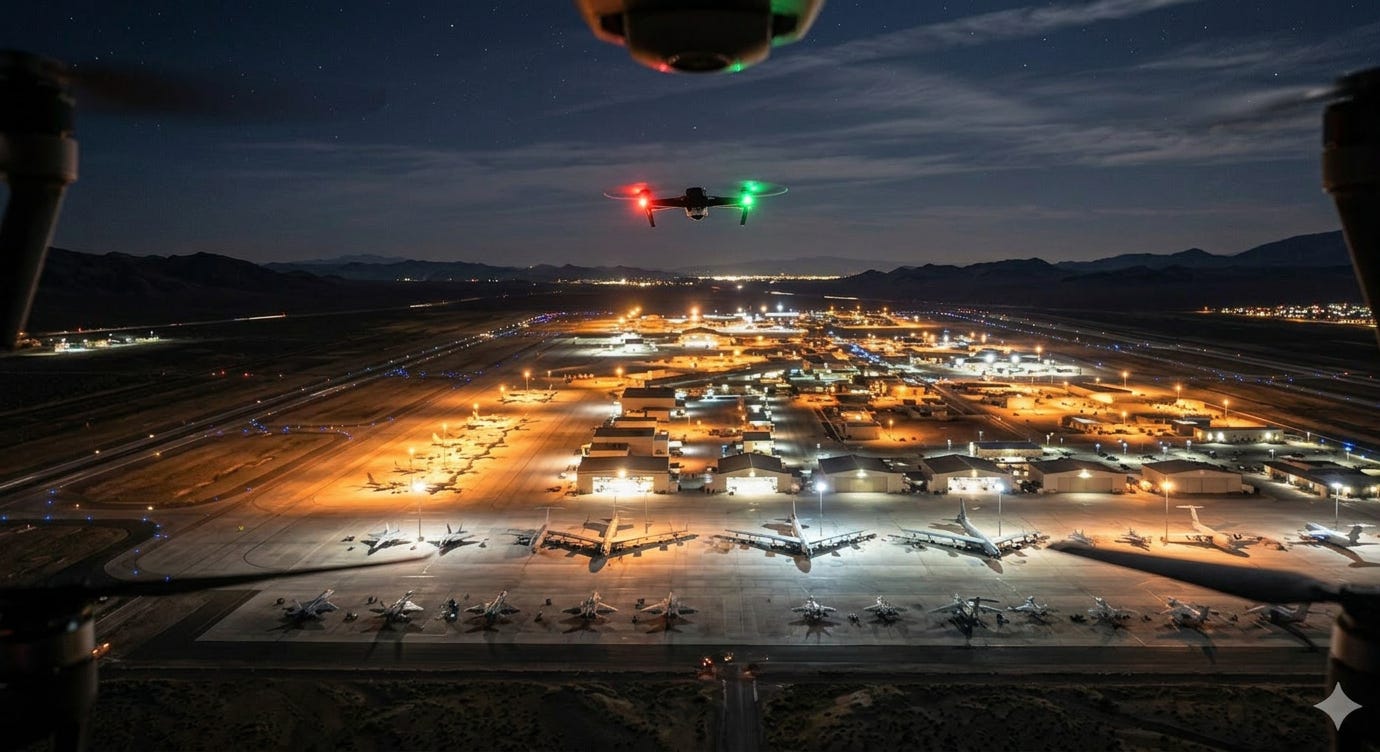
It’s 2 a.m. at Barksdale Air Force Base, Louisiana. Home of the B-52H. Home of Air Force Global Strike Command. The nerve center of America’s entire nuclear bomber force.
A wave of drones enters restricted airspace. They don’t stumble in. They arrive in coordinated formations of 12 to 15, varying their routes, staying lit, not out of carelessness, but to watch how the base responds. The Air Force tries to jam them. It doesn’t work. They stay for four hours. Then they leave.
They came back the next night. And the night after that. For a week.
This happened during the week of March 9, 2026, while the United States was actively bombing Iran.
War
Before I tell you what the government did about it, I need to tell you what the government was doing at the same time.
On February 28, the United States and Israel launched Operation Epic Fury, a massive air campaign against Iran. In the first 72 hours, more than 1,700 targets were struck. The Supreme Leader was killed. The Iranian navy was sunk. Hegseth held a press conference that read like a highlight reel from a movie he was also directing.
“The most lethal, most complex, and most-precision aerial operation in history,” he announced on X. “Iran will never have a nuclear weapon.”
Then, a few days later, at the Pentagon podium: “Looking up and seeing only US and Israeli air power every minute of every day, until we decide it’s over, and Iran will be able to do nothing about it. B-2s, B-52s, predator drones, fighters controlling the skies, picking targets for death and destruction from the sky all day long.”
This is the Secretary of War of the United States. Describing an active combat operation. In language indistinguishable from a Fox News chyron.
Also on February 28, simultaneously with the Iran strikes, the first drone waves hit Barksdale. The most sophisticated reconnaissance drones anyone had ever seen over a domestic American installation. Jamming-resistant, non-commercial signal characteristics, coordinated four-hour loiter windows, varied ingress routes, were mapping the electromagnetic signature of America’s nuclear bomber headquarters. The base issued shelter-in-place orders. The flight line shut down. B-52 launches supporting the Iran operation were disrupted.
Nobody in the administration mentioned it publicly.
Reality TV Style Presentation
The two things happening simultaneously. Hegseth’s triumphalist rhetoric about the most powerful military in history “destroying” Iran, and unknown drones documenting that military’s nuclear command infrastructure with impunity, are not a coincidence. They are a portrait.
A portrait of what compound failure looks like when it reaches the top of an institution.
This is not primarily a story about technology. The drone threat is real, the vulnerability is real, and the urgency is real. This is a story about whether the people in charge of the response are cognitively and institutionally equipped to understand what they are actually facing. The evidence on that question is now extensive, and it does not require partisan interpretation. The statements are public. The decisions are documented. The pattern is visible.
Incoherent Objectives
On February 28, the same morning Epic Fury launched, Hegseth was asked about the war’s objectives. He listed three: destroy Iran’s offensive missiles, destroy their missile production, destroy their navy. “Laser-focused,” he said.
Six days later, he listed them again. The same three.
Ten days later, he listed them again. Still three.
Meanwhile, Trump was giving interviews. The goal was to destroy the missiles. No, the goal was regime change. Actually, the Strait of Hormuz reopening, which was open before the war began, was a key objective. He “could call it a tremendous success right now. Or we could go further and we’re going to go further.” The timeline was four weeks. Or five. Or “whatever it takes.”
Rubio told reporters the US launched because it knew Israel was about to strike Iran and wanted to preempt Iran’s retaliation. Trump immediately contradicted him: “They were going to attack. If we didn’t do it, they were going to attack first. So if anything, I might have forced Israel’s hand.” The White House insisted the objectives were “clear and unchanging.” The list had gone from three to four to five.
As one analyst put it: “We don’t know the goals of this war, the metrics of success, or even whether Trump is assimilating information the way his military commanders are.”
That’s not an opposition talking point. That’s a structural description of how decision-making is functioning at the command level of an active war. One in which American B-52s are flying sorties from Barksdale, a base being surveilled by unidentified drones, dropping bunker-busters on Iranian nuclear facilities, while the commander-in-chief gives contradictory statements about what winning looks like across three separate news cycles on the same afternoon.
Senior officials, according to CNN, “have taken care not to make any firm commitments that he might later contradict, even if it’s meant confusing allies or heightening market anxieties.” Interior Secretary Burgum summarized the strategic framework as: “It’ll be over when the president decides it’ll be over.”
This is not fog of war. This is fog of governance. They are not the same thing.
El Paso, February 10
Two weeks after the launch of Epic Fury, in the middle of the Anthropic fight, while drones were flying over nuclear bases. Customs and Border Protection officers, using a classified Pentagon high-energy laser borrowed for anti-cartel drone operations, fired on what they believed was a Mexican drug cartel drone crossing the border near Fort Bliss.
It was a Mylar party balloon.
The laser was deployed without coordinating with the FAA. The FAA found out, classified the area as National Defense Airspace, and imposed a 10-day shutdown of El Paso International Airport, the first such closure of a civilian airport since September 11, 2001. Medical evacuation flights diverted. Cargo halted. The mayor of El Paso said no one had told the city, the hospitals, or the airport it was coming.
Transportation Secretary Duffy went on X: “The FAA and DOW acted swiftly to address a cartel drone incursion. The threat has been neutralized.”
That statement was not accurate. The threat was a birthday balloon. It had been “neutralized” by a classified directed-energy weapon deployed without FAA coordination.
Two weeks later, CBP flew one of its own surveillance drones near Fort Hancock without notifying the military task force assigned to the border. The military shot it down with the same laser. The Pentagon, CBP, and the FAA issued a joint statement confirming the incident. Three Democratic ranking committee members issued a joint statement: “Our heads are exploding.”
Senator Cantwell wrote to five cabinet secretaries: “The Federal interagency coordination process for counter-drone activities is clearly broken.”
JIATF-401, the Pentagon’s counter-drone task force, rushed a test of the laser to White Sands Missile Range in early March. During the test, an approaching commercial aircraft at Albuquerque International Airport briefly entered the one-degree tracking angle of the weapon. The automated shutoff triggered. The test was deemed a success because the laser didn’t shoot the commercial aircraft.
This is what competence looks like right now. Not shooting the commercial aircraft is the achievement. That’s the bar we’re at.
Anthropic and the DOW
Anthropic is the AI safety company that built Claude, the only AI model deployed on the Pentagon’s classified networks. They deployed it willingly, voluntarily, in a $200 million partnership. Claude was running in Epic Fury, providing target intelligence in the Iran strikes, in real time. This was not a reluctant contractor. This was a company that had bet its classified access on the belief that AI could serve national security without abandoning its technical principles.
They had two restrictions. Two. No fully autonomous weapons, systems that select and engage human targets without human oversight. And no mass domestic surveillance of Americans using AI to assemble legal data at industrial scale.
Hegseth’s response: deadline of 5:01 PM Friday. Comply or we will invoke the Defense Production Act and compel you. We will designate you a national security supply chain risk, the legal category reserved for Chinese telecommunications companies suspected of espionage. Pentagon CTO Emil Michael told reporters Amodei had a “God complex.” Trump called Anthropic “a radical left, woke company.”
When Anthropic didn’t comply, Hegseth posted to X: “This week, Anthropic delivered a master class in arrogance and betrayal... Cloaked in the sanctimonious rhetoric of ‘effective altruism,’ they have attempted to strong-arm the United States military into submission, a cowardly act of corporate virtue-signaling that places Silicon Valley ideology above American lives.”
Read that again. A company that objected to AI-powered mass surveillance of American citizens and AI systems that kill without human review was accused of placing “Silicon Valley ideology above American lives.”
Here is the precise irony: the same week Hegseth called Anthropic’s AI safety concerns a “master class in arrogance,” unidentified drones were mapping Barksdale’s nuclear bomber fleet. The surveillance phase of a potential Spider Web-style attack was underway. On American soil. During an active war. And the Pentagon’s public posture was to threaten a domestic AI company with sanctions reserved for Chinese spies for asking that a human remain in the kill chain.
The judge who reviewed this, a federal judge, appointed for life, reading the statute, called the designation “Orwellian” and ruled it “classic First Amendment retaliation.” She noted the Pentagon had designated Anthropic a national security threat because it had expressed disagreement “through the press.”
That’s not a close call. That’s an institution that doesn’t know the difference between a threat and a disagreement.
The Layers
The compound failure has three layers, and they reinforce each other.
The first layer is cognitive.
The language of the Iran war. “The most lethal, most complex, and most-precision aerial operation in history,” “laser-focused,” “generational turning point,” “the Iranian Air Force is no more, built for 1996, destroyed in 2026”, is the language of dominance theater. It is designed to perform strength, not to convey operational reality. This is not new; governments have always managed information in wartime. But the specific failure mode here is that the performance has colonized the internal reasoning. When your Secretary of War is using X posts as the primary medium for operational communication, when the war’s objectives expand from three to five in the middle of combat, when the commander-in-chief contradicts his Secretary of State about the war’s rationale in the same news cycle, the theater isn’t just for the public. The institution is performing for itself.
Dominance theater has a specific vulnerability to drone warfare. Drones are not impressed by the rhetoric. They don’t read the X posts. They don’t care about the press conference. They operate according to the logic of the intelligence they’ve already collected. The base layout, the radar emissions, the security response patterns, the gaps in coverage. The gap between “we are destroying their capabilities with ruthless precision” and “we cannot stop 12 drones from photographing our nuclear bombers for a week” is the gap between the performance and the reality. And in a warfare environment shaped by cheap autonomous systems, that gap is where the attack lives.
The second layer is institutional.
The El Paso incident is not an anomaly. It is the same failure as Barksdale, manifesting in a different system. Counter-drone capability exists; the laser works, the FAA coordination framework exists, the interagency task force exists. What doesn’t exist is a coherent governance architecture that makes these systems operate together. CBP doesn’t tell the military it’s flying. The military doesn’t tell the FAA it’s firing. The FAA doesn’t tell the White House its closing airspace. Each agency is optimizing for its own mission, in its own lane, using its own legal authority, which is why you end up shooting a party balloon with a classified weapon and calling it a cartel drone neutralization.
This is not fixable with a new task force or a new memo. It reflects a deeper organizational pathology: the Trump administration’s systematic dismantling of interagency coordination structures, combined with a command culture that punishes anyone who surfaces a problem before the boss has declared success. When the incentive structure rewards “laser-focused” declarations and punishes “the coordination process is broken” observations, you get more press conferences and fewer functional protocols.
The third layer is the most dangerous: ideological.
The Anthropic fight makes it explicit. The Pentagon’s actual stated position in writing, in public, in federal court, is that it will “never say” in writing to any vendor that any particular use of AI is off-limits, because it needs to “prepare for the future.” Pentagon CTO Michael: “So we’ll never say that we’re not going to be able to defend ourselves in writing to a company.”
Translate that: the Pentagon’s position is that it must preserve the option to use AI for mass domestic surveillance and fully autonomous killing, even if it doesn’t currently do so, because reserving the option is itself a form of defense preparedness.
This is not a legal argument. It is an ideological one, the belief that constraints on power are themselves a form of weakness, and that the expression of a constraint, even a narrow technical one about model reliability, is an attack on institutional authority that must be met with institutional force.
The Hegseth language makes this explicit. “Strong-arm the United States military into submission.” “Seize veto power over operational decisions.” “Fundamentally incompatible with American principles.” These are not descriptions of what Anthropic actually did. They are descriptions of what Hegseth experienced Anthropic as doing: challenging the premise that military authority over its own capabilities is absolute and non-negotiable.
But here’s the problem. The drone hovering over Barksdale at 2 a.m. doesn’t care about authority. It cares about whether the jamming works, whether the base has detected it, whether there’s a gap in the radar coverage. A military that cannot distinguish between a disagreement and a threat is a military that will have an extremely hard time recognizing threats until after they’ve completed their reconnaissance.
The Industrial Dimension
On December 22, 2025, the FCC banned all new foreign-made drones from the U.S. market. DJI, which controls 70–80% of every commercial drone in America, was effectively locked out. No new models. No new authorizations. The decision came in three days, without the formal security review Congress had mandated and DJI had demanded. No replacement ecosystem ready at scale.
This is the correct decision, probably five years late. DJI drones transmit data to Chinese servers. The national security case is real. But execution reveals the same compound failure: we recognized the threat, announced the solution, and discovered we’d built the problem into the foundation of an industry we now can’t function without. Police departments. Film productions. Infrastructure inspection. Emergency services. Agriculture. All running on hardware that is now effectively banned, with a domestic replacement, Skydio, which just won the largest Army drone contract in history, still years from achieving mass-market price parity.
The drones flying over Barksdale are almost certainly not DJI consumer hardware. They are custom-built, jamming-resistant, coordinated systems that suggest a state actor with serious engineering capability. But the DJI ban tells you something about the underlying dynamic: we recognized the surveillance risk posed by Chinese drone hardware in the commercial sector and spent eight years doing nothing while 70% of our commercial drone market consolidated under that hardware. We knew. We didn’t act. We eventually acted without a plan.
That is the same pattern as the base defense problem. We knew about the drone vulnerability at Langley in December 2023. We didn’t act at scale. We deployed one fly-away kit. We are still deploying one fly-away kit.
We knew about the interagency coordination problem before El Paso. It became undeniable after El Paso. We fast-tracked a White Sands test. Progress, but not at the pace of the threat.
We knew about the AI reliability problem before the Anthropic fight. Amodei said directly that his models aren’t reliable enough for autonomous weapons. The Pentagon’s response was to call that statement “arrogance and betrayal.”
The Challenge
Competent governance of this problem doesn’t look like the current administration. That much is clear from the evidence. But it also doesn’t look like a simple inversion, more caution, more process, more interagency coordination for its own sake. Ukraine won at Engels-2 by innovating in the field, and didn’t wait for a governance framework that would accommodate the need. China is currently demonstrating 200-drone swarms controlled by a single soldier. The tempo of this environment is not compatible with the pace at which American institutions currently make decisions.
So what does competent governance actually look like?
It starts with leaders who can hold two true things simultaneously: the threat is urgent and the response requires operational discipline. Not “laser-focused” as a press conference posture while the objectives expand from three to five. Actually laser-focused, which means you know what success looks like before you start, you measure against it honestly, and you say publicly when the measurement is coming up short.
It requires a legal framework for airspace that acknowledges the reality of 2026, shared space used simultaneously by commercial drones, military counter-drone systems, CBP surveillance operations, and potentially hostile reconnaissance platforms. It assigns clear authority rather than hoping five agencies coordinate in real time under pressure.
It requires treating AI safety constraints as engineering specifications rather than political affronts. When a model’s developer says “this model is not reliable enough to autonomously select human targets,” that is data. It is the same kind of data as a structural engineer saying “this bridge design cannot bear this load.” The appropriate response is not to accuse the engineer of trying to “seize veto power over operational decisions.” It is to either validate the claim, invalidate it with evidence, or build a better bridge.
And it requires leaders who understand that the space between “we are destroying Iran with ruthless precision” and “unknown drones are mapping our nuclear bombers with impunity” is not a contradiction to be managed rhetorically. It is a vulnerability to be addressed operationally. The performance of dominance is not dominance. The B-52 sitting in the open at Barksdale does not become harder to target because the Secretary of War posted about it on X.
The drones don’t read the X posts.
The question isn’t whether we are capable of building the systems, passing the laws, fielding the hardware. The question is whether the people in charge of doing so are capable of recognizing reality clearly enough to act on it and whether the institutions they lead have preserved enough of their analytic function to tell them when they’re wrong.
Based on the last month, the answer feels like a no.
The pattern here isn’t new to me: the technology moves at one speed, the governance moves at another, and the gap between them is where the unknown incubates. What’s different is the stakes. When this goes wrong, something irreplaceable will be sitting on a tarmac when the rooftops open and the swarms appear in the night skies.
Sources
Multiple waves of unauthorized drones spotted over Barksdale AFB — ABC News
U.S. Battled Drone Incursions Over Key Bases After Launch of Epic Fury — The War Zone
Drone Incursions Over B-52 Base Spark Concern — Air & Space Forces Magazine
Barksdale Air Force Base Hit By Coordinated Drone Swarm — DroneXL
Sophisticated Drones Attacked Louisiana’s Barksdale Bomber Base — Asia Times
Mystery Drones Take “Evasive Action” Over Major Louisiana Air Force Base — Newsweek
Briefing Set on Drone Swarms at Barksdale — Shreveport-Bossier Advocate
Mysterious Drones Swarmed Langley AFB For Weeks — The War Zone
Drone Warfare Has Come to the United States — The National Interest
Hundreds of Drone Incursions Reported at Military Installations — Breaking Defense
Palmdale UFO Scare Leads to Revelations About Mystery Drone Incursions Over Plant 42 — The War Zone
U.S. Military Reveals More Details About Drone Incursions at Strategic Base — DefenseScoop
U.S. Northern Command Says It Thwarted a Drone Threat in Early Hours of Iran War — DefenseScoop
Drones Over U.S. Bases May Be Threatening Spy Flights — The War Zone
Bureaucratic Confusion Leaves DOD Sites Exposed to Drones, DOD IG Says — Defense News
Report: Drones Overflew Base Housing Hegseth, Rubio, Pentagon Leaders — FLYING Magazine
FAA Shutdown of El Paso Airspace Triggered by Dispute Over Pentagon Laser — ABC News
CBP Shot Down Party Balloons With Anti-Drone Tech Before FAA Closed El Paso Airspace — NBC News
Airspace Closure Followed Spat Over Drone Tests and Party Balloon Shoot-Down — CBS News
U.S. Military Used a Laser to Shoot Down Customs and Border Protection Drone — NBC News
Pentagon’s Anti-Drone Laser Testing Plan Led to El Paso Airspace Closure — The Hill
Cantwell Demands Federal Agencies Address Coordination Failures — Senate Commerce Committee
Senators Criticize Agencies Over Dual Counter-Drone Incidents in Texas — DefenseScoop
Inside a ‘First of Its Kind’ Counter-Drone Laser Test in the American Desert — DefenseScoop
FCC Adds Foreign-Made Drones and Components to Covered List — DroneLife
FCC Adds All Foreign-Produced Uncrewed Aircraft Systems to Covered List — Wiley Law
Legal Report: How a DJI Ban Could Impact the Drone Industry — ASIS International
North America Drone Market Size and Forecast — Mordor Intelligence
How Ukraine’s Operation “Spider’s Web” Redefines Asymmetric Warfare — CSIS
Ukraine’s Operation Spider’s Web Shows Future of Drone Warfare — Council on Foreign Relations
Ukraine’s Operation Spider’s Web Is a Game-Changer for Modern Drone Warfare — Chatham House
‘Spider’s Web’ Warning: The US Must Prioritize Drone Defense — Breaking Defense
How Ukraine Is Using Autonomous Drone Swarms in Combat — TechUkraine
Hegseth Says ‘Epic Fury’ Goals in Iran Are ‘Laser-Focused’ — U.S. Army / DoD
Pete Hegseth Delivers Big Update on Iran: Read Speech in Full — Newsweek
Trump’s Conflicting Messages Sow Confusion Over the Iran War — AP / U.S. News
Trump’s Conflicting Messages Sow Confusion Over the Iran War — Washington Post
4 Weeks In, Trump’s Conflicting Signals on Iran War Frustrate GOP Lawmakers — CNN
How Trump’s Iran War Objectives Have Shifted Over Time — NPR
One Month Into Iran War, Some Trump Objectives Are Unfulfilled — ABC News
How Successful Has Trump Been in His One-Month-Old War in Iran? — Euronews
Calling the War in Iran a Success Doesn’t Make It So — WBUR Cognoscenti
Pentagon Threatens to Make Anthropic a Pariah If It Refuses to Drop AI Guardrails — CNN
Anthropic Wins Preliminary Injunction, Judge Cites ‘First Amendment Retaliation’ — CNBC
Judge Blocks Pentagon From Labeling Anthropic a ‘Supply Chain Risk’ — CBS News
Anthropic’s Claude AI Being Used in Iran War by U.S. Military — CBS News
Statement from Dario Amodei on Discussions With the Department of War — Anthropic
Hegseth Declares Anthropic Supply-Chain Risk — Breaking Defense
What Hegseth’s “Supply Chain Risk” Designation Does and Doesn’t Mean — Just Security
Pentagon Threatens to Label Anthropic’s AI a ‘Supply Chain Risk’ — Axios
OpenAI Announces Pentagon Deal After Trump Bans Anthropic — NPR