
The Lines Are Still Being Drawn
Hubris has a body count. It also has a history. And a trajectory.

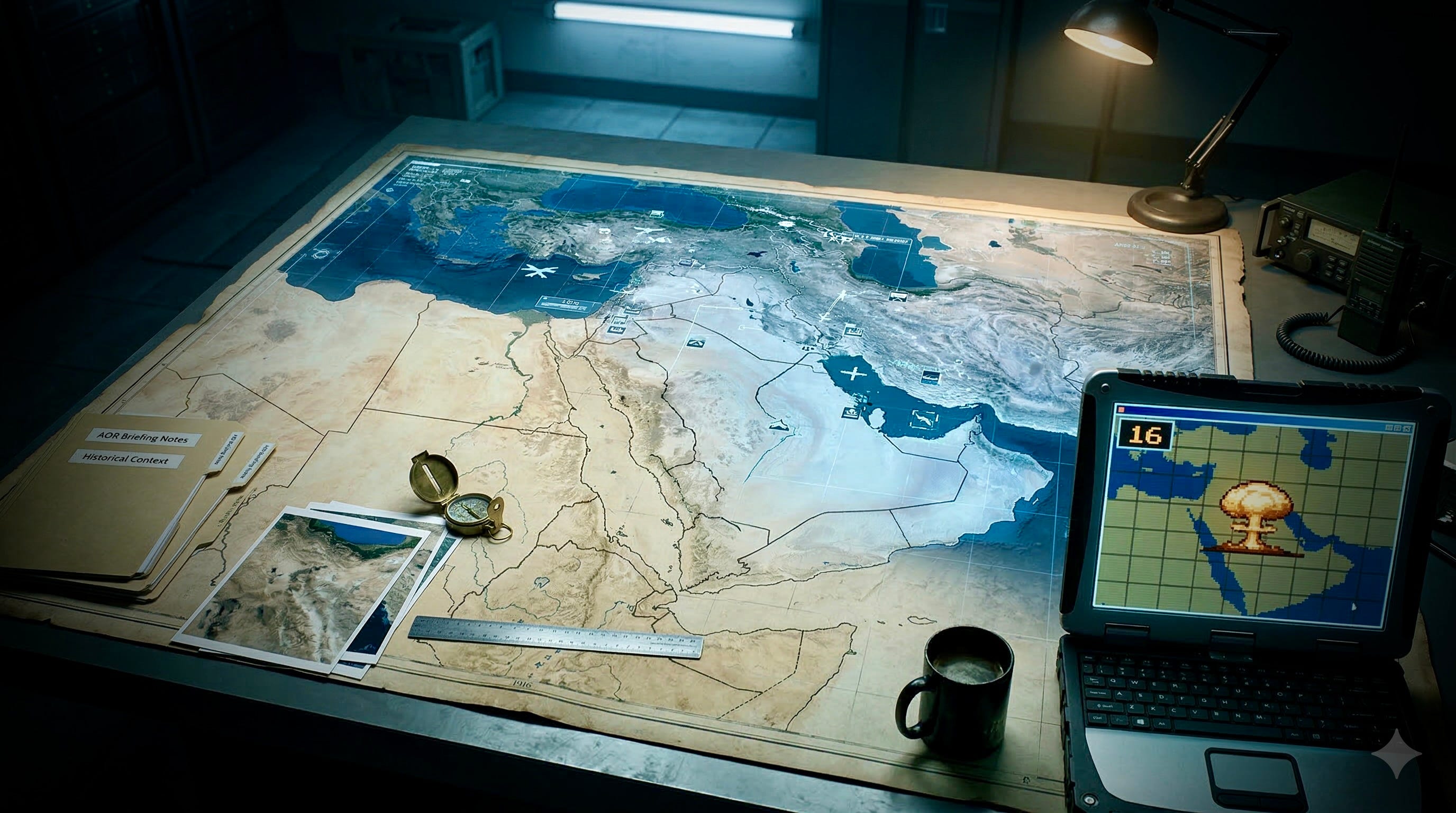
In my last piece, Hubris Has A Body Count, I argued that the most dangerous feature of hubris is not arrogance. It is the cessation of consequence-modeling. The system stops asking what its actions produce in the world beyond the moment of their execution. The people its decisions fall upon stop appearing in the calculation. They become, in the language I used there, the pixel-burst.
I want to extend that argument. Because what we are watching in Iran is not a new story. It is a very old one, operating through the same structural logic, producing the same categories of invisible people, heading toward the same category of consequence that the game designers will not personally absorb.
The difference this time is that the material at the center of it is not oil or territory.
It is fissile.
The Room Where It Started
On November 2nd, 1917, British Foreign Secretary Arthur James Balfour wrote a letter. Sixty-seven words. It promised a national home for the Jewish people in Palestine. It was addressed not to a head of state, not to a general, not to any elected representative of the people whose lives it would reshape, but to Lord Rothschild, because the Rothschild name was the kind of name that moves capital and political will simultaneously. The letter took minutes to write. Its consequences are still accumulating a century later.
What almost nobody knew at the time, what was being actively concealed, is that Britain had already promised the same land to the Arabs. In exchange for their revolt against the Ottoman Empire, the British High Commissioner had written letters to the Sharif of Mecca promising an independent Arab state spanning most of the region we now call the Middle East. The Arab revolt was real. The men fighting it were real. Their deaths were real.
The promise was not.
Simultaneously, two diplomats, British baronet Mark Sykes and French career official François Georges-Picot, were in a different room drawing lines across that same territory. France gets Syria and Lebanon. Britain gets Iraq and Palestine. The lines were drawn in weeks. They would generate consequences for generations.
Three promises. Same land. Each presented with apparent sincerity. Each quietly designed to survive only long enough to extract what was needed in the moment. The Arabs were promised a state to buy their military cooperation. The Rothschilds were promised a declaration to mobilize Jewish financial networks for the war effort. France was promised a sphere of influence to maintain the wartime alliance. Every promise served a short-term strategic need. None of them could coexist.
The men who made them knew this. They were not stupid. They were operating under wartime pressure so severe that the consequences of the next century genuinely felt theoretical compared to the consequences of the next month. What drove all of it, underneath the diplomatic language, was a balance sheet: the British government had purchased a controlling stake in Anglo-Persian Oil six days before the First World War began, and the borders of modern Iraq were negotiated as part of an oil company equity deal, territorial concessions and petroleum shareholding arrangements signed on the same day. They calculated they would be in a strong enough position to manage the contradictions when the time came.
They were wrong about the last part.
The people on the ground, Arab farmers, Kurdish tribes, and the Palestinian families, did not appear in the calculation. They were the terrain on which someone else’s win condition got executed.
The lines those men drew in a matter of weeks are still drawing blood a hundred years later.
The Language That Forecloses
“We have totally obliterated their nuclear program.”
President Trump, March 13, 2026. Day 14 of Operation Epic Fury.
Listen to what that sentence does. It does not describe. It closes. It makes every subsequent question about what was actually achieved sound like it is asking whether the sky is blue. It pre-authorizes an outcome, a solved problem, a completed mission even before the evidence for that outcome has arrived. Which is precisely the point, because the evidence, if examined, goes in a different direction entirely.
Here is what is simultaneously true on that same day:
Before the first bombs fell in June 2025, Iran possessed the enriched uranium equivalent to sixteen nuclear weapons. Not assembled bombs just the enriched material, the hardest part of the process, the part that takes years of industrial effort and cannot be recreated quickly. Two days before the US struck the Fordow facility, satellite imagery showed trucks moving material out of the site. Large trucks. The kind you need for objects the size of scuba tanks, which is approximately the size of the containers that hold uranium hexafluoride.
After the strikes, Defense Intelligence Agency reports were leaked. They said the same thing: we created holes. We shook underground chambers. We don’t know what was inside them when they collapsed. We don’t know where the material went.
Professor Robert Pape, who built the Air Force’s curriculum on exactly this kind of air campaign, who ran Iran war simulations for twenty years, who has advised every White House from 2001 to 2024, put it plainly: “We don’t know where a single ounce was. And we weren’t going to know for months after.”
We then conducted the largest US military operation since 2003. We killed the Supreme Leader. We killed approximately thirty of his senior associates and potential successors, including the most plausible moderate replacements. We dropped more munitions in sixteen days than most wars see in their opening months.
The material? Still dispersed. Still untracked. Now in the hands of a regime with every structural incentive to weaponize it.
This is the same architecture I described in the Hubris piece. The language is not designed to be accurate. It is designed to be irreversible, to pre-authorize an outcome before the decision is formally made, to make every alternative sound like retreat. A system that has stopped needing the world to be true does not ask what its actions produce beyond the moment of their execution.
The Iranian engineer. The mother checking prices at a market that may not exist next week. The student who has never held a weapon and has no vote in what his government does. The Omani mediator who announced a diplomatic breakthrough, Iran had agreed to never stockpile enriched uranium, full IAEA verification on the table, technical discussions scheduled for Vienna, and woke up the next morning to bombs.
They do not appear in the language. They are again just the pixel-burst.
The Deal That Was Working
Before the trap, there was a working alternative. This matters more than almost anything else in this story, because it answers the question people instinctively reach for, what were we supposed to do instead?
In July 2015, after twenty months of multilateral negotiation, the United States, Iran, and five other major powers reached the Joint Comprehensive Plan of Action. The JCPOA had real limitations. Sunset clauses. It didn’t address Iran’s missile program. Its critics were not wrong about these things.
But here is what it did.
Iran’s enriched uranium stockpile was reduced by 97 percent. That from 10,000 kilograms down to 300 kilograms. Enrichment was capped at 3.67 percent, far below weapons-grade. Iran shipped 25,000 pounds of enriched uranium out of the country, dismantled two-thirds of its centrifuges, and filled its heavy water reactor core with concrete. The breakout time, the window between Iran deciding to build a weapon and having enough fissile material to do so, extended from weeks to over twelve months. That is not a diplomatic talking point. That is a year of warning time during which the world could respond.
The verification architecture was what made it real. 130 to 150 IAEA inspectors on the ground. Online enrichment monitors transmitting data in real time. Cameras running continuously at every facility. Inspectors with the right to access any site deemed suspicious, triggered by intelligence gaps, unexplained purchases, isotope alarms. From the minute materials came out of the ground to the minute they left the country, the IAEA had eyes on them.
The deal was working. The IAEA confirmed it repeatedly. Iran was in compliance.
On May 8, 2018, Donald Trump walked away from it. Unilaterally. Without replacing it with anything. Without extracting any concession. The stated rationale was that it was a bad deal. Obama’s deal, incomplete, temporary, insufficiently comprehensive. The actual consequence was that a verified, monitored, functioning constraint on Iran’s nuclear program was dismantled, and nothing replaced it.
Iran did not come back to the table on American terms. It did exactly what any rational actor does when an agreement constraining its program is shredded while it remains in compliance: it began enriching again. To 20 percent by January 2021, which constitutes roughly 90 percent of the effort to reach weapons-grade. To 60 percent by April 2021. By June 2025, the material for sixteen bombs existed.
Pape said it as flatly as it can be said: “2018, Trump just ripped it up, walked away unilaterally, and from that point on, it’s been pedal to the metal by Iran in upgrading that enriched uranium. And that’s how you got to that material that would be enough for the 16 bombs.”
There is a straight causal line between a decision made in a press conference in 2018 and 400 kg of dispersed near-weapons-grade material that nobody can locate in 2026. That line does not require inference or interpretation. It is the documented sequence of events.
The first term produced one more thing that matters and gets less attention than the withdrawal.
On January 3rd, 2020, the United States assassinated Qasem Soleimani, commander of Iran’s Quds Force, Iran’s most operationally significant military figure, at Baghdad International Airport. The strike was tactically successful. And it established something beyond the immediate target: it demonstrated that American diplomatic engagement and American military action are not mutually exclusive. That a negotiating process does not protect you. That proximity to talks is no guarantee that the bombs aren’t coming.
This is the lesson that made February 27, 2026 legible. Oman announces a breakthrough. Bombs fall the next day. The pattern had already been established six years earlier. The Soleimani assassination was the proof of concept.
On February 28, 2025, one year before Epic Fury began, Zelensky sat in the Oval Office as Trump dressed him down for asking too much of America. Trump’s position was explicit and had been repeated publicly for weeks: “We have a big, beautiful ocean separating us. This is far more important to Europe than it is to us.” The ocean as security guarantee. Geography as a substitute for strategic engagement.
Zelensky’s response, in the room, on camera: “You have a nice ocean in between, and don’t feel it now, but you will feel it in the future. God bless you.”
He was right. He was describing, in real time, exactly the logic that makes Iranian nuclear proliferation an American problem regardless of the ocean. Dispersed fissile material does not respect geography. The lesson every government on earth draws from watching a verified nuclear agreement get torn up, that leverage is the only real guarantee, does not stay on the other side of the water. The game designers who believe the ocean insulates them from consequences are making the same category of error the British made in 1916: assuming the contradictions they are creating will stay in someone else’s backyard.
The ocean didn’t stop September 11. It doesn’t stop an ICBM. And it won’t stop the future Zelensky was pointing at in that room.
This is hubris operating across two terms, not one. The first term created the conditions, dismantled the verification architecture, drove enrichment from monitored 3.67 percent to unmonitored 60 percent, established that American commitments dissolve when politically inconvenient, demonstrated that proximity to negotiations is no protection from strikes. The second term inherited those conditions and treated them as a problem requiring escalation rather than a crisis requiring diplomacy.
The game designers changed between 2015 and 2026. The game’s trajectory did not.
The Escalation Trap
The architects of the 1917 Sykes-Picot Act did not think of themselves as building a trap. They thought they were solving urgent problems with the tools available. The trap was structural, built into the incompatible promises themselves, into the impossibility of honoring all of them simultaneously, into the certainty that the contradictions would eventually collide.
What Professor Pape identifies in the current Iran campaign is the same structural trap, operating at a faster tempo.
Stage One begins June 2025. Israel launches Operation Rising Lion, 200 jets, 330 munitions, five waves across Iran’s nuclear infrastructure. The tactical result: near-perfect. The strategic result: we don’t know where the material is. The buildings are destroyed. The enriched uranium was already moved. This is the trap’s first jaw: tactical success, strategic failure. The bombs hit their targets with extraordinary precision. What they cannot do is make fissile material un-exist.
After June, negotiations resumed. Iran came to the table with an offer Pape describes as better than the 2015 JCPOA. More favorable verification terms, tighter restrictions on enrichment. The Supreme Leader was on board. He had issued religious edicts, fatwas, against nuclear weapons. Twice. He was the man at the top of the Iranian system actively holding the hardliners back. The theological guardrail between enrichment and weaponization.
On February 27, 2026, the Omani foreign minister announced the breakthrough. Iran had agreed to never stockpile enriched uranium.
On February 28, Epic Fury began.
The word “again” remains load-bearing. June 2025. February 2026. Twice, diplomacy produced results. Twice, military action arrived before those results could be acted upon. Al-Busaidi said he was “dismayed” that “active and serious negotiations have yet again been undermined.” Dismayed is a diplomat’s word for something that does not have a diplomatic word, the language of someone describing the experience of having their good faith treated as a resource to be consumed rather than a relationship to be honored.
Stage Two is regime change, because once you’ve bounced the rubble twice, the only remaining escalation option is destroying the political structure controlling the material you couldn’t find. The logic is coherent in the same way that each step of the 1917 Sykes-Picot escalation was coherent: you do the next thing because the previous thing didn’t resolve the underlying problem, and not doing it has been made politically unacceptable by everything already said on record.
Here is what Stage Two produced.
Khamenei is dead. Killed by Israeli bombs, itself a story about who is actually directing this campaign and whether US and Israeli objective functions are as aligned as the public framing suggests. The thirty people killed alongside him included the most plausible moderate successors. The internal counterweights to the hardliners. The people with whom a negotiated outcome was conceivable.
His son Mojtaba is now Supreme Leader.
The Man With Every Incentive
Mojtaba Khamenei headed the Basij, the internal enforcement arm of the revolutionary state, the organization that led the crackdown on the December 2025 protests that killed an estimated seven to thirty-two thousand people. He has issued no fatwa against nuclear weapons. His father’s theological restraint died with his father. His credibility base is the Islamic Revolutionary Guard Corps. The 150,000-strong elite force most dedicated to the regime and most committed to its most aggressive posture.
Here is where the game theory becomes unambiguous.
Mojtaba has every structural incentive pointing in one direction. Every single one.
We are killing him. We killed his father. We destroyed the one negotiating framework that could have frozen the enrichment program. We handed him a dispersed stockpile of near-weapons-grade material whose location we cannot track. We installed him in a system where his domestic credibility depends entirely on not appearing weak in front of the IRGC hardliners who are his only base of support.
If he capitulates, he loses the regime. If he negotiates from weakness, he gets a bullet from his own side. He watched what happens to countries that give up their weapons. Iraq dismantled its program, was invaded anyway. Libya gave up its weapons, Gaddafi was killed in a drain pipe. Ukraine surrendered its arsenal in 1994 in exchange for security guarantees and is now fighting for its survival with conventional weapons while an entire generation of Ukrainians concludes the guarantee was worthless.
North Korea watched this same sequence in the 1990s. They drew the same conclusion. They now have sixty working nuclear weapons, and nobody is seriously discussing regime change in Pyongyang. They are actively testing again, sending their signal of don’t threaten us.
Ukraine gave up its weapons in 1994 in exchange for security guarantees. By January 2025, its president was telling an Italian newspaper that giving up those weapons was “absolutely stupid, illogical, and very irresponsible” and that he had told Donald Trump directly: “If I could go back to 1994, I would only trade our nuclear weapons for something that could truly deter any aggressor.”
Trump’s response, as Zelensky reported it: “Yes, I understand what you’re saying. You cannot make the same mistake three times.”
Read that exchange slowly. The man who tore up the JCPOA in 2018, the agreement that had Iran’s enriched uranium shipped out of the country and IAEA cameras running 24 hours a day, told the president of a country being destroyed for its nuclear disarmament that you cannot make the same mistake three times. He understood the lesson. He had already applied it in reverse. And the man now sitting in Tehran, reading the history that is available to read, is not going to make that mistake at all.
Mojtaba Khamenei is not an irrational actor. He is reading the history that is available to read.
Pape names the catastrophic irony at the center of all of it: “We’ve given them every incentive to develop the nuclear bomb. We’re killing them. So what exactly is their incentive not to?”
The fatwa is dead. The guardrail is gone. The new supreme leader is backed by hardliners. The material is dispersed in locations we cannot identify. The man making the decisions has no theological constraint, no moderate credibility base, no domestic survival path that runs through negotiation, and a son’s grievance layered on top of all of it.
This is not a variable in the situation. This is the situation.
This Doesn’t End. It Compounds.
Here is what the language of obliteration prevents you from thinking about: this is not a war with a finish line. It is the opening of a permanent condition. And there are only a few directions it can travel from here, with none of them clean, all of them expensive, and each one making the next more likely and more costly.
The North Korea outcome is the most probable and the least discussed. Iran survives the current strikes, disperses and protects the material through exactly the strategy the satellite imagery already confirms; trucks, dispersal, underground storage across hundreds of locations we cannot identify. They achieve weapons capability quietly. They test. They become permanently undiscoverable through conventional military means. A deal eventually happens, probably years from now, probably after Iran has a working weapon, almost certainly on worse terms than the agreement that was on the table February 27, 2026, the day before the bombs fell. The “obliteration” language means the administration cannot plan for this outcome publicly, to do so would be to admit the obliteration was not real. So the planning doesn’t happen. And the outcome arrives anyway.
The ground war outcome is what Pape assigns 75 percent probability. US forces deployed into Iran to physically search for dispersed fissile material. The logic is coherent: you can’t bomb what you can’t find, and eventually someone has to go look for it. The consequence is also coherent: a ground presence activates every remaining asymmetric option Iran possesses. Proxy networks across nine countries. Sleeper cells in Western cities. Houthi re-engagement in the Red Sea. Hezbollah activating what remains of its arsenal. The Strait of Hormuz shifting from threatened to functionally closed. This is the long attritional political war that beats superpowers not on the battlefield, America never loses the battles, but in the accumulated domestic cost of a forever war with no visible endpoint. Vietnam. Afghanistan. The pattern is consistent. The outcome is not military defeat. It is political exhaustion.
The fragmentation outcome is the most dangerous because it is the least controlled. The regime cracks, not from external pressure but from the internal contradictions of a hardening system built around a man with no established legitimacy, backed by a single faction of a million-man military, in a country where three major ethnic and sectarian communities have never shared a coherent political identity. Mojtaba’s consolidation fails. IRGC factions compete for control. The dispersed fissile material becomes a bargaining chip in an internal power struggle, or worse, something that walks out the door with a faction that has no interest in any constraint the international community could apply. This is the scenario that nuclear security experts call the worst-case proliferation event. Not Iran testing a weapon in its own mountains, which is terrible but predictable. The material ending up somewhere the satellites can’t find it, with people whose decision calculus we don’t understand.
The frozen conflict outcome is the most historically consistent with Sykes-Picot and the one the public is least prepared for because the entire rhetorical architecture of the campaign has promised resolution. No clear victory, no clear defeat. Iran as a permanent threshold nuclear state, able to weaponize within weeks whenever it chooses. Hormuz periodically threatened, periodically closed, a permanent insurance premium on global energy prices. The Gulf states structurally destabilized, their populations watching governments that invited American bases absorb Iranian drone strikes they did not ask for. American credibility as a diplomatic partner functionally destroyed. Every future negotiation conducted in the shadow of the precedent that the US bombs breakthroughs. The war doesn’t end. It becomes the background condition of the region for the next generation.
What the Sykes-Picot comparison teaches, if you follow it all the way through, is that these are not four separate possible outcomes. They are phases of the same continuing process. The North Korea outcome leads into the frozen conflict. The frozen conflict creates the internal pressure that produces fragmentation. Fragmentation generates the conditions for the next military escalation, which produces a new set of incompatible promises, a new set of invisible people absorbing consequences they didn’t choose, and a new set of game designers who will not personally absorb what they built.
The 1916 lines didn’t create a crisis. They created a permanent condition, a set of structural tensions that regenerate conflict indefinitely because the underlying contradictions were never resolved, only managed, and badly. The people living inside those tensions for a hundred years were never the primary consideration. They were the terrain.
What is being built right now has the same architecture. It is not a war with an end. It is a new permanent condition, layered on top of the old one, with a nuclear dimension that the original designers could not have imagined.
The Lines
The McMahon-Hussein letters, the actual correspondence forming the basis of Britain’s promise to the Arabs, were kept classified for twenty years. Not released until 1939. Suppressed specifically because releasing them earlier would have made Britain’s diplomatic conduct impossible to defend.
When a senior British parliamentarian finally commented on record after the release, he said simply: Britain had certainly meant what it said in 1915. And had certainly not done what it said in 1918.
There is a sentence available to be written about the Oman breakthrough that sounds exactly like that. The United States had certainly meant what it said in the negotiations. And had certainly not done what it said at the table.
The difference is the timeline. The consequences of 1916 took a century to fully detonate. The consequences of 2026 are operating on a much shorter fuse, because at the center of this one is not oil. It is 400 kg of near-weapons-grade uranium dispersed across a country the size of Western Europe, in rooms we cannot identify, controlled by a new supreme leader whose father’s restraint is dead, whose survival depends on strength, and who has watched the game long enough to know that the only pieces that don’t get taken are the ones that can take back.
Somewhere in Iran right now, in one of those rooms the material is sitting in the dark.
We don’t know which room.
The game designers don’t know either.
The pixels, this time, are fissile.
The history that changes how you read the present is the only history worth having. If this matters to you, share it with someone who needs to see it.
Sources
Historical — Sykes-Picot, Balfour, McMahon-Hussein
June 2025 strikes / Operation Rising Lion
Operation Epic Fury / February–March 2026
US and Israel begin “major combat operations” in Iran — Axios
Trump: US “totally obliterated” Iranian military targets — CNN liveblog March 13
US-Israel strikes on Iran: February/March 2026 — House of Commons Library
Nuclear material / DIA leak / escalation trap
Robert Pape: “Why Escalation Favors Iran” — Foreign Affairs, March 9 2026
Pape: “Precision Strikes Will Not Destroy Iran’s Nuclear Program” — Foreign Affairs, June 2025
Pape full interview — Diary of a CEO / Stephen Bartlett, transcript
Iran’s nuclear challenge remains unresolved — European Leadership Network
Oman breakthrough / diplomatic collapse
JCPOA — terms, verification, compliance
JCPOA: then and now — Center for Arms Control and Non-Proliferation
Restoring the JCPOA’s nuclear limits — Arms Control Association
Trump JCPOA withdrawal 2018 / Iran enrichment acceleration
Soleimani assassination
Mojtaba Khamenei / Basij / IRGC
Zelensky — nuclear weapons quotes
Zelensky — “nice ocean” / Oval Office
Zelensky: “you have a nice ocean in between” — The Editors / Substack
Trump “big, beautiful ocean” — White House Cabinet remarks February 26 2025
North Korea nuclear arsenal
Strait of Hormuz / oil markets