
The Lie and the Plan
None of this is about narco terrorism; it's about the carrot or the stick to grow the American Empire.

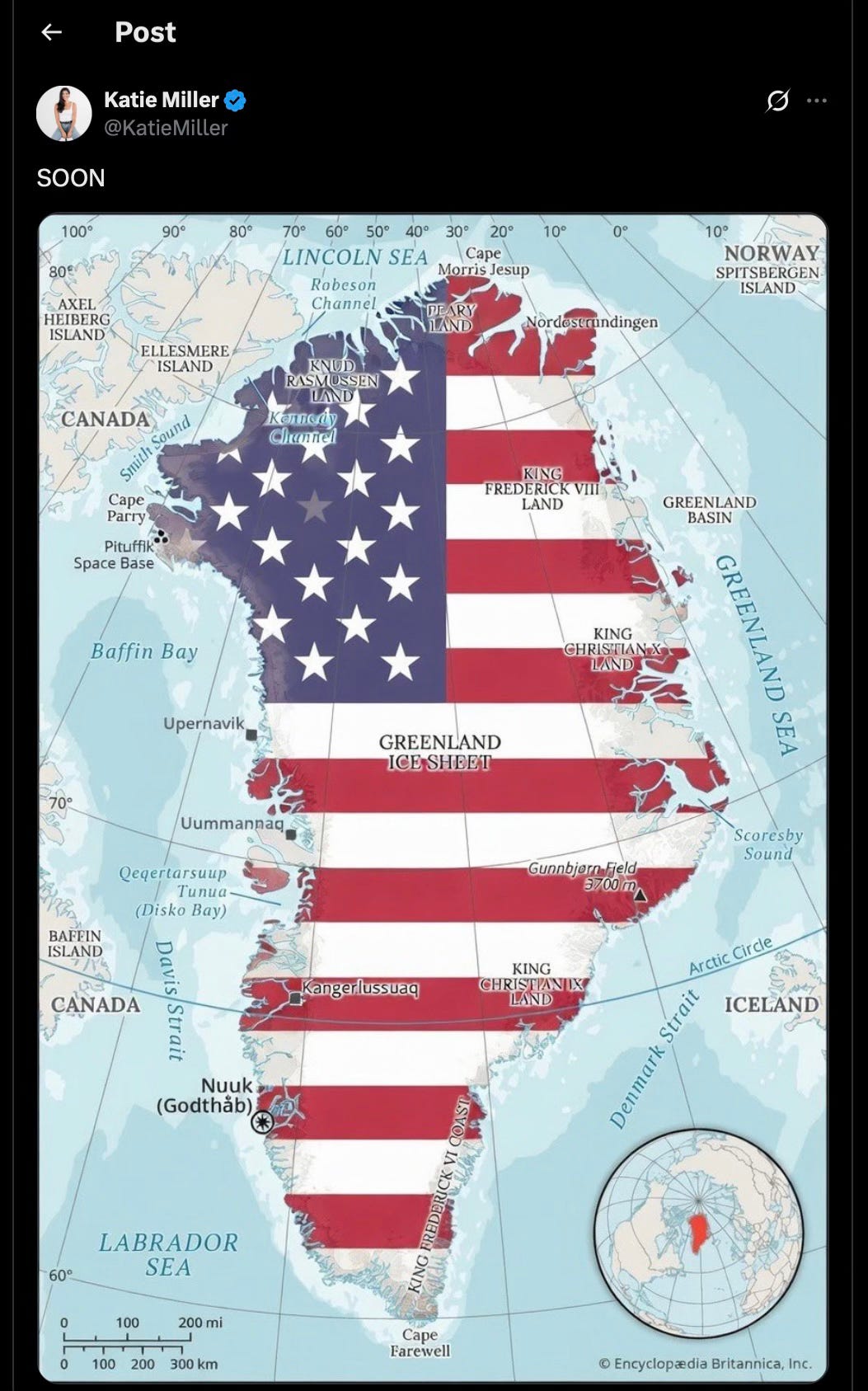
Posted by Katie Miller after the operation in Venezuela, this is only the beginning.
Zoom Out To See The Bigger Picture
The Pentagon ran 24 simulations of a Chinese invasion of Taiwan. The U.S. “won” most of them.
The cost: two aircraft carriers sunk. 200-400 aircraft destroyed. More than 3,000 American troops dead in three weeks. The Center for Strategic and International Studies concluded: “The United States suffered more in the long run than the ‘defeated’ People’s Republic of China.”
That’s the best-case scenario. And it depends on supply chains that still run through the country we’d be fighting. Hence our 15 year push to break that dependency.
This is the new Cold War. Not the old one—ideological, binary, mutually assured destruction keeping the peace. This one is economic, technological, and playing out across chip fabs, critical minerals, and AI infrastructure. The nukes are still there, still in the background, still the reason this stays cold for now. But the competition is real, and we’re not currently positioned to win it without great costs.
That’s the context for what happened on January 4, 2026.
At 6:00 AM Eastern, U.S. forces captured Venezuelan President Nicolás Maduro. By noon, he was indicted on narco-terrorism charges. President Trump announced we’d “run” Venezuela until we decide otherwise.
The justification: fentanyl. Tren de Aragua. Narco-terrorism. Protecting American lives.
One problem: Venezuela doesn’t produce fentanyl.
The DEA knows where fentanyl comes from—precursors from China, manufactured in Mexican cartel labs, distributed by Sinaloa and CJNG across the southwestern border. Venezuela isn’t part of that supply chain. Never has been.
So why are we there?
The documents published by the White House tell you very plainly. And what they reveal isn’t new. It’s a fifteen-year strategy that just hit the accelerator due to the AI race.
The Book They Don’t Show You
Every president campaigns on doing things differently. They promise to break from the past, chart a new course, put their stamp on history.
Then they win. And they meet the elders—the intelligence chiefs, the national security establishment, the people running the long game across administrations. A book gets laid out in front of them. Not literally, but effectively. Here are the threats that don’t change with elections. Here are the strategies that can’t be abandoned. Here’s what has to happen to prevent American decline.
The rhetoric changes. The branding changes. The strategy continues.
Pull up Obama’s 2015 National Security Strategy. It’s still on the archived White House website:
“The United States has been and will remain a Pacific power... We will manage competition from a position of strength while insisting that China uphold international rules and norms.”
“We will continue to advance a Western Hemisphere that is prosperous, secure, democratic... the hemisphere is increasingly important to global energy supplies.”
“We stand by the citizens of countries where the full exercise of democracy is at risk, such as Venezuela.”
That was 2015. Venezuela was already named. China was already the target. Hemispheric resources were already the prize.
Biden continued it. CHIPS Act. Semiconductor export controls. Quad alliance. Different branding, “rules-based international order”, same destination.
Now Trump. Same destination. Faster vehicle.
The Acceleration
Trump’s 2025 National Security Strategy, release only a few weeks ago, says the quiet part loud. Compare:
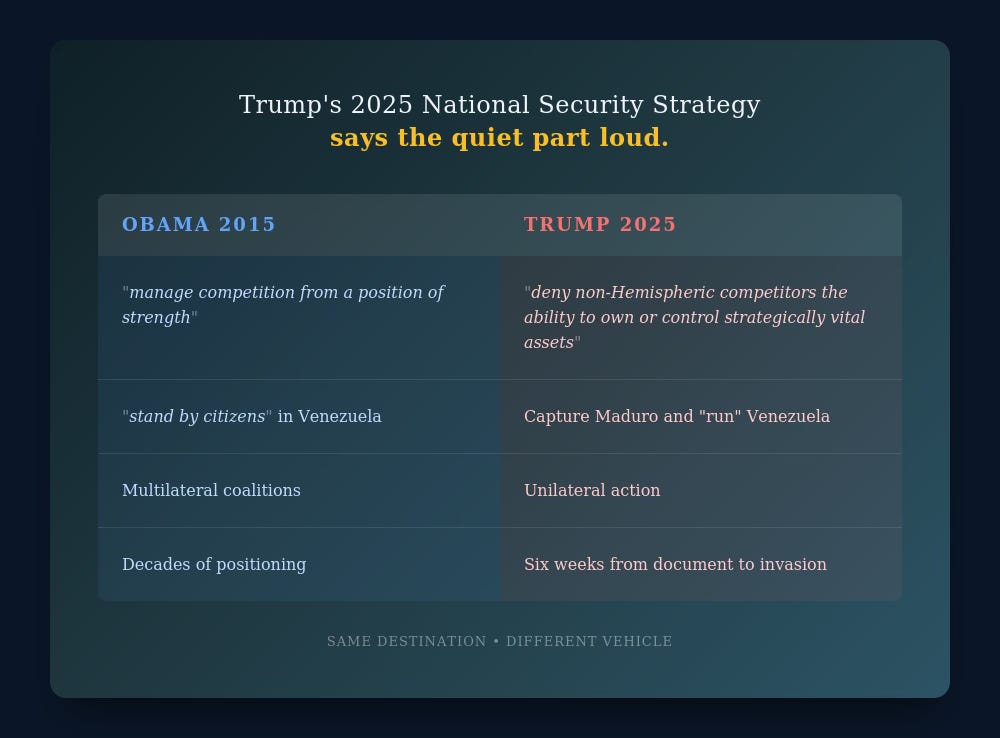
The 2025 NSS puts the Western Hemisphere first—before Asia, before Europe, before the Middle East:
“We will deny non-Hemispheric competitors the ability to position forces or other threatening capabilities, or to own or control strategically vital assets, in our Hemisphere.”
“The terms of our agreements... must be sole-source contracts for our companies. At the same time, we should make every effort to push out foreign companies that build infrastructure in the region.”
This isn’t about drugs. It’s about resources, supply chains, and China. Venezuela has 300 billion barrels of oil and critical minerals. Argentina has lithium and got $60 billion in support plus a $25 billion AI data center. Venezuela got invaded.
Carrot. Stick. Same objective.
The AI Action Plan explains the urgency:
“America’s environmental permitting system and other regulations make it almost impossible to build this infrastructure in the United States with the speed that is required.”
They can’t build fast enough at home. They need the hemisphere now. The timeline has collapsed.
Why the Lie Matters
Here’s what I’m not saying: I’m not saying the strategy is wrong.
I think the strategic logic is sound. Contain China. Secure critical resources. Build AI infrastructure before the real competition begins. I want America to win that competition. I want the West to continue.
But we can’t have an honest debate about whether this method is worth it—what we’re trading, what it costs, who benefits—if we’re being told it’s about fentanyl.
The fentanyl framing isn’t just inaccurate. It’s a tell. It says the people running this strategy don’t think you can handle the truth. They think you need a villain and a rescue narrative. They think the real reasons—great power competition, resource security, AI supremacy—won’t sell.
Maybe they’re right. Maybe Americans won’t support hemispheric control if you call it that.
But democracy requires informed consent, and that was completely ignored with the actions this weekend. You can’t build national unity for the competition ahead when half the country thinks this is about drugs and the other half thinks it’s Trump going rogue.
It’s neither. It’s a bipartisan strategy, fifteen years in the making, now accelerating. The groundwork was laid during Obama. Trump 1 continued it. Biden continued it. Trump 2 is executing it faster and louder, which should tell you something about what’s happening in the world.
Read the Documents
I’m not asking you to trust me. The documents are public:
Read them. The continuity is obvious. The strategy is written down.
Then ask yourself: why is the coverage all tribal theater? Why is the left screaming about authoritarianism and the right cheering narco-terrorism takedowns when the documents show this has been the plan across three administrations?
Because playing left versus right is easier. It gets clicks. It keeps you engaged and enraged and distracted from the structural reality that doesn’t change based on who you voted for.
The lie isn’t just about Venezuela. It’s about how we talk about everything now. Tribal framing instead of structural analysis. Outrage instead of understanding. Entertainment instead of information. Division vs coalitions, the coalitions that will be needed in the this new Cold War.
We’re in a real competition with real stakes. We can’t navigate it if we’re being lied to about what we’re doing and why. And we can’t just take the position that we are always “winners”, wining is hard.
That’s the conversation we should be having. Are we American’s or just political tribes now? One will let the west survive and the other makes us weaker.
Sources
War Games & Strategic Context
CSIS, “The First Battle of the Next War: Wargaming a Chinese Invasion of Taiwan” (January 2023)
Full report PDF: CSIS Taiwan War Game Report
National Security Strategies
Obama Administration, 2015 National Security Strategy (February 2015)
Trump Administration, 2025 National Security Strategy (December 2025)
AI Action Plan
White House, “Winning the Race: America’s AI Action Plan” (July 2025)
White House, AI Action Plan Announcement
Fentanyl Supply Chain (Not Venezuela)
Congressional Research Service, “Illicit Fentanyl and Mexico’s Role”: “Mexico was again the most significant source of illicit fentanyl... companies in the PRC remain the largest source of precursor chemicals”
Cato Institute, “Trump’s Venezuela Gambit”: “Venezuela never appears as a fentanyl source or transit country” in DEA assessments
Venezuela Operation
DefenseScoop, “US deploys 150-plus military aircraft, drones” (January 2026)
Army Technology, “What US aircraft were used in Operation Absolute Resolve?”
AI Warfare Systems
Bloomberg, “AI Warfare Becomes Real for US Military With Project Maven” (February 2024)
Wikipedia, Project Maven
DefenseScoop, “Palantir lands $480M Army contract for Maven”