
The Infrastructure War
Gods or Ashes: The Race for AGI and Super Intelligence Part 3

The New East India Companies Plant Their Flags
AGI doesn’t run on good intentions. It runs on power—enormous, grid-straining amounts of it, flowing through data centers so large they show up on satellite imagery, built wherever companies can extract the most energy with the least democratic oversight.
This is where the abstract competition becomes concrete: in neighborhoods overtaken by humming server farms, in democracies overruled by economic pressure, in resources diverted to train models that may never benefit the people who paid for them. And it’s creating concentration patterns that pose unprecedented national security risks.
Memphis: The Template
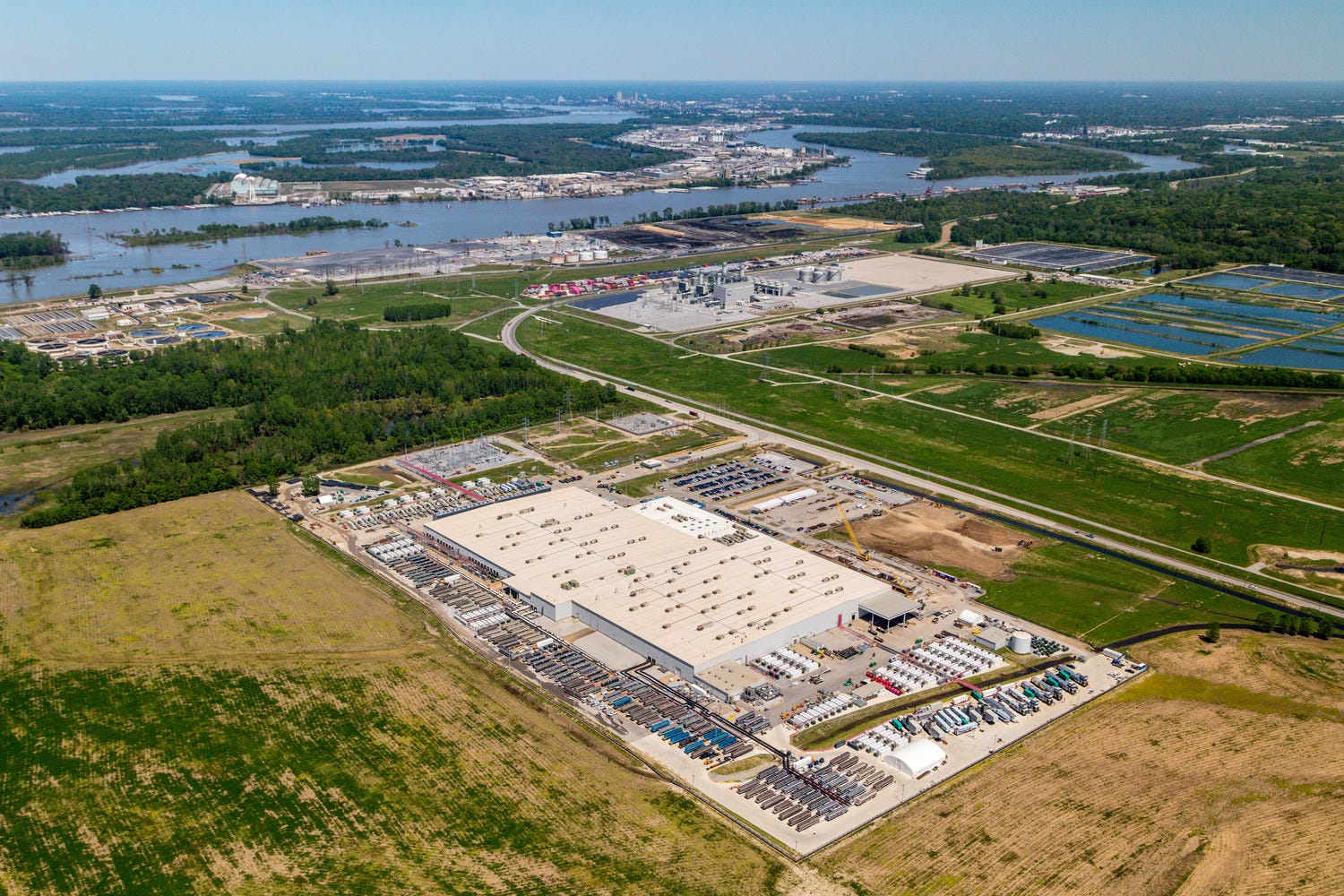
Elon Musk’s Colossus facility in Memphis shows how this works.
In June 2024, xAI announced plans for the world’s largest AI supercomputer. By September—just 122 days later—it was operational with 100,000 NVIDIA GPUs. By February 2025: 200,000 GPUs. Most data centers take 18-24 months to build. Colossus did it in four months—a timeline NVIDIA’s CEO called a “superhuman task.”
The speed came from sidestepping normal processes. The Tennessee Valley Authority allocated 300 megawatts without public hearings about grid capacity—enough power for 300,000 homes. Environmental reviews and public comment periods were bypassed through “economic development” fast-tracking. Water rights for millions of gallons from one of North America’s largest aquifers were secured quickly and quietly. Community input was minimal. Residents learned from news reports after deals were signed.
The facility initially ran on 150 megawatts of temporary diesel generators because grid connections weren’t ready—generators running 24/7 in South Memphis, a predominantly lower-income Black community. “Every day those turbines are operating, they are polluting the air and doing significant harm to families in South Memphis,” noted Amanda Garcia of the Southern Environmental Law Center.
Now Colossus 2 is being built next door, targeting 1 million GPUs by 2026. The Greater Memphis Chamber created an “xAI Special Operations Team” for “round-the-clock concierge service” to ensure nothing slows the expansion.
This is the template being replicated globally: Find available power, water, and weak opposition. Move fast. Build big. Let communities deal with consequences.
When Democracy Meets Capital
The Netherlands shows what happens when communities try to resist.
Microsoft proposed massive data center campuses in Hollands Kroon that would consume electricity comparable to major cities. Local residents organized protests through every democratic channel available. They understood what politicians didn’t want to acknowledge: data centers bring few jobs, consume enormous resources, and send profits to distant shareholders.
But the fight became a legal battle between government layers. The municipality supported the project and issued permits. The province argued the municipality lacked authority and launched enforcement proceedings against Microsoft. While they fought in court, Microsoft kept building under a “tolerance decision”—permission to continue construction during the legal dispute.
By the time the legal system caught up, the project was fait accompli.
This is the pattern: When one jurisdiction resists, find another. When opposition organizes, work with sympathetic government levels. Keep building while battles proceed. The asymmetry of resources ensures that even when democracy functions, it functions slowly—while construction proceeds at “superhuman” speed.
The Voices No One Wants to Hear
Behind every approval are people whose lives change—usually for worse—by decisions they couldn’t influence.
The Sound That Never Stops
“It’s just a constant whir at a frequency that’s obnoxious,” said Dale Browne, whose Virginia neighborhood sits next to four Amazon data centers that have generated months of complaints.
The noise isn’t like traffic that ebbs and flows. It’s relentless, 24/7, from cooling systems and backup generators. Inside facilities, noise reaches 96 decibels—equivalent to a lawnmower. At property lines: 50-85 decibels. But those numbers understate the problem.
The worst part is the low-frequency sound. It travels long distances, penetrates buildings, and critically, can’t be filtered out by the human brain. As Braxton Boren, an American University acoustics professor, explained about one proposed facility: low-frequency sound “has long wavelengths, is not absorbed by air molecules, and travels long distances.” Trees don’t block these waves. Distance helps less than you’d think. The data center’s 24/7 hum is “stressful and annoying, reduces cognitive ability during work or school, disrupts sleep and harms wildlife ecology.”
The health impacts are real: sleep disruption, stress, headaches, cognitive impairment, cardiovascular risks. Residents near data centers report the constant noise makes their homes—often their largest financial investment—unlivable.
The Economic Mirage
“Why can’t we move the data center to your neighborhood?” Helen Messer shouted at a developer in Chesapeake, Virginia, to applause. It’s a question developers never answer honestly.
The industry’s pitch is seductive: jobs, tax revenue, economic development. The reality is grimmer.
Northern Virginia—the global data center capital—had just 12,140 operational data center jobs in 2023. For context: fewer than the state’s school bus drivers. Yet data centers consumed 26% of Virginia’s electricity. The ratio of jobs to resource consumption is historically terrible.
In Iowa, Microsoft received $50 million in tax breaks for facilities employing fewer than 200 people long-term, while consuming enough water to supply tens of thousands of homes. When local officials question these deals, companies suggest they might build elsewhere. The tax breaks get approved.
The jobs that do exist are highly specialized. Local communities don’t benefit. And when locals see their property values crater and their wells run dry, the promised prosperity feels like a cruel joke.
The Uprising
Over the past two years, $64 billion in data center projects have been blocked or delayed by community opposition. There are now 142 activist groups across 24 states organizing resistance.
And it’s bipartisan. Of public officials opposing large-scale data centers, 55% are Republicans and 45% are Democrats. In pro-business Texas, even the state Senate has shown support for tighter regulations.
In Peculiar, Missouri, residents organized as “Don’t Dump Data in Peculiar” and successfully blocked Diode Ventures’ $1.5 billion project. The Planning Commission removed data centers from the city’s zoning ordinance entirely. In Arizona, Tract’s $14 billion project was withdrawn after residents raised concerns about building heights, noise pollution, and strain on utilities. In Indiana, Provident Realty Advisors canceled a $1.3 billion project after significant pushback. In Virginia, Amazon withdrew its Ashton data center proposal after a 6-1 Planning Commission vote against it.
But for every project blocked, several more succeed. The industry is learning to work faster, to secure approvals before opposition organizes, to find communities desperate enough economically to accept any deal.
Data centers are typically built in lower-income communities where property values are lower and political opposition is weaker. These communities bear immediate, certain costs—noise, resource consumption, environmental impacts—in exchange for vague promises of future prosperity. The profits flow to distant shareholders in the billions. The costs stay local forever.
The Global Buildout and Colonial Parallel
As of late 2025, the pattern is playing out on every continent except Antarctica. Virginia leads with 643 data centers consuming 26% of the state’s electricity. Ireland’s data centers now consume 22% of the nation’s electricity, up from 5% in 2015. Texas, California, Oregon, Iowa—all experiencing explosive growth. Singapore, despite expensive power, serves as Asia’s hub. India predicts 10x capacity increase by 2027. The Middle East is building AI infrastructure as part of post-oil strategies. Latin America competes with renewable energy resources.
Each location follows the same script: corporations identify regions with available power, desperate economies, and weak regulatory frameworks. They arrive with promises. They build massive facilities. The profits leave. The costs stay.
The parallel to 19th-century imperialism isn’t subtle. The East India Company model:
Private corporations with state backing arrive, make economic promises, establish infrastructure control, extract resources for corporate benefit, and convert economic control into political power.
Now consider OpenAI, Google, Microsoft, xAI: The U.S. government has made AI dominance a strategic priority with billions in subsidies. Companies promise jobs and prosperity. Once built, regions become dependent. Power, water, and land are consumed while profits flow to distant shareholders. Communities find themselves unable to resist expansion.
The difference is that while the East India Company planted flags on foreign soil, these companies plant flags everywhere—including their home countries. The power dynamic is the same: corporations with resources that dwarf small nations, making offers desperate communities can’t refuse.
This is the new colonialism: not ships and soldiers, but economic pressure and infrastructure dependency.

The Power Crisis and Environmental Fiction
In 2024, global data centers consumed 415 terawatt-hours of electricity—1.5% of global demand. By 2030, projections reach 945 TWh. For perspective, a single ChatGPT query uses 10x the electricity of a Google search. Training GPT-4 consumed enough power for 5,000 homes for a year. And this is before AGI. We’re building infrastructure for technology we don’t understand, with resource requirements we can’t predict.
AI infrastructure spending tells the acceleration story: $120 billion in 2023, $220 billion in 2024, $364 billion in 2025. Goldman Sachs estimates data centers could consume 8% of U.S. electricity by 2030, up from 4.4% in 2023.
Where’s this power coming from? Coal plants scheduled to close are getting life extensions. New natural gas plants are being built. Renewable energy transitions are being delayed. The AI boom is keeping fossil fuels alive.
When companies claim “100% renewable energy,” here’s the reality: The data center draws power from the grid 24/7. The company buys renewable energy credits equivalent to consumption. But those renewable electrons power something else, somewhere else on the grid. Meanwhile, fossil fuel plants ramp up to meet the data center’s actual demand. It’s accounting fiction.
The water consumption is staggering. Google consumed 5.6 billion gallons in 2022. Microsoft’s use increased 34% in 2023. In drought-stricken regions like Iowa and the American Southwest, this creates direct competition between AI training and human consumption. Communities report wells running dry while data centers consume millions of gallons daily.
Google’s greenhouse gas emissions rose 48% from 2019 to 2023, primarily due to AI data centers. And then there’s the e-waste: GPUs need replacement every 2-4 years. Colossus’s 200,000 GPUs will eventually become 200,000 pieces of toxic electronic waste containing rare earth minerals and hazardous materials.
The Concentration Risk: A National Security Nightmare
While companies race to build computing power, they’re creating geographic patterns that pose unprecedented security risks.
Northern Virginia has become the world’s most critical digital infrastructure hub. With 643 data centers, it handles 70% of the world’s internet traffic. Loudoun County alone operates 6 gigawatts of data center capacity. Amazon’s US-EAST-1 region—the backbone of AWS—is based here. When AWS experienced outages in Northern Virginia in recent years, services across the internet collapsed. “We urgently need diversification in cloud computing,” warned Corinne Cath-Speth of Article 19, a free speech advocacy group.
The concentration is extraordinary: 15 states account for 80% of all U.S. data center capacity. Virginia consumes 26% of its total electricity for data centers. Other high-concentration states include North Dakota at 15%, Nebraska at 12%, Iowa at 11%, and Oregon at 11%.
This clustering makes economic sense—established infrastructure, favorable tax treatment, available power. But economic efficiency creates strategic vulnerability.
The China Threat: Already Inside
In April 2025, TIME Magazine published an exclusive report based on findings circulated inside the Trump White House: “Every AI Datacenter Vulnerable to China.”
The findings are stark. One top U.S. tech company’s AI data center was attacked and intellectual property was stolen. Another facility was targeted in an attack that, if successful, would have knocked it offline for months. A former OpenAI researcher described vulnerabilities that had been reported on the company’s internal Slack channels but left unaddressed for months.
Chinese state-sponsored hacking groups—designated by Microsoft as “Typhoon” operations including Volt Typhoon, APT41, and Salt Typhoon—are actively targeting U.S. critical infrastructure (power, water, communications, military), and now including data centers. The goal isn’t just espionage. It’s pre-positioning for large-scale disruption in a future conflict, particularly around Taiwan.
FBI Director Christopher Wray’s April 2024 warning was unambiguous:
“The cyber threat posed by the Chinese government is massive. The PRC has made it clear that it considers every sector that makes our society run as fair game in its bid to dominate on the world stage, and that its plan is to land low blows against civilian infrastructure to try to induce panic and break America’s will to resist.”
Here’s what China could do: Steal AI model weights worth billions in investment and years of research. Launch relatively cheap attacks that could disable facilities for months, crippling AI development. Compromise supply chains—China manufactures most transformers, generators, and critical data center components. Coordinate cyberattacks with military action, disrupting U.S. communications, logistics, and command capabilities.
The Virginia vulnerability is particularly acute. If China wanted to maximally disrupt U.S. AI capabilities, military communications, and digital infrastructure in a Taiwan conflict scenario, Northern Virginia is the target. With 70% of the world’s internet traffic flowing through this region, a coordinated cyberattack would be catastrophic—disrupting not just AI training, but global internet services, financial systems, and military communications.
The TIME report warns that China could quietly divert critical components to its own facilities “since after all, they control the industrial base that is making most of them.” Lead times on China-sourced generators, transformers, and other components will mysteriously lengthen as China prioritizes its own buildout.
An Auburn University report notes that China is probing “systemic vulnerabilities across multiple lifeline sectors.” In a conflict scenario, energy sector attacks could cause cascading power outages across multiple states, crippling military installations. Communications disruptions could delay military deployments. Transportation system compromises could impede logistics.
In September 2024, the National Telecommunications and Information Administration issued a formal Request for Comments on “Bolstering Data Center Growth, Resilience, and Security.” The questions themselves reveal the concerns: How do operators select diverse geographical areas for business continuity? What supply chain risks threaten continuity? How do operators ensure untrusted or counterfeit components don’t make it into facilities? The subtext is clear: current geographic concentration and security posture are inadequate for national defense.
The infrastructure war for AGI dominance is creating vulnerabilities that could determine the outcome of an actual war. Companies racing to build computing power are concentrating it in ways that maximize economic efficiency while minimizing strategic resilience.
The East India Company parallel becomes even starker: Just as the Company created infrastructure dependencies that became geopolitical leverage, data center concentration creates dependencies adversaries can exploit. The difference is these vulnerabilities exist within U.S. territory. We’re building the infrastructure for superintelligence in configurations that invite catastrophic disruption.
The Arms Race and Who Pays
Each company in the AGI race is frantically building capacity. OpenAI partners with Microsoft for global facilities. Google leverages its existing network while building specialized AI farms. xAI takes the most aggressive approach with Colossus—world’s largest supercomputer in months. Meta is spending over $40 billion in 2025 alone on infrastructure. China’s AI companies are building comparable infrastructure with direct government coordination.
No single company can slow down without losing the race. It’s a collective action problem driving an unsustainable pace, with costs externalized to communities and the environment, while creating vulnerabilities that invite foreign attack.
Here’s the fundamental asymmetry: Communities provide tax breaks, infrastructure upgrades, subsidized resources, and fast-tracked permits. They receive few permanent jobs, minimal tax revenue offset by initial breaks, strained utilities, noise, pollution, reduced property values, and national security vulnerabilities they have no control over.
Companies receive massive infrastructure, favorable regulatory treatment, and below-market resource access. Their shareholders receive potentially trillions if AGI succeeds, with losses absorbed by investors and communities if it fails. In the end, communities are being extracted from either way with small gains if AGI succeeds.
The nation receives strategic vulnerabilities concentrated in attack-prone locations, infrastructure that could be crippled in a conflict’s first hours, and dependence on adversary-controlled supply chains.
Communities bear immediate, certain costs for vague promises of future prosperity. Nations accept strategic vulnerabilities pursuing economic advantages that might evaporate in conflict. And residents rarely get a meaningful voice. By the time the public learns about these deals, they’re already signed.
The Control Question
The infrastructure war isn’t just about who builds the most data centers. It’s about who controls the most powerful technology in human history—and whether those controls can survive deliberate attack.
Every data center is a flag planted. Every gigawatt secured is territory claimed. Every fast-tracked permit is a small democracy overruled. Every geographic concentration is a vulnerability created.
When AGI arrives—if it arrives—it will run on this infrastructure. The companies that built it won’t just own the technology; they’ll own the physical substrate that makes it possible.
That’s why they’re racing. That’s why they’re spending hundreds of billions. That’s why they’re willing to steamroll local opposition, environmental concerns, and national security warnings.
Because in their calculation, control of AGI infrastructure is control of humanity’s future.
And right now, that control is being decided not by democratic processes, international agreements, or strategic defense planning, but by whichever companies can build the most computing power the fastest, in whatever locations will let them do it with the least resistance—even if those locations create the strategic equivalent of glass jaws.
The flags are being planted. The empires are being built. The vulnerabilities are being locked in.
And most of humanity—including most of the national security establishment—is learning about it after the critical decisions have already been made.
In Part 4, we’ll examine the ideology driving this race: How the people building AGI talk about it like a god they’re summoning, why they view themselves as nation-builders rather than entrepreneurs, and what their own words reveal about how much they value human welfare versus winning the race.
Main Sources
Key Infrastructure & Energy Data
International Energy Agency: “Data centres & networks” https://www.iea.org/energy-system/buildings/data-centres-and-data-transmission-networks
U.S. Department of Energy: “DOE Releases New Report Evaluating Increase in Electricity Demand from Data Centers” https://www.energy.gov/articles/doe-releases-new-report-evaluating-increase-electricity-demand-data-centers
Pew Research Center: “US data centers’ energy use amid the artificial intelligence boom” https://www.pewresearch.org/short-reads/2025/10/24/what-we-know-about-energy-use-at-us-data-centers-amid-the-ai-boom/
Colossus/xAI Memphis
xAI: “Colossus” https://x.ai/colossus
Capacity Media: “Musk’s xAI’s Colossus Cluster set for one million GPU supercomputer expansion” https://www.capacitymedia.com/article/musks-xais-colossus-cluster-set-for-one-million-gpu-supercomputer-expansion
Ireland Data Centers
Central Statistics Office Ireland: “Data centres consumed 22pc of Ireland’s electricity in 2024” https://www.siliconrepublic.com/enterprise/data-centres-cso-survey-2024-electricity
Community Impact & Opposition
Data Center Watch: “$64 billion of data center projects have been blocked or delayed amid local opposition” https://www.datacenterwatch.org/report
NPR: “Why more residents are saying ‘No’ to AI data centers in their backyard” https://www.npr.org/2025/07/17/nx-s1-5469933/virginia-data-centers-residents-saying-no
Courthouse News Service: “As data centers proliferate, neighbors knock the noise” https://www.courthousenews.com/as-data-centers-proliferate-neighbors-knock-the-noise/
National Security & China Threats
TIME Magazine: “Exclusive: Every AI Datacenter Vulnerable to China: Report” https://time.com/7279123/ai-datacenter-superintelligence-china-trump-report/
FBI: “Wray: Chinese Government Poses ‘Broad and Unrelenting’ Threat to U.S. Critical Infrastructure” https://www.fbi.gov/news/stories/chinese-government-poses-broad-and-unrelenting-threat-to-u-s-critical-infrastructure-fbi-director-says
New Jersey Cybersecurity: “China-Linked Cyber Operations Targeting US Critical Infrastructure” https://www.cyber.nj.gov/threat-landscape/nation-state-threat-analysis-reports/china-linked-cyber-operations-targeting-us-critical-infrastructure
Federal Policy
NTIA: “Request For Comments on Bolstering Data Center Growth, Resilience, and Security” https://www.ntia.gov/federal-register-notice/2024/request-comments-bolstering-data-center-growth-resilience-and-security