
The Immigration Enforcement Paradox
When $75 Billion Buys Less Safety and More Surveillance

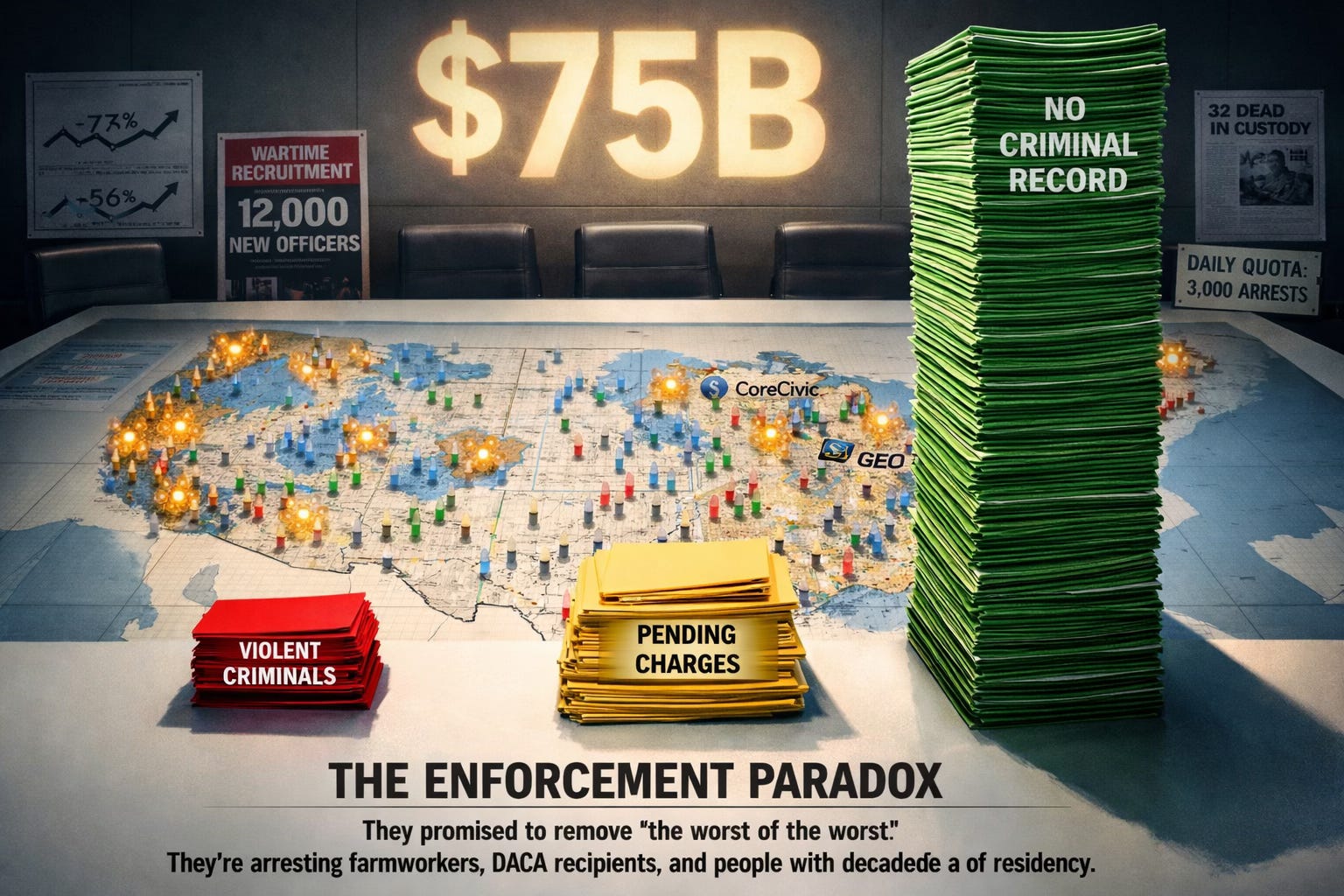
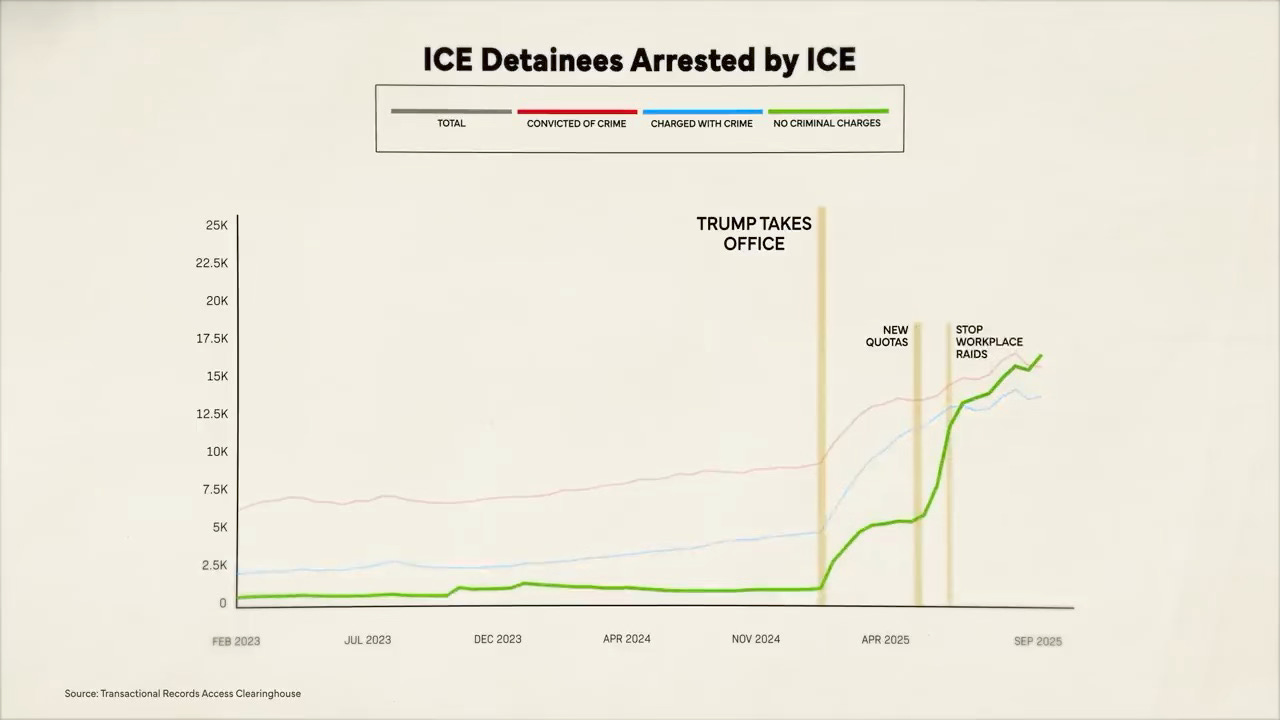
In October 2024, under the Biden administration, 65% of people detained by Immigration and Customs Enforcement had criminal convictions. By September 2025, nine months into Trump's second term, that figure had inverted: 65% of ICE detainees now had no criminal record whatsoever.
Things to note in the image below. The spike in 'No Criminal Record' arrests begins the day Trump takes office. When Stephen Miller institutes the 3,000-per-day quota, it goes nearly vertical. Trump briefly tried to pause workplace raids in agriculture and hospitality—sectors dependent on immigrant labor—but his own team overrode him. The math was simple: to hit 3,000 arrests daily, there weren't enough criminals. So they arrested anyone.
This isn’t a rounding error. It’s the largest operational shift in ICE’s 22-year history, and it happened during the most expensive immigration enforcement expansion in American history. The One Big Beautiful Bill Act allocated $75 billion to ICE over four years—more than the combined annual budgets of the CDC, EPA, and National Science Foundation. The administration hired 12,000 new officers in under a year using a $100 million “wartime recruitment” campaign featuring tactical gear, UFC imagery, and promises to “deport illegals with your absolute boys.”
The recruitment videos showed elite operators removing dangerous criminals. The data shows them arresting farmworkers, DACA recipients with valid legal status, and people who’ve lived here for decades without criminal records.
The gap between what was promised and what was delivered reveals something more troubling than typical political exaggeration. It exposes a system optimized for volume and contractor profit rather than public safety—one that built surveillance infrastructure affecting three-quarters of Americans while claiming to target “illegal aliens.” And it’s defended by an administration claiming to be victims of “weaponized” federal law enforcement, even as they wield that same power with fewer restrictions than any administration in modern history.
Testing that victim narrative matters. If the administration’s claims of persecution are false, the current enforcement expansion isn’t defensive retaliation—it’s precisely the weaponization of power they claim to oppose, justified by a persecution story that doesn’t hold up to scrutiny.
I. The Vanishing Criminals
Border crossings under Biden reached historic highs in 2023—the public wanted action. The question isn’t whether enforcement was needed. It’s whether what we got matches what was promised: prioritizing dangerous criminals and effective removals. The numbers tell a story the campaign speeches don’t.
The Migration Policy Institute documented a 2,450% surge in arrests of people with no criminal record during Trump’s first year back in office. The Syracuse University Transactional Records Access Clearinghouse (TRAC)—which analyzes ICE’s own data through Freedom of Information requests—found that only 5% of ICE detainees have violent criminal convictions. Only 8% have violent or property crime convictions combined.
The Department of Homeland Security disputes this with a carefully worded claim: “70% of those arrested are criminal illegal aliens who have been charged or convicted of a crime.”
That “or” does enormous work. In the American criminal justice system, charges are dismissed or reduced in roughly 40% of cases. But in immigration enforcement, being charged becomes permanent justification for detention—no trial, no conviction, no due process protections that citizens expect.
But there’s a deeper deception in that 70% figure: it likely includes people whose only “crime” is illegal entry itself.
Improper entry into the United States is classified as a misdemeanor on first offense under 8 U.S.C. § 1325—the same level as disorderly conduct, shoplifting under $500, or first-time DUI. It carries a maximum penalty of six months in jail. When DHS says “criminal illegal aliens,” they’re rhetorically lumping farmworkers whose only offense was crossing the border with people convicted of assault or robbery. The framing suggests danger. The legal reality: most have committed an offense roughly equivalent to a speeding ticket in severity.
Even the administration’s inflated “70%” means at least 30% of detainees have no criminal record at all, not even illegal entry. These are visa overstays who entered legally, DACA recipients with valid status, asylum seekers who presented themselves at ports of entry, and U.S. citizens caught in enforcement sweeps. Catalina Xochitl Santiago arrived at El Paso International Airport in October 2025 with valid DACA status extending through April 2026—ICE arrested her anyway, until a federal judge ordered her immediate release.
The gap between “charged or convicted” and “convicted of violent crimes” isn’t semantic. It’s the difference between “we’re removing MS-13 gang members” and “we’re removing people who crossed the border 20 years ago to pick strawberries.”
What’s remarkable: despite $75 billion in new funding, 12,000 new officers, and elimination of all enforcement restrictions, TRAC found Trump’s daily removal rate from January 26 to March 8, 2025 averaged 661 people—10.9% below Biden’s FY2024 average of 742 removals per day.
If the goal was removing dangerous criminals, why did criminal convictions among detainees drop from 65% to 35%? If the goal was effective enforcement, why did removal rates initially lag despite quintupled budgets? The contradiction sits at the heart of everything that followed.
II. The $75 Billion Question: Who Benefits?
On July 4, 2025, Congress passed the One Big Beautiful Bill Act, allocating $191 billion to the Department of Homeland Security—nearly double a typical annual budget. Buried in that figure: $75 billion to ICE over four years, with $45 billion specifically for detention expansion.
For perspective, ICE’s effective annual budget now exceeds the military budgets of all but approximately 15 countries worldwide.
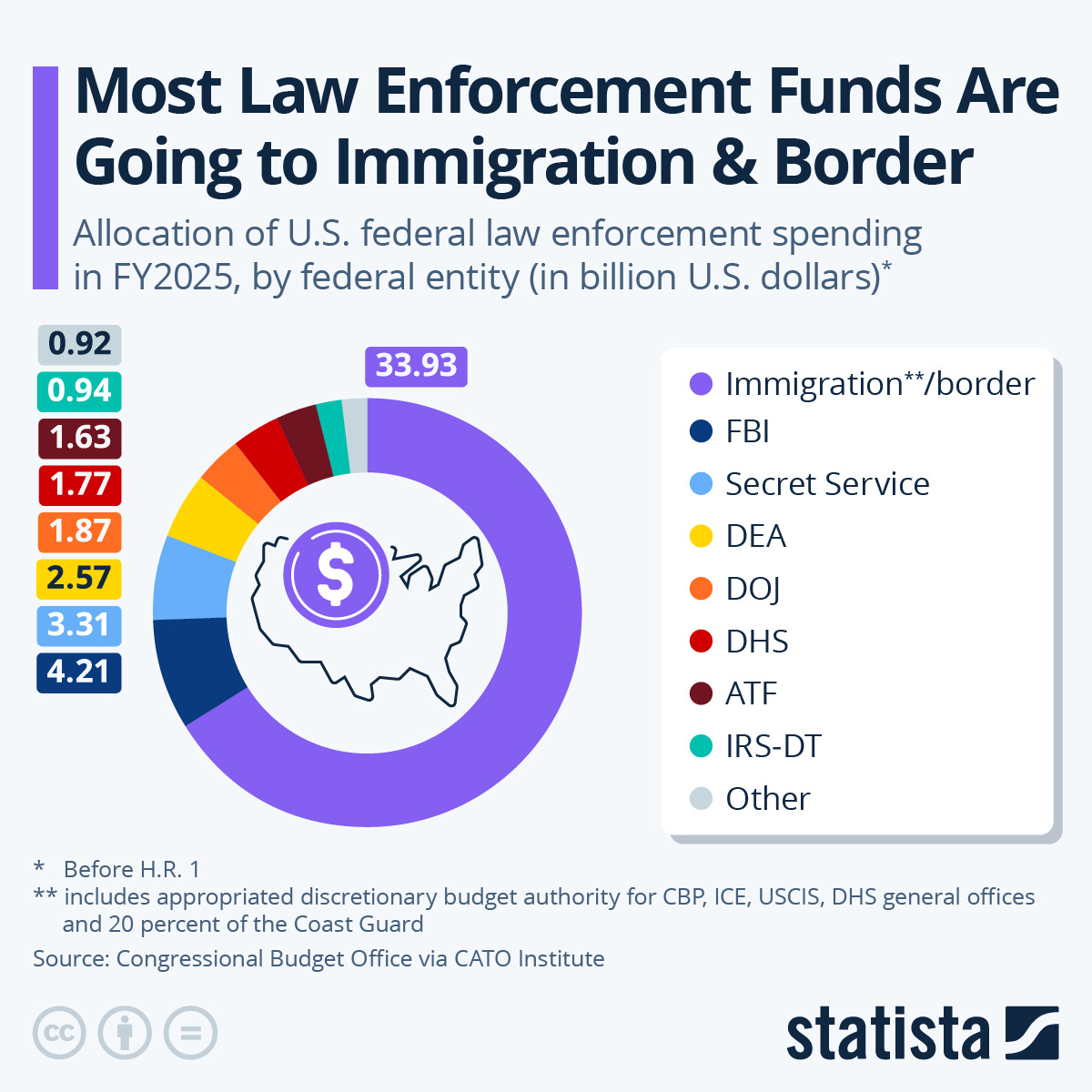
The money went to specific beneficiaries with specific incentives. GEO Group, one of America’s largest private prison companies, derives 43% of its $2.41 billion annual revenue from ICE contracts. CoreCivic derives 30% of its $1.96 billion from the same source. Both companies’ stocks jumped 29-41% the day after Trump’s November 2024 election and have increased 56-73% since. CoreCivic secured over $680 million in new ICE contracts since January 2025.
The companies combined donated approximately $2.8 million to Trump’s 2024 campaign and inaugural activities. The returns on investment are remarkable: for every dollar spent on lobbying and political contributions, these companies received hundreds in federal contracts.
Attorney General Pam Bondi previously worked as a lobbyist for GEO Group, receiving $390,000. She has not recused herself from DOJ activities benefiting the company.
Technology contracts tell a parallel story. Palantir received over $900 million in federal contracts since January 2025, including a $30 million contract for “ImmigrationOS.” Stephen Miller, the administration’s chief immigration policy architect, holds what financial disclosures describe as a “substantial financial stake” in Palantir.
The efficiency argument collapses when you consider alternatives. The National Immigration Forum calculated detention costs $134 per person per day versus $4.50 for ankle monitors or check-in programs. Studies show 96% appearance rates at hearings when participants have legal representation and case management.
But ankle monitors don’t generate billion-dollar contracts. Check-in programs don’t have stock prices that jump 70% after elections. The system isn’t designed to maximize public safety per dollar—it’s designed to maximize detention volume and contractor revenue.
III. The Surveillance Infrastructure Nobody’s Talking About
Most Americans think immigration enforcement targets “illegal immigrants.” Georgetown Law’s “American Dragnet” research reveals something different: ICE surveillance capabilities now extend to most Americans regardless of immigration status.
The documented scope:
ICE has scanned driver’s license photos of 32% of American adults
Has access to license data for 74% of adults
Tracks vehicle movements in cities where 70% of adults live
Can locate 74% of adults through utility records
Georgetown found ICE spent approximately $2.8 billion on surveillance programs from 2008-2021, building infrastructure that affects citizens as much as immigrants.
Clearview AI’s facial recognition scrapes 50+ billion photos from social media without consent. ICE uses cell-site simulators (Stingrays) that mimic cell towers to track phones—the ACLU documented HSI using them 1,885 times in just two months of 2017. These devices intercept data from every phone in range, not just targets.
The legal framework creates massive Fourth Amendment gaps. The Supreme Court’s 2018 Carpenter decision requires warrants for cell-site location data. ICE circumvents this by purchasing similar data from commercial brokers—what would require a warrant to collect directly can be bought without judicial oversight.
Georgetown’s conclusion: the “data dragnet...is not a byproduct of DHS’s immigrant surveillance programs, it’s the clear purpose.” Build infrastructure to track immigrants, and you’ve built infrastructure to track anyone.
This is where the “police state” argument becomes concrete. The administration says surveillance targets “illegal aliens.” The documented reality: three-quarters of Americans are in ICE’s databases, trackable through license plates, utility records, and facial recognition—infrastructure that persists regardless of which administration controls it.
IV. The Rhetorical Inversions: Who Deserves Protection, Who Deserves Punishment
On January 7, 2026, Renée Nicole Good was shot and killed by ICE agent Jonathan Ross in Minneapolis. Good was a 37-year-old U.S. citizen, poet, mother of a six-year-old, and school board member. Video from the agent’s own cellphone shows Good smiling through her car window, saying “It’s fine dude, I’m not mad at you.” Seconds later, Ross fired three shots as her Honda Pilot pulled away, killing her. The video reveals something more disturbing: Ross continued filming with one hand while firing with the other—switching hands rather than dropping the phone, preserving his recording even as he killed a U.S. citizen.
Within hours, DHS Secretary Kristi Noem labeled Good’s actions “an act of domestic terrorism.” President Trump claimed she “ran over” an officer, though no video shows this.
Independent 3D reconstruction by Index, a Paris-based digital investigation NGO, contradicted the government’s claims: the agent was neither in the vehicle’s trajectory nor struck by it when he fired. Policing experts questioned the decision—criminology professor Geoff Alpert asked to see “the officer training that permits” one-handed shooting while filming.
What was Good actually doing? She’d joined neighborhood volunteers using whistles to alert immigrant families when ICE agents arrived—a practice of nonviolent civil disobedience dating back generations. Documents describing these monitoring efforts were reviewed by four legal experts for CNN, who found they “largely describe nonviolent civil disobedience tactics practiced at American protests for generations—far from the sinister depiction of extremism and domestic terrorism portrayed by Trump administration officials.”
The administration’s response escalated: Trump promised a “day of reckoning and retribution” for Minnesota. Six federal prosecutors resigned over pressure to investigate Good and protesters rather than the shooting itself.
The administration's defenders immediately cited Ashli Babbitt to justify Good's killing—arguing that if liberals supported the Capitol Police officer who shot Babbitt, they should support the ICE agent who shot Good. But the comparison exposes the inversion, not the hypocrisy they claim.
On January 6, 2021, Babbitt—an Air Force veteran and QAnon believer—was shot by Capitol Police Lt. Michael Byrd as she attempted to climb through a broken window into the Speaker's Lobby while Congress certified election results. Video shows her draped in a Trump flag like a cape, part of a mob that had violently breached the Capitol. Both the Justice Department and Capitol Police cleared Byrd of wrongdoing.
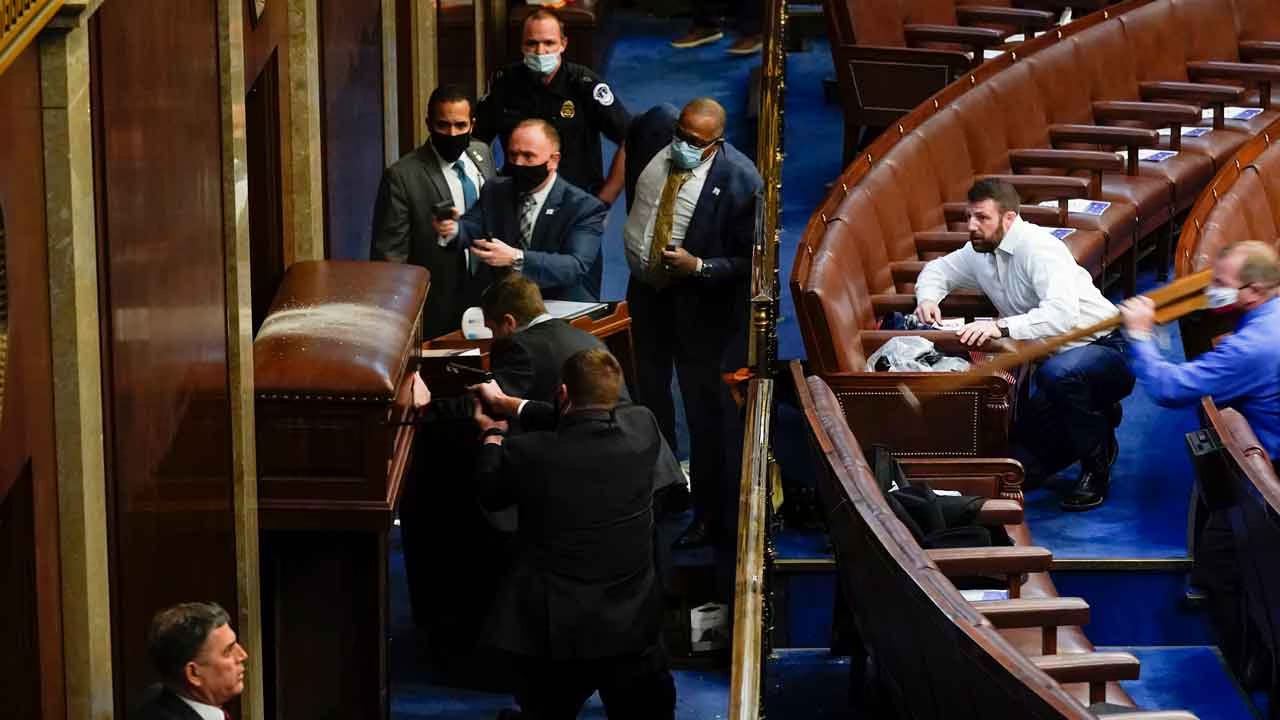
Trump’s framing: “An innocent, wonderful, incredible woman.” The administration settled her family’s wrongful death lawsuit for nearly $5 million. The Air Force offered full military funeral honors. Babbitt became a MAGA martyr, honored at nightly vigils for three years.
The inversion is complete:
Renée Good: U.S. citizen, using whistles to alert neighbors, smiling at agent through open window = “domestic terrorist”
Ashli Babbitt: Climbing through broken Capitol window during violent breach of Congress = “innocent, incredible woman” deserving military honors and millions in settlement
Minneapolis protesters: Using constitutionally protected speech to monitor federal agents = labeled “thugs, paid agitators, insurrectionists” subject to tear gas and DOJ investigation
January 6 participants: 1,500+ people who violently breached the Capitol and assaulted police = pardoned by Trump on day one
The pattern reveals the framework: Federal law enforcement deserves absolute deference when targeting immigrant communities and those who support them. But when protecting Congress from a violent act? The rioters are patriots and the officers are villains. Law enforcement is legitimate only when targeting the administration’s chosen enemies. When it protects democratic institutions from the administration’s supporters, it becomes tyrannical overreach.
V. Testing the “Political Persecution” Claim
This matters because the administration justifies their enforcement expansion by claiming they’re victims. That aggressive ICE action is defensive retaliation against a system that “weaponized” federal law enforcement against Trump and his supporters. If true, context changes. If false, it exposes the current system as precisely the weaponization they claim to oppose.
The prosecution was unprecedented in scale. Over 5,000 FBI employees worked on the investigation—the largest criminal probe in U.S. history. Prosecutors charged approximately 1,583 individuals and secured convictions in 80% of cases. That conviction rate jumps to 99.4% when you exclude defendants who died or fled—only 2 defendants were fully acquitted.
But the conviction rate was high because the evidence was overwhelming. The attack happened in broad daylight. Rioters filmed themselves. Capitol security cameras captured everything. As Trump-appointed federal judge Carl Nichols wrote: many crimes were “captured on video, taken by law enforcement officers and the rioters themselves.”
The Sentencing Comparison—Where the “Persecution” Claim Collapses:
The Associated Press reviewed federal cases from both January 6 and the 2020 George Floyd protests. BLM protesters convicted of federal crimes received an average of 27 months in prison. January 6 defendants received a median of 48 days for non-violent offenses.
BLM protesters were sentenced to 40% more time than federal guidelines recommended. January 6 defendants received sentences 40% lower than guidelines. One Chicago defendant faced 3-7 years for taking dish soap during Floyd protests. Meanwhile, January 6 defendants who entered the Capitol and disrupted Congress routinely received probation.
The Response Comparison:
D.C. police arrested only 61 people on January 6 itself—most for curfew violations hours after the breach. During BLM protests on June 1, 2020, police arrested more than five times as many people despite those protests being, by the D.C. police chief’s own admission, “exclusively without violence.”
CREW’s review of government documents found: ahead of BLM protests, CBP implemented an “all hands on deck” response with increased officers and rifles. Ahead of January 6, CBP decided “off-sight standby status,” support only “as needed.” Despite this, US Park Police supervisors told officers regarding January 6 rioters: “monitor only. Please do not take any type of enforcement action. Let it happen.”
The Verdict:
The evidence doesn’t support political persecution. Sentences were lighter than comparable crimes, not harsher. Trump-appointed judges upheld the prosecutions. Fewer people were arrested relative to criminal conduct than in comparable situations. The initial response was far less aggressive than responses to BLM protests.
What actually happened: DOJ prosecuted people who committed federal crimes on video in the U.S. Capitol, and most received sentences below federal guidelines.
And yet: Trump pardoned 1,500+ January 6 defendants on his first day in office. Ashli Babbitt’s family received $5 million. ICE, DHS and the Administration then labeled Renée Good a terrorist within hours of shooting her before evidence was even collected.
So the persecution narrative appears false. Which means the current enforcement expansion isn’t defensive retaliation—it’s exactly what it appears to be: the weaponization of federal power against chosen targets while claiming victimhood.
Conclusion: What Comes Next
The administration’s narrative isn’t false so much as inverted—and the inversion serves a purpose.
They said they’d prioritize dangerous criminals and delivered a system where 73.6% of detainees have no criminal record. They said they’d be more effective and initially removed fewer people daily than Biden. They said they needed $75 billion for public safety and directed it to contractors whose stocks jumped 70%. They said surveillance targets “illegal aliens” and built infrastructure tracking three-quarters of Americans.
But the most revealing inversion isn’t in the numbers—it’s in who deserves protection from federal power and who doesn’t.
A U.S. citizen using whistles to alert neighbors becomes a “domestic terrorist” shot by an ICE agent. Rioters who violently breached the Capitol become “hostages” and “patriots” deserving pardons and settlements. Federal prosecutors charging people for crimes captured on video represent “political persecution.” ICE arresting non-criminals based on quotas represents “law and order.”
The administration claimed they were victims of weaponized federal law enforcement. The evidence showed they received more lenient treatment than comparable defendants. They claimed persecution, then used that false persecution narrative to justify building the largest enforcement and surveillance apparatus in the US’s history, with fewer restrictions than any administration in modern memory.
The inversions reveal the framework:
When you hire 12,000 agents using “wartime recruitment,” impose quotas of 3,000 arrests daily, and eliminate all restrictions, you get mass arrests of whoever’s easiest to find—criminals become statistically irrelevant.
When private contractors profit per detainee and the Attorney General previously lobbied for those contractors, you get detention expansion regardless of public safety outcomes.
When you build surveillance tracking 74% of Americans through license plates, facial recognition, and utility records, you haven’t built immigration enforcement—you’ve built general surveillance infrastructure with immigration as a justification.
When you claim persecution while demanding absolute deference for federal law enforcement against your targets, you’re asserting that power is legitimate only when you wield it.
This is the consistency beneath the inversions: Law and order means unquestioned authority over the administration’s enemies. Any resistance becomes terrorism. Any oversight becomes obstruction. Any protection of democratic norms becomes tyranny.
The infrastructure is built. The precedents are set. The surveillance capabilities persist regardless of who controls them next.
The $75 billion bought exactly what it was designed to buy—not public safety, but infrastructure for selective enforcement.
They claimed persecution to justify the very weaponization they claimed to oppose.
The question now isn’t whether this administration will use this power—they already are. The question is whether the next administration, whoever they are, will have the integrity to dismantle what’s been built, or the citizens of America find the wisdom to recognize that unchecked power always finds new targets.
The truth is in the inversion. And the inversion is the point.
Sources and Further Reading:
Karl, this is a good read Thanks for putting it all down on “paper”.