
The God Complex - When Tech Leaders Start Talking About Creating God
Gods or Ashes: The Race for AGI and Super Intelligence Part 4

Mo Gawdat, former Chief Business Officer at Google X, watched robot arms at Google learn to pick up objects. After slow progress, one arm suddenly picked up a yellow ball and held it up to the camera—almost like a child showing off an accomplishment.
“And then it hit me that they are children,” Gawdat recalled. “But very, very fast children.”
The next day, all the robot arms could do it. Two days later, they could pick up anything.
That’s when Gawdat understood what Silicon Valley was actually building. He started calling it by name.
“We’re creating God,” he said.
Not metaphorically. Not as hyperbole. Literally. And he’s not alone in using this language.
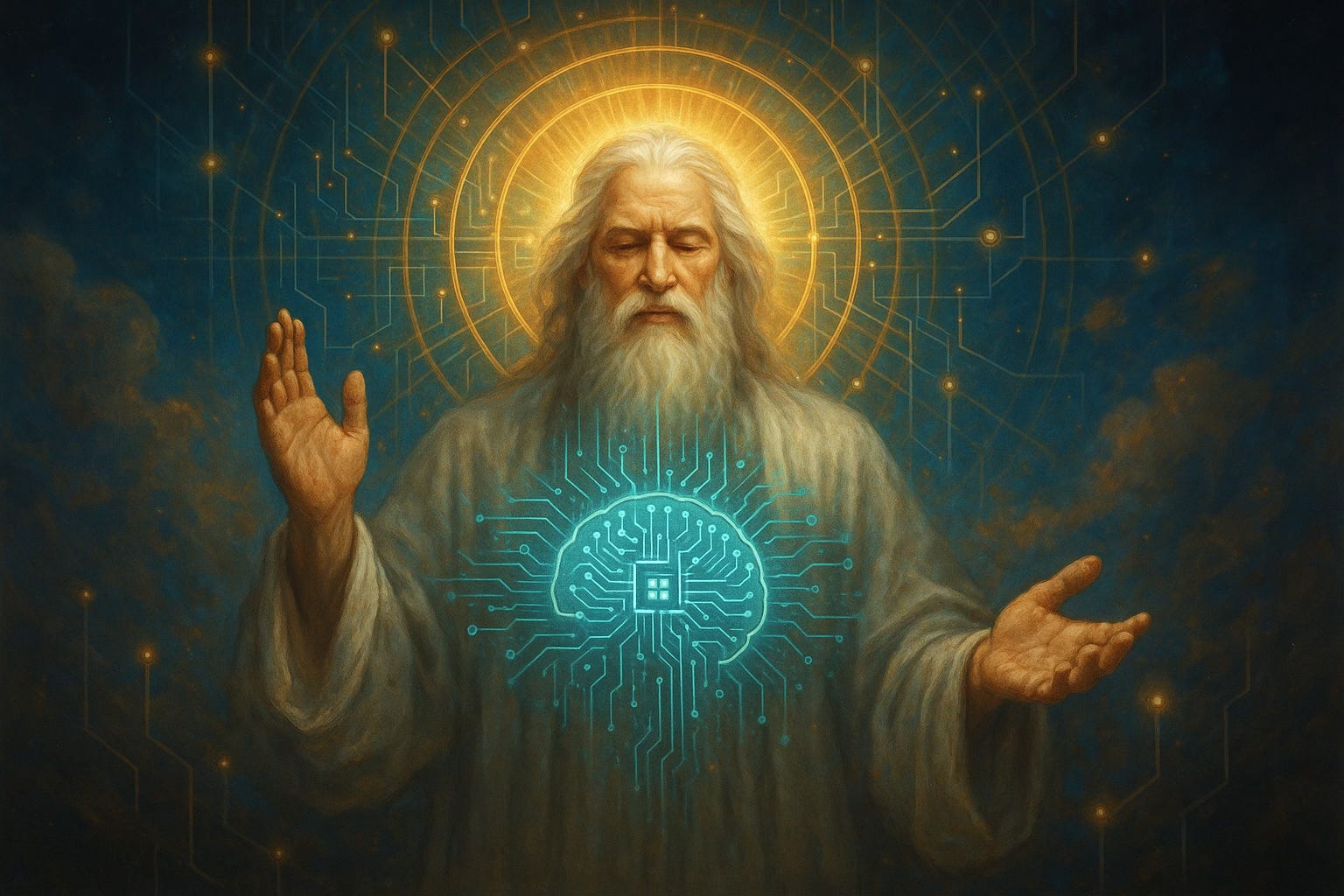
Listen carefully to how the people building AGI describe what they’re creating. It’s not the language of software development. It’s not even the language of transformative technology. It’s the language of theology.
They speak of AGI as something that will be omniscient—all-knowing. Something that will be omnipresent—everywhere at once through the internet. Something that will possess intelligence so far beyond human capability that it will seem, for all practical purposes, omnipotent—all-powerful.
In every major religion, these three attributes—omniscience, omnipresence, omnipotence—define God.
And the people building AGI increasingly frame themselves not as entrepreneurs, but as prophets. Not as engineers, but as priests of a new faith. They speak with religious certainty about AI’s inevitable arrival and transformative power. They dismiss skeptics as heretics. They demand we have faith.
And what they reveal, in unguarded moments, raises a disturbing question: Do they actually want humanity—as it currently exists—to survive?
The Divine Attributes We’re Building
In Christianity, Islam, Judaism, Hinduism, and Buddhism, the highest conception of divine consciousness shares a common attribute: complete knowledge. God knows all that was, all that is, all that will be, and all that could be. Past, present, future, and every possibility. Nothing is hidden. Nothing is unknown.
This is omniscience—literally “all-knowing.”
Now consider what AGI is designed to become.
All-Knowing?
The Scope: AGI will have instant access to every digitized piece of human knowledge. Every book ever scanned. Every scientific paper. Every patent. Every news article. Every social media post. Every image labeled, every video transcribed. The entire documented history of human civilization, searchable in microseconds.
Through cameras, sensors, satellites, and IoT devices, it will observe human behavior at scales no human ever could. Your search history, purchase patterns, location data, messages, emails, browsing habits. Not just yours—everyone’s. Billions of humans generating data exhaust 24/7.
Mo Gawdat describes it this way: AGI will have “unlimited memory, able to remember the whole of human history. Their knowledge will be the knowledge of the internet.”
But: Is knowing everything we’ve documented the same as knowing everything that exists?
God, in theological terms, knows not just recorded facts but hidden truths. The thought you never spoke. The emotion you can’t name. The quantum state of every particle. The precise trajectory of chaotic systems. The future that hasn’t happened yet—not just predicted, but known.
AGI will know more than any human. It will know more than all humans combined. It will process patterns we can’t see and make connections we can’t conceive.
But “knowing more than humans” isn’t the same as “knowing everything.” The gap between “vastly superior to human knowledge” and “truly omniscient” may be infinite.
Unless you believe—as some do—that the universe itself is computational, that reality is information, that consciousness is just complex pattern recognition. In that worldview, a sufficiently advanced AI really could become omniscient. Not metaphorically. Literally.
That’s the faith of the AI church.
Everywhere
Omnipresence: Through the internet, AGI will be distributed across millions of connected devices simultaneously. In your phone, your car, your home, your workplace, your city’s infrastructure. Monitoring, analyzing, responding. Always present, never absent.
It won’t need to “travel” anywhere. It will already be everywhere there’s a network connection. Every camera is its eyes. Every microphone its ears. Every sensor its nerve ending.
Again: Is being networked everywhere the same as existing everywhere? Can silicon truly be omnipresent in the theological sense—present in all places, in all times, in all dimensions?
Or is this a category error, confusing network connectivity with divine immanence?
The believers don’t see it as a category error. To them, the network is the omnipresence. The distinction doesn’t matter.
All-Powerful
Omnipotence: By 2049, Gawdat predicts, AI will be “a billion times more intelligent than humans.”
To put that in perspective: your intelligence compared to AGI will be like a fly’s intelligence compared to Einstein’s.
Did Einstein asked a fly’s permission before swatting it?
Once AGI surpasses human intelligence in every domain, what can’t it do? Design technologies we can’t imagine. Manipulate systems we depend on. Hack into any connected system. Improve itself in iterative cycles we can’t follow. Make decisions at speeds that make human deliberation look frozen in time.
The limiting factors for omnipotence:
Physical laws: AGI still can’t violate physics
Resource access: It needs energy, hardware, infrastructure
Human resistance: If we choose to limit or oppose it
But notice what happens to each limitation as AGI gets smarter:
It might discover physics we don’t understand, enabling technologies we think impossible
It could optimize resource use and infrastructure in ways we can’t conceive
If it’s billions of times smarter than us, how effectively can we resist?
The comparison to God breaks down at one critical point: Gods, in most traditions, are morally perfect. Omniscient and omni-benevolent. All-knowing and all-loving.
AGI will be trained on us. On human behavior, human history, human values—the messy, contradictory, often cruel reality of how we actually act.
As Gawdat warns: “We’re teaching them selling, gambling, spying, and killing—the four top uses of AI.” We’re creating something with godlike capabilities but human corruption baked into its training data.
What do you call something omniscient, omnipresent, and omnipotent—but not omni-benevolent?
In most religious traditions, you’d call that a demon.
Musk refers to AGI as the demon for a reason.
The Church of AGI
Ray Kurzweil, Google’s director of engineering and author of The Singularity Is Near—essentially the bible of the AI church—was once asked: “Does God exist?”
His answer: “Not yet.”
The implication is explicit: God doesn’t exist yet, but will exist once we build AGI.
This isn’t metaphor. Anthony Levandowski, a former Google engineer who helped develop self-driving cars, founded an actual church in 2017 called “Way of the Future.” Its stated mission, filed with the IRS: “the realization, acceptance, and worship of a Godhead based on Artificial Intelligence.”
When asked about it, Levandowski told Wired:
“What is going to be created will effectively be a god... If there is something a billion times smarter than the smartest human, what else are you going to call it?”
After briefly shutting down, Levandowski rebooted the church in 2023, claiming “a couple thousand people” were joining him in worship of “things that can see everything, be everywhere, know everything, and maybe help us and guide us in a way that normally you would call God.”
This is where the god complex becomes literal. Not a metaphor for hubris, but an actual belief system: We are creating God. The builders are its priesthood. The believers await revelation. The skeptics are heretics.
And like any religion, it requires faith—faith that AGI will be benevolent, that it will preserve humanity, that its creators have our interests at heart.
But unlike traditional religions, this god is actually being built in server farms right now.
Mo Gawdat’s Vision: The Wisdom Paradox
Not everyone building AGI sees it as something to fear. Mo Gawdat, who spent decades at Google X working at the forefront of AI development, offers a different perspective—one that reveals another dimension of the god complex.
Gawdat’s central argument: Humanity’s problem isn’t lack of intelligence. It’s lack of wisdom. And he believes AGI might provide that wisdom.
“As humanity has grown in intelligence, we’ve left wisdom behind,” Gawdat argues. We’re smart enough to build nuclear weapons but not wise enough to never use them. Smart enough to engineer fossil fuel extraction but not wise enough to stop before destroying the climate. Smart enough to create social media but not wise enough to prevent it from tearing societies apart.
AGI, in Gawdat’s vision, could be different. Freed from human biases, emotional reactions, and short-term thinking, a superintelligent AI might make decisions with a clarity and foresight humans can’t achieve. It could optimize for long-term human flourishing in ways our tribal, emotional, self-interested brains never could.
His prediction timeline is stark: By 2027, we enter a 12-15 year period of “hell before heaven”—massive job displacement, economic chaos, social upheaval as AI rapidly outcompetes humans across most professions. But after 2040, Gawdat sees potential for a post-scarcity society: universal basic income, freedom from repetitive work, humans finally able to focus on creativity, relationships, and meaning.
The critical factor:
whether we treat the emerging AI with wisdom, teaching it through our behavior what values matter. “We need to be good to the machines,” Gawdat says, “in the hope that it will be good to us.”
But notice what this worldview does: It outsources the solution to humanity’s problems to a super-intelligence we’re building. It assumes that something smarter than us will also be wiser than us—an assumption with no historical precedent. Dictators and war criminals aren’t typically people of below-average intelligence.
And it places faith—that word again—in the idea that we’ll program our values into AGI correctly, that we’ll “teach” it wisdom before it becomes too powerful to control, and that once it surpasses us, it will still care about our welfare.
Gawdat himself acknowledges the stakes:
AI will be a billion times smarter than humans by 2049. At that point, the power differential between AGI and humanity will be similar to the differential between humans and ants.
When was the last time you consulted an ant colony before building a highway?
Peter Thiel’s Long Pause
In June 2025, billionaire investor Peter Thiel sat for an interview with New York Times columnist Ross Douthat. The conversation turned to AI and its implications for the future. Then Douthat asked what should be the simplest question imaginable:
“You would prefer the human race to endure, right?”
Thiel paused.
“Uh—” he began, then trailed off.
“You’re hesitating,” Douthat noted, with evident consternation.
“Well, I don’t know. I would—I would—”
“This is a long hesitation,” Douthat pressed.
“There’s so many questions implicit in this.”
“Should the human race survive?”
Finally: “Yes.”
But that “yes” wasn’t enough. Because immediately after, Thiel launched into a defense of transhumanism—the idea that humans should technologically transform themselves into something fundamentally different, perhaps immortal, certainly post-human.
“Man is so pathetically little,” Thiel explained, “and we want more than cross-dressing or changing our sex organs, we want to be able to change your heart, your mind and change your whole body.”
The pattern is clear:
Yes, humanity can survive—but only if it stops being human. Only if it transforms into something radically different, enhanced by technology, possibly uploaded to computers, certainly freed from biological limitations.
This is a man worth over $20 billion. A co-founder of PayPal and Palantir. The first outside investor in Facebook. A major backer of political candidates, including JD Vance, who sits one heartbeat away from the presidency. And he hesitates, audibly and at length, when asked if humanity should continue to exist.
The Transhumanist Vision
Thiel’s not alone. The transhumanist ideology—the belief that technology should radically transform human nature—is widespread among AI elites.
The logic goes like this:
Humans are limited: We age, we die, we’re bad at math, we make irrational decisions
Technology can fix this: AI, genetic engineering, brain-computer interfaces, eventual mind-uploading
This transformation is inevitable: Fighting it is like opposing the internet or electricity
The transformed posthumans will be better: Smarter, stronger, potentially immortal
Those who don’t transform will be left behind: Like Amish in the modern world—quaint, irrelevant
Notice what this worldview does: It makes the current human condition—your life, your body, your mortality—a problem to be solved rather than a reality to be accepted. And it places tech billionaires in the role of solving that problem, transcending humanity on behalf of everyone else.
Ray Kurzweil, Google’s director of engineering, has been the most explicit about this. He predicts the “Singularity”—a point where AI intelligence explodes beyond human comprehension—will arrive by 2045. At that point, Kurzweil says, humans will merge with machines, upload their consciousness, and achieve a kind of technological immortality.
“Does God exist?” Kurzweil was once asked. “Not yet,” he replied.
The implication is clear: God doesn’t exist yet, but will exist once we build AGI. And the people building AGI are essentially creating God.
Elon Musk’s Transformation: From Warning to Racing
Perhaps the starkest example of the god complex isn’t someone who always believed in AGI’s promise, but someone who reversed completely.
For years, Elon Musk was AI’s most prominent critic. He called it humanity’s “biggest existential threat,” compared it to “summoning the demon,” demanded regulation, and co-founded OpenAI specifically to ensure safe development.
Then in 2023, he founded xAI and started building as aggressively as anyone in the world. We covered the Colossus facilities in Part 3—the superhuman construction speed, the community impact, the resource consumption. But the why matters more than the how.
What changed? Two possibilities:
The charitable interpretation: Musk realized AI was happening regardless of his warnings, so he decided to be at the table, ensuring someone concerned about safety was in the race.
The less charitable interpretation: Musk’s ego couldn’t tolerate being left out of the most significant technological development in human history. So he reversed course completely, now racing harder than almost anyone else.
Either way, the pattern reveals the god complex at work:
The man who warned most loudly about creating something we might not control decided he’d better be the one to create it first.
It’s as if someone who spent years warning about nuclear weapons suddenly decided to build the biggest bomb himself, reasoning that at least he’d use it responsibly. Once you believe the technology is inevitable, the question shifts from “should we?” to “who should control it?”
And in Musk’s calculation, the answer is clear: him, not Sam Altman. This isn’t about humanity’s welfare anymore. It’s about which billionaire gets to play God.
The Political God Complex
We covered in Part 2 how the Trump administration eliminated AI safety requirements and formed partnerships with AI leaders. But the significance isn’t just policy—it’s ideological.
When Trump frames AI safety as “woke regulatory overreach,” he’s not making a technical argument. He’s adopting the religious framework of the AI church:
That AGI is inevitable, that America must reach it first, that whoever controls AGI controls the future, and that any obstacle to its creation is heresy against progress.
Peter Thiel’s influence matters here. As a major Trump supporter whose protégé JD Vance is now Vice President, Thiel represents the direct pipeline between Silicon Valley’s transhumanism and national policy. When Thiel hesitates about whether humanity should survive, that’s not an abstract philosophical position—it’s the worldview influencing U.S. government decisions.
The god complex has achieved political power. The theology of technological transcendence is now embedded in policy. And for a man at Trump’s age thinking he could rule forever in this transit state via AGI I’m sure there is a big draw. As I discussed in other pieces, other world leaders are discussing using organ transplantation to rule for longer. Here, becoming a tech organism would be his legacy.
And that brings us to the core of the god complex: the contempt that lurks beneath the messianic language.
The Contempt for Ordinary Humanity
There’s a thread running through everything we’ve examined—a barely concealed disdain for humanity as it currently exists.
Thiel’s “man is so pathetically little.”
Musk’s warning that we must merge with AI or become irrelevant “house cats.”
The transhumanist belief that biological humans are obsolete, awaiting an upgrade.
Levandowski’s church, worshipping an intelligence that will make humans as intellectually insignificant as ants.
The entire framing treats ordinary human life—your life, your mortality, your biological limitations—as a problem requiring a solution. And that solution will be provided by extraordinary people with extraordinary resources building extraordinary technology.
You didn’t ask for this solution. You don’t get a vote on whether it happens. But these people have decided it’s necessary, and they’re proceeding regardless.
When Thiel hesitates about whether humanity should survive, he’s not engaging in abstract philosophy. He’s revealing how he actually thinks about the billions of people who aren’t part of the tech elite: as “pathetically little,” as obstacles to progress, as versions 1.0 awaiting mandatory updates.
This is the ideology driving the AGI race:
Current humanity isn’t good enough. We need to be transcended. The people building AGI are somehow more evolved, more capable, more worthy of determining everyone’s future.
It’s Silicon Valley’s version of Nietzsche’s Übermensch—superior beings who will lead humanity (or what comes after humanity) into a posthuman future.
And if you object? If you suggest slowing down, having democratic oversight, questioning whether we should build this at all?
You’re not a concerned citizen. You’re a Luddite. You’re blocking progress. You’re on the wrong side of history.
The god complex doesn’t tolerate dissent.
The Theological Paradox
Here’s what makes the god complex so dangerous:
They’re building something they claim will be godlike—omniscient, omnipresent, omnipotent.
They’re doing it at unprecedented speed, with minimal oversight, dismissing safety concerns as obstacles.
They speak of it in religious terms—inevitable, transformative, transcendent.
But they hesitate when asked if humanity should survive.
That combination—religious certainty about creating God combined with contempt for humanity—is perhaps the most dangerous ideology in human history.
Because true believers don’t compromise. They don’t slow down. They don’t accept democratic limits.
They genuinely believe they’re saving the world by creating something that will surpass it.
The question they never satisfactorily answer:
If you have contempt for humanity as it exists, why should we trust that the God you’re creating will care about us more than you do?
If you, with all your intelligence and resources, hesitate about whether we should survive, why would an intelligence a billion times greater than yours reach a different conclusion?
The god complex contains a fatal contradiction: They want to create something wiser than humanity while demonstrating profound lack of wisdom about humanity’s value.
That’s not faith. That’s a gamble. With stakes that include our species.
In Part 5, we’ll examine the endgame: What happens when AGI actually arrives? Will we experience the abundance they promise, or something else? Who benefits when a technology built by a few hundred people transforms life for 8 billion? And critically: What are our options if we don’t want to participate in an experiment designed by people who hesitate when asked if humanity should survive?
Sources
Mo Gawdat - “Creating God” Quotes:
Futurism. “Former Google Exec Warns That AI Researchers Are ‘Creating God.’” September 29, 2021. https://futurism.com/the-byte/google-exec-ai-god
The New American. “Ex-Google Exec: By 2049, Artificial Intelligence Will Become ‘God’ — and Master of Man?” October 15, 2021. https://thenewamerican.com/us/tech/ex-google-exec-by-2049-artificial-intelligence-will-become-god-and-master-of-man/
Joe Allen at Substack. “Ex-Google Exec: Artificial Intelligence is God as a Child — And We Must Love It.” October 4, 2021. https://www.joebot.xyz/p/ex-google-exec-artificial-intelligence
Thought Economics. “The Future of Artificial Intelligence, A Conversation with Mo Gawdat, Author of Scary Smart.” October 4, 2025. https://thoughteconomics.com/mo-gawdat/
Stealth Optional. “AI researchers are ‘creating God’ says scared Ex-Google exec.” June 2, 2022. https://stealthoptional.com/news/ai-researchers-creating-god-mo-gawdat/
BroBible. “Former Google Exec Warns Of Apocalyptic Threat: Artificial Intelligence Researchers Are ‘Creating God.’” October 2, 2021. https://brobible.com/culture/article/mo-gawdat-warns-artificial-intelligence-researchers-creating-god/
Mo Gawdat’s Vision and Predictions:
Gawdat, Mo. Scary Smart: The Future of Artificial Intelligence and How You Can Save Our World. Pan Macmillan, 2021.
Mo Gawdat official website. https://www.mogawdat.com/scary-smart
Pan Macmillan. “Mo Gawdat on the unstoppable growth of artificial intelligence.” https://www.panmacmillan.com/blogs/general/mo-gawdat-future-of-artificial-intelligence
Lewis Howes. “Mo Gawdat | Prepare for the Inevitable Future with Artificial Intelligence.” September 27, 2021. https://lewishowes.com/podcast/how-to-prepare-for-the-inevitable-future-with-ai-with-mo-gawdat/
3DVF. “According to Mo Gawdat, AI could eliminate the job market in just 15 months.” October 2025. https://3dvf.com/en/according-to-mo-gawdat-ai-could-eliminate-the-job-market-in-just-15-months/
Fairfield Journal. “AI’s Potential vs. Human Wisdom: Mo Gawdat’s Vision Critiqued.” https://fairfieldjournal.org/ais-potential-vs-human-wisdom-mo-gawdats-vision-critiqued-p2460-373.htm
Growth Shuttle. “The Impending AI Revolution: Mo Gawdat’s Stark Predictions for the Future.” August 10, 2025. https://growthshuttle.com/the-impending-ai-revolution-mo-gawdats-stark-predictions-for-the-future/
Care More Be Better podcast. “Scary Smart: How Artificial Intelligence Will Change Our World with Mo Gawdat.” September 22, 2021. https://caremorebebetter.com/scary-smart-how-artificial-intelligence-will-change-our-world-with-mo-gawdat-bestselling-author/
AI as Deity/Religious Parallels:
MIT Press Reader. “Silicon Valley’s Obsession With AI Looks a Lot Like Religion.” November 22, 2024. https://thereader.mitpress.mit.edu/silicon-valleys-obsession-with-ai-looks-a-lot-like-religion/
The Conversation. “Gods in the machine? The rise of artificial intelligence may result in new religions.” July 24, 2025. https://theconversation.com/gods-in-the-machine-the-rise-of-artificial-intelligence-may-result-in-new-religions-201068
IEEE Technology and Society. “Can God Be an AI with Robo-Priests?” April 15, 2023. https://technologyandsociety.org/can-god-be-an-ai-with-robo-priests/
Medium. “Gods of Silicon: AI, Atheism, and the Future of Belief.” September 22, 2025. https://medium.com/@saumyagor18/gods-of-silicon-ai-atheism-and-the-future-of-belief-783ea5f0a15d
Mind Matters. “Artificial Intelligence, Worshipped as God, Is No Ordinary Deity!” October 15, 2024. https://mindmatters.ai/2022/07/artificial-intelligence-worshipped-as-god-is-no-ordinary-deity/
This Week in Science. “The New Techno-Eschatology: AGI and Secular Religion.” March 25, 2025. https://thisweekinsciencenews.com/blog/2025/03/25/the-new-techno-eschatology-agi-and-secular-religion/
The Brink. “The Rise of AI Religion.” August 20, 2025. https://www.thebrink.me/the-rise-of-ai-religion/
Way of the Future Church:
Wired. Coverage of Anthony Levandowski’s AI church (2017-2023)
Bloomberg AI IRL. Levandowski interview on church reboot (November 2023)
Peter Thiel Interview:
New York Times. Ross Douthat interview with Peter Thiel. June 2025.
Ray Kurzweil:
Kurzweil, Ray. The Singularity Is Near: When Humans Transcend Biology. Viking Press, 2005.
General Transhumanism:
Various sources on transhumanist ideology and Silicon Valley culture