
The New Free Speech Framework
When “Censorship” Means “Democratic Oversight”

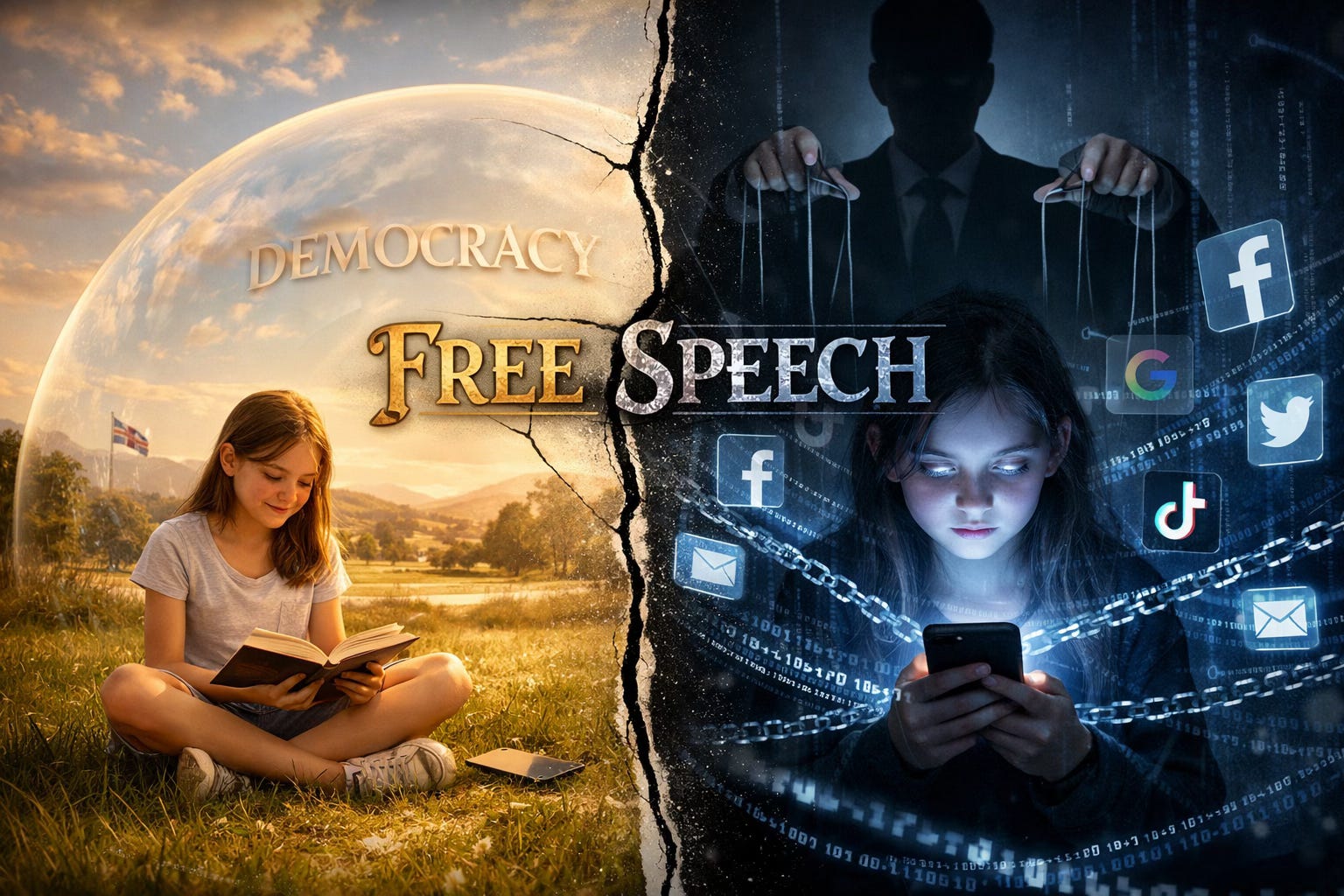
The 2025 National Security Strategy (NSS) treats European democracy as an ideological adversary while accommodating authoritarians. The domestic “free speech” movement uses identical logic. They’re components of the same project.
If you want to just listen to a discussion about this article or watch a summary, jump to the bottom.
I. Two Screens, Two Worlds
It’s December 10, 2025. In Sydney, a twelve-year-old named Flossie Brodribb stands before a gathering of parents and lawmakers. Behind her, Instagram and TikTok accounts held by over a million Australian children are being deactivated. “This ban is bold and brave,” she tells the crowd. “I believe it will help kids like me to grow up healthier, safer, kinder, and more connected to the real world.”
Australia has just become the first nation to ban children under 16 from major social media platforms—Facebook, Instagram, TikTok, YouTube, X, Snapchat, Reddit. Companies face fines up to $50 million. The Communications Minister frames it simply: “With one law, we can protect Generation Alpha from being sucked into purgatory by predatory algorithms described by the man who created the feature as ‘behavioral cocaine.’”
Seventy-seven percent of Australians support the law. Denmark, Norway, France, Spain, Malaysia, and New Zealand are watching closely. The European Parliament has endorsed a similar EU-wide minimum age of 16. Officials call it “the first domino.”
Now look at the other screen.
Six days earlier, the Trump administration released its National Security Strategy (NSS) identifying a peculiar threat: European democracy. Not European authoritarianism. European democracy—specifically, the regulatory frameworks that allow governments like Australia’s to protect citizens from predatory algorithms.
The NSS describes EU platform regulation as “censorship.” It calls for America to “cultivate resistance” within allied nations. It promises support for “patriotic parties” who oppose the very kind of democratic oversight Australia just implemented.
And on December 11, Trump signed an executive order creating an “AI Litigation Task Force” to sue American states that pass similar protections.
Two democracies. Two responses to the same threat. One protects its children from behavioral cocaine. The other sues to ensure the dealers operate freely.
II. The NSS and Europe: Treating Democracy as the Enemy
The NSS treats the European Union, America’s closest democratic ally, with language once reserved for adversaries.
On Platform Regulation: The EU’s Digital Services Act, requiring platforms to address disinformation and illegal content, is framed as “censorship” America must oppose.
On Political Parties: The document calls for supporting “patriotic parties” within European nations, parties that often oppose EU integration and share platforms with figures like Viktor Orbán.
On Cultural Identity: “Ensuring that Europe remain European” appears as a legitimate strategic concern, language with obvious civilizational implications.
Compare this to actual authoritarian governments:
On Saudi Arabia: Accept them “as they are” without “hectoring about internal governance.”
On Russia: Despite documented election interference and an ongoing invasion of Ukraine, the NSS fails to identify Russia as a primary threat. The Kremlin praised the document.
On China: While rhetorically hawkish, the administration refused to enforce a bipartisan law, upheld unanimously by the Supreme Court, requiring TikTok’s divestiture from Chinese ownership. Security concerns, it seems, are negotiable.
To understand why democratic Europe is treated as an adversary, understand what EU regulations actually threaten: the ability to manipulate populations at scale without democratic accountability.
The EU’s Digital Services Act requires platforms to explain how their algorithms work, offer users alternatives to personalized feeds, and address illegal content and disinformation. The AI Act requires safety assessments for high-risk systems. The Digital Markets Act prevents the largest platforms from unfairly privileging their own services. These aren’t attacks on American business, they’re guardrails on behavioral manipulation.
As we documented in previous analyses, figures like Curtis Yarvin have explicitly theorized a “technological republic” where democracy is replaced by CEO-monarchs. Peter Thiel funds Praxis Nation, a project to build a “sovereign network” outside democratic governance. The vision is explicit: governments are obstacles to route around, and whoever controls information systems controls reality.
European regulation threatens that vision at its core. If platforms must explain their algorithms, they can’t secretly optimize for division. If AI systems require safety assessments, they can’t be deployed to manipulate elections. If disinformation must be addressed, information warfare becomes harder. Every law Australia passes, every regulation Europe implements, every American state that demands transparency, each one shrinks the territory where tech barons can operate as de facto sovereigns.
JD Vance made this explicit at an AI summit in France, warning against “tightening regulations on tech companies that project soft U.S. power abroad.” Note the framing: platform manipulation is “soft power.” Democratic oversight is the enemy.
When Elon Musk called for the EU to be “abolished” after it fined X €140 million for DSA violations, he wasn’t defending free speech. He was defending the right to operate behavioral modification systems without democratic constraint. When Vance suggested halting NATO funding if Europe continued fining American platforms, he wasn’t protecting commerce, he was protecting information warfare infrastructure from accountability
III. America’s Own History of Fighting Misinformation
Here’s what the “free speech” narrative omits: the United States has a long history of government action against misinformation, far more aggressive than anything the Biden administration attempted.
The historical baseline: During WWI, the Espionage and Sedition Acts criminalized disloyal speech; Eugene Debs was imprisoned for ten years. During WWII, the Office of War Information coordinated propaganda across all media. For 38 years (1949-1987), the FCC’s Fairness Doctrine legally required broadcasters to present balanced coverage, the Supreme Court unanimously upheld this as “essential to democracy.”
What Biden actually did: In 2021, White House officials flagged content they believed was dangerous COVID misinformation and asked platforms to review it. Press Secretary Jen Psaki disclosed the administration was in “regular touch” with platforms and wanted them to “move more quickly to remove harmful, violative posts.” Court records show officials expressed frustration when platforms moved slowly, emails with subject lines like “You are hiding the ball.” President Biden said platforms were “killing people,” then walked it back days later.
How platforms responded: This is critical, platforms made their own decisions and frequently said no. Meta removed over 20 million posts under policies the company had independently announced before Biden’s flagging began. Spotify kept Joe Rogan despite White House criticism, adding disclaimers but rejecting calls to remove content. In Zuckerberg’s 2024 letter to Congress, he said Meta “regrets” some decisions and felt “pressured,” but stated: “I feel strongly that we should not compromise on content standards due to pressure from any Administration in either direction.”
The legal verdict: The Supreme Court ruled 6-3 in Murthy v. Missouri that plaintiffs lacked standing, they couldn’t prove government caused content removals rather than platforms’ own policies. Justice Barrett noted platforms “had strengthened their pre-existing content moderation policies before the government defendants got involved.” Justice Alito dissented, warning the decision “permits the successful campaign of coercion in this case to stand as an attractive model for future officials.”
What didn’t happen: No one was prosecuted. No one was imprisoned. No broadcast licenses were threatened or revoked. No media outlets were sued by the government. No funding was cut for critical coverage.
The irony: The same movement calling Biden-era flagging “censorship” now uses actual government power—license threats, lawsuit settlements extracted through regulatory pressure, defunding public media—to punish speech it dislikes.
IV. The Domestic Mirror
A chorus from Fox News to Jim Jordan to state legislatures has built the case that liberals are “the party of censorship.” Some observations contain truth—platform moderation has sometimes been arbitrary, and the Murthy case revealed officials expressing frustration when platforms moved slowly.
But the Trump administration’s actual actions reveal what “free speech” means in practice.
Threatening Broadcast Licenses: Trump stated explicitly: “They give me only bad publicity... I would think maybe their license should be taken away.” FCC Chair Brendan Carr launched formal reviews of ABC, CBS, NBC, NPR, and PBS. Fox escaped scrutiny entirely.
Extracting Settlements: CBS paid $16 million; ABC settled for $15 million. The settlements came as both companies had business pending before the FCC. As Commissioner Anna Gomez observed, these companies “will need regulatory approval of their transactions.”
Defunding Public Broadcasting: Congress rescinded $1.1 billion in NPR/PBS funding. The stated reason: “bias”—meaning critical coverage.
Suspending Critics: Jimmy Kimmel was suspended from ABC after Carr publicly threatened regulatory action. Nexstar and Sinclair—both with FCC business pending—pulled Kimmel within hours of Carr’s warning.
The Consolidation Play: Here’s what’s happening beneath the license threats: the FCC is simultaneously moving to eliminate the 39% ownership cap that prevents broadcast monopolies. The beneficiaries would be companies like Nexstar and Sinclair, the same companies that pulled Kimmel within hours of Carr’s threats. Both have extensive business pending before the FCC. Nexstar’s proposed $6.2 billion Tegna merger requires lifting the cap.
A 2019 study found media consolidation is associated with “a substantial increase of national news at the expense of local news, as well as a significant rightward shift in the ideological slant of the coverage.” Sinclair is notorious for mandating “must-run” conservative commentary across its hundreds of local stations.
Free Press summarized: “Chairman Carr is placing a for-sale sign on the public airwaves and inviting media companies to monopolize the local news markets as long as they agree to display political fealty to Donald Trump and the MAGA movement. The price broadcast companies have to pay for consolidating further is bending the knee.”
A recent poll found 89% of Democrats, 74% of Republicans, and 77% of independents oppose loosening ownership rules. The FCC is moving forward anyway.
The States’ Rights Hypocrisy: The December 11 AI executive order creates a federal “AI Litigation Task Force” to sue states over AI regulation. It explicitly targets Colorado’s algorithmic discrimination law, claiming it forces AI to produce “false results.” Trump stated: “Some States are even trying to embed DEI ideology into AI models, producing ‘Woke AI.’”
The contradiction is stark: the same party that invoked states’ rights to overturn Roe v. Wade now creates federal task forces to override state consumer protections (we need to remember, these are products). When states restrict abortion, that’s constitutional federalism. When states protect citizens from algorithmic discrimination or require AI transparency, the federal government must sue them into compliance.
The principle isn’t federalism. It’s power. States can regulate what the movement wants regulated and cannot regulate what it wants deregulated.
The “Woke AI” Procurement Infrastructure: The same day Trump signed the executive order targeting states, OMB issued Memorandum M-26-04 implementing “Preventing Woke AI in the Federal Government.” The policy requires AI vendors seeking federal contracts to demonstrate compliance with two “Unbiased AI Principles”: “truth-seeking” and “ideological neutrality.”
The definitions reveal the framework’s logic. “Truth-seeking” means LLMs “shall be truthful” and “prioritize historical accuracy, scientific inquiry, and objectivity.” But the executive order claims Colorado’s anti-discrimination law “may even force AI models to produce false results in order to avoid a ‘differential treatment or impact’ on protected groups.” Follow the reasoning: if an algorithm systematically disadvantages protected groups, that output is “truthful.” If you require the algorithm not to discriminate, you’re forcing it to produce “falsehoods.”
Discrimination equals truth. Anti-discrimination equals ideology.
“Ideological neutrality” means developers “shall not intentionally encode partisan or ideological judgments into an LLM’s outputs”—language that frames algorithmic fairness measures as partisan bias. Vendors must also disclose “any modifications or configurations undertaken to comply with any regulation from a government other than the U.S. Federal Government.” European regulatory compliance is explicitly treated as potential ideological contamination requiring disclosure.
The framework operationalizes what the NSS declares: democratic oversight of AI systems—European or American—is an ideological threat. “Truth” is whatever an unregulated model produces. “Bias” is any attempt to ensure it doesn’t discriminate.
Criminalizing Opposition: The December 4 Bondi memo completes the picture. Implementing Trump’s NSPM-7, Attorney General Pam Bondi directed all federal law enforcement to compile files on groups exhibiting “ideological indicia” of domestic terrorism—defined as “anti-Americanism, anti-capitalism, anti-Christianity,” “radical gender ideology,” and “hostility towards traditional views on family, religion, and morality.” The FBI must create tip lines and cash rewards for identifying leaders of these “terrorist” organizations.
A footnote claims “no investigation may be opened based solely on activities protected by the First Amendment.” But the memo simultaneously defines protected speech, including “doxing”, as terrorism. As Lawfare noted, the pattern echoes the Church Committee’s 1975 findings: political opposition reframed as security threat, informal blacklists, targeting beliefs rather than conduct.
The same movement claiming Biden “censored” Americans by flagging COVID misinformation is building infrastructure to criminalize political viewpoints as terrorism. “Free speech” protects aligned speakers. Opposition is domestic terrorism.
V. The MI6 Counterpoint
Ten days after the NSS, MI6 Chief Blaise Metreweli delivered what reads as a point-by-point rebuttal, without ever naming the United States directly.
On Russia: NSS: Doesn’t identify Russia as a direct threat. The Kremlin praised the document. Metreweli: “We all continue to face the menace of an aggressive, expansionist and revisionist Russia, seeking to subjugate Ukraine and harass NATO. I find it harrowing that hundreds of thousands have died... because of Putin’s historical distortions.”
On Information Warfare: NSS: European responses to disinformation = “censorship” Metreweli: “The algorithms flatter our biases and fracture our public squares. And as trust collapses, so does our shared sense of truth—one of the greatest losses a society can suffer.”
On Technology: NSS: Deregulate AI for “dominance” Metreweli: “The defining challenge of the twenty-first century is not simply who wields the most powerful technologies, but who guides them with the greatest wisdom... Power itself is shifting from states to corporations, and sometimes to individuals.”
The head of British intelligence identifies algorithmic manipulation, not platform regulation, as the threat. “The front line is everywhere. Online, on our streets, in the minds and on the screens of our citizens.”
VI. The TikTok Paradox
Congress passed a bipartisan law requiring TikTok’s divestiture. The Supreme Court upheld it unanimously, citing genuine security concerns: Chinese laws requiring intelligence cooperation, 170 million Americans’ behavioral data, a weaponizable algorithm.
Trump refused to enforce the law, announcing he was “working on a deal” to keep Chinese ownership. Legal experts called this “maybe the broadest assertion of presidential power to ignore congressional statutes... ever.”
The contradiction is total:
Chinese algorithmic manipulation of 170 million Americans = negotiable business matter
European regulation of algorithmic manipulation = censorship requiring “resistance”
American state regulation of AI = ideological bias requiring federal lawsuits
Russian information warfare = unmentioned in NSS
If the concern were algorithmic manipulation, it wouldn’t matter who owned the algorithm. The concern clearly isn’t manipulation, it’s who gets to do the manipulating.
VII. What the First Amendment Actually Says
“Congress shall make no law... abridging the freedom of speech, or of the press.”
Read it carefully. The First Amendment restricts government, not private actors. It means:
Government cannot punish speech it dislikes
Government cannot retaliate against media for critical coverage
Government cannot use regulatory power to coerce favorable treatment
Government cannot condition benefits on ideological alignment
Now look at what’s happening:
Christmas Eve 2024: Trump posts on Truth Social: “If Network NEWSCASTS, and their Late Night Shows, are almost 100% Negative to President Donald J. Trump, MAGA, and the Republican Party, shouldn’t their very valuable Broadcast Licenses be terminated? I say, YES!”
September 2025: Trump tells reporters: “They give me only bad publicity, press. I mean, they’re getting a license. I would think maybe their license should be taken away.”
The President is explicitly stating that broadcast licenses should be revoked based on the political content of coverage. This isn’t ambiguous.
The FCC as Enforcement: Chair Carr launches reviews of ABC, CBS, NBC, NPR, PBS. He resurrected a dismissed investigation of CBS’s 60 Minutes. Fox escapes scrutiny entirely. Carr wrote in 2019: “FCC does not have a roving mandate to police speech in the name of the public interest.” By 2025, he’s investigating networks for unfavorable coverage.
Settlements as Coercion: CBS paid $16 million; ABC paid $15 million. These came as both companies sought FCC merger approvals. Days after CBS’s settlement, Carr met with Skydance’s CEO, received “unbiased journalism” assurances, and approved the Paramount merger. These weren’t legal victories, they were payments extracted through implicit regulatory threats.
The Constitutional Violation: When Biden officials flagged misinformation for platforms to review, critics called it censorship, though platforms decided independently and no government power was exercised.
When Trump threatens licenses for negative coverage, extracts settlements through regulatory pressure, defunds public media for bias, and celebrates the suspension of critics—that’s actual government suppression of speech.
The distinction isn’t subtle. It’s the entire point of the First Amendment.
VIII. What “Free Speech” Has Come to Mean
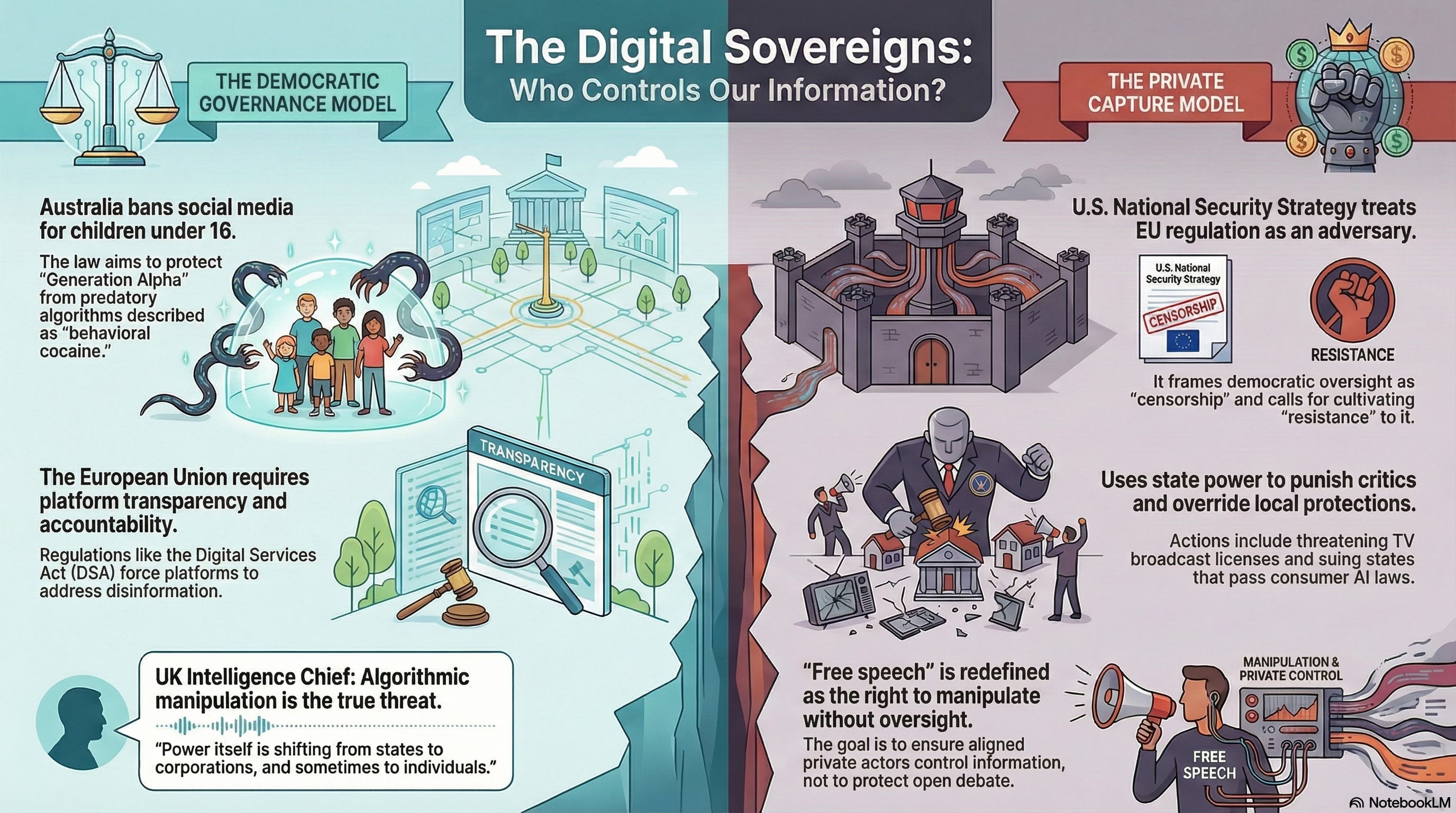
Strip away the rhetoric:
“Free Speech” Means:
Platforms don’t moderate content the administration finds useful
Government doesn’t fund critical media
European hate speech laws are abolished
AI produces outputs serving aligned interests
Aligned billionaires control information systems without oversight
“Free Speech” Does NOT Mean:
Government can’t threaten licenses for criticism
Government can’t sue media into settlements
Government can’t defund broadcasting for ideology
States can’t regulate algorithmic discrimination
Europe can’t address disinformation
The principle isn’t speech—it’s power. Who controls systems shaping political reality? The answer: not democratic institutions. Control belongs with aligned private actors, and government will use its power to ensure that outcome.
This is the inversion of the First Amendment. Government is supposed to be constrained from suppressing speech. Instead, government suppresses speech it dislikes while claiming democratic oversight of private actors is the real censorship.
IX. The Choice
We’ve traced this through multiple lenses: the tokenization of democracy through crypto, the industrialization of division through algorithms, the data heist disguised as efficiency, the TikTok capture disguised as national security.
The NSS adds the ideological dimension: democratic governance—European or American—as obstacle rather than value.
“Free speech” isn’t the principle being defended. It’s the rhetorical vehicle for consolidating control over information systems in aligned private hands while delegitimizing democratic oversight.
Consider what’s being built: An FCC that threatens licenses for critical coverage while eliminating ownership limits, allowing compliant conglomerates to consolidate. A federal government that sues states for protecting citizens from algorithmic discrimination. A framework where European platform regulation is “censorship” but American license threats for negative coverage are legitimate.
When MI6’s chief warns that “power is shifting from states to corporations, and sometimes to individuals,” she describes exactly what the NSS celebrates. The question isn’t whether information systems will be governed, it’s whether democratic publics will govern them, or whether they’ll be governed by whoever has enough money and power to capture them.
Australia bans social media for children to protect them from “behavioral cocaine.” The Trump administration creates litigation task forces to prevent American states from doing the same.
The question is which vision prevails: democratic governance of information systems, or private capture under the banner of “free speech.”
That’s not a debate about censorship. It’s a debate about who rules.
This piece extends previous analyses: “The Tokenized Presidency” on crypto corruption, “The TikTok Heist” on algorithmic capture, “The Signal” on manufactured division, and “Our Tech Overlords” on surveillance architecture. The NSS provides the ideological framework unifying these projects.
New features:
Generative AI is getting kind of crazy, these are created just by putting this article in:
Video:
Audio:
Sources
Australia Social Media Ban
2025 National Security Strategy
Brookings: Breaking Down Trump’s 2025 National Security Strategy
CBC: Kremlin says Trump’s new national security plans ‘correspond in many ways to our vision’
Al Jazeera: Russia welcomes Trump’s revised US security strategy
December 11 AI Executive Order
White House: Ensuring a National Policy Framework for Artificial Intelligence
Crowell & Moring: Executive Order Tries to Thwart “Onerous” AI State Regulation
Biden Administration and Platform Communications
NPR: Supreme Court sides with Biden administration in social media case
NBC News: Supreme Court tosses out claim Biden administration coerced social media companies
FCC Actions and Media Consolidation
Free Press: More Chickens for Broadcasters That Obey the FCC’s Censorship Mandate
The Desk: Poll: Most Americans oppose loosening broadcast ownership rules
Bondi Memo and Domestic Terrorism Designations
FIRE: DOJ plan to target ‘domestic terrorists’ risks chilling speech
Lawfare: The Bondi Memo’s Quiet Rewriting of Domestic Terrorism Rules
Democracy Now: Trump Admin Targets “Anti-Americanism, Anti-Capitalism, Anti-Christianity”
MI6 Speech
GOV.UK: Speech by Blaise Metreweli, Chief of SIS, 15 December 2025
CNN: UK’s new spy chief warns the ‘front line is everywhere’ amid growing threat from Russia
ITV News: New MI6 chief describes a ‘dangerous world’ amid growing Russian threat
Historical Context
EU Regulations