
The False Premise: Power and Constraints
When the people who screamed “dictator” for eight years go silent

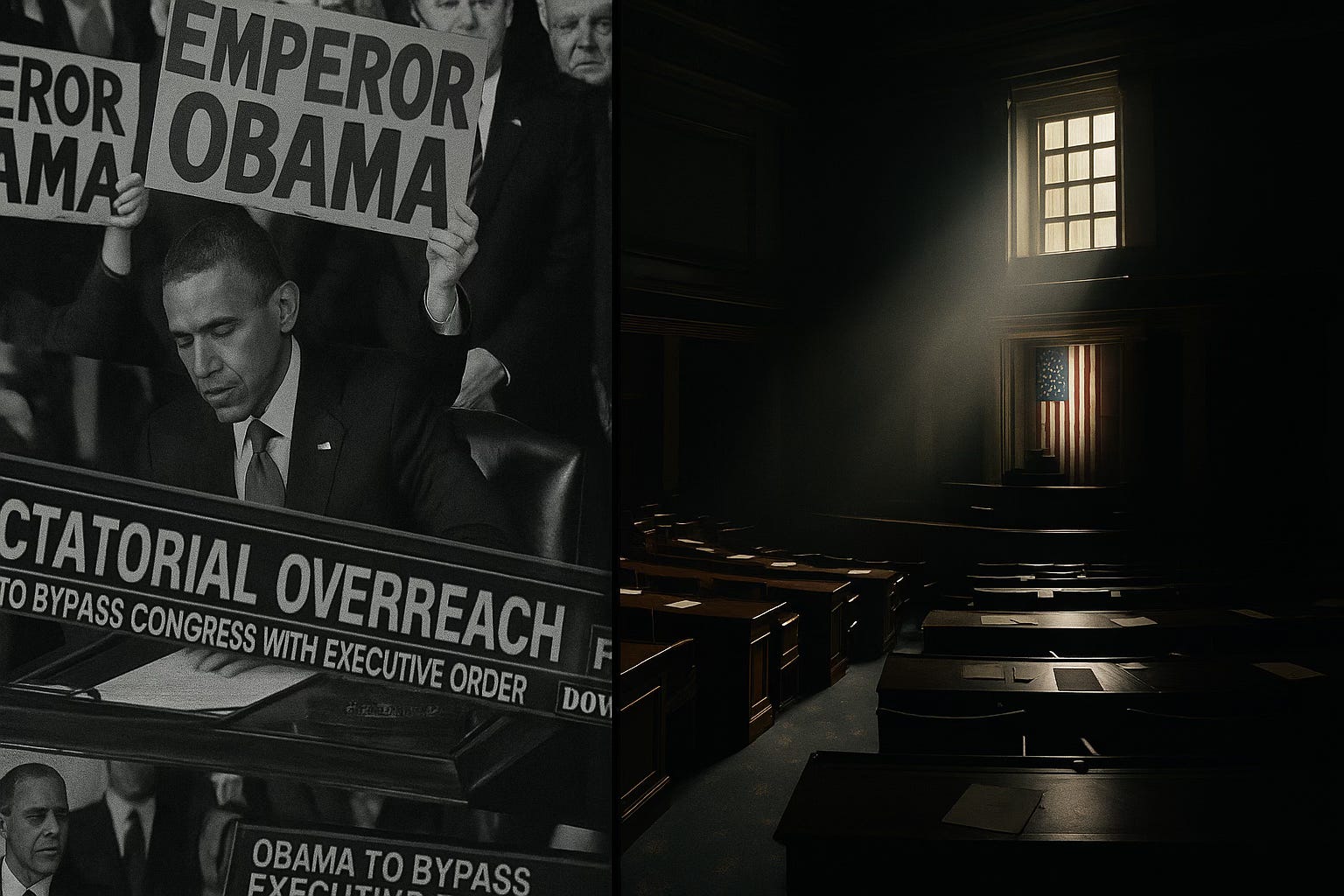
Approximately 1,500 January 6 participants pardoned on day one. 17 inspectors general fired in a single night—a federal judge later ruled the firings violated statutory notice requirements. Federal court proceedings over troop deployments met with continued operations while the administration seeks emergency Supreme Court relief. National Guard federalized over governors’ objections in California and Oregon.
And the people who spent eight years calling Obama an “emperor” and Biden a “wannabe dictator”? Silent.
Here’s the premise they’re implicitly defending: Trump should have sweeping presidential power because previous presidents were unusually restrained. If Trump needs all this authority, it must mean Obama and Biden held back when they could have done the same.
Let’s test that premise.
The question isn’t whether presidents should have power—it’s what happens when that power meets resistance. Do courts constrain them? Does Congress push back? Do inspectors general investigate? Do institutional norms hold?
Previous presidents faced those constraints and, crucially, accepted them. Trump’s second term is testing whether any of them still apply when the president refuses to comply and his party refuses to object.
The Authority Question: What Happens When Power Meets Resistance
Presidential power is defined by what happens at the boundaries—when courts say no, when Congress objects, when watchdogs investigate.
The pattern under Obama and Biden: Courts blocked DAPA (3.9 million deportation deferrals). Obama complied. Courts blocked student loan forgiveness ($430 billion) and vaccine mandates (80 million workers). Biden withdrew both. Republicans called them dictators. But when courts ruled, both presidents accepted the constraint.
The pattern under Trump’s second term: District Judge Charles Breyer ruled in June 2025 that LA troop deployment violated the Posse Comitatus Act, calling the rationale “contrived.” The administration continued deployments while seeking emergency stays. By October, a divided 9th Circuit panel ruled the president likely has authority to federalize the Guard under certain circumstances, though deployment limits remain litigated. Throughout, operations continued.
The difference: previous presidents complied with district court orders during normal appeals. Trump’s administration continues challenged operations while seeking emergency Supreme Court intervention to bypass lower courts.
What They Said vs. What They Accept

What Republicans called tyranny under Obama/Biden:
“Emperor Obama” for DACA/DAPA attempts that courts blocked and he abandoned
“Dictatorial overreach” for executive orders (Obama averaged 35/year)
“Wannabe dictator” for student loan forgiveness Biden withdrew after courts ruled
Congressional outcry over Obama’s single controversial IG removal attempt in 2009
“Unpresidential” and “divisive” when Obama called Republican tactics “hostage-taking”
Outrage when Biden called MAGA philosophy “semi-fascism”
What Republicans accept under Trump:
210 executive orders through October 2025 (Federal Register data)
17 inspectors general fired in one night; federal judge ruled firings violated Inspector General Act notice requirements
Continued operations during court challenges while seeking emergency stays (vs. Obama and Biden complying during appeals)
National Guard federalized in California over Governor Newsom’s objections—first such action since 1965 for non-civil-rights purposes
Describing domestic opponents as “enemy from within” equivalent to foreign adversaries
Telling 800+ military leaders that Democrats are “vicious people we have to fight”
Posting AI-generated content depicting violence against 7 million peaceful protesters
Supporters explicitly defending “the president shitting on Democrats”
The question isn’t hypocrisy. It’s what this reveals about what they actually opposed.
The Oversight That Constrained Previous Presidents—And Its Systematic Elimination
Presidential power operates within constraints: external checks (Congress, courts, federalism) and internal ones evolved through reform (inspectors general, civil service protections, Senate-confirmed officials). These exist because previous generations learned what happens without them.
Previous presidents faced institutional costs for overreach:
Obama’s 2009 attempt to remove AmeriCorps IG Gerald Walpin triggered bipartisan backlash, resulting in new protections requiring 30-day notice and explanation. When courts blocked DAPA, he complied during appeals despite administrative capacity to continue. When Congress pushed back on Bush’s wartime authority, debates ensued and some programs scaled back.
The constraint wasn’t legal impossibility—it’s that defying courts or eliminating oversight triggered consequences neither party was willing to accept.
What Trump’s second term is testing:
January 2025: 17 inspectors general fired simultaneously without statutory notice. In April, Judge Ana C. Reyes ruled the firings violated the Inspector General Act, calling it an “obvious” violation. Court declined reinstatement; removals remain in effect despite unlawfulness finding.
June-October 2025: Federal courts issue rulings on troop deployments. Administration continues operations while seeking emergency stays. April 2025: Judge James Boasberg found probable cause the administration defied his deportation orders; D.C. Circuit curtailed contempt proceedings in August, but judicial finding of probable defiance remains on record.
Schedule F reinstated: Hundreds of thousands of civil servants stripped of job protections, becoming at-will employees subject to loyalty tests—the 140-year firewall between partisan and professional government removed by executive order.
Congress? Eight emergency declarations in ten months. Federal workforce purges. Military deployments to U.S. cities. Congressional response: one House resolution that failed 49-51. Forty-seven oversight hearings. Zero enforcement actions.
Previous presidents were constrained by institutional pushback that created costs for overreach. Trump’s second term operates where that pushback has evaporated.
The Courts: From Check to Advisory Body
The Supreme Court’s emergency docket—historically reserved for genuine time-sensitive matters like execution stays or election deadlines—has become a routine avenue for bypassing lower court rulings.
Under Obama and Bush, emergency Supreme Court procedures were used sparingly. Under Trump’s second term, the administration shows increased reliance on emergency relief to bypass district and appellate rulings. Rather than comply with lower courts while appealing—the traditional pattern—the administration continues challenged operations while seeking immediate Supreme Court intervention.
Examples across multiple contexts:
District courts block troop deployments → administration seeks emergency Supreme Court stays while operations continue
Courts rule IG firings violated statutory requirements → administration seeks emergency relief from enforcement
Lower courts issue preliminary injunctions → administration requests immediate intervention rather than complying during appeal
This changes the function of judicial review. Previous administrations generally complied with district and appellate orders while pursuing normal appeals. The current pattern—continue operations, seek emergency Supreme Court relief—makes lower court rulings advisory pending higher court intervention.
When Judge Breyer ruled the LA deployment violated Posse Comitatus in June, troops remained while the administration appealed for emergency stays. By October, after months of litigation, a 9th Circuit panel ruled the president likely has federalization authority in some circumstances, though scope remains disputed. Throughout, operations continued uninterrupted.
The administration actively seeks judicial relief through emergency procedures. But the effect is similar to ignoring orders: lower court rulings don’t constrain operations while emergency appeals proceed. And the Supreme Court’s increasing willingness to grant emergency relief reinforces this pattern.
Presidential Language: The Rhetoric → Policy → Institutions Ladder
Presidential language shapes action: label opponents as enemies, justify forceful policy, erode institutional constraints.
George W. Bush: After 9/11, with maximum political capital: “We have seen the unfurling of flags, the lighting of candles, the giving of blood, the saying of prayers in English, Hebrew, and Arabic.” When Democrats called him a liar over Iraq WMDs: “I respect people who don’t agree with me...You’re equally American if you’re a Democrat, Republican, or independent.”
Barack Obama: Called Republican tactics “hostage-taking” and said Fox News “operates with a different set of facts.” When Republicans shut down the government: “This isn’t about me, and it’s not about Democrats. This is about you—all of you.”
Republican reaction: McConnell said Obama’s rhetoric was “needlessly divisive.” Boehner called it “beneath the office.” Fox News ran “Obama’s Divisive Rhetoric” segments repeatedly.
Joe Biden: Called MAGA philosophy “semi-fascism” and said MAGA Republicans “represent an extremism that threatens the very foundations of our republic.” Also said: “I’m President for all Americans, whether you voted for me or not.”
Republican reaction: Graham called it “the most divisive speech I’ve ever heard from an American president.” McCarthy said Biden “has chosen to divide, demean, and disparage.” Congressional Republicans called it “dangerous.”
Donald Trump: To 800+ generals and admirals (Sept 30, 2025): “They’re vicious people that we have to fight, just like you have to fight vicious people.” Called Democrats “bad people” who don’t respect the military. On “enemy from within”: “We have some very bad people, some sick people, radical left lunatics. It should be very easily handled by, if necessary, by National Guard, or if really necessary, by the military.”
Named targets: Called Pelosi “an enemy of the state.” Said Schiff should be prosecuted. Demanded NBC/MSNBC be investigated for “treason.”
October 18, 2025: After 7 million Americans participated in peaceful “No Kings” protests, Trump posted AI-generated video showing himself in a “King Trump” fighter jet dropping what appears to be feces on protesters. VP Vance posted his own crown-and-cape video.
Republican reaction: Near total silence. Senator Mike Johnson: “The President is a counter-puncher.” Conservative media: “Just trolling” to “Democrats deserve it.” Social media supporters explicitly say: “I’m fine with the president shitting on Democrats.”
The Ladder:
Bush: “You’re equally American if you’re a Democrat, Republican, or independent”
Obama: “Hostage-taking” tactics → GOP outraged at divisiveness
Biden: “Semi-fascism” → GOP calls it most divisive speech ever
Trump: “Enemy from within” requiring military force + AI depicting violence against protesters → GOP says “just trolling”
The progression: label → justify force → erode constraints. Previous presidents understood dehumanizing opponents corrodes democracy. That constraint is gone.
The 2026 Question
By November 2026, Americans vote in midterms. Federal troops are deployed to Democratic cities. The administration calls Democratic voters “the enemy from within” and posts content depicting violence against them. Courts issue orders met with continued operations during emergency appeals.
This isn’t speculation—it’s pattern recognition. The administration that pardoned 1,500 January 6 participants, fired 17 inspectors general without statutory notice (ruled unlawful), continued operations during court challenges, federalized Guard over governors’ objections, calls opponents “enemies from within,” posts AI violence imagery, and has supporters saying “Democrats deserve it”—will oversee 2026 elections with federal troops in opposition strongholds.
Firsts & Nevers
Unprecedented in Trump’s Second Term (Through October 2025):
First recognition of criminal immunity for core “official acts”: Supreme Court ruling in Trump v. United States (2024) established that presidents enjoy absolute immunity for acts within core constitutional powers and presumptive immunity for other official acts—fundamentally altering accountability framework
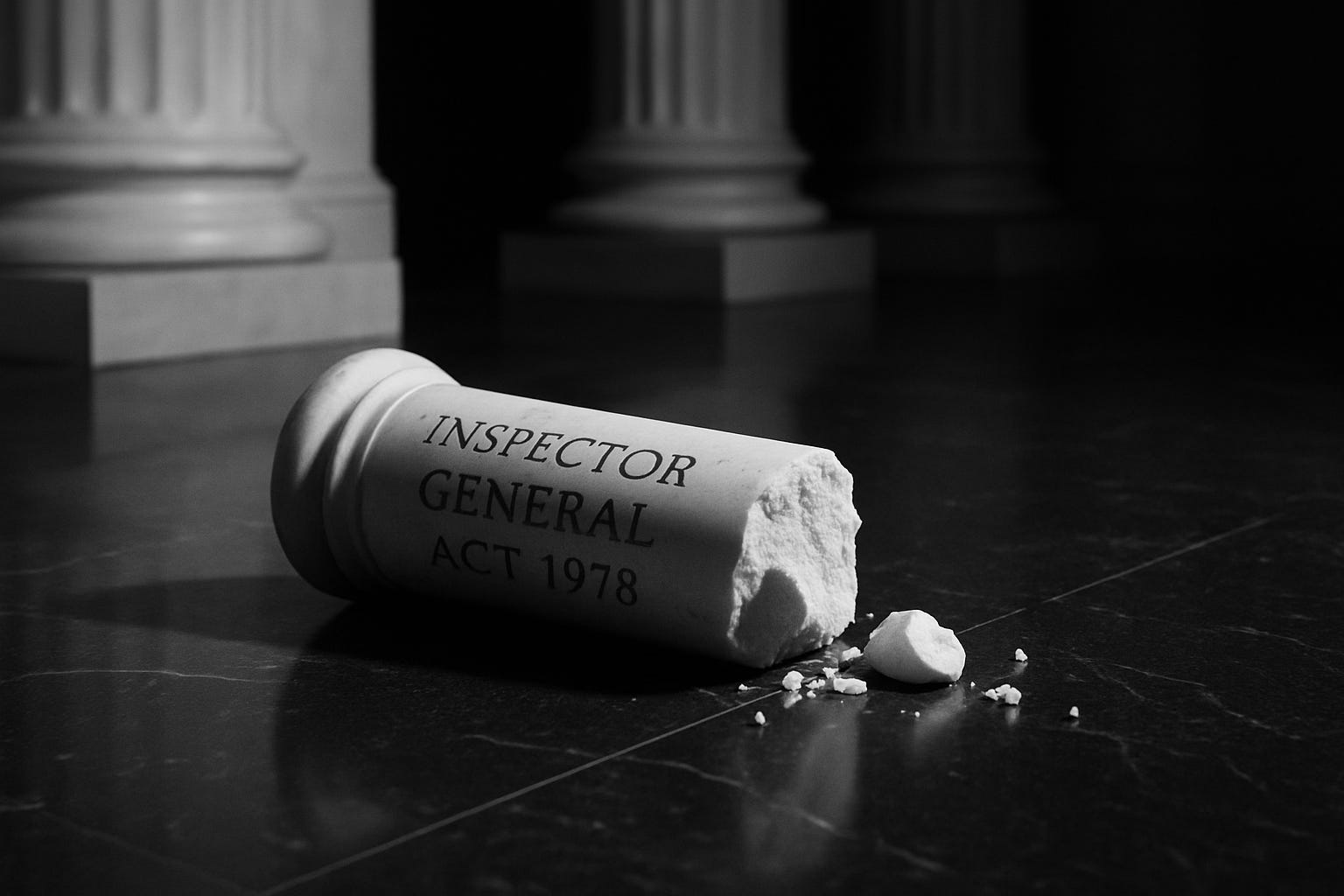
17 inspectors general fired without statutory notice: Federal Judge Ana C. Reyes ruled in April 2025 that the mass removals violated the Inspector General Act’s notice requirements, calling it an “obvious” violation; firings remain in effect despite unlawfulness finding
210 executive orders through October 2025: Exceeds average annual rate of any modern president in comparable timeframe (Federal Register data)
National Guard federalized over governor objection for non-civil-rights purposes: First such deployment since 1965; previous instances enforced constitutional rights against state defiance
What Never Happened Under Obama/Biden:
Continued operations after district courts ruled actions unlawful (both complied during appeal process)
Mass removal of inspectors general without statutory notice
Called domestic political opponents “enemy from within” requiring military response
Posted content depicting violence against peaceful protesters
The Premise Exposed
Were previous presidents unusually restrained? No. Bush pushed wartime authority through military commissions. Obama used aggressive executive action on immigration. Biden expanded executive power on student debt. Trump’s first term challenged nepotism and interference norms.
But they operated within a framework where constraints mattered: courts ruled, they complied during appeals. Watchdogs investigated, they cooperated or faced consequences. Norms created pushback, they adjusted or paid political costs.
The constraint wasn’t legal impossibility—it was institutional cost. Defying courts meant legitimacy loss. Ignoring Congress meant legislative battles. Firing watchdogs triggered backlash.
Trump’s second term tests what happens when those costs evaporate:
Courts issue orders → Administration continues operations while seeking emergency Supreme Court relief
17 inspectors general fired → Federal judge rules it unlawful → Firings remain in effect
Governors object → Troops deploy anyway → Courts issue rulings → Operations continue during litigation
Norms create friction → Norms ignored → Friction disappears
The difference isn’t Trump wanting more power. It’s that institutional resistance constraining predecessors has been systematically tested, bypassed, or rendered inoperative through non-compliance—and his party refuses to restore it.
What This Reveals
The people who screamed “emperor” and “dictator” for eight years never opposed executive overreach—they opposed executive power wielded by someone they didn’t control. They never supported limited government—they supported unlimited power in the right hands. They never wanted courts to constrain presidents—they wanted courts to constrain Democratic presidents.
Now they control executive power and use every tool they once called tyrannical to build a system where:
Courts can be bypassed through emergency relief procedures
Congress can be ignored through endless emergency declarations
Watchdogs can be eliminated despite statutory protections
Governors’ objections can be overridden through federal authority
Institutional norms can be shattered when your party won’t object
Presidential authority hasn’t fundamentally changed. What changed is the willingness to accept constraints on that authority—and the institutional capacity to enforce those constraints when the president refuses to comply and his party refuses to push back.
The Founders designed a system where ambition would counteract ambition. We’re watching what happens when one party’s ambition is to eliminate all counteracting forces—and they have the votes, the courts, and the complicity to do it.
Sources
Executive Orders and Presidential Actions:
Federal Register: Executive Order tracking and verification (federalregister.gov)
Ballotpedia: Executive Order database
Inspector General Firings:
Federal News Network: “Judge says Trump violated law by firing inspectors general, but declines to reinstate them” (April 2025)
Government Executive: Coverage of IG removal litigation and statutory requirements
January 6 Clemency:
Reuters: “Trump grants clemency to approximately 1,500 Jan. 6 defendants on first day in office” (January 2025)
National Guard Deployments and Court Rulings:
The Washington Post: National Guard federalization coverage, court ruling updates, 9th Circuit decisions
Associated Press: Federal troop deployment litigation
CalMatters: Los Angeles deployment timeline and Posse Comitatus analysis
NPR: National Guard deployment legal framework
Contempt Proceedings:
Reuters: Coverage of Boasberg probable cause finding and D.C. Circuit curtailment of contempt proceedings
Trump v. United States:
The Washington Post: Supreme Court immunity decision analysis and implications
Supreme Court of the United States: Trump v. United States (2024)
Additional Analysis:
Brennan Center for Justice: Presidential emergency powers and domestic military deployment analysis
Posse Comitatus Act legal framework and historical application
It's interesting how you frame the authority question by boundaries. How do you see a president's refusal to comply redefing those power structures versus just pushing against them?