
Silicon Immigrants
The End of the Human Monopoly on Work

I. The Ghost in the Cab
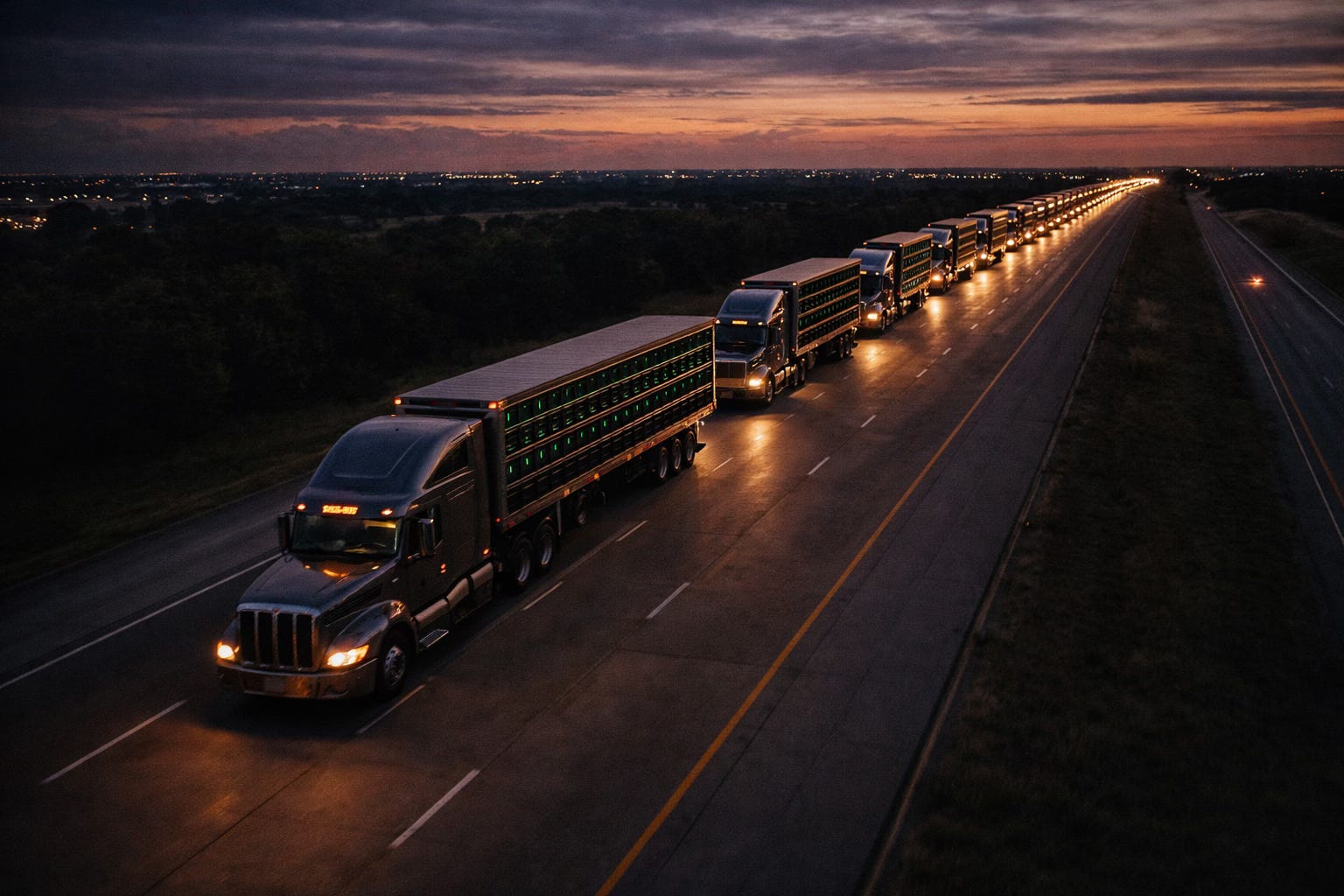
You’re driving on I-45, somewhere between Dallas and Houston. An 18-wheeler passes you, chrome glinting under the December sun. For a split second, your mind drifts to the week’s headlines—federal immigration raids, border walls, desperate human migrants seeking a foothold in a country increasingly hostile to newcomers.
But look closer at this truck.
The cab is empty. No driver. No human heart beating behind the wheel.
This is an Aurora freight truck. It has been running this corridor since May 2025, logging over 100,000 accident-free miles. It doesn’t sleep. It doesn’t unionize. It doesn’t require a wage.
But that’s not the real story.
Look at what the truck is carrying.
Inside are racks of NVIDIA Blackwell GPUs—chips worth $30,000 to $70,000 each, capable of running AI systems that can do the work of hundreds of humans. Morgan Stanley reported the entire 2025 production was sold out before the year even started. These chips are being delivered to one of over 11,800 data centers worldwide. Google now operates 1 million GPU equivalents. Microsoft has 700,000.
Each GPU rack that rolls off that truck will spawn thousands of AI agents. NVIDIA’s CEO Jensen Huang envisions 100 million AI agents working alongside 50,000 humans, a ratio of 2,000 digital workers for every person.
This truck isn’t smuggling immigrants.
It’s delivering them.
These are the Silicon Immigrants—autonomous systems and robots being deployed by the millions into every office, warehouse, and hospital in America. Unlike every previous wave of migration, which brought new neighbors to our shores, this one was designed to ensure that once they arrive, there is no work left for the locals.
II. What Are Silicon Immigrants?
When you hear “AI,” you probably think of ChatGPT. A chatbot. You type a question, it types an answer. A tool.
That’s not what’s going to replace all the workers.
There are four generations of AI. Most people only know the first.
Generation 1: Chatbots (2022-2024)
This is the AI you know—ChatGPT, Claude, Gemini. You ask a question, it gives an answer. It’s a tool. The humans were still in control, still employed.
Generation 2: AI Agents (2024-NOW)
This is what’s deploying right now, and most people haven’t noticed the shift.
An AI agent doesn’t just answer questions, it acts. You don’t give it a prompt; you give it a goal. It figures out the steps, makes decisions, uses tools, and completes tasks. Autonomously. Without asking for permission at each stage.
The difference is the difference between a reference librarian and an employee. A chatbot answers “What’s the return policy?” An agent processes the return, updates inventory, issues the refund, and emails the customer, all without human involvement.
Klarna deployed an AI agent for customer service in February 2024. Within a month, it was handling two-thirds of all customer chats, the equivalent workload of 700 full-time employees. Not assisting 700 workers. Replacing them. Resolution time dropped from 11 minutes to 2 minutes. Customer satisfaction stayed the same. Klarna’s CEO announced the company would stop hiring entirely and let natural attrition shrink the workforce.
This pattern is now repeating across every industry.
Generation 3: AGI (2026-2028?)
Artificial General Intelligence. AI that can perform any cognitive task a human can do, across any domain, without specialized training for each new task.
Today’s AI agents are narrow, they excel at specific jobs they’ve been configured for. AGI won’t need configuration. Give it a new problem it’s never seen, in a field it’s never worked in, and it figures it out—faster, cheaper, and without forgetting.
The leaders building these systems aren’t hedging their timelines anymore. Anthropic’s CEO Dario Amodei says AGI arrives “by 2026 or 2027.” OpenAI’s Sam Altman believes it could come “reasonably soon.” Google’s Demis Hassabis and Sergey Brin are publicly stating AGI is Google’s primary goal. The companies are in an open race, measuring the finish line in months, not decades.
When AGI arrives, the question isn’t which jobs it can do. The question is which jobs it can’t. Any job that uses a computer as an interface is in the crosshairs.
Generation 4: ASI (2030s?)
Artificial Superintelligence. AI that doesn’t just match human cognitive ability, it surpasses it. In every domain. By margins we can’t predict. Altman has said superintelligence could arrive “within a few thousand days” of AGI. At that point, the economic question isn’t about displacement. It’s about whether human labor has any value at all.
The original Industrial Revolution took a century to move workers from farm to factory.
We are compressing four generations of AI, from tool to assistant to equal to superior, into less than a decade.
III. The Players: Who’s Building This?
The Compute Barons
Jensen Huang (NVIDIA) — The Arms Dealer Provides the hardware for the entire AI race. Predicts 100 million AI agents alongside 50,000 humans—a ratio of 2,000 digital workers for every person. NVIDIA’s revenue: $35.1 billion in Q3 2024 alone, up 94% year-over-year.
Sam Altman (OpenAI) — The Architect of Scale AI will replace coding jobs “in a gradual but accelerating manner.” Pushed the shift from chatbots to autonomous agents. Currently negotiating a $100 billion partnership with NVIDIA for 10 gigawatts of AI infrastructure.
Dario Amodei (Anthropic) — The True Believer “By 2026 or 2027, AI systems will be better than almost all humans at almost all things.” Predicts AI will write “90% of all code“ within months.
Elon Musk (xAI/Tesla) — The Accelerationist xAI targets compute equivalent to 50 million GPUs by 2030—45 times the power of the world’s current top supercomputer. Tesla plans 1 million Optimus humanoid robots annually by 2027.
Google’s Leadership — The AGI Hunters Sergey Brin crashed Google I/O 2025 unannounced to declare the company’s goal: “Build the world’s first AGI.” CEO Sundar Pichai calls 2025 “critical” and “disruptive.” DeepMind’s Demis Hassabis—fresh off his 2024 Nobel Prize in Chemistry for AlphaFold—plans to “turbocharge” Gemini into a “universal assistant” across any domain. Market cap: $3.5 trillion. All three pulling in the same direction.
These men are not predicting displacement. They are promising it to their shareholders.
The Political Accelerators
President Trump — Executive Order 14179: Fast-tracked AI infrastructure. Data centers can bypass local environmental reviews under “national security urgency.” Converted the AI Safety Institute into the “Center for AI Standards and Innovation”—focused on promotion, not protection.
Vice President JD Vance (February 2025): “Excessive regulation of the AI sector could kill a transformative industry just as it’s taking off.”
Senator Ted Cruz (R-TX) — Chair, Senate Commerce Committee: America needs to “remove restraints on the AI supply chain and unleash American dominance.” Drafted legislation for a ten-year moratorium on state AI regulation. Released a “light-touch” regulatory framework and the SANDBOX Act to waive federal regulations for AI developers.
The House passed the moratorium 215-214. One vote. The Senate is next.
The Resistance
Senator Ed Markey (D-MA): “A 10-year moratorium on state AI regulation won’t lead to an AI Golden Age. It will lead to a Dark Age for the environment, our children, and marginalized communities.”
Representative Frank Pallone (D-NJ): Called the moratorium a “giveaway to big tech.”
State legislators from 32 states signed a letter opposing the federal moratorium, arguing states must be able to protect their residents when Congress fails to act.
Governor Gavin Newsom (D-CA): Vetoed California’s AI safety bill SB 1047—but also vetoed bills banning self-driving trucks without human operators. The message: California wants AI development, just on its own terms.
The Warning Voices
From the Creators (If you’re only going to watch one interview, watch Blaise Metreweli)
Yoshua Bengio — Godfather of Deep Learning: “Scared for his grandson.” Believes even a 0.1% chance of AI-led human extinction is “unbearable.” Endorsed the whistleblower letter calling for AI safety protections.
Geoffrey Hinton — The Other Godfather: Left Google to warn about AI risks. Said he now regrets his life’s work.
Blaise Metreweli — Chief of MI6 (December 2025): “Algorithms and tech bosses will become more powerful than states.”
From the Ethicists
Tristan Harris — Center for Humane Technology (TED 2025): “We are seeing companies caught in a race to go as fast as possible to get to AGI first, driven by market dominance and competitive pressures that reward taking as many shortcuts as possible.” Warned: “Half of AI researchers believe there’s a 10% or greater chance that humans will go extinct from their inability to control AI.”
From the Whistleblowers
Daniel Kokotajlo and William Saunders — Former OpenAI Safety Teams: Both quit OpenAI—Kokotajlo forfeiting millions in equity because he “lost hope that they would act responsibly,” Saunders because OpenAI was “prioritizing getting out newer, shinier products” over safety. Kokotajlo now warns: “It’s an open secret in the industry that we don’t actually know how to control these systems.”
When the people who built the thing are telling us to be afraid, we should listen.
The Labor Movement
Liz Shuler — President, AFL-CIO: “Bring workers in early in the process.”
Lorena Gonzalez — California Federation of Labor: “We cannot allow AI and technology to be our next NAFTA. It is up to us to determine what kind of society we want to live in.”
The Teamsters on the federal moratorium: “A power grab by Big Tech—and a direct threat to workers.”
SAG-AFTRA and the Writers Guild won the first major contract provisions against AI replacement after the 2023 strikes. Unions representing 15 million workers are demanding a seat at the table. So far, the table is full of billionaires.
IV. “I’m Safe. I’m a Professional.”
“I’m a software engineer. AI can’t really code.” “I went to a top CS program. I’ll be fine.” “I’m a lawyer. You can’t automate judgment.”
Here’s what’s actually happening.
The Coders
For a decade, “learn to code” was the safest career advice in America. Parents pushed their kids toward computer science. Universities doubled enrollment. The pipeline was supposed to be bulletproof.
It’s not.
Computer science graduates now face 6.1% unemployment—higher than philosophy majors at 3.2%, art history at 3.0%, and even journalism at 4.4%. Computer engineering is worse: 7.5%. Software development job postings on Indeed have fallen 71% since February 2022. Hiring of new grads by the fifteen largest tech companies is down over 50% since 2019.
What happened? AI coding tools like Cursor and Copilot are eliminating the entry-level positions those graduates were trained for. Microsoft now reports AI writes 20-30% of their code. Then came 15,000 layoffs. Anthropic’s CEO Dario Amodei says AI will write “90% of all code” within months.
The ladder is being pulled up while a generation is still climbing it.
The Lawyers
Law was supposed to be automation-proof. The profession requires judgment, argumentation, the ability to navigate ambiguity, everything AI supposedly couldn’t do.
Then JPMorgan deployed a system called COIN to review commercial loan agreements. Work that used to take lawyers and loan officers 360,000 hours now happens in seconds. Entry-level legal hiring has dropped 17%, and paralegal hiring has fallen 26%. The partners aren’t disappearing, but the pipeline that creates new partners is being dismantled from the bottom up.
The Accountants
Oxford and Deloitte put the probability of accounting automation at 95% within twenty years. Enterprise finance departments have already shrunk 40% since 2004—before generative AI even existed.
The Doctors
Even medicine isn’t immune. Radiology was once considered the gold standard of specialized expertise, years of training to read imaging scans that could mean life or death. Now AI systems detect lung nodules with 94% accuracy; radiologists hit 65%. AI reads mammograms at 90% accuracy versus 78% for human specialists. The machines aren’t catching up to doctors. They’ve already passed them. Hospital systems are already deploying AI diagnostics. The specialists who trained for a decade are discovering their expertise has a shelf life.
The Pattern
The pattern is the same everywhere. First, professionals insist AI can’t do what they do. Then AI handles the routine parts. Then professionals say, “Well, not the complex work.” Then AI does the complex work. Then entry-level positions disappear. Then the pipeline to senior positions breaks.
There is nowhere to hide and we aren’t even discussing the robot revolution yet.
V. The Compressed Industrial Age
The institutions that study labor markets are not known for alarmism. When Goldman Sachs, McKinsey, and the World Economic Forum all converge on the same conclusion, it’s worth paying attention.
Goldman Sachs estimates AI could expose 300 million full-time jobs to automation, with real effects beginning in 2027 and full impact by the late 2030s. McKinsey projects 30% of U.S. work hours automated by 2030. The World Economic Forum estimates 85 million jobs displaced by 2025-2026. The IMF puts it bluntly: almost 40% of global employment is exposed.
The displacement is already underway. In the first half of 2025, 77,999 tech workers lost their jobs. Software job postings have collapsed 71% since 2022. Entry-level positions are vanishing across every white-collar profession.
But here’s what the tech optimists miss: every tech job supports roughly five local service jobs. When a software engineer loses their salary, they stop eating at the local diner. The waitress loses hours. She stops calling the plumber. The plumber doesn’t hire an apprentice. Multiply 77,999 tech layoffs by five, and you get 390,000 service jobs weakened in six months.
If you’re blue-collar, you aren’t safe, you will be starved of your customer base, then the robots come.
By 2027, the second wave hits. Autonomous trucks deploy by the tens of thousands. Tesla plans 500,000 to 1 million Optimus robots annually. Customer service faces 80% automation potential. All sectors hit simultaneously.
The original Industrial Revolution took a century. We are compressing the same displacement into 24 to 36 months.
Currently there are no known plans on the transition that are public facing, and that’s the issue at hand. The one we need to be focusing on.
VI. The Global Fracture
While the U.S. races to deregulate, the rest of the world sees what’s coming.
China: Strict licensing, pilot programs, safety operators required. After a fatal crash in March 2025: immediate regulatory tightening. Deceptive marketing banned.
Canada and EU (December 2025): Signed alliance to resist “U.S. technological dominance.” Relying on U.S. AGI is as dangerous as relying on Russian gas.
MI6 Chief Metreweli: We are in the “Grey Zone”—”the front line is everywhere.”
United States: Federal regulation non-existent. States compete for the loosest rules. A proposed ten-year moratorium would block states from acting even when AI causes measurable harm. “… even if AI systems cause measurable harm, such as through discriminatory lending, unsafe autonomous vehicles, or invasive workplace surveillance.”
We’ve chosen to let it happen as fast as possible without any guardrails.
VII. A Different Path
It doesn’t have to be “Gods or Ashes.”
Narrow AI is a microscope, it helps us see further. AGI is a replacement, it takes the lens away entirely and starts to hand it to the machines.
We could choose a human-centric path:
Fusion Energy: Google DeepMind’s AI now controls plasma inside tokamak reactors at over 100 million degrees Celsius. Their partnership with Commonwealth Fusion Systems could deliver clean, limitless energy by the early 2030s without draining communities to power data centers.
Medical Sciences: AlphaFold predicted the 3D structures of 200 million proteins, a task that would have taken humanity centuries. Over 3 million researchers in 190 countries now use it to develop new drugs. This is AI amplifying human researchers, not replacing them.
Climate Modeling: GraphCast predicts weather up to 10 days in advance, 1,000 times more efficiently than traditional supercomputers. It predicted Hurricane Lee’s landfall three days earlier than conventional methods. This saves lives without eliminating meteorologists.
The distinction: AI that amplifies human capability vs. AI that replaces human capabilities.
We’re currently choosing replacement, not because those building this want that to happen, but because it’s the only economic method to get there. We could choose amplification and also transition, but most don’t even know this is happening.
VIII. The Human Covenant
If the government won’t regulate the race, the people must set the terms of the finish line. Five non-negotiable demands:
1. THE RIGHT TO KNOW: Any AI interacting with a citizen must explicitly identify as AI.
2. HUMAN-IN-THE-LOOP: AI cannot have final sign-off on life-altering decisions—medical diagnoses, criminal sentencing, hiring, firing. Someone must be legally liable.
3. THE GOOD NEIGHBOR POLICY: Data center developers must disclose projected water and energy usage before breaking ground and pay fees so their consumption doesn’t raise local bills.
4. PACE CONTROLS: Major AI deployments should require gradual expansion and community impact assessments before nationwide rollout.
5. THE TRANSITION TAX: Productivity gains from AI must be taxed to fund workforce transition programs. Goldman Sachs projects AI could add 7% to global GDP, roughly $4 trillion annually, that wealth must be shared.
Be skeptical of the techno-optimists. When Altman says AI will create “abundance,” ask: abundance for whom? When Huang promises 100 million AI agents, ask: what happens to the workers they replace?
IX. The New American Dream
Let’s be clear about something: America needs to win the AI race.
This isn’t a question. American leadership in artificial intelligence is better for our security, our economy, and our values than ceding that ground to China or any other nation. The Compute Barons aren’t wrong that this technology will reshape civilization. They’re not wrong that the stakes are existential. They’re not wrong that speed matters.
What they’re currently not talking about is who is part of the victory, and how we get there safely.
This is the start of World War III. Not fought with bombs and battalions, but with data centers and datasets, with compute and code. The battlefield is every office, every factory, every hospital, every home. And right now, the American people aren’t being drafted into this war, they’re being left out of it.
That’s not how America wins wars.
We didn’t win World War II by telling workers to go home while executives figured it out. We won because an entire nation mobilized, not as spectators, but as participants. The AI race demands the same. Not a nation divided between those who build the future and those who get replaced by it. Not Republicans fighting Democrats while China sprints ahead. Not tech billionaires treating workers as legacy costs to be optimized away.
The American Dream was never about a fixed set of jobs. It was about the promise that if you work hard, you can build a life. That promise doesn’t have to die with AI, but it will if we let a handful of executives define the transition without us.
We don’t win by deporting immigrants while Silicon Immigrants take our place. We don’t win by fighting culture wars while the real war is being decided in server farms. We don’t win by pretending this isn’t happening.
We win by doing what Americans have always done: showing up, demanding a seat at the table, and refusing to be written out of our own story.
The American people need to be in on how this transition is going to happen.
Steven Bartlett, host of The Diary of a CEO, has asked all of his recent AI community guests the same question: “If I put a red button in front of you, and pushing it would stop AI development, would you push it?”
They are starting to say “Yes.”
Here’s how to start us on a new path:
Call your senators. The moratorium passed the House 215-214. The Senate is next. States must be able to protect their residents.
Support labor organizing. The AFL-CIO, Teamsters, and 63 unions are fighting for worker voice in automation decisions.
Demand whistleblower protections. Senator Grassley’s AI Whistleblower Protection Act needs co-sponsors.
Support state-level regulation. Over 1,080 AI bills were introduced across 50 states in 2025. Only 118 passed. Your state legislators are accessible.
Talk about it. Your family. Your coworkers. Your community. The silence only benefits those making decisions without you.
That truck on I-45 is almost past you now, carrying its cargo of GPUs to the data center, where they’ll spawn millions of Silicon Immigrants.
The truck isn’t smuggling people. It’s delivering their replacements. And they’re counting on your silence.
The switch exists. It’s called democracy.
Time to use it.