
Our Tech Overlords, Minority Report is Here
Minority Report was an unnerving thriller that warned about predictive policing and invasive surveillance, death to free will. It's now here thanks to DOGE, Trump and Peter Thiel.

With each day we learn more and more about what DOGE was really up to, it was not finding fraud/abuse, saving money, it was just a data heist. After being feed years of lies about the lack of efficiency and abuses of the federal government, MAGA then cheered Musk and others on, never realizing they were giving up their free will to the technocrats. The future of a techno-fascist nation is now here and live.
Palantir has been involved in this since the beginning, Peter Thiel’s company has been linked to war atrocities in Gaza using the very systems that are now going to be deployed in the US. Think a combination of social tracking, risk evaluation and preemptive intervention all coming in the next months after DOGE downloaded tons of our personal data and linked government agency databases. Those databases were intentionally kept apart in the past, now the goal is to combine all of them into one Data Lake that Palantir’s tools can monitor at all times using AI to predict and act without transparency or real oversight.
Background on Tech Nation States
Silicon Valley has been planning the idea of a CEO president using AI for a while now, Curtis Yarvin has been writing about it for years, those with power and money in the tech sector have been listening, they want a technological republic.
They argue that modern liberal-democratic governments are structurally doomed to stagnation because no one really owns them. The fix from their point of view is called “neocameralism” or “Dark Enlightenment” and looks like this:
Turn the state into a for-profit company.
The sovereign becomes a CEO with absolute chartered authority.
The territory is corporate property; residents are “customers” who buy long-term leases, not shareholders.
Real shareholders own and can fire the sovereign.
Shares in the “government-corp” trade on an open market.
If the CEO mismanages (crime rises, services slip, profits fall), investors sack them, much faster than a four-year election cycle.
Security replaces politics.
The regime’s core product is physical security and predictable law, delivered like any commercial service.
No open political contest: dissident activism is treated the way a mall treats shoplifters …. ejected, not debated.
A world of many city-states (“patches”).
Dozens or hundreds of sovereign “patches” compete for residents and capital.
Freedom is achieved primarily through exit (moving to a better-run patch) rather than voice (voting). (notice the coder speak here)
No pretense of public morality.
Governance is bluntly absolutist and profit-seeking; the only check is the market for good order.
Yarvin claims this honesty beats today’s mix of opaque bureaucracies, special interests, and performative politics.
They want to swap democracy for a shareholder-driven, monarchy-like corporate state, betting that profit incentives plus the threat of capital flight will deliver safer, richer, and more competent governance, just as long you can live with zero say in how it’s run.
Watching Praxis Nation popup as a real entity funded in part by Peter Thiel shows just how much they are pushing for this to happen. The community there already claims they are approaching a trillion dollars in funding for companies that align with their goals around this ideology. And their best shot to make this all happen is under the current administration using DOGE to get in and gain control. Start networking everything into one, Wired has been doing great coverage of this.
“Praxis is the world’s first Sovereign Network: a global community developing a shared culture, institutions, and infrastructure. Praxis is a home for the brave, who strive for virtue and wisdom. Our purpose is to restore Western Civilization and pursue our ultimate destiny of life among the stars.”
The core belief here is that governments are not needed, only a techno monarch.
How things were before 2025
We as the citizens of this nation have given our government tons of our personal data, but with the protection of privacy by siloing it into smaller databases controlled by separate agencies, to make sure that a full picture of who we are, what we do in our lives, and how we want to live can’t be assembled. It was an agreement we have made with our government to allow us, as citizens, to get our benefits, fund our government, and feel protected from that same government. In authoritarian nations, citizen files are the norm, China uses a scoring system. In the past the KGB did the same, creating leverage on anyone at anytime so the government could control its people. America has dabbled here as well, J. Edgar Hoover was working his way there before we pulled ourselves back from that cliff.
Prior to 2025 our system of data looked like this:
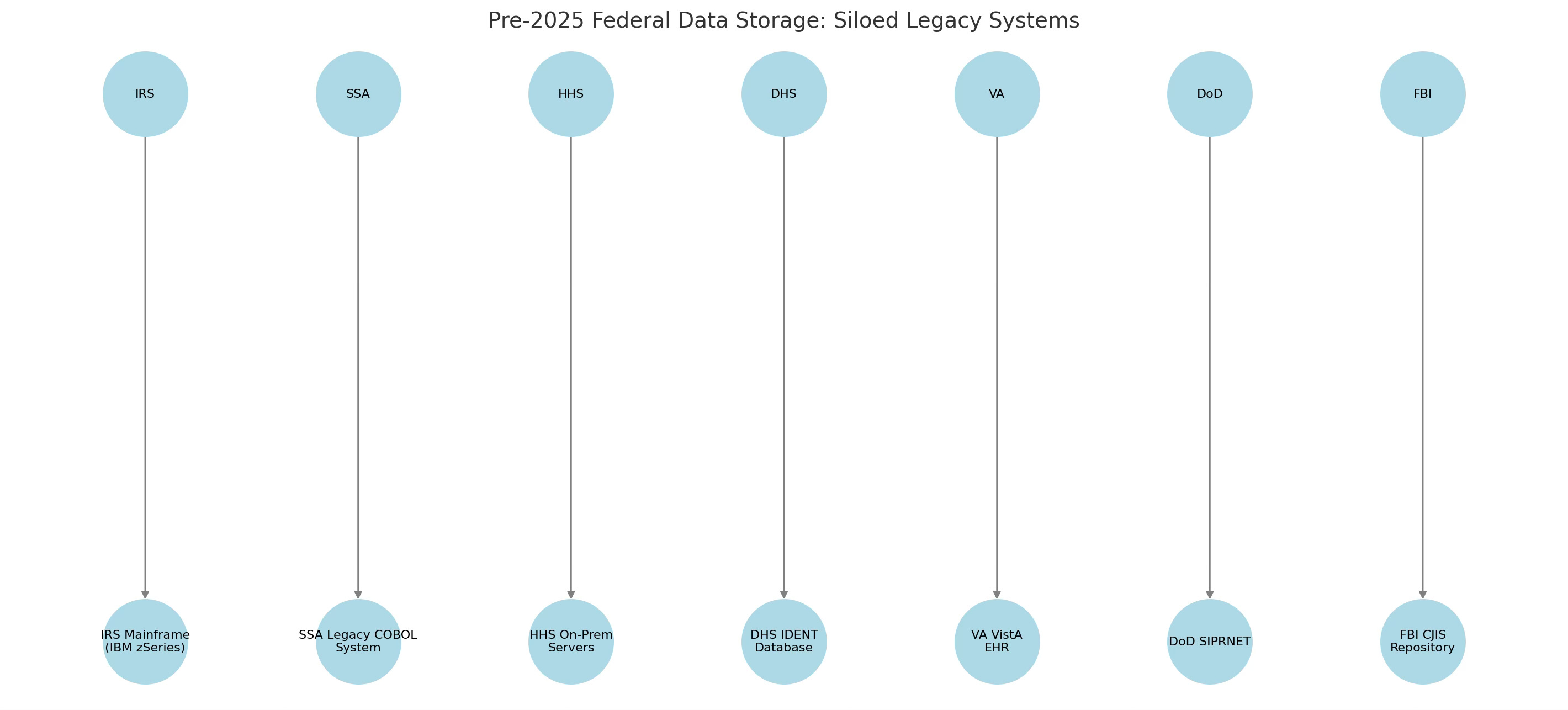
Within an agency, many steps were taken to make sure that no one person could assemble more than their job entailed, making sure that they could not link data back together, this was a safeguard. Below shows how the IRS kept things separated in terms of an audit, and how the Treasury could not see how an audit was being conducted and how many layers of security measures were in place.
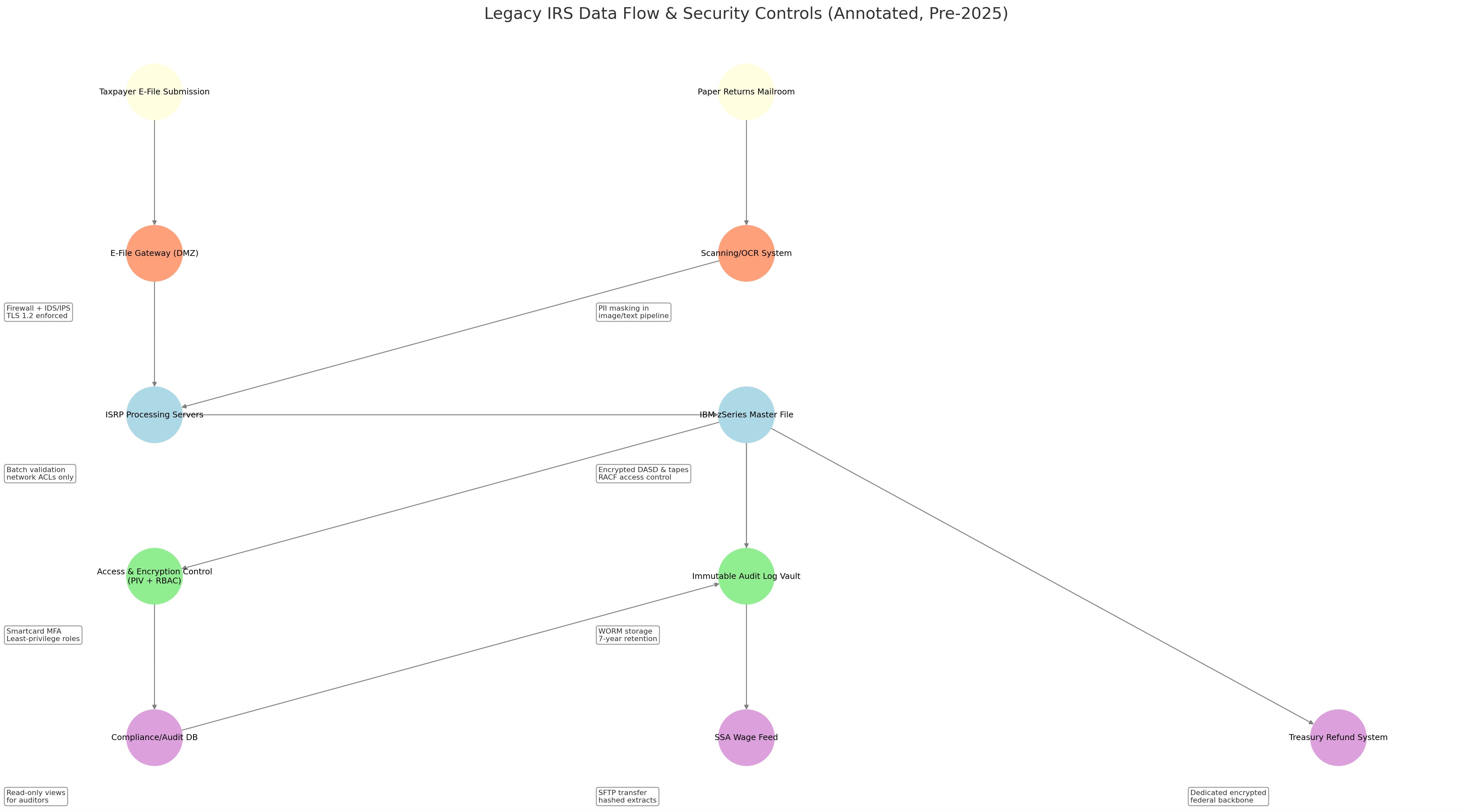
Net Privacy Takeaway
Strongest point: Mainframe encryption and WORM audit logs mean bulk exfiltration leaves a forensic trail.
Weakest point: Implicit internal trust: one rogue admin or compromised smart-card can trawl everyone’s data with almost no real-time detection.
For you: Your tax file was safest from outside hackers, less so from insiders or supply-chain contractors. Real privacy relied on trust in IRS employees and legacy role hierarchies, not on modern zero-trust or differential-privacy defenses.
The Planned updates to Zero-Trust (in progress)
These upgrades aimed to convert a 1990-era “hard shell, soft center” into a Zero-Trust, crypto-first environment:
Contain Insider Threats – Micro-segmentation + ABAC would make a rogue admin’s trawl noisy and localised.
Encrypt Everything, All the Time – FPE tokens and hourly expiring mTLS would render stolen datasets useless.
Detect, Not Just Audit – EDR and real-time blockchain logs move the IRS from forensic hindsight to near-real-time incident response.
Give Taxpayers Visibility – The planned activity portal was the first crack in the “black box,” letting individuals spot weird accesses.
Think of it this way, the pre-2025 had a perimeter of trust, you show a badge at the lobby once. After that, you can wander nearly anywhere because the building assumes you’re safe.
The planned Zero-Trust way, the building no longer trusts anyone just because they got past the lobby. Every door, every hallway, every file room, even the supply closet, checks your badge again and makes sure you actually need to be there right now. Security cameras constantly watch for strange behavior, and an alarm goes off the moment something looks off.
Key principles:
“Never Trust, Always Verify.” Every user, device, or program must prove its identity and its reason for access, every single time.
Small Safe Zones. Instead of one big network, the system is broken into tiny segments. A breach in one segment can’t spread to the rest.
Continuous Monitoring. Real-time checks look for anything unusual (odd login location, strange data download) and cut off access instantly.
This has been in development for almost a decade, some would say that the government was slow here, but another way would be to say, they were very thoughtful and detailed given the scope and impact.
The key here is that the data per agency was still broken into tiny segments, not one big chunk.
Enter DOGE and Palantir
The minute I heard about DOGE I knew what it was, about data collection. The tech industry is all about data collection, then using that data as ways to either control, divide or profit off of. DOGE was the easy part, convince the public that government is being so abused, so lazy, that only the tech sector could come in and find that fraud and abuse, never mind that they were breaking down the privacy barriers that public just didn’t seem to know ever existed.
Behind the scenes, Palantir had been working its way into many of the agencies on their own. They did not just slip in overnight, they got a taste of what a government contract could do, then members of government, especially those who wanted a more unified intelligence approach, slowly allowed them in.
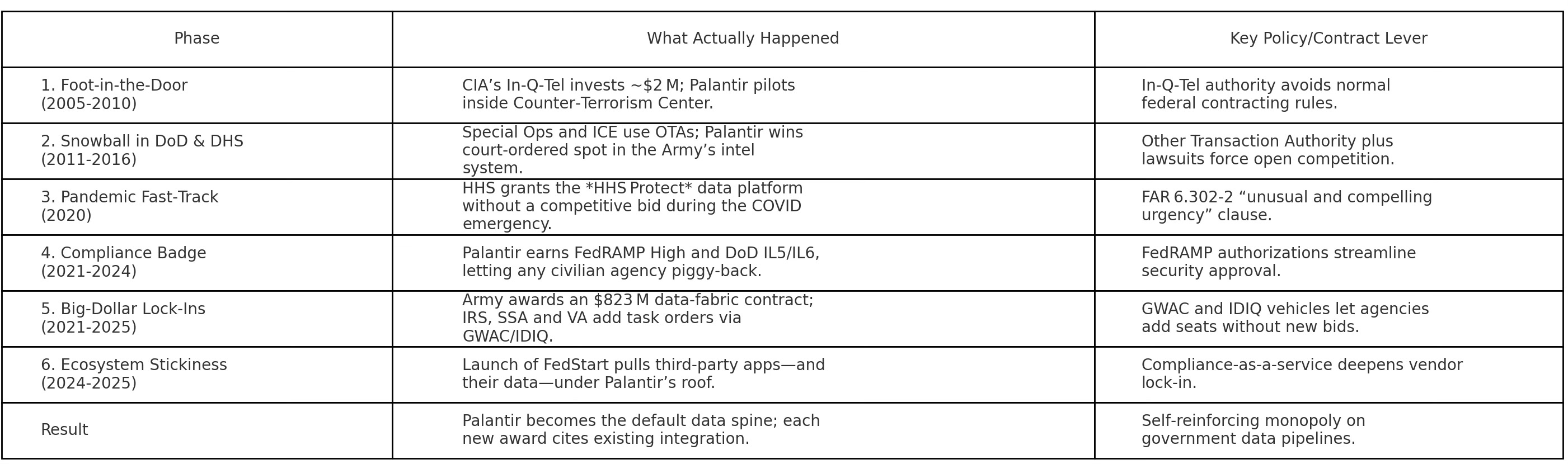
In the best of cases the new map of how data works within and between agencies looks like this under Palantir:
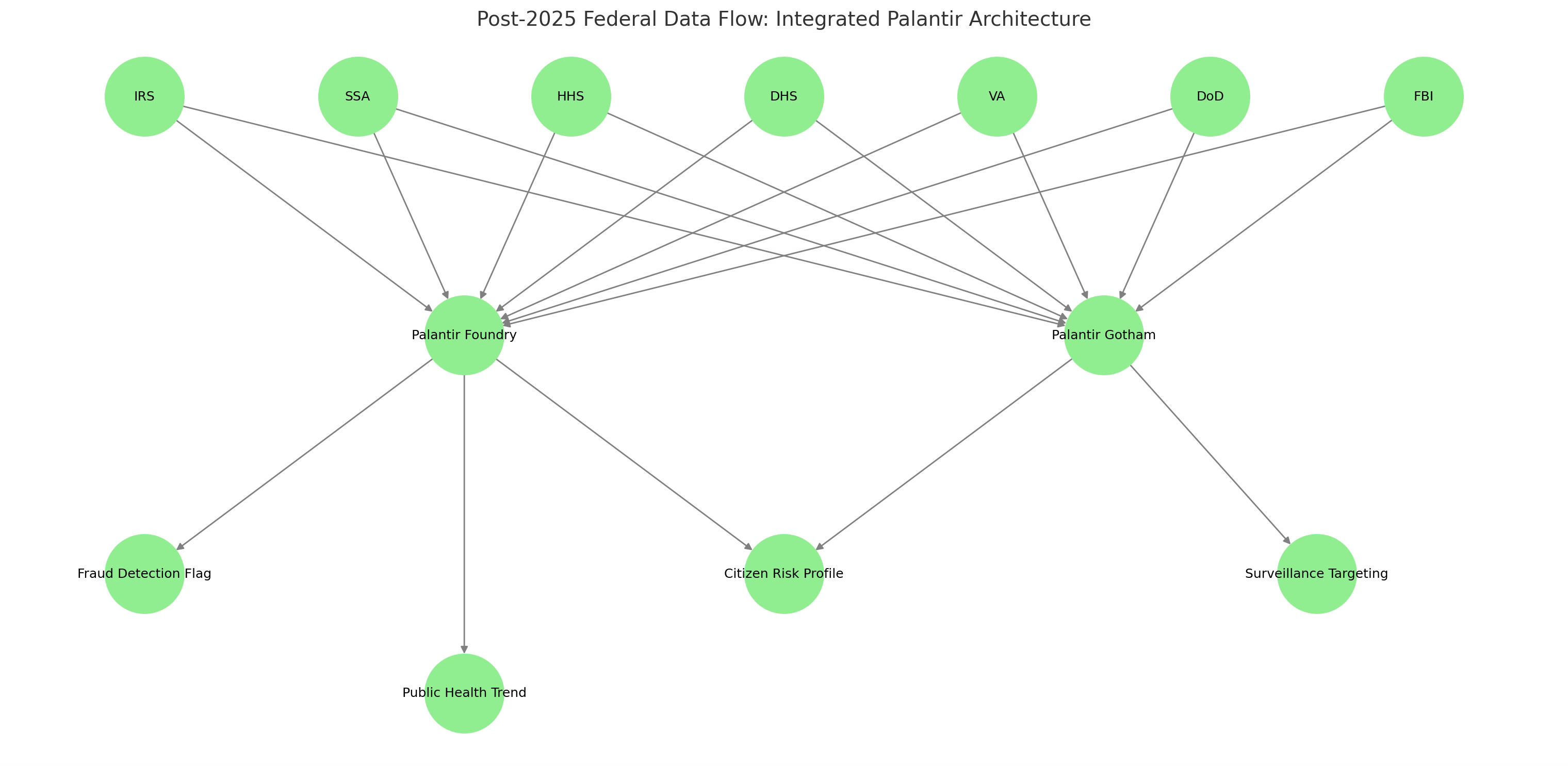
You can quickly see the difference here, instead of each agency being self contained, now all the data going into two systems Foundry and Gotham. And while at first this looks good in terms of fraud detection and public health trends, it comes with a citizen risk profile and targeted surveillance.
China as a model
China never launched a one nationwide “social-credit score” as the media states. Instead, it runs a patchwork that feels like one: court-debtor blacklists that ban people with unpaid judgments from planes and high-speed trains, dozens of ministry blacklists/redlists that trigger “joint punishments” such as license denials and higher inspections, and pilot city point-systems (e.g., Rongcheng’s 0-1,000 score) that reward bill-paying or volunteering while shaming jay-walkers on public screens. All those records flow into the National Public Credit Information Center, which republishes matched ID lists to agencies and banks, so penalties fire automatically until offenders “credit-repair” the issue.
The result is a de-facto behavior control web of opaque criteria, patchy appeals, and data errors that can freeze travel, loans or job prospects, powered more by overlapping blacklists than by a single omnipotent number.
What the tech sector saw was they could make it more efficient but using just two systems; Foundry and Gotham which are under one corporate entity, Palantir.
How this could turn into Minority Report
This could easily become AI driven decision making for the government going forward, using the combination of government data tied with social media data sharing.
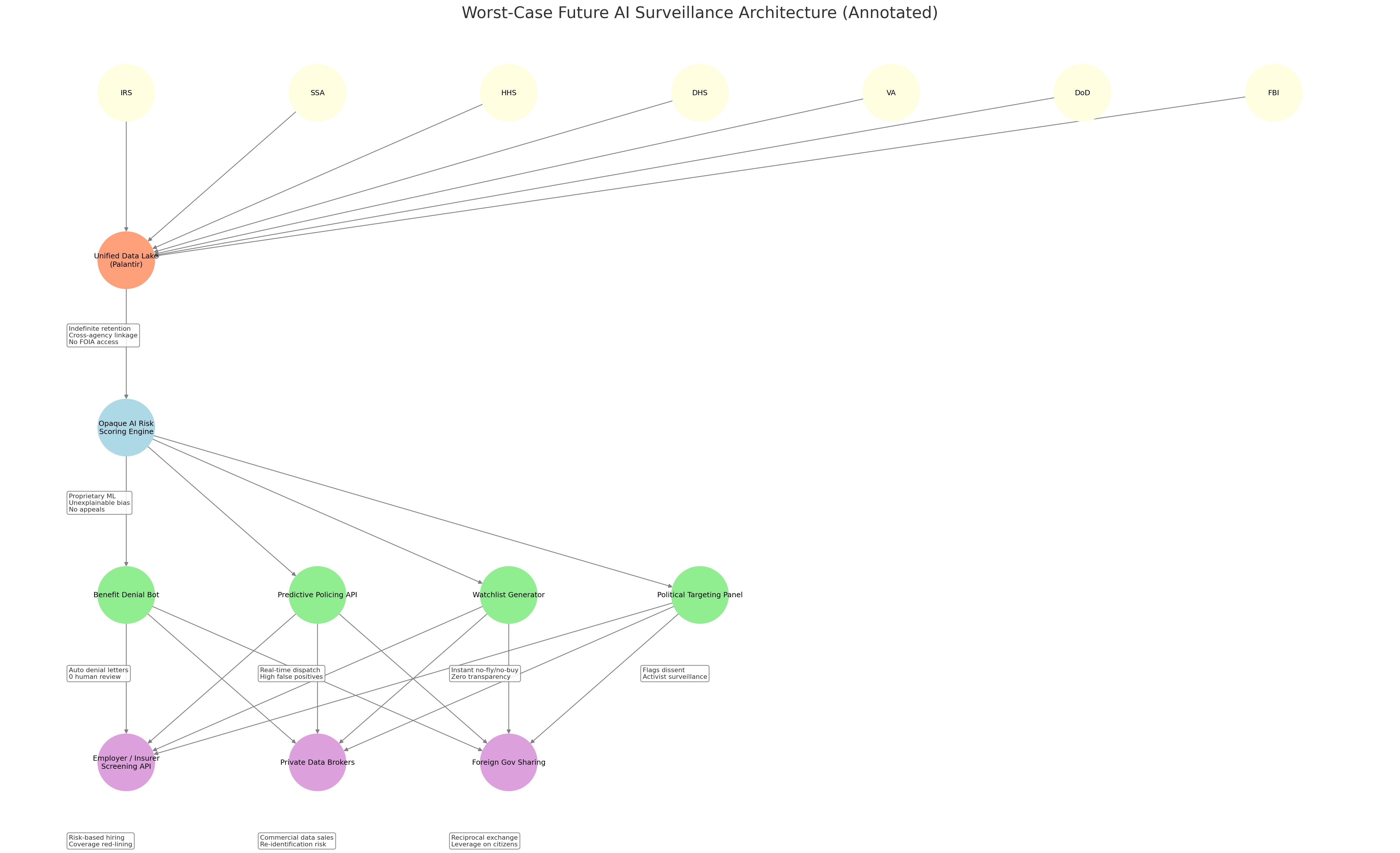
As we talked about above, all the agencies data was separated for a reason, our protection. So the place to start on the dangers here is the orange dot, “Unified Data Lake”. Once that happens, those who have access, good or bad actors can do serious damage to people, families, businesses and other corporations.
The green dots are the scary parts of the story. Words like “Denial Bot”, “Predictive Policing”, “Watchlist Generator”, and “Political Targeting Panel” should not be part of a government interface to a free society, especially in conjunction with a corporation. The idea here is that AI can make decisions for us based on the parameters of the corporation in conjunction with the government, no human thought needed, just efficient execution of a directive based on AI “logic”.
And once done, how would anyone know until they are in the crosshairs?
Walk-Through of the Worst-Case Future Of AI Surveillance
Below is a step-by-step tour down the slippery slope, how raw agency data morphs into automated punishment and political leverage when guardrails collapse. Using the graph above.
1. Bulk Ingestion (Top Layer – Light-Yellow)
Seven major agencies—IRS, SSA, HHS, DHS, VA, DoD, FBI—all pipe continuous feeds (tax filings, wages, medical records, biometrics, intelligence intercepts) straight into a single Unified Data Lake.
What’s wrong here?
No purpose limitation. Every record is sucked in “just in case.”
Indefinite retention wipes out the natural forgetting society relies on.
2. Unified Data Lake (Salmon Layer)
This Palantir-run reservoir holds the full cross-agency dossier on every resident.
Indefinite retention · Cross-agency linkage · No FOIA access
Why it’s dangerous: A single breach or a hostile administration now owns the keys to everyone’s life history, something we have never had in America.
3. Opaque AI Risk-Scoring Engine (Light-Blue Layer)
A proprietary model chews through that lake and spits out a risk score for each person.
Proprietary ML · Unexplainable bias · No appeals
Why it’s dangerous: Inputs are hidden; outputs are treated as gospel. Even engineers can’t trace why you’re “high risk.”
4. Automated Action Modules (Light-Green Layer)
Risk scores trigger four bots without human review:
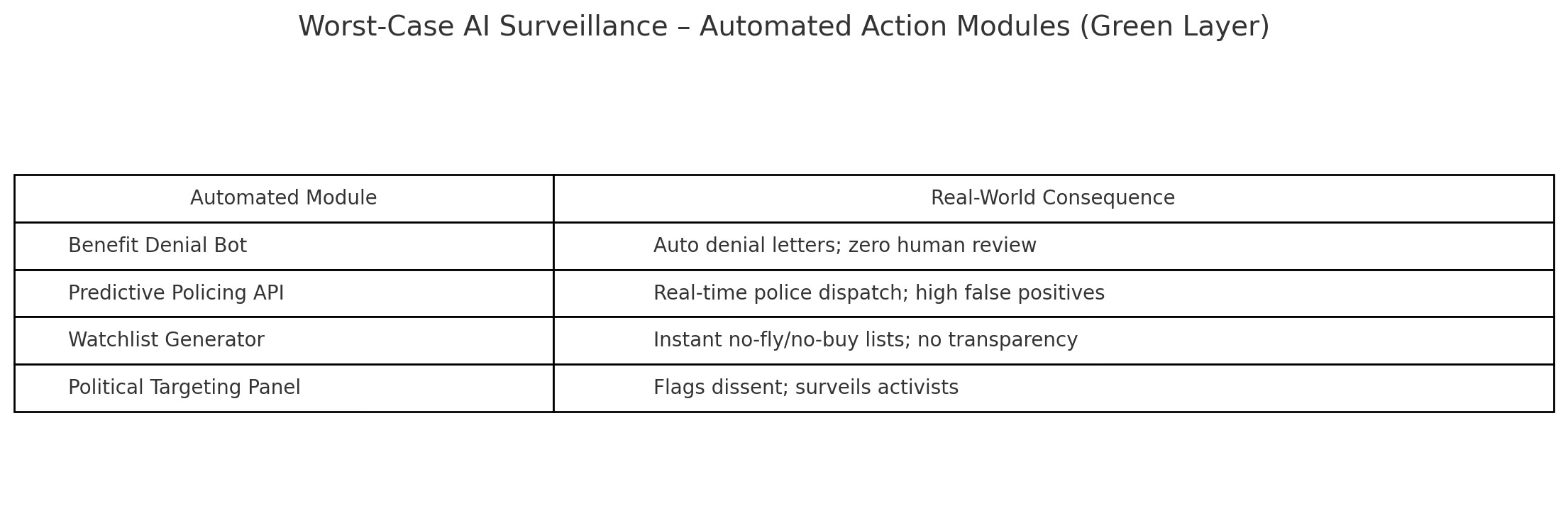
The common thread: execution first, questions never.
5. Downstream Exploitation (Plum Layer)
Automated outputs are monetized or weaponized:
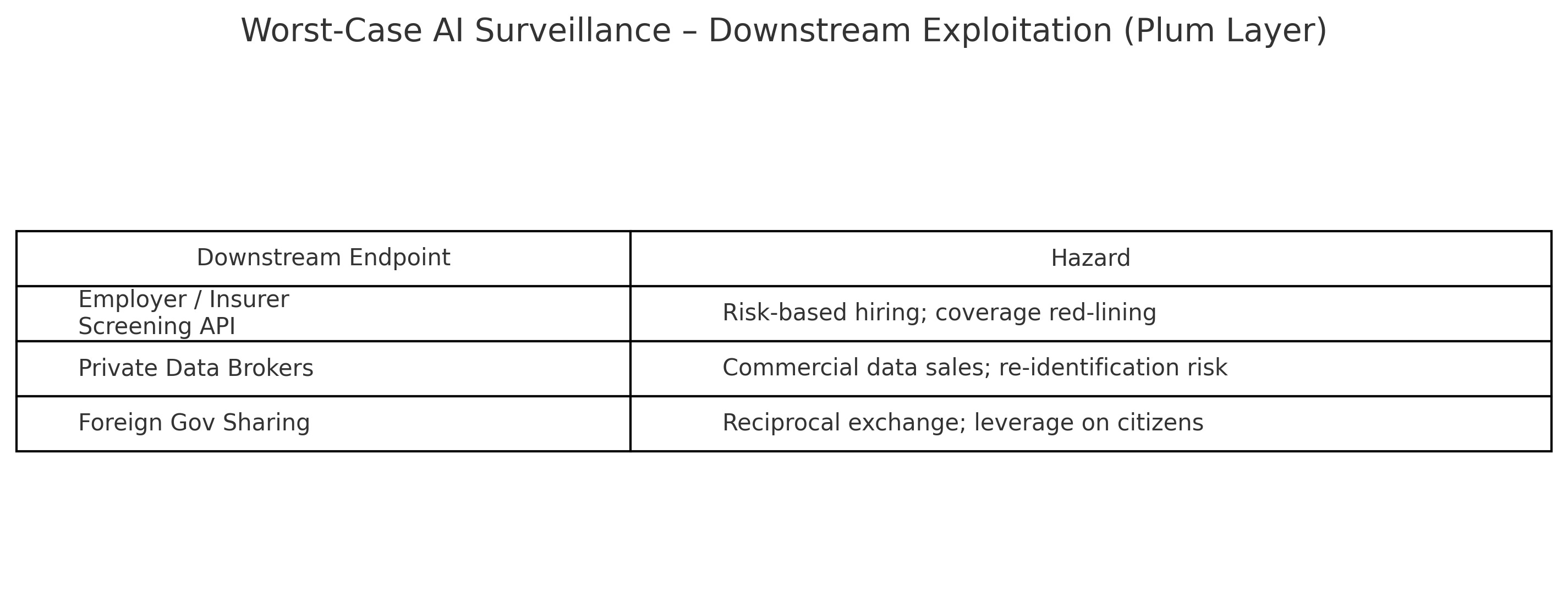
Why it’s dangerous: No meaningful consent, no opt-out, and zero accountability after the data leaves the federal bubble.
The Big Picture
Total Visibility → Total Predictability → Total Control
The system begins as a fraud-prevention tool and ends as an all-purpose behavior-shaping weapon.Bias Amplification at Machine Speed
Historical inequities (race, class, disability) get baked into risk scores and magnified faster than any court can keep up.Power Asymmetry Locked In
Whoever controls the scoring engine controls livelihoods, movement, even political opposition. Overthrowing that power later is exponentially harder than preventing it now.
Why This Isn’t Sci-Fi
The building blocks already exist: Palantir’s Gotham/Foundry, real-time facial recognition, credit-file APIs, and ICE’s subpoena-free data purchases. By missing the opportunity to hold privacy front and center, we are giving our freedoms away. We are currently already living in an algorithmic world via social media. Now imagine due-process laws also being controlled by algorithms vs people.
The slide to this Minority Report future is a matter of “when,” not “if” due to the level of control these tech billionaires have on policy and political figures.
How to stop this from happening
Stopping Yarvin-style “shareholder monarchy” isn’t about fighting a single crank idea; it’s about closing the real cracks in democracy that make authoritarian quick-fixes sound tempting. Here’s the blunt, forward-looking playbook:
1. Yank the demand out from under it
Deliver competent government, fast. Most voters don’t crave absolutism; they crave stuff that works. Modernize bureaucracies (agile procurement, data transparency, sunset clauses) so agencies ship results in months, not decades.
Tackle monopoly economics. A system that quietly concentrates wealth while preaching egalitarianism breeds cynicism. Aggressive antitrust, wealth-tax enforcement, and closing carried-interest/step-up loopholes shrink the billionaire cheer squad for post-democracy corporatism.
2. Make democratic voice cheaper than exit
Electoral plumbing upgrades:
Ranked-choice & multi-member districts break the two-party doom loop that fuels “burn it all down” thinking.
Public campaign vouchers or “democracy dollars” cut the pay-to-play circuit.
Participatory budgeting & digital mini-publics (citizen assemblies with real budgetary teeth) let frustrated citizens fix potholes instead of fantasizing about CEO-kings.
Localism that matters: Push fiscal power down to cities/counties but keep constitutional rights locked at the top so no patch can turn into a shareholder fiefdom.
3. Harden constitutional guardrails against privatized sovereignty
No sale of sovereign functions. Amend charters and constitutions to bar transfer of policing, justice, or taxation authority to any private entity … full stop!
Ultimate loyalty oath: Any official with coercive power must swear constitutional allegiance; breach it and you’re out, assets forfeited. Shareholders can’t vote rights away.
4. Treat political extremism like technical debt
Early-warning audits. Independent watchdogs (think GAO on steroids + AI anomaly detection) flag creeping privatization, emergency powers abuse, or opaque PPPs before they ossify.
Rapid rollback statutes. Give legislatures 30-day fast-track authority to unwind executive actions that privatize core state functions.
5. Re-arm civil society
Civic education 2.0. Teach how institutions actually work (budgets, rulemaking, FOIA) and where to poke them. No abstract “checks and balances” fluff, just practical drills.
Media resilience. Fund local journalism via public-interest trusts; starved news deserts are breeding grounds for extremism.
Cross-ideological pro-democracy coalitions. Libertarians, labor, faith groups, chambers of commerce all share one interest: not waking up with a CEO-king. Keep them talking.
6. Tech stack for democracy, not monarchs
Open-source govcloud. Critical code should be forkable by the public, audit-friendly, and immune to single-vendor lock-in (sorry, Palantir).
Cryptographic e-voting + verifiable audit trails so the “rigged system” narrative can’t take root.
Algorithmic transparency laws for any platform that shapes civic discourse; no black-box feeds.
7. Culture: reward constraint, not charisma
Praise boring competence. Celebrate the health-inspector who prevents an outbreak, not just the firebrand senator dunking on Twitter.
Shame the coup-curious. Make overt flirtation with abolishing democracy a reputational toxin in business and academia.
Bottom line
Neocameralism thrives on a vacuum, when democracy looks corrupt, sclerotic, and unfixable. Fill that vacuum with rapid-fire institutional repair, airtight legal guardrails, and a civic culture that prizes accountability over spectacle, and the “CEO-king” pitch dies of market starvation.
Our nation was founded on removing a single person rule, why would we want to head back to it now? We are the richest, most powerful nation in the world, but have allowed the technocrats to divide us for their profit and control.
Time is running out to stop it, do your part!
The data being used here is provided by OpenAI using multiple models and references.
References:
DOGE’s data-grab and performance
Wired – “DOGE Is Building a Master Database to Surveil and Track Immigrants” WIRED
Wired – “DOGE Is in Its AI Era” WIRED
Wired – “DOGE Has Achieved Its Final Form” WIRED
Washington Post – “DOGE vowed to make government more ‘efficient’—but it’s doing the opposite” The Washington Post
Associated Press – Federal judge blocks DOGE from Social-Security databases (temporary injunction) AP News
Palantir’s new cross-agency platform & prior controversies
Economic Times – “Palantir to create vast federal data platform tying together IRS, Social Security and immigration records” The Economic Times
Guardian – Report from Palantir’s first AI-warfare expo, highlighting battlefield applications and human-rights concerns The Guardian
Guardian – “ ‘The machine did it coldly’: Israel used AI to identify 37,000 Hamas targets” (broader AI-war story that critics link to Palantir-style tooling) The Guardian
Yarvin / “Dark Enlightenment” influence
New Yorker – “Curtis Yarvin’s Plot Against America” (profile) The New Yorker
Guardian – “He’s anti-democracy and pro-Trump: the obscure ‘dark-enlightenment’ blogger influencing the next US administration” The Guardian
Praxis and the “sovereign-network” push
Praxis press release – “Praxis announces $525 million financing to build the next great city” Praxis Nation
Wall Street Journal – “Tech-utopian project Praxis gets $525 million in commitments for planned ‘heroic’ city”