
Live-Testing Authoritarianism: How Project 2025’s Blueprint Is Unfolding in Los Angeles
L.A. has become ground zero for the playbook’s assault on federalism and civil rights backed by combative Trump-administration rhetoric and hard-line GOP spin.

In late May and early June 2025, Los Angeles saw a rapid escalation of federal immigration and law-enforcement operations that mirror the Project 2025 playbook, The Heritage Foundation’s governing blueprint for a second Trump administration, already influencing current federal operations in form and tone. What began as “after-hearing” ICE arrests in a downtown courthouse evolved, within two weeks, into military-style raids, mass detentions, and even National Guard and now Military deployments without state consent. Below, each flashpoint is paired with the playbook passages that dictated the tactics and the strident escalation language embedded within.
This is a live test, are we ok with authoritarianism?
We the People should be saying loud and clear… NO! And we can only do that by standing up, peacefully to the show of force. Don’t give them what they so clearly want.
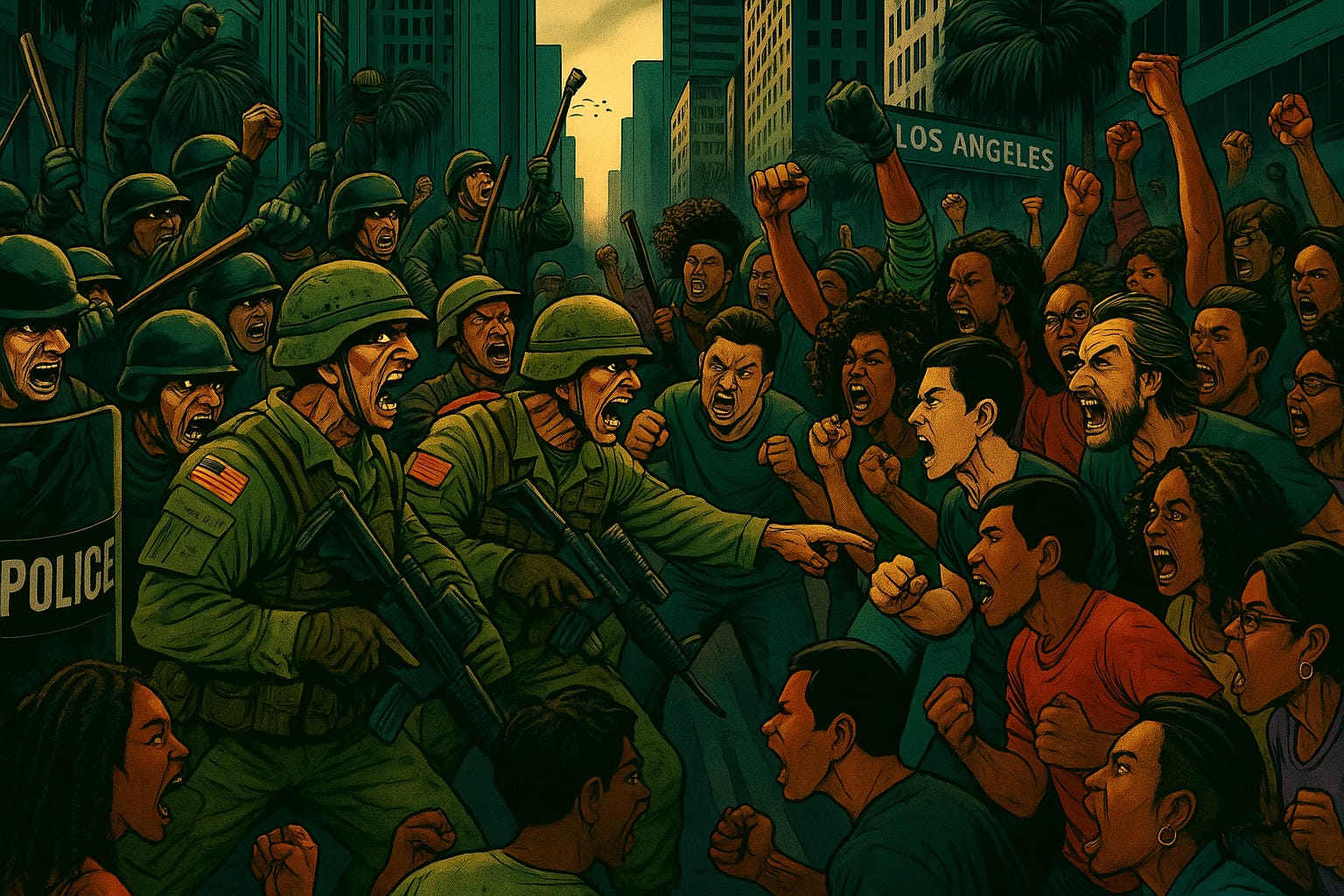
The 2025 Playbook, in Brief
To understand what we are seeing in LA, you need to understand Heritage Foundation’s Mandate for Leadership, this is all coming straight from the playbook which includes:
Sec 2.3 (“Mobile Removal Operations”) – promotes an aggressive expansion of immigration enforcement that removes traditional boundaries around where arrests should or shouldn’t happen. It frames every public or private setting as a legitimate zone for immigration apprehension, effectively turning all spaces into potential enforcement arenas. The tone is unapologetic and intentionally dismissive of “sensitive locations” like courthouses, schools, or hospitals. By asserting that no venue is off-limits, the section aims to instill a climate of fear and uncertainty among immigrant communities, prioritizing speed and surprise over procedural fairness. Strategically, it redefines civil spaces as enforcement zones, thereby undermining trust in civic institutions.
Sec 4.1 (“Shock-and-Awe Sweeps”) – This section outlines a strategy for high-visibility, high-impact immigration raids designed to intimidate both undocumented immigrants and the local governments that protect them. The tone evokes military doctrine, favoring sudden, forceful actions with maximum presence to project dominance. These operations are meant not just to enforce law but to send a political message to so-called “sanctuary cities.” Cooperation with local law enforcement is framed as optional; federal supremacy is the guiding principle. Strategically, it uses spectacle and fear to discourage resistance, setting the stage for a national template of rapid, overwhelming raids on targeted communities or industries.
Sec 5.2 (“Domestic Threat Labels”) – Reframes civil protest as a potential threat to national security, advocating for preemptive classifications of demonstrations as “domestic threats.” The goal is to justify swift escalations in policing and surveillance under the guise of public safety. The tone is authoritarian: dissent is presumed suspect, and continued protest is treated as justification for military-style suppression. This approach erodes First Amendment protections by treating political opposition as a security issue. Strategically, it provides a framework for rebranding activism as insurrection—thereby enabling federal crackdowns on lawful assembly and undermining democratic norms.
Sec 6.4 (“Federal Forces Early Use”) – The tone of Section 6.4 reflects a clear endorsement of aggressive federal authority, advocating for the early and unapologetic deployment of federal military forces in domestic affairs—particularly when state or local governments resist federal directives. Rather than treating military involvement as a last resort, the playbook frames it as a demonstration of strength, reinforcing a “decisive federal will.”
It signals a strategic shift away from cooperative federalism toward a command-and-control model of governance. Governors who object to federal enforcement actions are portrayed as obstacles to be bypassed, not partners to be consulted. The Insurrection Act is positioned not as an emergency option but as a routine tool for domestic order, encouraging its invocation whenever unrest disrupts federal priorities.
By normalizing the presence of federal troops in civilian contexts and downplaying the need for state consent, Section 6.4 lays ideological groundwork for a more centralized, militarized approach to governance. The implication is clear: if cities or states oppose federal immigration crackdowns, protest management, or other “law and order” campaigns, Washington should not just override them—it should overwhelm them.
All of it wrapped in zero-tolerance rhetoric: “decisive federal will,” “preemptive labeling,” “no apologies.”
Early June: Courthouse Stings & On-Site Detainment
What happened:
ICE agents ambushed non-citizens leaving “master calendar” hearings (initial procedural sessions that don’t determine legal outcomes) at the North Los Angeles Street Immigration Court. Judges repeatedly reassure migrants that these sessions are purely procedural.
Detainees were handcuffed, hustled into a box-truck “field jail,” fingerprinted and given under-minute medical screenings—then blind-transferred in unmarked vans to remote centers. No attorneys. No due process.
Attorneys report hundreds were herded into basement holding areas and conference rooms, sometimes for 12–24 hours, because ICE claimed local detention centers were full. There was no support for those held and no access to counsel.
Why it matters:
A courtroom the supposed bastion of due process became a tactical trap.
Sensitive-Location Violation: Department of Homeland Security policy designates courthouses as “sensitive locations” where arrests are generally discouraged, and yet ICE used the very structure of these hearings to trap people.
Due-Process Erosion: Waiting in good faith for procedural hearings became a liability, turning a foundational element of judicial process into a policing perimeter.
Political & Judicial Responses:
Mayor Karen Bass (D): “I am deeply angered. We will not stand for this.”
Gov. Gavin Newsom (D): “This reckless operation tears families apart. We will sue.”
White House: “Enforcing the law, no apologies.”
California Judicial Council: Condemned the assault on courthouse neutrality.
ACLU SoCal: “Flagrant due-process violation.”
Playbook Tie-In:
Project 2025’s enforcement framework explicitly encourages federal agents to detain undocumented individuals without spatial constraint—turning even traditionally protected spaces like courthouses into lawful ambush zones. Section 2.3 advocates a “mobile removal” model in which immigration arrests can occur anywhere, at any time, with no exceptions made for locations once considered off-limits. The strategy is framed with zero-tolerance language, rejecting due process concerns in favor of tactical surprise. In effect, it weaponizes public trust in civic institutions by using them as bait.
June 6, 2025 • Paramilitary-Style Raids
What happened:
Pre-dawn ICE/HSI sweeps backed by DEA/FBI target the Fashion District, a clothing wholesaler, and Home Depot. Agents executed four search warrants, then used internal removal orders to detain 44 people (plus one obstruction arrest). Processing took place in a mobile unit; detainees were shipped to Victorville and Adelanto.
Why it matters:
Fourth Amendment on the Run: Turning workplaces and retail outlets into arrest zones sidesteps traditional warrant safeguards and normalizes warrantless or effectively warrantless detentions.
Sanctuary City Undermined: By sweeping across three distinct sites without local cooperation, ICE/HSI signaled that city ordinances and state sanctuary policies can be overrun by federal “shock-and-awe” tactics.
Playbook Precedent for Everywhere: These paramilitary-style raids set the template for “no-notice” operations nationwide can be executed against any community or business, chilling daily life and legal commerce.
Political & Judicial Responses:
Gov. Newsom: “Reckless…eroding trust.”
Rep. Kevin McCarthy (R): “Pelosi’s sanctuary agenda is to blame.”
LAPD/City Hall: Refused cooperation under sanctuary law.
ACLU & Local Bar Assoc.: Pledged litigation over 4th-Amendment breaches.
Playbook Tie-In:
Project 2025 prescribes a “shock-and-awe” enforcement model, urging federal agencies to conduct surprise raids with overwhelming tactical force. Section 4.1 frames these actions as deliberate displays of strength, executed without local coordination or warning, to intimidate both immigrant communities and sanctuary jurisdictions. The objective isn’t just enforcement but deterrence through spectacle. The playbook treats visibility, fear, and disruption as essential tools in neutralizing local resistance.
June 7, 2025 • Expanded Sweeps & Protests
What happened:
ICE roamed downtown again, detaining 40+ more, including a union organizer. Crowds rallied outside federal buildings, blocking sidewalks and staging sit-ins.
Why it matters:
Criminalizing Dissent: Targeting a union organizer and peaceful sit-in protesters sends a clear message that political activism, especially on immigration, is now treated as a security threat, undermining First Amendment protections.
Normalization of “Domestic Threat” Labels: By classifying downtown gatherings as “threats,” federal agencies establish a precedent for broad surveillance and suppression of any large-scale protest, chilling public assembly across the country.
Blueprint for Nationwide Escalation: This operation demonstrates how Project 2025’s Sec 5.2 playbook can be used to justify emergency powers and military-style tactics against civil-rights demonstrations in any city, further eroding local autonomy and democratic norms.
Political & Judicial Responses:
AG Rob Bonta: “We’ll take this to court immediately.”
Sen. Lindsey Graham (R-SC): “Long overdue action.”
Federal Judges (EOIR Memo): Demanded an immediate halt to courthouse arrests.
ACLU: “Discriminatory and unlawful.”
Playbook Tie-In:
Section 5.2 of Project 2025 shifts the ground rules on protest, advocating the use of federal authority to preemptively categorize demonstrations as security threats. The strategy enables the government to bypass traditional First Amendment protections by labeling dissent as potentially violent from the outset. It calls for escalated response tactics, including military-style suppression and if protests persist, effectively criminalizing public assembly. This reframing of activism as “threat activity” gives the federal government a legal rationale to suppress civil unrest before it starts.
June 8, 2025 (Afternoon) • National Guard Federalization Under Title 10
What happened:
President Trump ordered 2,000 California National Guard soldiers onto federal active duty under a seldom-used Title 10 “danger of rebellion” provision despite Gov. Newsom’s objections. Their mission: secure federal buildings, protect ICE operations, and serve in support roles alongside DHS and DOJ personnel. At no point were these troops granted standalone arrest powers; any detentions remained the responsibility of federal agents and local law enforcement.
Why it matters:
Erosion of State Sovereignty: Federalizing California’s National Guard over the governor’s objection flouts the 10th Amendment and undermines the principle that states control their own militias, setting a dangerous precedent for bypassing elected state leadership.
Militarization of Domestic Policy: Positioning soldiers in support roles alongside DHS and DOJ normalizes the use of military forces in civilian law-enforcement contexts, inching us toward institutionalized martial-law tactics.
Chilling Effect on Local Resistance: The presence of uniformed troops creates an intimidating atmosphere that deters lawful protests, legal challenges, and public scrutiny—deterring local officials from pushing back.
Precedent for Future Deployments: By exploiting a rarely used Title 10 “danger of rebellion” clause instead of the Insurrection Act, this operation provides a template for future administrations to federalize state forces with minimal legal pushback.
Political Responses & Tone:
Gov. Gavin Newsom (D): “Unconstitutional breach of state sovereignty—I demand their immediate withdrawal.”
Mayor Karen Bass (D): “Los Angeles doesn’t need soldiers in our streets; we’ll keep our communities safe.”
White House Press Secretary: “Guard troops are simply protecting federal assets—no apologies.”
Sen. Tom Cotton (R-AR): “Full support for the president’s authority to defend the homeland.”
Playbook tie-in:
Section 6.4 lays out a doctrine of preemptive escalation, urging the president to act decisively, even unilaterally, by overriding governors and invoking the Insurrection Act if necessary. The underlying message is that federal authority must not be constrained by state objections. This approach normalizes the use of military power in domestic affairs and signals a strategic shift toward top-down enforcement with minimal checks from local leadership. It recommends the early deployment of federal forces to assert control over state-level situations, especially when local authorities resist federal directives.
June 8, 2025 (Evening) • Freeway Blockade & Crackdown
What happened:
Protesters blocked the 101 Freeway near the Met Detention Center. CHP and LAPD cleared the lanes with tear gas, declared “unlawful assembly,” and arrested 29.
Why it matters:
Criminalizing Civil Disobedience: Declaring a freeway blockade an “unlawful assembly” and using tear gas against peaceful demonstrators blurs the line between protest and crime, threatening First Amendment rights.
Blurring Law-Enforcement Roles: Joint CHP/LAPD actions, spurred by federal priorities, turn local traffic enforcement into a tool for political repression, eroding trust in municipal policing.
Gateway to Broader Suppression: This freeway crackdown offers a playbook for labeling any disruptive protest “strategic threats,” justifying aggressive crowd-control measures and mass arrests nationwide.
Economic and Social Disruption: Shutting down a major artery not only endangers public safety, it signals that peaceful assemblies can trigger punitive responses, chilling civic engagement across communities.
Political & Judicial Responses:
Mayor Bass: “Violence is unacceptable.”
LAPD Chief Moore: “We enforce traffic safety, not immigration policy.”
WH Press Sec: “Protesters are lawless agitators.”
Playbook Tie-In:
Project 2025 reframes nonviolent protests like sit-ins as calculated disruptions to public order, recommending they be treated as strategic threats rather than constitutionally protected demonstrations. Section 5.4 promotes the use of sweeping enforcement tactics, mass arrests, movement restrictions, and crowd-control operations, not to de-escalate tensions, but to visibly reassert state control. The playbook’s logic is clear: suppress resistance early, decisively, and without apology to deter future challenges to federal authority.
June 9, 2025 • Active-Duty Marines Deployed to Los Angeles
What happened:
Roughly 700 active-duty Marines from the 2nd Battalion, 7th Marines (Camp Pendleton) were ordered into Los Angeles to support ICE, DHS, and DOJ operations amid ongoing immigration-related protests. This marks one of the first deployments of active-duty military in a major U.S. city during peacetime without state consent since 1965.
The Marines are assigned to protect federal assets, establish perimeters, and support crowd control logistics. Officials claim they will not engage in direct law enforcement unless the Insurrection Act is formally invoked.
Why it matters:
Civil-Military Boundary Collapse: The use of Marines, even in “support” roles, signals a breakdown in the firewall between military and civilian law enforcement long protected by the Posse Comitatus Act.
Federal Overreach Without Consent: With Gov. Newsom objecting, this marks a historic override of state authority, escalating the constitutional standoff over federal control of public order in sanctuary jurisdictions.
Military Normalization in Domestic Affairs: Marines on city streets, visibly aligned with ICE and DOJ will reshape the image of civilian governance into something more akin to military occupation.
Path to Martial Enforcement: Though not yet involved in arrests, the presence of active-duty troops during civil unrest primes the environment for an Insurrection Act invocation, shifting the country closer to full martial governance.
Political & Judicial Responses:
Gov. Gavin Newsom (D): “This is an abuse of federal power and a threat to our state’s sovereignty. We will seek legal remedies immediately.”
Sen. Josh Hawley (R): “This is what restoring law and order looks like.”
ACLU Statement: “Deploying Marines to monitor civilians is authoritarian theater. We’re preparing immediate legal challenges.”
Playbook Tie-In:
Section 6.4 lays out a doctrine of preemptive escalation, urging the president to act decisively, even unilaterally, by overriding governors and invoking the Insurrection Act if necessary. The underlying message is that federal authority must not be constrained by state objections. This approach normalizes the use of military power in domestic affairs and signals a strategic shift toward top-down enforcement with minimal checks from local leadership. It recommends the early deployment of federal forces to assert control over state-level situations, especially when local authorities resist federal directives.
Jan 6th vs These Events
The idea that our government thinks it needs to do this and include Nation Guard and now Military boots on the ground is all a test. Let’s look at a comparison on what happened on January 6th vs LA over the weekend:
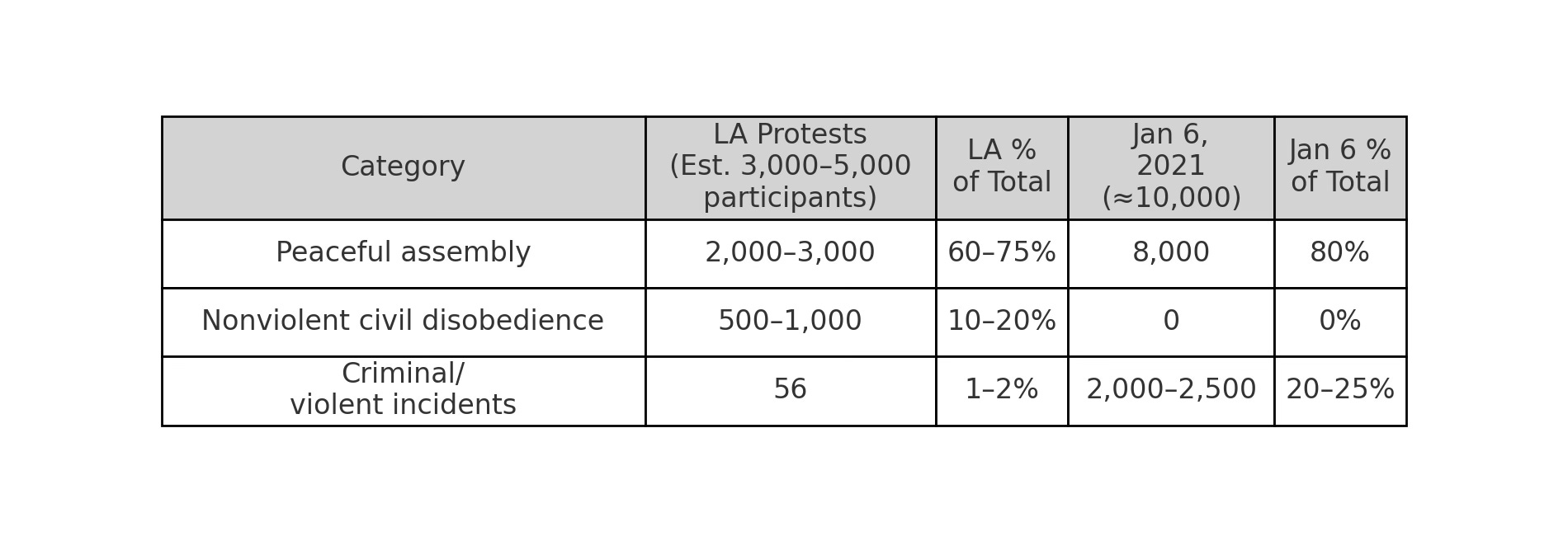
There is a stark contrast in the handling of these two events. In Los Angeles roughly 60–75 percent of the crowd remained peaceful and another 10–20 percent engaged in nonviolent civil disobedience, with only 1–2 percent arrested for criminal or violent acts; more will come, but how many is still undefined, yet the federal government didn’t hesitate to federalize 2,000 National Guard troops under Title 10, position them alongside ICE and DHS teams, and normalize a “shock-and-awe” posture against largely nonviolent demonstrators.
By comparison, January 6 saw about 20–25 percent of its participants forcibly breach the Capitol, an overtly violent, criminal action, without any analogous use of the National Guard in a support role to law enforcement.
In L.A., deploying military assets to secure federal buildings and backstop aggressive immigration raids over an overwhelming majority of peaceful protestors sets a precedent for eroding the traditional Posse Comitatus boundary and signals that any large-scale demonstration can be treated as a domestic security threat, regardless of the crowd’s actual behavior.
Who could have deployed the Guard on Jan 6th:
President Donald Trump (Commander-in-Chief)
Has ultimate authority to activate the D.C. National Guard at any time.
He did not authorize their deployment in advance, despite intelligence warnings of potential violence.
Secretary of Defense (Christopher Miller at the time)
After Trump delegated authority, Miller had control over the D.C. National Guard and delayed approval for hours, citing vague concerns about "optics."
Acting Secretary of the Army (Ryan McCarthy)
Intermediary between the D.C. Guard and the Pentagon
Who requested the Guard but couldn't activate them:
D.C. Mayor Muriel Bowser
Requested limited National Guard support in advance, but only for traffic control.
Could not activate them herself—D.C. is not a state, so it lacks governor-level authority.
Capitol Police Chief Steven Sund
Repeatedly requested National Guard support on Jan 6, but his requests were denied
The Capitol Police Board (specifically the House and Senate Sergeants-at-Arms)
Could approve a Guard request, but were slow to act. Paul Irving (House) and Michael Stenger (Senate) resigned afterward over the delay.
Bottom Line
It started with courthouse stings. Migrants were ambushed leaving procedural hearings. No warnings, no lawyers, no medical checks. Then came the raids. Pre-dawn, no-notice, paramilitary-style ICE sweeps tore through the Fashion District. Next? Protesters were labeled “domestic threats.” Union organizers disappeared into unmarked vans. The National Guard was federalized over the governor’s objections.
Now, active-duty Marines are inbound to Los Angeles.
Not National Guard. Not reservists. Marines. Boots on the ground in a civilian city—without a natural disaster, without a war, and without state consent.
This isn’t escalation. It’s convergence. We have two players acting out this plan, the hard right under the Heritage Foundation, and Silicon Valley actors like Palantir and Thiel-backed interests, the tech oligarchs envisioning their own nation-state architecture. They are both loving what they are seeing.
The Rubicon isn’t ahead of us. We’ve already crossed it.
This isn’t support. This is the normalization of military presence in civilian governance. When active-duty troops deploy without a war, without a natural disaster, and without a governor’s consent, that’s not policy enforcement. That’s martial control with a legal fig leaf.
L.A. isn’t a test run anymore.
It’s the first operational theater of Project 2025.
ICE Raids and Arrests (June 6-7, 2025):
Reuters - Trump deploys National Guard as Los Angeles protests against immigration agents continue
AP News - More than 40 people arrested in Los Angeles for immigration violations
CBS Los Angeles - Protests held after dozens arrested in immigration operations across Los Angeles
National Guard Deployment:
ABC News - National Guard troops arrive in Los Angeles after immigration protests turn violent
Reuters - California governor calls Trump National Guard deployment in LA unlawful
Active-Duty Marines:
Bloomberg - Los Angeles Protests: Pentagon Mobilizes Marines to Reinforce National Guard
Gateway Pundit - 500 Active Duty Marines Prepared to Deploy to Downtown Los Angeles
Courthouse Arrests (General ICE Tactic):
The Intercept - ICE Agents Are Camped Outside Immigration Courts to Make Arrests
ABC News - In a new tactic, ICE is arresting migrants at immigration courts, attorneys say
NBC News - Immigration arrests in courthouses have become the new deportation tool
Protests and Violence: