
It’s Not an Immigration Crisis—It’s a Processing Failure
What Happened to the Nation That Built Ellis Island?

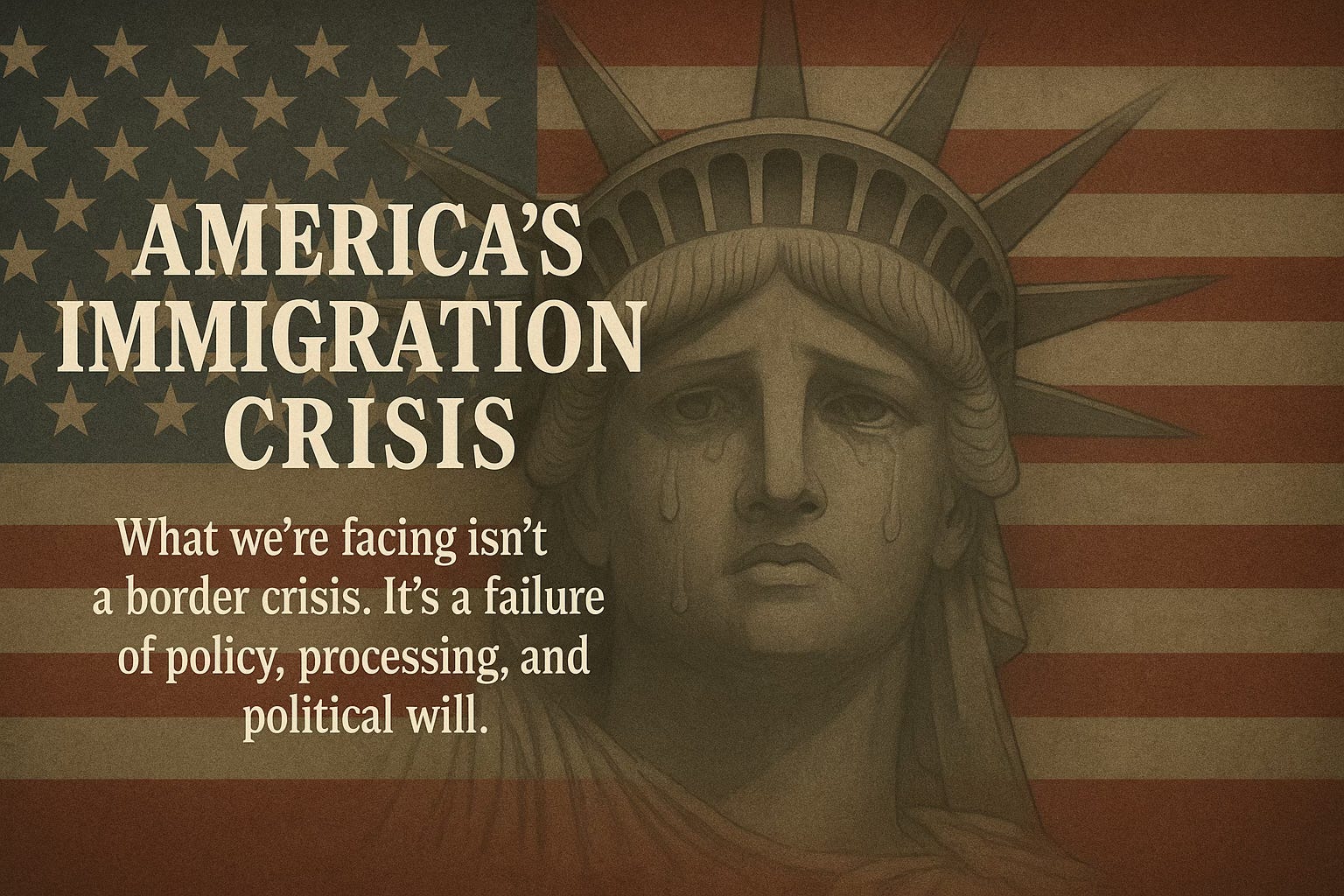
The Power Immigrants Bring
Before we talk policy, let’s remember why this even matters. Immigrants aren’t a burden, they’re a competitive advantage. They’ve fueled American growth from the very beginning of our nation. From steelworkers and railroad builders to software engineers and nurses, immigrants bring labor, talent, and entrepreneurial energy that keeps this country dynamic. Over 40% of Fortune 500 companies were founded by immigrants or their children.¹ Immigrants don’t take from America. They build it.
But there’s another side to this conversation we don’t talk about enough: what happens when we start removing immigrants, especially undocumented ones, en masse. Entire industries, from agriculture to construction to elder care, depend on immigrant labor, documented or not. Mass deportation isn’t just morally fraught, it’s economically damaging. It disrupts local economies, breaks up families, and leaves employers scrambling.
Undocumented immigrants pay over $11 billion annually in state and local taxes, and around $13 billion to Social Security and Medicare through payroll taxes they’ll likely never collect. Deporting millions doesn’t just tear apart families, it rips billions from safety net trust funds.²
We’ve handled more before with less. In 1907, Ellis Island processed over 1 million immigrants with about 400 staff. Nationwide, we processed nearly 1.3 million that year.³ No AI. No biometric scanners. Just clipboards, translators, and grit.
Today, we process similar numbers, 700,000 to 1.1 million annually between 2000 and 2024⁴, with far better tools. And yet, the system is slower, more cumbersome, and more brittle than it’s ever been. We’ve got the capacity. What we don’t have is the will.
Addressing Legitimate Concerns
Any honest discussion of immigration reform must acknowledge valid concerns that drive opposition to expanded processing capacity.
Rule of Law and Fairness: Critics rightfully point out that expanding asylum processing without stronger initial screening could reward those who bypass legal immigration channels while penalizing those who wait years for visas. This isn’t xenophobia, it’s a legitimate concern about fairness and incentives. The solution isn’t to slow down processing for everyone, but to create more legal pathways while maintaining rigorous but efficient screening.
Integration and Social Cohesion: Rapid increases in immigration can strain local services, schools, and housing markets, particularly in smaller communities. These concerns are real and deserve planning, not dismissal. However, the answer isn’t fewer immigrants, it’s better coordination between federal immigration policy and local capacity building, plus federal support for communities experiencing rapid demographic change.
Security and Screening: National security concerns about who’s entering the country are valid, especially given global instability. But security and speed aren’t mutually exclusive. Modern biometric systems, international intelligence sharing, and AI-assisted screening (I have issues here, but could be useful) can make fast processing more secure than slow processing. The current backlog creates security risks by pushing people underground and overwhelming our ability to track who’s actually here.
Economic Displacement and Fiscal Impact: Some communities have experienced wage depression or job competition from immigration, particularly in lower-skilled sectors, while local governments face real costs that aren’t always offset by federal support. These concerns deserve honest analysis, not ideological dismissal. However, research consistently shows that immigration’s net economic effect is positive.⁵ The displacement tends to be temporary and sector-specific. Targeted policies, like strengthening labor protections, investing in worker retraining, and better federal-state cost-sharing, can address these challenges without restricting immigration.
These concerns don’t justify our current broken system, but they do need to be part of any sustainable solution.
What Lankford's Bill Got Wrong
Earlier this year, Senator James Lankford introduced a border bill (S.4361, 2024) that was supposed to fix everything. It didn’t. On the surface, it looked like a compromise: money for Ukraine and Israel, plus border provisions meant to appease both sides. But dig into the immigration section, and it was clear, it wasn’t about fixing processing, it was about freezing it.
The bill would've created an automatic trigger to shut down asylum access at the southern border whenever daily crossings hit a threshold. At 5,000 crossings per day, the shutdown could be ordered. At 8,500, it would be mandatory.⁶ No discretion, no judgment calls. Just a hard wall that slammed shut the moment numbers rose, regardless of whether those people had legitimate claims.
It also would've dramatically raised the bar for what qualifies as a credible fear of persecution and gutted the executive branch's humanitarian parole authority, the same tool that allowed past presidents to bring in Vietnamese refugees, Cubans fleeing Castro, and Afghan interpreters.
Sure, the bill added funding for judges, asylum officers, and border agents. But what’s the point of hiring more firefighters if you legally ban them from turning on the hose?
This bill was written to limit asylum access, not streamline it.
Our Broken Enforcement Model
ICE operates on a strategy built around raids, detention, and removal, surprise workplace sweeps, facial recognition scans from DMV databases, and ankle monitors for asylum seekers. This enforcement-first, fear-based model creates both humanitarian disasters and operational dysfunction.
Compare that to countries like Canada or Germany. Canada uses community-based alternatives to detention, focusing on case management and compliance support. Germany processes far more asylum seekers per capita but invests in centralized housing and integrated legal pathways, not militarized raids. Compliance rates in Canada often exceed 90%.
The human cost is severe. Children are separated from parents. People fleeing war, cartel violence, or domestic abuse are locked in private detention centers for months or years. Court backlogs leave families in limbo, and even those who follow the rules live under constant threat of removal.
Meanwhile, private prison contractors like CoreCivic and GEO Group profit from keeping detention beds full, creating a perverse financial incentive to delay rather than resolve.
The Crime Myth vs. Reality
The current focus on immigrant crime distorts both the data and the solution. Multiple studies, including from the Cato Institute and American Enterprise Institute, consistently show that immigrants, including undocumented ones, commit crimes at lower rates than native-born Americans.⁷ In Texas, for instance, foreign-born residents have significantly lower conviction rates for violent crimes.⁸
But the real public safety issue isn’t immigrant crime, it’s how our enforcement approach makes everyone less safe. Fear-based tactics drive immigrant communities underground, making them reluctant to report crimes, serve as witnesses, or cooperate with police. When a quarter of a community won’t call 911, criminals know it. Cities with sanctuary policies consistently show better police-community cooperation and higher crime clearance rates.⁹
Our current system also misallocates resources. ICE spends billions targeting people whose biggest offense is immigration violations, while actual violent criminals slip through understaffed local police departments. Quick, fair immigration processing would let law enforcement focus on real threats instead of chasing paperwork violations.
The Financial Cost of Dysfunction
This enforcement-heavy system isn’t just morally questionable, it’s financially ruinous. ICE detention costs U.S. taxpayers an average of $150 per detainee per day, compared to $4–$7 a day for alternatives like supervised release or check-ins.¹⁰ In 2023 alone, ICE’s detention and removal budget exceeded $4 billion, much of it flowing to private contractors.¹¹
Mass deportations strip billions more from the economy. Undocumented immigrants contribute over $11 billion annually in state and local taxes, and around $13 billion to Social Security.¹² Deporting millions doesn’t just hurt individual businesses; it shrinks the national tax base, destabilizes labor sectors, and undermines consumer demand in immigrant-heavy communities.
We are burning through billions while fixing nothing.
When Deterrence Becomes Dysfunction
The Dade-Collier Training and Transition Airport facility in Florida’s Big Cypress National Preserve represents everything wrong with our current approach. Built to hold up to 5,000 detainees in a remote swamp location, the site dubbed "Alligator Alcatraz" by critics, exemplifies how deterrence-focused policy creates both humanitarian and operational disasters.
Rather than moving people through hearings quickly, facilities like this one create bottlenecks that slow down the entire system. Detainees sit for months without resolution, costs balloon, and the backlog grows. It’s not solving the processing problem, it’s making it worse.
This isn’t about being "soft" on immigration. It’s about being smart. Quick, fair processing serves everyone’s interests: legitimate asylum seekers get timely decisions, those without valid claims are removed faster, and taxpayers aren’t footing the bill for expensive, indefinite detention.
When deterrence becomes the primary objective, processing inevitably suffers.
A Real Strategy for Immigration
The way we process immigrants today is dysfunctional. The average asylum case now takes 4–7 years to resolve.¹³ Backlogs at USCIS for green cards and work authorizations stretch from months into years. Meanwhile, people wait in legal limbo, unable to work legally, travel, or fully participate in society.
In the early 1900s, most Ellis Island cases were processed within hours to days. Even in the 1980s and 1990s, typical processing took under 12 months. That decline isn’t because of volume, it’s because of dysfunction by design. Keep it as a political issue.
Four Pillars of Fixing Immigration
Modernize the infrastructure: USCIS and EOIR are still running on outdated technology. Integrate systems, automate intake, and make everything digitally native.
Expand legal pathways: Visa caps are based on 1990s formulas while entire industries are desperate for labor. If you want fewer people crossing illegally, open legal doors that match today’s economy.
Fix asylum by speeding it up, not shutting it down: More asylum officers, more judges, on-site processing, legal aid for faster outcomes. If the claim is fraudulent, dismiss it fast. If it’s legitimate, approve it fast. Either way, move.
Take politics out of policy: Border numbers get weaponized in election years. We need a real immigration strategy insulated from cable news hysteria.
The Bottom Line
We’ve built more fire stations. We’ve trained more firefighters. But every time the fire gets big, we shut off the water? That’s not crisis response. That’s sabotage.
We’re not in crisis because of the people trying to come here. We’re in crisis because we refuse to process them. And that’s a choice, not a necessity.
What’s missing isn’t capability, it’s courage. And fixing the system isn’t radical it’s American.
Footnotes
Partnership for a New American Economy, "The 'New American' Fortune 500," 2011; Center for American Progress, "Immigrants as Economic Contributors," 2020
Institute on Taxation and Economic Policy, "Undocumented Immigrants' State and Local Tax Contributions," 2017; Social Security Administration, Chief Actuary Report, 2013
U.S. Department of Homeland Security, "Yearbook of Immigration Statistics: 2019 Edition," Table 1
U.S. Department of Homeland Security, "Yearbook of Immigration Statistics," various years 2000-2024
National Academy of Sciences, "The Economic Impact of Immigration," 2017; Congressional Budget Office, "The Economic Impact of S. 744," 2013
Emergency National Security Supplemental Appropriations Act, 2024, Section 3301-3315
Alex Nowrasteh, "Criminal Immigrants in 2017: Their Numbers and Demographics," Cato Institute, 2019; American Enterprise Institute, "Immigration and Crime: What the Research Says," 2018
Texas Department of Public Safety, "Texas Crime Report," 2019-2023; Austin American-Statesman analysis, 2020
Tom K. Wong et al., "The Effects of Sanctuary Policies on Crime and the Economy," Center for American Progress, 2017; Police Executive Research Forum, "Police-Community Relations in Immigration Enforcement," 2018
U.S. Immigration and Customs Enforcement, "Budget Overview," FY 2023; Detention Watch Network, "The Real Alternatives to Detention," 2019
U.S. Immigration and Customs Enforcement, "Congressional Budget Justification," FY 2023
Institute on Taxation and Economic Policy, "Undocumented Immigrants' State and Local Tax Contributions," 2017; Social Security Administration, "Effects of Unauthorized Immigration on the Actuarial Status of the Social Security Trust Funds," 2013
Executive Office for Immigration Review, "Adjudication Statistics," FY 2023; American Immigration Council, "The Rising Cost of Waiting," 2021