
Hubris Has A Body Count
We worried about the players. The designers were always the problem.

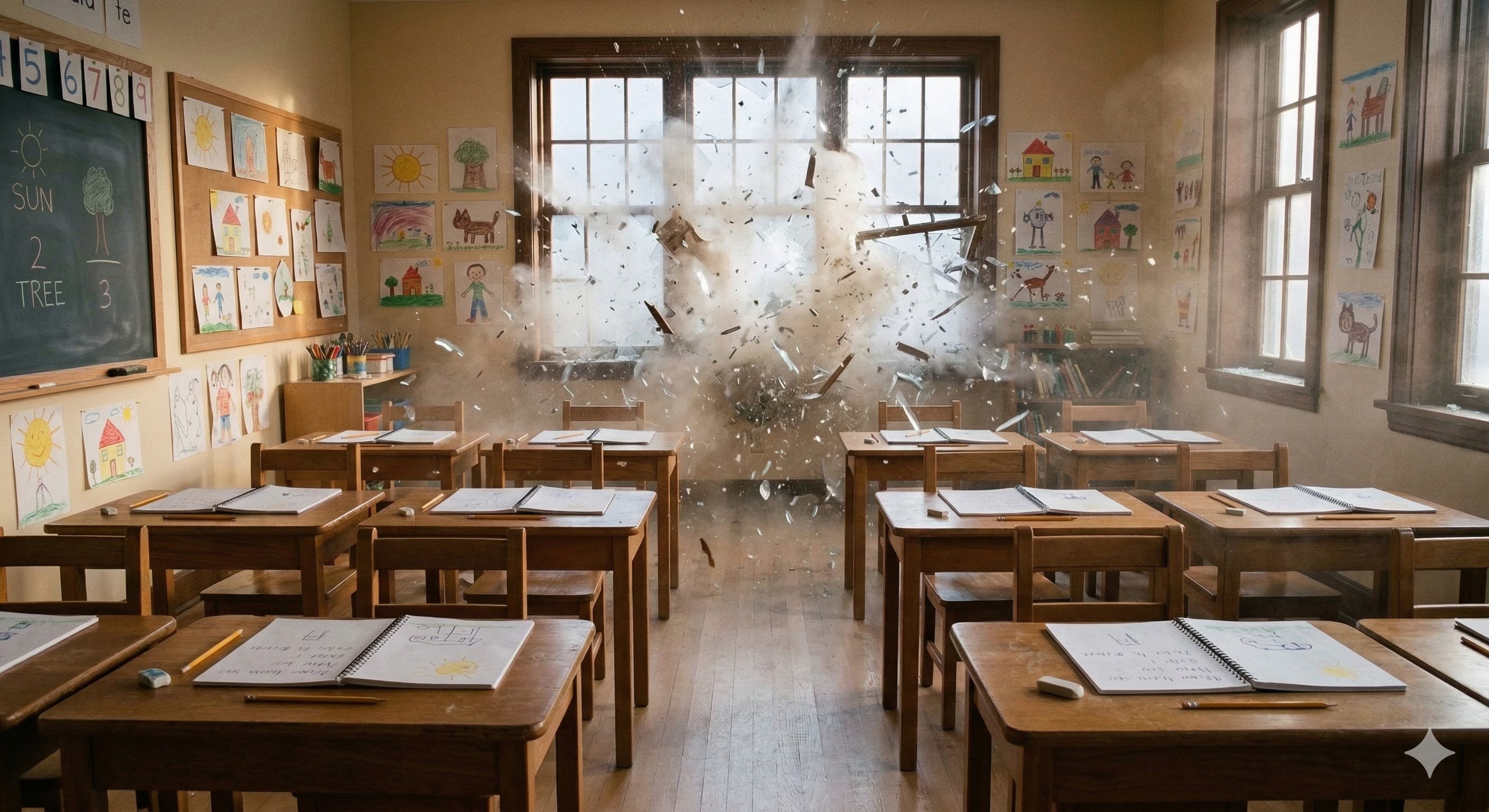
The Wrong Lesson
We spent a decade panicking about first-person shooter games. The fear was simple: kids marinating in simulated kill loops would eventually export that violence into the real world. The research came back negative. The players didn’t become killers. Case closed.
We drew the wrong lesson.
The problem was never that the game creates violence. The problem is what happens to a mind that only ever inhabits a world with one win condition. You stop generating alternatives. Negotiation, patience, withdrawal; none of those are programmed as options, so the cognitive muscle atrophies. You don’t decide against them. They simply stop appearing.
But there is a second problem. A deeper one.
In the game, the people you obliterate are not people. They are targets. They are scores. They are the satisfying pixel-burst of an obstacle removed. The game does not require you to model what they wanted, what they feared, who was waiting for them, what their death produces in the world beyond the moment of its execution. The game does not ask you to carry that weight because the game was not designed to produce wisdom. It was designed to produce winning.
Now consider who’s designing the game.
The Language of Appetite
Listen to how Pete Hegseth talks about Iran. Not deterrence language, deterrence is conditional, it says if you do X we will do Y, it leaves a door open because the door being open is the point. What Hegseth speaks is something else entirely. “Death and destruction from the sky. All day long.” Iran is “toast, and they know it.” “We are accelerating, not decelerating.” On March 6, Trump demanded Iran’s “unconditional surrender” and told Reuters he wanted to personally participate in choosing Iran’s next leader.
Notice what is absent from this language. Not just diplomatic nuance. Not just strategic conditionality. What is absent is any acknowledgment that the targets of this rhetoric are human beings. Those with families, with fears, with ordinary lives being conducted in the shadow of an armada they did not summon and a conflict they did not choose. The Iranian engineer. The mother in Tehran checking prices at a market that may not exist next week. The student who has never held a weapon and has no vote in what his government does. They do not appear in the language. They are not modeled. They are the pixel-burst.
This is not incidental. This is structural. When a system has stopped modeling consequences, the first thing it stops modeling is the humanity of the people those consequences fall upon. Not because the people in power are necessarily monsters, though history suggests the threshold between ordinary hubris and monstrous outcome is lower than we prefer to believe, but because the game was not designed to ask that question.
At the State of the Union on February 24, Trump claimed Iran was “working to build missiles that will soon reach the United States of America.” The Defense Intelligence Agency’s own assessment concluded Iran was a decade away from that capability. Arms control expert Daryl Kimball called the claims “not supported by available evidence.” It didn’t matter. The language wasn’t designed to be accurate. It was designed to be irreversible, to pre-authorize an outcome before the decision was formally made, to make every alternative sound like retreat.
But accurate language requires modeling reality. And modeling reality requires modeling the people inside it. The lie about the missiles is not just a strategic manipulation. It is a symptom of a system that has stopped needing the world to be true, because the world, in this operating mode, is not a place inhabited by people whose lives matter in the calculation. It is a game board. The pieces do not bleed.
Cuba follows the same architecture. A national emergency declaration on January 29. By February 27, Trump was suggesting a “friendly takeover”, calling Cuba “a failed nation” that “wants our help.” Eleven million people live in Cuba. They were not consulted about whether they want to be taken over. Their wants, their actual, specific, human wants, do not appear in the language at all. They are a nation, an abstraction, a problem to be solved by a man who has decided he knows what they need better than they do.
This is hubris in its oldest form. Not arrogance about capability. Arrogance about consequence. The certainty that your actions are so obviously correct that the people they fall upon should be grateful, and that their failure to be grateful is a malfunction in them, not a signal worth receiving.
What Hubris Costs
Hubris has a clinical definition that gets lost when we treat it as mere arrogance. In its precise meaning, hubris describes the condition in which accumulated power produces the cessation of consequence-modeling. Not that consequences are modeled incorrectly. That they stop being modeled at all.
And consequences, at this scale, are not abstractions. They are the specific weight of specific deaths, specific displacements, specific ruptures in specific families that will reverberate for generations. The Bulletin of the Atomic Scientists called the Iran war “dangerous and pointless.” The Union of Concerned Scientists documented rising nuclear risk. These are not political assessments. They are attempts to quantify what the game designers do not model: the cost, in human terms, of a system operating without the corrective weight of human consequence.
Sir John Glubb, after studying thirteen empires across three thousand years, identified a recurring terminal phase he called the Age of Decadence, characterized not by external defeat but by internal failure of imagination. The ruling class stops being able to conceive of alternatives to its own dominance. But there is something Glubb observed that gets less attention than his structural analysis: in every case, the suffering fell first and hardest on the people with the least power to affect the decisions being made. The soldiers. The civilians. The populations of the countries the empire decided were problems to be solved. The ruling class experienced the consequences last, and often not at all, insulated by wealth, distance, and the institutional capacity to narrate failure as something other than failure.
That pattern is not historical. It is present tense.
The average Iranian citizen did not choose their government’s nuclear program. The average American soldier did not choose the war they are now being asked to prosecute. The average Omani diplomat did not choose to have his breakthrough bombed the day after he announced it. The average person, in Tehran, in Havana, in Washington, in the countries watching this unfold and updating their threat assessments accordingly, experiences the consequences of decisions made by people who will not personally absorb those consequences. The distance between the decision and its human cost is not a bug in the system. It is a feature of hubris at scale. The game designers do not live inside the game.
The Day After the Breakthrough
On February 27, 2026, Oman’s Foreign Minister Badr bin Hamad Al-Busaidi announced what he called a “breakthrough” in indirect US-Iran negotiations. Iran had agreed to never stockpile enriched uranium. Full IAEA verification was on the table. Technical discussions were scheduled for Vienna the following week.
The following day, the United States and Israel launched strikes on Iran.
Take a moment with what Al-Busaidi experienced in that 24-hour window. He had put his name, his credibility, his country’s reputation as a neutral mediator, and the accumulated trust of years of careful diplomatic work on the line. He had announced a breakthrough, publicly, in good faith, as a diplomat who believed the process was real. He woke up the next morning to bombs.
He said he was “dismayed” that “active and serious negotiations have yet again been undermined.”
Dismayed is a diplomat’s word for something that does not have a diplomatic word. It is the language a person uses when they are trying to remain professional while describing the experience of having been used, of having their good faith treated as a resource to be consumed rather than a relationship to be honored. The Omani foreign minister is not a casualty of the Iran war in the conventional sense. But something was taken from him, and from his country, and from the international community’s capacity to trust American diplomatic engagement, that will not be returned by a future administration’s good intentions.
The word again remains load-bearing. June 2025. February 2026. Twice, diplomacy produced results. Twice, military action arrived before those results could be acted upon. The people who did the diplomatic work, who put their credibility and their countries’ reputations into the process, were not warned. They were not consulted. They were not considered. They were the pixel-burst.
L. Ali Khan of Washburn University School of Law documented the consequence: the administration had “transformed diplomacy into a calculated ruse” and “permanently damaged American credibility in future negotiations.” Dr. Tara Drozdenko identified the human implication that travels beyond this specific conflict: “Other governments worried that they may one day suffer the unwelcome attention of the United States will be unable to trust in diplomatic processes.”
Those other governments are led by people. People who watched what happened to the Omani foreign minister. People who are now performing their own calculations about what American engagement means, what American assurances are worth, what risk they assume when they put their names on a breakthrough and announce it to the world. The indifference to their experience, to the specific human cost of having your diplomatic work treated as cover for a military operation already in motion, is not a side effect of hubris. It is its defining characteristic.
A system that does not model the humanity of its targets does not model the humanity of its partners either. The Iranian civilian and the Omani mediator are both invisible in the same way, both casualties of a game that was not designed to ask what their lives are worth.
The Fork That Doesn't Matter
Here is where the analysis arrives at a fork that feels important and turns out not to be.
Did anyone plan this? The pattern is consistent enough, the sequencing deliberate enough, the beneficiaries identifiable enough that deliberate architecture seems like a reasonable hypothesis. Or is this the blundering of a rhetorically undisciplined administration that stumbled into consequences it didn’t foresee?
The answer is that it doesn’t matter, and the reason it doesn’t matter is precisely the point about human cost.
Whether the deaths were planned or stumbled into, they are deaths. Whether the Omani mediator’s work was deliberately used as cover or carelessly disregarded, it was destroyed. Whether the Iranian civilians who did not choose their government’s nuclear program were targeted or simply present in the way of an outcome that was going to happen regardless, they are the ones absorbing the consequences of decisions made by people insulated from those consequences by distance, wealth, and the institutional capacity to narrate failure as victory.
Incompetence at this scale is indistinguishable from malice in its consequences. And the consequences fall on the people who had the least say in producing them, as they always have, in every empire, in every Age of Decadence, in every moment when the game designers forgot that the pixels bleed.
The machine doesn’t need to keep running to keep foreclosing. It only needed to run long enough.
The People Nobody Was Modeling
There is a particular cruelty in what hubris does to ordinary people that distinguishes it from ordinary political failure.
Ordinary political failure produces bad outcomes that the system, if it retains the capacity for self-correction, can eventually recognize and address. The consequences land, the feedback arrives, the decision-makers update their models. This is how democracies are supposed to work. The pain of bad decisions eventually reaches the people making them, or the people who replace them, and the system adjusts.
Hubris breaks this mechanism. It breaks it specifically by eliminating the feedback loops, the diplomats who would report from the field, the intelligence analysts who would contradict the narrative, the allied leaders who would push back in private, the institutional memory that would say we tried this before and here is what happened. When those people are gone, removed through dismissal, departure, self-censorship under rhetorical gravity, or the simple attrition of a system that stopped valuing their function, the consequences of bad decisions no longer reach the decision-makers in any form they can act on.
The ordinary citizen, American, Iranian, Cuban, Omani, or citizen of any nation now recalculating its relationship to American power, does not benefit from this insulation. They receive the consequences directly, without the buffer of distance and institutional protection. The soldier deployed into a war whose endgame shifts week to week. The family in Tehran. The future mediator who will not put their name on a breakthrough because they watched what happened to the last person who did. The American taxpayer funding a war whose goals, as CNN reported, are “shifting and contradictory.”
These people are not in the game. They are in the world the game is being played in.
And the game, by design, does not ask about them.
The Game the Pixels Can't Escape
The kids who played Doom couldn’t act out the game. That was why the panic was misplaced. The simulation stayed simulation because the players had no command authority, no carrier groups, no nuclear codes, no ability to make the world inside the screen become the world outside it.
These men can.
And they are not just playing a game with one win condition. They are building an environment in which that game is the only one available: dismantling the back-channels, removing the diplomats, bombing the breakthroughs, speaking a language so committed to a single outcome that every alternative has to fight its way upstream against the current of everything already said publicly and on record. The people who pay the price for that environment are not the game designers. They are never the game designers. They are the people who were already living in the world before it was turned into a game, who did not ask to have their lives become the terrain on which someone else’s win condition gets executed.
History does not remember the game designers kindly. Glubb’s empires ended. McNamara spent the last decades of his life writing about what he failed to see. Powell called his UN presentation a blot he could not remove. The architects of these moments eventually encountered the weight of what they had done. Usually too late, usually from a distance that protected them from the full force of it, usually in memoirs rather than consequences.
The people in Tehran did not get to write memoirs about it.
The danger was never the threat. It was what the threat was doing to the people nobody was modeling. The civilians, the mediators, the allied leaders recalculating their trust, the soldiers, the ordinary citizens of nations that became game boards, and the Americans watching their country’s credibility as a negotiating partner dissolve in real time into something that other governments will spend decades deciding whether to trust again.
There is a second story running beneath this one, about what happens when the same pattern of hubris-driven indifference gets applied not to foreign policy but to the cognitive infrastructure of the state itself. To the AI systems being woven into military operations, intelligence analysis, and civilian life. To the question of who gets to decide what values those systems hold, and what happens to the people, inside America and beyond it. When the answer is determined by the same system that bombed a diplomatic breakthrough the day after it was announced.
That story is harder to see. The people it will affect are even less visible than the ones described here.
It’s next.
Sources
Hegseth quotes (March 4) Times of Israel | Jerusalem Post | Audacy
Trump “unconditional surrender” / choose next leader (March 6) Axios | Al Jazeera | CNN
Trump SOTU missile claim vs. DIA reality (Feb 24) CNN | Reuters/ToI | ABC News | PolitiFact | FactCheck.org
Oman breakthrough / “dismayed” (Feb 27-28) The Hill | Middle East Eye | TRT World | NBC News liveblog
US counter-narrative on Oman talks Times of Israel
Minab school strike Wikipedia | Al Jazeera investigation | CBS News | UN/OHCHR
Hegseth “we’re investigating” (school question, Day 5) Brent Molnar Substack
No endgame / allies have no idea CNN
Death toll / American soldiers killed PBS NewsHour | The War Zone
Glubb — The Fate of Empires (1978) Book citation — no URL needed