
HOW DID WE FORGET - PART 6
THE SHOPKEEPER’S SIGN - When the Comfortable Fictions Finally Collapsed

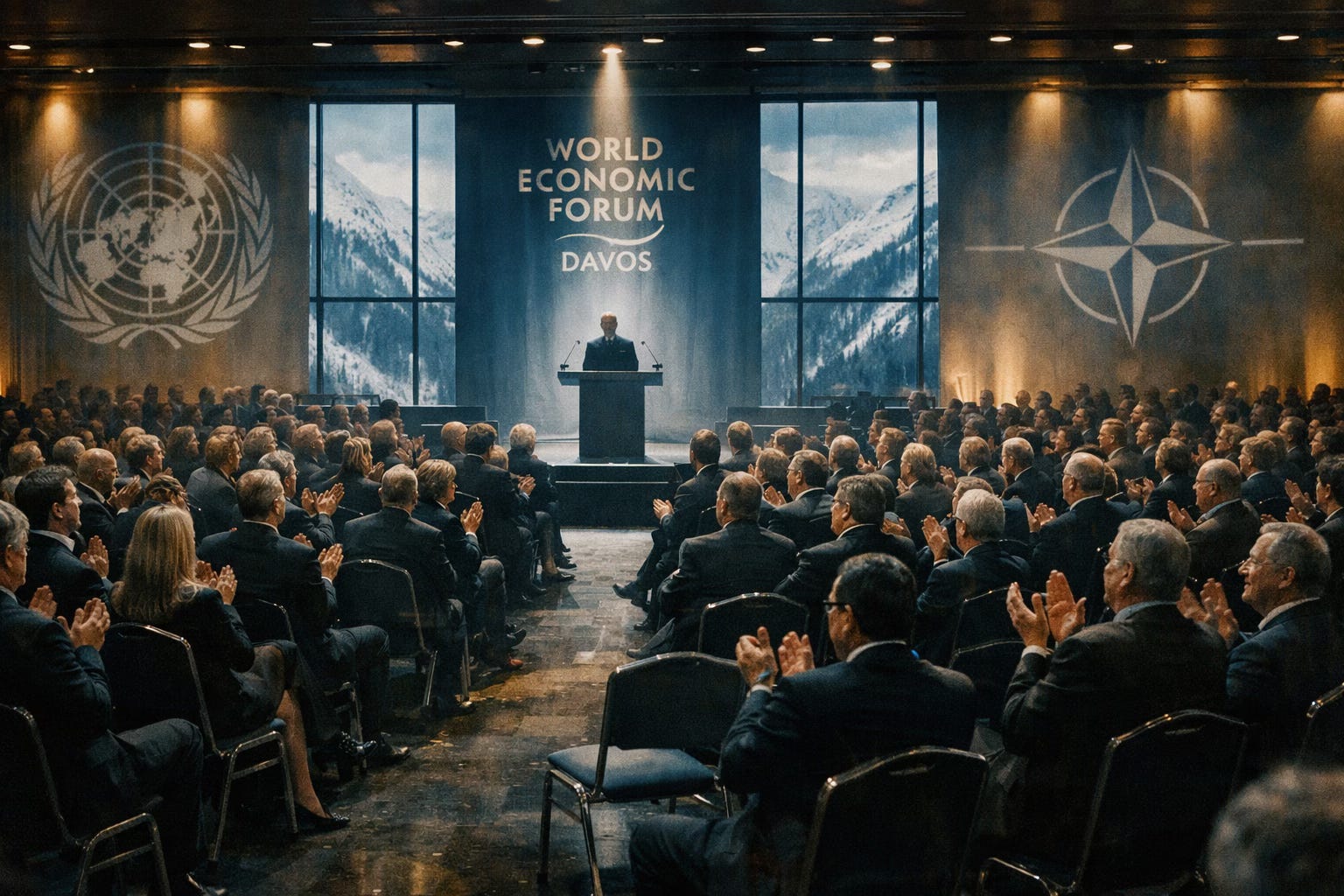
The global elite gathered in the Swiss Alps to applaud the demolition of the world order they’d spent decades maintaining. What does it mean when the architects eulogize their own creation?
Davos
The applause started before he’d finished the sentence.
“All the U.S. is asking for is a place called Greenland,” President Trump told the assembled global elite at the World Economic Forum in Davos on January 21, 2026. The ballroom—packed with CEOs controlling trillions, heads of state managing nuclear arsenals, and financiers who’d architected the post-war order—broke into applause as the American president demanded territorial acquisition from a NATO ally.
“What I’m asking for is a piece of ice, cold and poorly located,” Trump continued, at one point confusing Greenland with Iceland, his words drawing laughter rather than shock. Then came the threat dressed as courtesy: “You can say yes and we will be very appreciative. Or you can say no and we will remember.”
More applause.
The scene was surreal not because Trump was demanding 21st-century territorial expansion—we’ve grown accustomed to his geopolitical provocations. The surrealism came from the audience reaction. The same people who’d spent decades invoking “rules-based international order,” who’d lectured the world about democratic norms and institutional stability, were clapping enthusiastically as the most powerful military force on Earth openly discussed coercing an ally into surrendering territory.
A day earlier, on the same Davos stage, Canadian Prime Minister Mark Carney had delivered a different kind of bombshell, one that received a standing ovation. “The old order is not coming back,” Carney declared. “We should not mourn it.” He then did something remarkable for a sitting head of government: he admitted the whole thing had been a lie we all agreed to tell.
This is the story of how we forgot. Or more precisely, how we chose not to see. And how that choice is finally becoming impossible to maintain.
THE GREENGROCER’S SIGN
In 1978, Czech dissident Václav Havel wrote an essay called “The Power of the Powerless.” In it, he described how totalitarian systems perpetuate themselves not through violence alone, but through the participation of ordinary people in rituals they privately know to be false.
His example: a greengrocer who places a sign in his window each morning reading “Workers of the world, unite!” The greengrocer doesn’t believe it. His customers don’t believe it. Everyone knows it’s a lie. But he places the sign anyway—to avoid trouble, to signal compliance, to get along. And because every shopkeeper on every street does the same, the system persists.
Carney quoted this parable in his Davos speech, then turned it on the assembled global elite:
“For decades, countries like Canada prospered under what we called the rules-based international order. We joined its institutions, praised its principles, and benefited from its predictability. We could pursue values-based foreign policies under its protection. We knew the story of the international rules-based order was partially false. That the strongest would exempt themselves when convenient. That trade rules were enforced asymmetrically. And that international law applied with varying rigour depending on the identity of the accused or the victim. This fiction was useful... So, we placed the sign in the window.“
Read that again. The Prime Minister of Canada, speaking to the World Economic Forum, admitted that the “rules-based international order” functioned like Soviet communism—not because people believed in it, but because everyone agreed to pretend they believed in it.
The applause he received suggests they all knew. They’d always known.
HOW DID WE FORGET? WE DIDN’T. WE CHOSE NOT TO SEE.
The Berlin Wall fell on November 9, 1989. The Soviet Union formally dissolved on December 26, 1991. And in that moment, something dangerous happened to American strategic thinking: we forgot why we’d built the post-war order in the first place.
We didn’t build NATO because we loved multilateralism. We built it because Stalin controlled half of Europe and possessed nuclear weapons.
We didn’t create the Bretton Woods system because we believed in international cooperation. We created it because we needed to rebuild markets shattered by depression and war, and prevent the economic chaos that had enabled fascism.
We didn’t maintain a massive military and nuclear arsenal because we were warmongers. We maintained them because the alternative was Soviet domination or nuclear annihilation.
The post-war American-led order wasn’t idealism—it was survival strategy that happened to create unprecedented prosperity. And that prosperity made us forget it was a strategy at all.
For thirty-five years since 1991, we’ve operated under a comfortable delusion: that American wealth and power were permanent features of reality, not outcomes that required constant, costly maintenance. We believed we’d “won” history, that liberal democracy and market capitalism were inevitable endpoints, that the world would naturally organize around our preferences.
We were wrong.
The world is a jungle. Human nature hasn’t changed. Someone always wants to dominate. And while we spent three decades believing in the “end of history,” our competitors were preparing for its continuation.
China built the world’s largest navy. Russia rebuilt its nuclear arsenal and invaded its neighbors. Tech oligarchs consolidated more wealth than nation-states. Europe—12% of world population, 25% of GDP, over half of global welfare spending—destroyed its nuclear capacity and ran down its military because there seemed to be no consequences.
Until there were consequences.
And all of it happened while we placed signs in windows about “international order” and “democratic values.”
Davos 2026 was the moment the signs came down.
THE DOLLAR AS WEAPON
On the same day Trump demanded Greenland, another panel convened at Davos: “Dedollarization or Redollarization?” The discussion should have been arcane central banking talk. Instead, it became a case study in how the comfortable fiction unraveled.
The moderator opened by noting that “the head of Deutsche Bank has called [the US Treasury Secretary] to disavow a report on how many dollar assets European investors might dump.” Think about that. The CEO of Germany’s largest bank felt compelled to personally assure the American government that Europeans weren’t about to flee dollar holdings en masse.
This isn’t how confidence works. This is how panic works.
Jeffrey Frieden of Columbia University made the connection explicit: “Confidence in a currency is also confidence in the government that issues the currency not to unduly allow politics or geopolitics to interfere with the use of the currency and monetary and financial stability.”
Translation: The dollar’s reserve status depends on the United States not weaponizing it. But we’ve been weaponizing it for two decades—sanctions on Russia, Iran, Venezuela, freezing assets, cutting countries out of SWIFT. Every time we use the dollar as a geopolitical tool, we remind the world that their wealth exists at American sufferance.
The panelists discussed this matter-of-factly. There was no pretense that sanctions are temporary emergency measures. They’re normalized tools of statecraft now. The “rules-based order” always meant: we make the rules, you follow them, and we’ll change them when convenient.
The private sector understands this perfectly. Businesses “just want the most liquid currency” regardless of geopolitics. But governments are building alternatives—BRICS payment systems, bilateral currency swaps, de-dollarization agreements—because they finally internalized the lesson: the sign in the window doesn’t protect you when the hegemon decides you’re a threat.
THE 1920s PARALLEL: POWER BUILT ON MONEY ALONE
On January 23, another Davos panel asked: “Are the 2020s the New 1920s?”
Historian Adam Tooze captured why the parallel terrifies: “The basis for their power was money. It was finance. It was the dollar’s hegemony in the 1920s that was supposed to anchor this world that was otherwise really fragile.”
Both eras feature breakthrough technologies concentrating wealth (electrification then, AI now), massive financial consolidation in few hands, weak or “nave-proof” institutions designed to prevent political interference, strained trade systems, and intensifying great power competition. Both relied on financial hegemony to mask fundamental fragility.
The 1920s ended in 1929—what Tooze called “the hubris and failure of imagination and failure of politics.”
We’re doing it again. But this time with AI systems being developed without democratic consent, 12,241 nuclear warheads (down from a Cold War peak of 70,300, but still enough to end civilization), climate deadlines approaching, and financial infrastructure even more concentrated and interconnected.
The difference is speed. In the 1920s, you measured technological change in decades. Today, AI labs project “AGI”—artificial general intelligence matching or exceeding human capabilities across most domains—within this decade. Anthropic’s Dario Amodei predicts “late 2026 or early 2027.” Google DeepMind’s Demis Hassabis estimates 50% probability by 2030.
Whether those timelines prove accurate or not, the trajectory is clear: unprecedented technological change is colliding with great power competition and institutional collapse. And nobody at Davos wants to seriously discuss what happens when AI development, nuclear weapons, and failing global order converge.
WHEN THE FICTIONS FINALLY FAIL
Carney put it starkly: “We are in the midst of a rupture, not a transition. Great powers have begun using economic integration as weapons, tariffs as leverage, financial infrastructure as coercion, supply chains as vulnerabilities to be exploited.”
He called for “middle powers” to build alternative coalitions, to work together rather than compete for favor from hegemons. It’s a compelling vision. But it requires the very institutional trust that just evaporated.
Because here’s what Carney was really saying: The old order provided escape valves. Diplomacy. Institutions. Face-saving mechanisms. When leaders got backed into corners, the “rules-based order” gave them ways out.
What happens to leaders in traps when there are no more escape valves?
THE NUCLEAR SHADOW NOBODY WANTS TO DISCUSS
In my previous piece, I examined the psychology of world leaders—Xi Jinping, Vladimir Putin, Donald Trump—and how each is locked in a “trap” of their own making. Domestic politics and international positioning create situations where backing down means losing power. They cannot retreat without potentially fatal consequences.
The post-war order was designed precisely to prevent this. NATO’s Article 5. UN Security Council procedures. International courts. Trade agreements. Financial systems. These weren’t just bureaucracies—they were pressure release valves. Ways for leaders to claim victory while actually compromising. Ways to avoid the final question: who has more firepower?
Now those valves are closing.
Trump demands Greenland and threatens economic punishment if Denmark refuses. Denmark can’t yield without losing credibility. Trump can’t back down without looking weak. Both are locked in.
Carney says Canada “stands firmly with Greenland and Denmark” and reaffirms NATO commitments. Trump excludes Carney from his “Board of Peace” in retaliation. Both are locked in.
And what is this “Board of Peace” that Trump wields as reward and punishment? A telling glimpse of the new order replacing the old: membership costs $1 billion paid to the United States, with Trump himself as permanent chairman even after he leaves office. The founding members include UAE, Bahrain, Saudi Arabia, Qatar, Egypt, Turkey, Albania, Armenia, Azerbaijan, Belarus, Hungary, Kazakhstan, Morocco, Pakistan, Indonesia, and Vietnam—a mix of Middle Eastern powers and states with authoritarian or transactional relationships with the U.S. Not a single NATO ally joined—not Canada, not Britain, not France, not Germany.
This is the new architecture being built: not multilateral institutions with shared governance, but transactional arrangements where access costs cash and loyalty, where the United States operates as vendor rather than partner. The UN Security Council operated on the fiction of great power consensus. The Board of Peace operates on the reality of pay-to-play.
The pattern repeats globally: US vs. China over Taiwan, Russia vs. Ukraine, India vs. Pakistan, Iran vs. Israel. Every confrontation follows the same logic—leaders in domestic traps, international order providing fewer off-ramps, escalation becoming the only available move.
And through it all, 12,241 nuclear warheads sit ready for launch. About 2,100 are on high operational alert, meaning they can be fired within minutes. The vast majority belong to Russia (5,460 warheads) and the United States (5,180). China is growing its arsenal fastest, adding roughly 100 warheads annually.
The nuclear shadow looms over everything, acknowledged by everyone, directly addressed by no one. In Trump’s speech? Zero mentions. In Carney’s speech? Zero. In the dollar panel? A handful, all in passing.
THE INFRASTRUCTURE BENEATH
There’s another element to this story that Davos elites preferred not to examine: the technological infrastructure enabling both the old order’s maintenance and its weaponization.
The “rules-based international order” required information asymmetry. Governments knew more than citizens. Institutions operated with discretion. Leaders could make deals quietly, present them publicly, and maintain the fiction of consent.
The dollar’s hegemony required financial infrastructure—SWIFT networks, correspondent banking, clearing systems. All running on technology increasingly concentrated in fewer hands.
Now we’re building the next layer: AI systems, surveillance networks, cognitive targeting infrastructure. And as I’ve documented in my “Gods or Ashes” series, there’s a through-line connecting it all—companies like Oracle building the backbone beneath both government surveillance and AI development, operating largely without democratic oversight or public awareness.
This infrastructure doesn’t replace the old fictions with transparency. It creates new asymmetries. New forms of control. New “signs” for the window.
The greengrocer isn’t refusing the sign because truth triumphed. He’s refusing because the old sign doesn’t work anymore. New ones are being printed.
WHAT REPLACES THE OLD ORDER?
Look at the timelines converging:
AI Development: Systems with “intellectual capabilities matching or exceeding that of Nobel Prize winners across most disciplines” by late 2026 or early 2027, according to Anthropic. A “country of geniuses in a datacenter.”
Geopolitical Competition: Accelerating daily. Greenland today, Taiwan tomorrow? Trade wars becoming kinetic? Economic coercion escalating?
Nuclear Modernization: All nine nuclear powers upgrading arsenals. New delivery systems. New doctrines. Russia developing nuclear-powered cruise missiles. China building hundreds of new ICBM silos.
Climate Deadlines: Tipping points approaching. Resource competition intensifying.
Financial Instability: Dollar weaponization driving de-dollarization. Debt levels unsustainable. Inequality reaching breaking points.
These aren’t separate crises. They’re interconnected, accelerating, and converging.
Trump offers “Golden Age of America”—a vision of restored dominance through unilateral power. Carney offers middle power coalitions—building “what we claim to believe in.” Both assume we have time to build alternatives. That the transition will be managed, gradual, survivable.
But here’s the dark twist Havel understood: the greengrocer doesn’t refuse the sign because he’s committed to truth. He refuses because the old sign doesn’t protect him anymore. And when the system prints new signs—new fictions, new lies we’re supposed to believe—he’ll calculate whether placing those serves his interests.
We’re not transitioning from lies to truth. We’re transitioning from old lies to new ones.
Trump’s “Golden Age of America” is a new sign. “Middle power coalitions” is a new sign. “Transformative AI will solve everything” is a new sign. “We can manage great power competition peacefully” is a new sign.
The question isn’t whether we’ll participate in comfortable fictions. The question is: which fictions will we choose to maintain?
The comfortable fiction of the “rules-based order” at least provided the illusion of stability while these pressures built. Now that fiction has been publicly demolished by its own architects. The signs are coming down from the windows. Reality becomes visible.
What happens when you remove the pressure valve while increasing the pressure?
THE ANSWER
We didn’t forget. We chose not to see.
We chose not to see that American hegemony required constant, costly maintenance. That “end of history” was narcissistic delusion. That nuclear weapons still existed and human nature hadn’t changed. That prosperity built on exploitation generates resistance. That technological power concentrated in elite hands serves elite interests.
Since 1991, we operated under a fatal assumption: that American wealth and power were permanent features, not outcomes requiring strategic maintenance. We believed liberal democracy had “won,” that the world would organize around our preferences, that history had ended.
The world is a jungle. Someone always wants to dominate. For three decades, while we cashed the “peace dividend,” our competitors prepared. China built infrastructure and industrial capacity. Russia rebuilt its military and nuclear forces. Tech billionaires accumulated wealth rivaling nations.
Now reality is reasserting itself. The jungle never went away. We just had the luxury of pretending it had.
THE STAKES
We are living through the most dangerous convergence in human history.
Technological change accelerating beyond our ability to comprehend it, let alone govern it. AI systems being developed without democratic consent, by private companies, for profit, with capabilities that may exceed human intelligence across most domains within years.
Great power competition intensifying as the old order collapses. No escape valves. Leaders in traps. Economic coercion escalating toward kinetic conflict.
Nuclear weapons—over 12,000 of them—in the hands of nine countries, with thousands on high alert, while deterrence doctrines degrade and new delivery systems deploy.
And beneath it all: infrastructure being built—surveillance networks, AI systems, financial controls—that concentrates power in fewer hands than any previous moment in history.
The generation that remembered why we built international institutions, why we created multilateral systems, why we invested in collective security—that generation is dying. The generation that experienced World War II, that watched nuclear weapons demonstrated, that understood viscerally what happens when great powers collide—they’re gone.
We forgot because we chose not to see. We chose comfort over clarity. We chose reassuring fictions over difficult realities.
At Davos 2026, the fictions finally collapsed. The architects of the old order declared it dead. The audience applauded.
Now what?
REMEMBERING ISN’T ENOUGH
The title of this series is “How Did We Forget?” But that was never quite the right question.
We didn’t forget nuclear weapons exist. We chose to stop thinking about them.
We didn’t forget that power corrupts. We chose to believe “our” power was different.
We didn’t forget that institutions require maintenance. We chose to stop paying the cost.
We didn’t forget that the world is a jungle. We chose to pretend civilization was permanent.
Remembering isn’t enough. The nuclear weapons are still there. The great powers still compete. The AI systems are still being built. The climate is still changing. The inequalities still widen.
The comfortable fictions are gone. Reality is visible.
Havel’s greengrocer refused the sign. But the system didn’t immediately fall. Individual resistance isn’t enough. Seeing clearly isn’t enough. Remembering isn’t enough.
The question isn’t “How did we forget?”
The question is: “What will we do now that we remember?”
This is Part 6 in the “How Did We Forget” series examining the nuclear shadow, institutional decline, and concentrated technological power. Previous parts covered the abolition movement’s failure, institutional memory loss, “abolition in the mirror,” deterrence degradation, and leader psychology.
For more on the technological infrastructure beneath these dynamics, see my parallel series “Gods or Ashes: Inside the Race for AGI.”
Sources
NPR: https://www.npr.org/2026/01/21/nx-s1-5683078/trump-davos-speech-tariffs-greenland
TIME: https://time.com/7355488/trump-davos-speech-takeaways-analysis/
CNBC: https://www.cnbc.com/2026/01/21/donald-trump-davos-speech-greenland-tariffs-europe.html
CBC (Full Transcript): https://www.cbc.ca/news/politics/mark-carney-speech-davos-rules-based-order-9.7053350
Official PM Canada: https://www.pm.gc.ca/en/news/speeches/2026/01/20/principled-and-pragmatic-canadas-path-prime-minister-carney-addresses
Globe and Mail: https://www.theglobeandmail.com/politics/article-mark-carney-davos-speech-full-transcript/
Standing ovation verified: https://theconversation.com/mark-carneys-davos-speech-marks-a-major-departure-from-canadas-usual-approach-to-the-u-s-274090
80,000 Hours (comprehensive): https://80000hours.org/agi/guide/when-will-agi-arrive/
Fortune (DeepMind): https://fortune.com/2025/04/04/google-deeepmind-agi-ai-2030-risk-destroy-humanity/
Axios (Hassabis): https://www.axios.com/2025/12/05/ai-deepmind-gemini-agi
Fortune (OpenAI): https://fortune.com/2025/04/15/ai-timelines-agi-safety/
Full Fact: https://fullfact.org/europe/does-europe-account-half-worlds-welfare-spending/
Eurostat (social spending): https://ec.europa.eu/eurostat/statistics-explained/index.php?title=Social_protection_statistics_-_social_benefits
Times of Israel (complete charter): https://www.timesofisrael.com/full-text-charter-of-trumps-board-of-peace/
Al Jazeera: https://www.aljazeera.com/news/2026/1/22/trump-launches-board-of-peace-at-ceremony-in-davos
CBC: https://www.cbc.ca/news/world/board-of-peace-gaza-trump-list-of-countries-9.7055866
CNBC: https://www.cnbc.com/2026/01/22/who-is-on-trumps-gaza-board-of-peace.html
The Hill: https://thehill.com/policy/international/5703219-carney-trump-tensions-rise/