
HOW DID WE FORGET - PART 4
When the Guardrails Fail at Once & What We Forgot About Institutional Maintenance

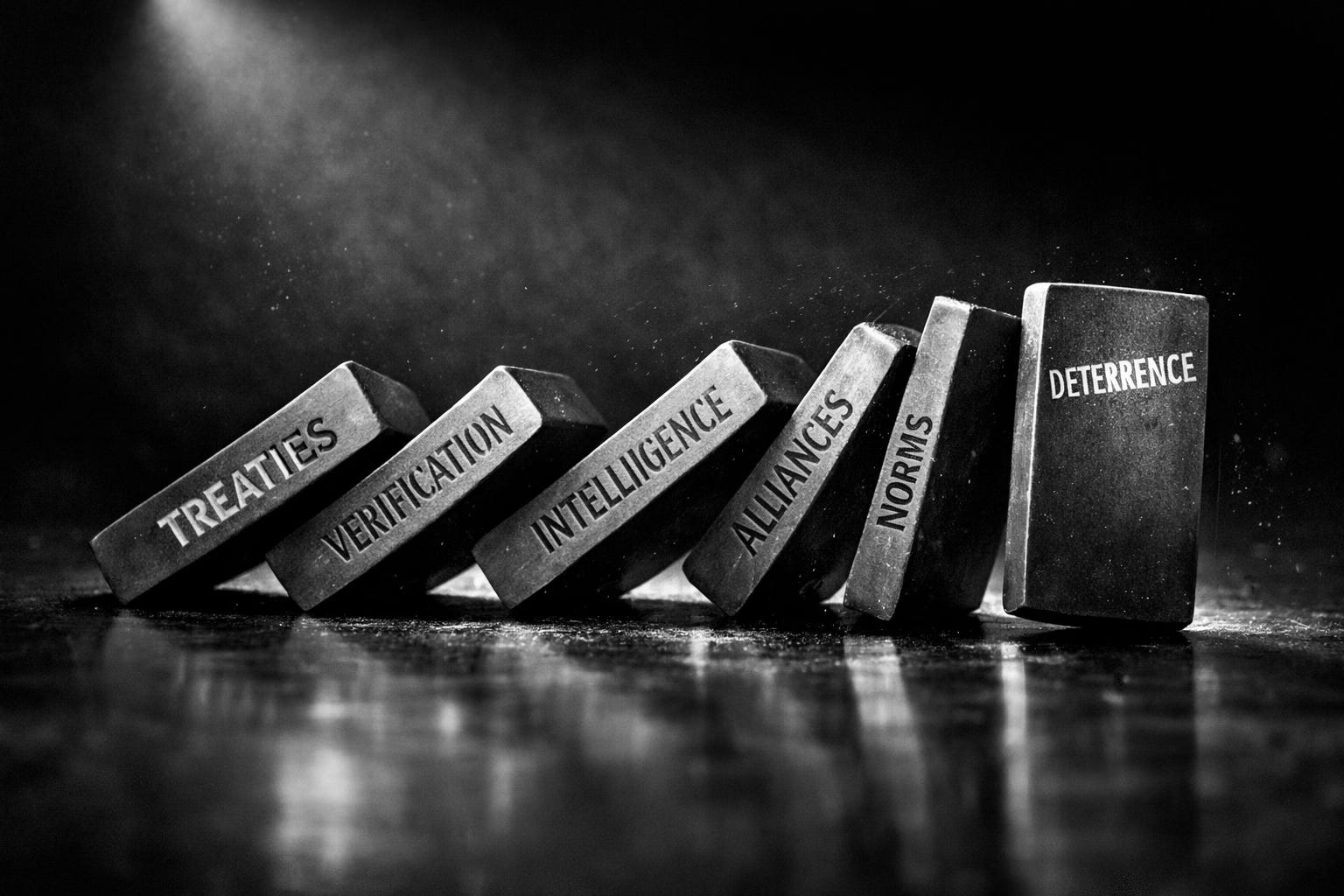
THE DATE
On February 5, 2026, the New Strategic Arms Reduction Treaty expires.
For the first time since 1972, no legally binding limits will constrain the world’s two largest nuclear arsenals. No inspections. No data exchanges. No notifications when missiles move. No verification of any kind.
This matters beyond the superpower balance. When the architecture that constrains the biggest players crumbles, smaller players notice. Nations with tactical nuclear weapons, dirty bomb capabilities, or the desperation to use them watch carefully to see whether rules still exist—or whether force is now the only arbiter.
WHAT ENDS
New START wasn’t just a piece of paper. It was architecture.
Eighteen on-site inspections per year. Mandatory notification of any movements or changes. Real-time data exchanges on force levels and locations. A system designed so that neither side had to wonder what the other was doing—because they could check.
Russia suspended participation in February 2023. No inspections since. No data exchanges. The treaty technically remains in force, but blind. And in twenty-nine days, even the legal framework disappears.
Putin has offered to maintain the numerical limits for another year. Without verification. Without inspections. Without notifications.
An unverifiable promise.
The Arms Control Association called it clearly: “little likelihood that any of its provisions will remain in force.” The first uncontrolled nuclear environment since Richard Nixon.
THE FORTRESS FALLS
For decades, American nuclear command and control was protected by obsolescence.
The systems that would launch America’s nuclear arsenal ran on 8-inch floppy disks until 2019. Not because the Pentagon couldn’t afford upgrades, because they didn’t want them. You can’t hack what has no IP address. Security through obscurity. Analog systems air-gapped from anything digital.
That’s ending.
NC3 modernization will cost $154 billion through 2034. The old analog systems are being replaced with digital networks designed to integrate with the Pentagon’s broader command architecture. Faster. More capable. More connected.
More vulnerable.
The Atlantic Council’s 2024 study: “the transition from analog to digital technologies has the potential to introduce vulnerabilities and unintended consequences.” Nuclear infrastructure could be “penetrated, corrupted, destroyed, or spoofed, leading to a loss of positive control (the ability to fire weapons) or negative control (the ability to prevent unauthorized or accidental use).”
A cyberattack could either prevent launch or cause one.
And while America rewires its nuclear command structure, adversaries are deploying weapons designed to blind it. The systems meant to detect incoming missiles, to communicate launch orders, to enable presidential decision-making, all increasingly depend on satellites that adversaries are learning to kill.
The window of vulnerability is now.
THE INVISIBLE SHIELD
Robert Gates, the only defense secretary in American history asked to stay by an incoming president of the opposing party, called what’s happening to America’s intelligence community “a supremely bad idea” with “long-term consequences.”
“Who they have fired are all the young people. These people are really the future of these agencies.”
The scale: The NSA Director—fired without explanation. The Defense Intelligence Agency chief—dismissed. 1,200 positions cut at CIA. FBI’s heads of Counterterrorism, Cyber Response, and Intelligence—all fired. More than one-third of CISA, the agency Congress created to protect critical infrastructure—gone. The Foreign Influence Task Force—disbanded.
Senator Mark Warner documented it: “Hundreds of analysts monitoring China and Russia... fired.”
U.S. Coast Guard Counterintelligence distributed new intelligence in April 2025: “agents from China, Russia, and other countries have set their sights on recently fired probationary workers, or those with security clearances, hoping to obtain valuable information about U.S. critical infrastructure or national security interests.”
The people we trained to protect America are being actively recruited by adversaries.
The invisible shield is being dismantled. And we are now blind in ways we don’t yet know.
THE ALLIANCE FRACTURES
The Five Eyes intelligence partnership began in 1946. For nearly eighty years, the most powerful intelligence alliance in history.
It’s breaking apart.
January 2025: Trump restricted intelligence-sharing on Russia and Ukraine.
March 2025: The “Ukraine intel blackout” shut Britain and Australia out of updates on Russian troop movements.
July 2025: DNI Tulsi Gabbard signed a directive barring information-sharing on Russia-Ukraine peace talks with Five Eyes partners entirely.
October 2025: Dutch intelligence chiefs announced they were scaling back intelligence-sharing with America over “politicization” and “human rights violations.”
November 2025: The UK carved out intelligence sharing related to lethal targeting after American strikes that allies believe violate international law.
The Spectator’s assessment: “Trump is destroying Five Eyes by destroying the trust that underpins it.”
What does it mean when America’s closest allies start hedging on whether to share intelligence?
It means warnings that might prevent the next attack may not arrive. It means blind spots are opening up in real time. It means that when a cornered adversary moves toward a desperate option, we may not see it coming.
THE DOCTRINE
In November 2025, the White House released its National Security Strategy.
The document opens by condemning the “network of international institutions” that American foreign policy elites “lashed American policy to”—institutions the document calls driven by “anti-Americanism” and “transnationalism that explicitly seeks to dissolve individual state sovereignty.”
The country that built the United Nations, that wrote the UN Charter, that created the post-World War II international order, is now calling that architecture anti-American.
In its place, the NSS proposes the “Trump Corollary to the Monroe Doctrine”:
“The United States will reassert and enforce the Monroe Doctrine to restore American preeminence in the Western Hemisphere... We will deny non-Hemispheric competitors the ability to position forces or other threatening capabilities.”
The document authorizes “the use of lethal force to replace the failed law enforcement-only strategy of the last several decades.”
It states:
“The United States must be preeminent in the Western Hemisphere as a condition of our security and prosperity—a condition that allows us to assert ourselves confidently where and when we need to in the region.”
The same document claims to defend national sovereignty. Page 9: “It is natural and just that all nations put their interests first and guard their sovereignty.”
The contradiction is the point. Sovereignty is sacred, except in spheres of influence. Rules apply, except when strength decides otherwise.
This isn’t new in history. It’s new for the country that spent eighty years saying it was different.
THE PROOF
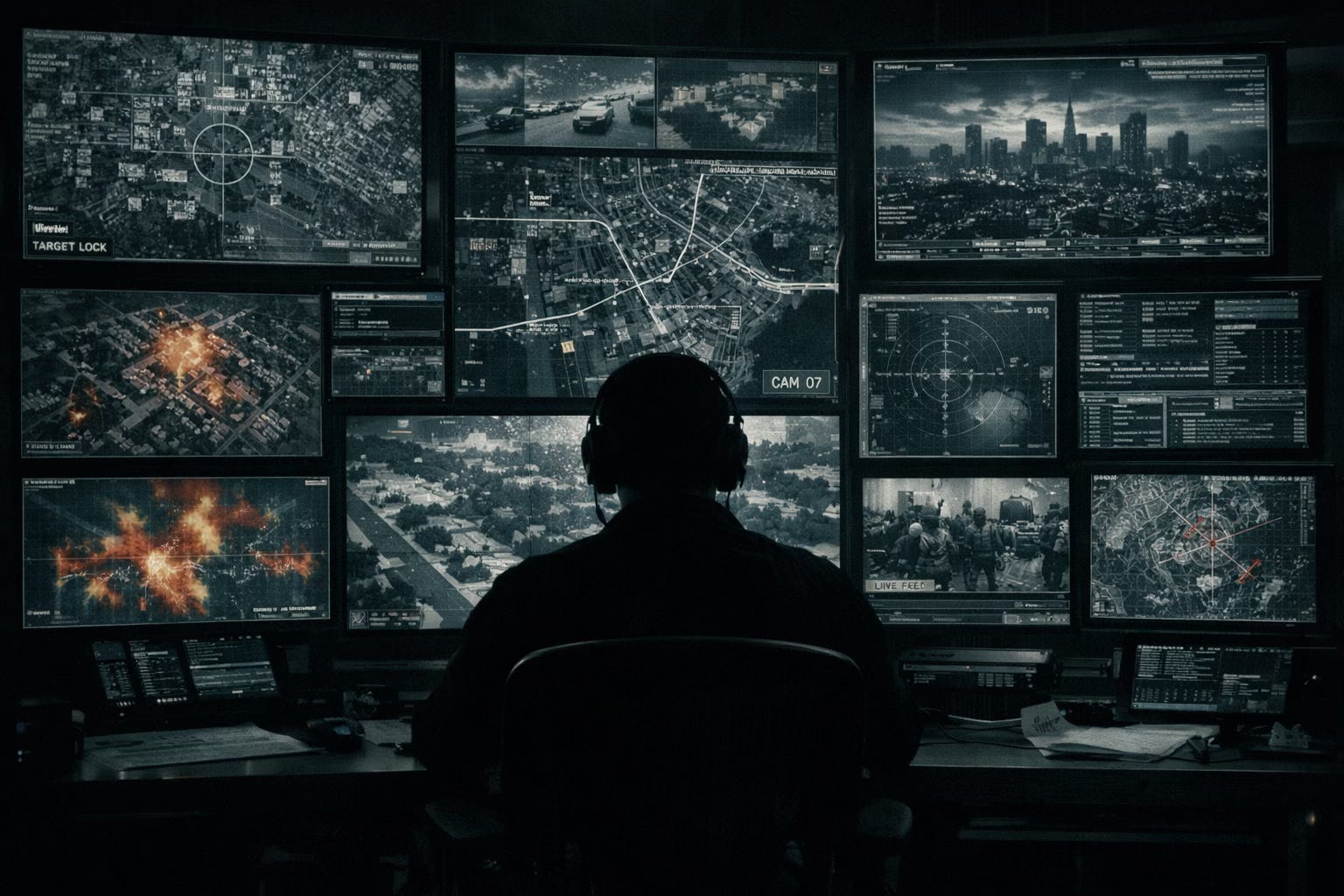
On January 3, 2026, the United States executed the doctrine.
American forces launched airstrikes across northern Venezuela, captured President Nicolás Maduro, and transported him to New York. At Mar-a-Lago, President Trump announced the U.S. would “run the country” temporarily.
The largest U.S. military operation in Latin America since 1989. Done without congressional notification. Done without UN authorization.
This matters for nuclear risk in two ways.
First, the precedent. Senator Mark Warner:
“If the United States asserts the right to use military force to invade and capture foreign leaders it accuses of criminal conduct, what prevents China from claiming the same authority over Taiwan’s leadership? What stops Vladimir Putin from asserting similar justification to abduct Ukraine’s president?”
I think he’s asking the wrong question. China and Russia already claim spheres of influence. They don’t need American permission. What changed is that America can no longer credibly object.
Second, and more immediately dangerous, smaller actors are watching.
Iran. North Korea. Pakistan’s arsenal in a succession crisis. Non-state actors who’ve sought fissile material for decades.
When the world’s most powerful nation demonstrates that sovereignty is conditional, that international law is optional, that force is the true arbiter—the calculation changes for everyone.
We enter the law of the jungle.
THE INFRASTRUCTURE
The Venezuela operation wasn’t conventional military power. It was the full integration of capabilities quietly assembled over the past decade—capabilities built for counterterrorism, now deployed for regime change.
Gen. Dan Caine described it at Mar-a-Lago: as American forces approached Venezuelan shores, the military “began layering different effects provided by U.S. Space Command, U.S. Cyber Command and other members of the interagency to create a pathway overhead.”
Trump added: “The lights of Caracas were largely turned off due to a certain expertise that we have.”
That expertise has names.
The CIA spent months building “pattern of life” surveillance on Maduro—tracking his movements, his security details, his daily routines. Stealth drones maintained near-continuous observation. The NSA provided geolocation support. Satellite imagery fused with signals intelligence into a unified targeting picture.
The analytical backbone is the AI targeting infrastructure we examined in Part 3—the same systems that process targets faster than humans can evaluate them, that reduce human oversight to twenty-second approvals, that turn judgment into rubber stamps. In Venezuela, those systems enabled what one defense analyst called the compression of “the decision space for defending against U.S. direct action to near-zero for targets who do not possess peer-level denial capabilities.”
Palantir, which runs the Pentagon’s Maven smart system, saw its stock jump on speculation it enabled the operation.
Here’s what should concern Americans beyond foreign policy:
These systems weren’t built in a vacuum. They were built on infrastructure that spans the globe, and the homeland.
Palantir’s other major clients include domestic law enforcement. The same company whose AI helps identify targets in Caracas helps police departments identify persons of interest in American cities. The same pattern-of-life analysis. The same data fusion.
Oracle, a company you’ve never heard of in this context but should, settled a lawsuit for $115 million over what prosecutors called “worldwide surveillance,” profiling billions of people without consent. Oracle now controls TikTok’s algorithm under national security arrangements and holds massive contracts with AI companies building these same capabilities.
And the architecture is expanding. At a recent developer conference, Oracle’s CEO Larry Ellison explained the next phase: AI trained on public data was just the beginning. “Peak value,” he said, comes when AI can reason using “privately owned data”—and Oracle has built the infrastructure to make private data anywhere, on any cloud, accessible to AI systems for processing. The company that profiled billions without consent is now positioning as the universal gateway between AI and everyone’s private information.
The surveillance infrastructure is not foreign or domestic. It’s both. The same architecture, the same companies, the same AI systems—pointed in different directions depending on who’s making the decision.
For the nuclear calculation, the implication is immediate:
A nation watching Venezuela understands that conventional defense is nearly impossible against these capabilities. Pattern-of-life surveillance means continuous tracking. Cyber operations mean your power grid can be disabled at the moment of attack. Precision extraction means no time to respond.
If you’re Iran. If you’re North Korea. If you’re any nation that might be next. You’ve just watched the world’s most powerful military demonstrate it can reach into your capital, disable your defenses, and extract your leader in three hours.
What’s your defensive option?
The answer, for nations with nothing left to lose, might be the one option that can’t be surgically removed: demonstrated nuclear capability.
The infrastructure that makes regime change surgical is the same infrastructure that makes desperate actors more desperate.
THE CONVERGENCE
These aren’t separate problems. They’re a system collapsing.
Each failure makes the others more dangerous. Without verification, we guess at adversary capabilities. Without intelligence, we miss warning signs. Without allied information-sharing, blind spots multiply. Without normative constraints, actors at every level recalculate what’s possible. And with demonstrated capability to reach anyone, anywhere, those who might be targeted face impossible choices.
There’s another possibility. One where the full spectrum of global surveillance is in place, the AI systems are processing targets faster than humans can evaluate them, and fewer hands are on the controls. Where the people making decisions are so abstracted from the violence that it becomes entertainment.
Trump described watching the Venezuela operation from Mar-a-Lago: “I watched it literally, like I was watching a television show.”
This is the logical endpoint of the infrastructure we’ve built. The targeting systems from Part 3 are now operational at scale. A generation raised on first-person shooters operating the real thing from laptops on folding tables. The distance between pressing a button and ending a life reduced to pixels on a screen.
The guardrails weren’t just treaties and institutions. They were friction. Time to think. Humans in the loop who understood what they were authorizing. Remove the friction, abstract the violence, let the machines handle the targeting—and you don’t need a desperate actor to make a catastrophic decision. You just need everyone to be watching their screens while the algorithms do what algorithms do.
This is the environment in which a desperate actor might conclude that a tactical nuclear strike or dirty bomb is rational. Not the major powers, they’re playing a longer game. But the nations being told their sovereignty is conditional. The regimes wondering if they’re next. The actors with access to materials and nothing left to lose.
Or the environment in which no one makes a deliberate decision at all. Where the systems are running, the data is flowing, and the humans are just watching it unfold like a television show. The live and never-ending version of The Running Man.
The guardrails weren’t designed to prevent rational escalation by careful strategists. They were designed to prevent catastrophic miscalculation in moments of crisis. To create space for de-escalation. To ensure that warnings reached decision-makers in time.
Those guardrails are failing. Some through neglect. Some by design.
WHAT WE FORGOT
We forgot that institutions don’t maintain themselves.
We forgot that verification matters more than promises.
We forgot that the boring, unglamorous work of maintaining systems is what keeps those systems from failing.
We forgot that alliances are earned, not inherited.
We forgot that you can tear down in months what took decades to build.
And we forgot the most important thing:
The rules-based international order wasn’t imposed on the United States. We built it. After watching two world wars kill a hundred million people, American leaders designed a system meant to prevent the next catastrophe.
That system was imperfect. It was sometimes hypocritical. It was frequently frustrating.
It was also the architecture that kept desperate actors from concluding they had no options left.
We’re dismantling it at high velocity. And we’re about to find out what fills the void.
TWENTY-NINE DAYS

On February 5, 2026, the last legal constraint on Russian and American nuclear forces disappears.
And somewhere, a cornered actor is doing the math.
Part 5 will examine why the major powers—Russia and China—are playing a different game entirely, and what happens when men trapped by their own rhetoric face each other across a void where guardrails used to be.
SOURCES
New START Treaty:
Arms Control Association, “Life After New START: Navigating a New Period of Nuclear Arms Control” (January 2025) https://www.armscontrol.org/act/2025-01/features/life-after-new-start-navigating-new-period-nuclear-arms-control
NC3 Modernization:
Atlantic Council, “Modernizing Space-Based Nuclear Command, Control, and Communications” (July 2024)https://www.atlanticcouncil.org/in-depth-research-reports/issue-brief/modernizing-space-based-nuclear-command-control-and-communications/
Breaking Defense, “NC3 space systems face critical modernization challenges, new study finds” (July 2024)https://breakingdefense.com/2024/07/nc3-space-systems-face-critical-modernization-challenges-new-study-finds/
Intelligence Community:
Kansas Reflector, “Former CIA, defense leader Robert Gates cringes at Trump’s gutting of national security agencies” (May 2025) https://kansasreflector.com/2025/05/01/former-cia-defense-leader-robert-gates-cringes-at-trumps-gutting-of-national-security-agencies/
Five Eyes:
The Spectator Australia, “Why Trump is freezing out Five Eyes allies” (November 2025)https://www.spectator.com.au/2025/11/why-trump-is-freezing-out-five-eyes-allies/
France24, “Has the US shut its ‘Five Eyes’ allies out of intelligence on Ukraine-Russia peace talks?” (August 2025) https://www.france24.com/en/americas/20250826-has-the-us-shut-its-five-eyes-allies-out-of-intelligence-on-ukraine-russia-peace-talks
Washington Monthly, “Five Eyes Become Three Blind Mice” (November 2025)https://washingtonmonthly.com/2025/11/20/five-eyes-three-blind-mice-trust-crisis/
National Security Strategy:
Brookings Institution, “Breaking down Trump’s 2025 National Security Strategy” (December 2025)https://www.brookings.edu/articles/breaking-down-trumps-2025-national-security-strategy/
Lawfare, “Trump Administration Releases 2025 National Security Strategy” (December 2025)https://www.lawfaremedia.org/article/trump-administration-releases-2025-national-security-strategy
Venezuela Operation:
DefenseScoop, “US deploys 150-plus military aircraft, drones and other tech in raid to capture Venezuela’s Maduro” (January 3, 2026) https://defensescoop.com/2026/01/03/us-military-operation-venezuela-absolute-resolve-details-gen-caine/
Breaking Defense, “150 aircraft, cyber effects and ‘overwhelming force:’ How the Venezuela operation unfolded” (January 3, 2026) https://breakingdefense.com/2026/01/venezuela-150-aircraft-cyber-effects-maduro-operation-how-it-happened-caine/
AI/Surveillance Infrastructure:
Bloomberg, “AI Warfare Is Already Here” (February 2024) https://www.bloomberg.com/features/2024-ai-warfare-project-maven/
DefenseScoop, “’Growing demand’ sparks DOD to raise Palantir’s Maven contract to more than $1B” (May 2025)https://defensescoop.com/2025/05/23/dod-palantir-maven-smart-system-contract-increase/
DefenseScoop, “How the new Navy-Palantir ‘ShipOS’ partnership is informed by Project Maven” (December 2025) https://defensescoop.com/2025/12/23/palantir-navy-shipos-partnership-informed-by-project-maven/
SpaceNews, “Pentagon boosts budget for Palantir’s AI software in major expansion of Project Maven” (May 2025) https://spacenews.com/pentagon-boosts-budget-for-palantirs-ai-software-in-major-expansion-of-project-maven/
CNBC, “Palantir lands $10 billion Army software and data contract” (August 2025)https://www.cnbc.com/2025/08/01/palantir-lands-10-billion-army-software-and-data-contract.html