
How Did We Forget
A New Year’s Resolution for a Nation at Risk


THE CLOCK
Ten! Nine! Eight!
You know this ritual. The champagne ready, the ball dropping, everyone counting down together. Seven! Six! Five! The moment when one year becomes the next and everything feels possible.
Four! Three! Two! One!
Happy New Year!
This is when we make our resolutions. Lose the weight. Call mom more. Be more patient with the kids. Spend less time on the phone. We make them with the best intentions, promises to ourselves that this year will be different. That we’ll be better.
Most won’t last until February. We know that. We make them anyway.
But there’s another clock.
This one doesn’t drop a ball. It doesn’t reset at midnight. Most of us have forgotten it exists, or never knew it did. But it’s been watching the time since 1947, when a group of scientists who had just built the atomic bomb needed a way to measure something no one had ever measured before: how close humanity stood to destroying itself.
They called it the Doomsday Clock.
At its creation, the clock was set to seven minutes to midnight. It moved backward when we signed treaties. Forward when we built more bombs. In 1953, after we tested hydrogen bombs, it reached two minutes to midnight. In 1991, after the Cold War ended, it reached seventeen minutes, the safest it had ever been.
We exhaled. We moved on. We forgot.
The clock didn’t.
I’ll tell you where it stands now at the end of this piece. And I’ll suggest a resolution—not for you as an individual, but for us. All of us. The kind of resolution that might actually matter.
First, I want to remind you of something we’ve forgotten.
THE BEACON
Here’s what America looked like to my grandfather when he arrived at Ellis Island: a beacon.
Not a perfect country. But a country where the rules were supposed to apply to everyone. Where you could work hard and build something. Where your children might have more than you did.
That’s still what America looks like to families waiting at the border today. To engineers applying for visas. To dreamers around the world who see this place as proof that the future doesn’t have to look like the past.
They’re not naïve. They know about the inequality, the injustice, the violence. They come anyway. Because America, whatever its flaws, built something new.
After 1945, we made a choice no dominant power had ever made. Instead of extracting tribute from defeated enemies, we rebuilt them. Instead of hoarding power, we created institutions designed to share it. NATO. The Marshall Plan. The United Nations.
And we backed it up at home. The GI Bill sent a generation to college. Strong unions meant that when the economy grew, workers’ wages grew with it. A high school graduate could get a factory job, buy a house, raise a family, retire with dignity. The CEO of a major company made about 20 times what the average worker earned.
The beacon worked because it was true. We preached shared prosperity abroad and practiced it at home.
That’s what we built.
THE STRONGEST HAND
A few weeks before the inauguration, Scott Galloway put it bluntly: “I see Trump as inheriting the strongest hand he could have in America on almost every dimension... on a relative scorecard, we are kicking everyone’s ass.”
Ian Bremmer, the world’s leading geopolitical risk analyst, agreed. “Everywhere you look, the United States is stronger now.”
The numbers back them up. Defense spending exceeds the next eight countries combined (at market exchange rates). The dollar remains the world’s reserve currency. American companies dominate AI, cloud computing, semiconductors. Our adversaries are struggling: China facing its worst economic challenges since the 1990s, Russia bleeding in Ukraine, Iran’s proxy network in ruins.
This is not a nation in decline. By every objective measure, America held the strongest hand any country has held since 1945.
So why did so many of us feel like we’re losing? Why were we so angry about our place in the world? Why so much vitriol at home?
Bremmer explained what worried him: not that America was weak, but that we’d use our strength to dominate rather than lead. “In the law of the jungle,” he said, “we’re the Big Ape. Absolutely. But the law of the jungle is a much more brutal, nasty, and dangerous place.”
We had the strongest hand anyone’s ever held leading into 2025. The question was whether we’ll play it like leaders, or like winners who tell the losers to suck it up and accept the rules.
I’ll let you decided on which path we are currently on and how that might play out.
TWO KINDS OF ANGER
Here’s where it gets complicated. Millions of Americans are angry. But not all anger is the same.
The first kind is earned.
If you live in Youngstown or Dayton or any town hollowed out over the past forty years, your anger has receipts. Ohio lost 402,000 manufacturing jobs between 2000 and 2010. Michigan lost 429,000. These weren’t just job losses—they were community collapses. Dayton has lost half its population since 1960. One-third of its residents live in poverty.
Since 1979, worker productivity grew 81%. Worker pay grew 29%. That gap went somewhere.
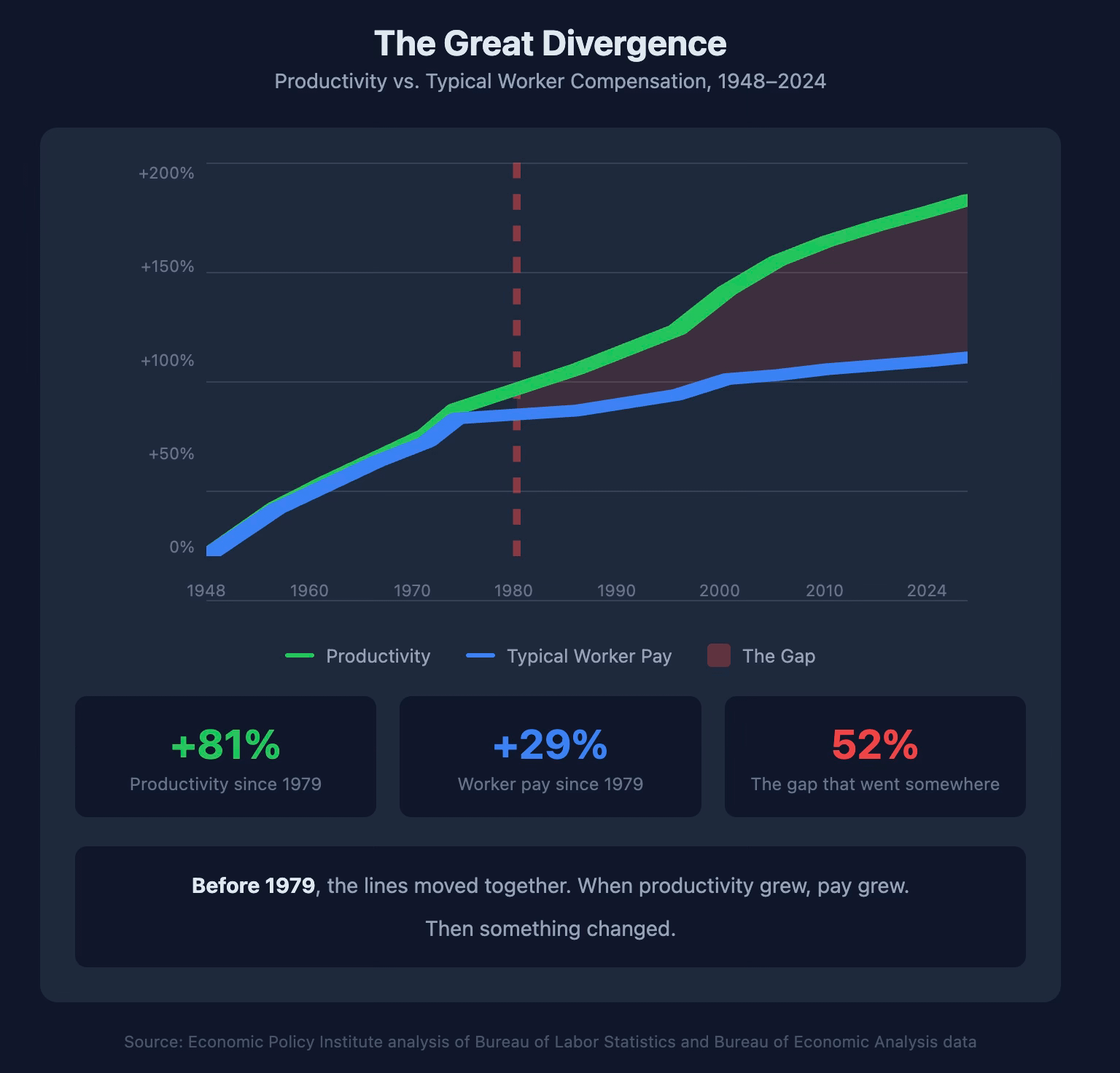
The CEO-to-worker average pay ratio in 1950 was 20 to 1. Today it’s 270 to 1.
When someone in a hollowed-out factory town says the system is rigged, they’re right.
The second kind is different.
Here’s how wealth actually stacks in America:
The bottom 50%—about 65 million households—share 2.5% of the nation’s wealth. Combined, they hold about $4 trillion.
The top 9%—households with $1.9 million or more—are doing fine. They feel middle class, but they’re not.
The next 0.9%—about 1.2 million households, with $13.7 million or more—hold 17% of all wealth. More than the bottom half combined.
And then there’s the top 0.1%. Just 136,000 households. Entry point: $62 million. They hold 13.8% of everything.
But we’re not done.
Within that 0.1% sit roughly 900 billionaires. Their combined wealth: $7.8 trillion. The bottom half of America—65 million households—holds $4.1 trillion.
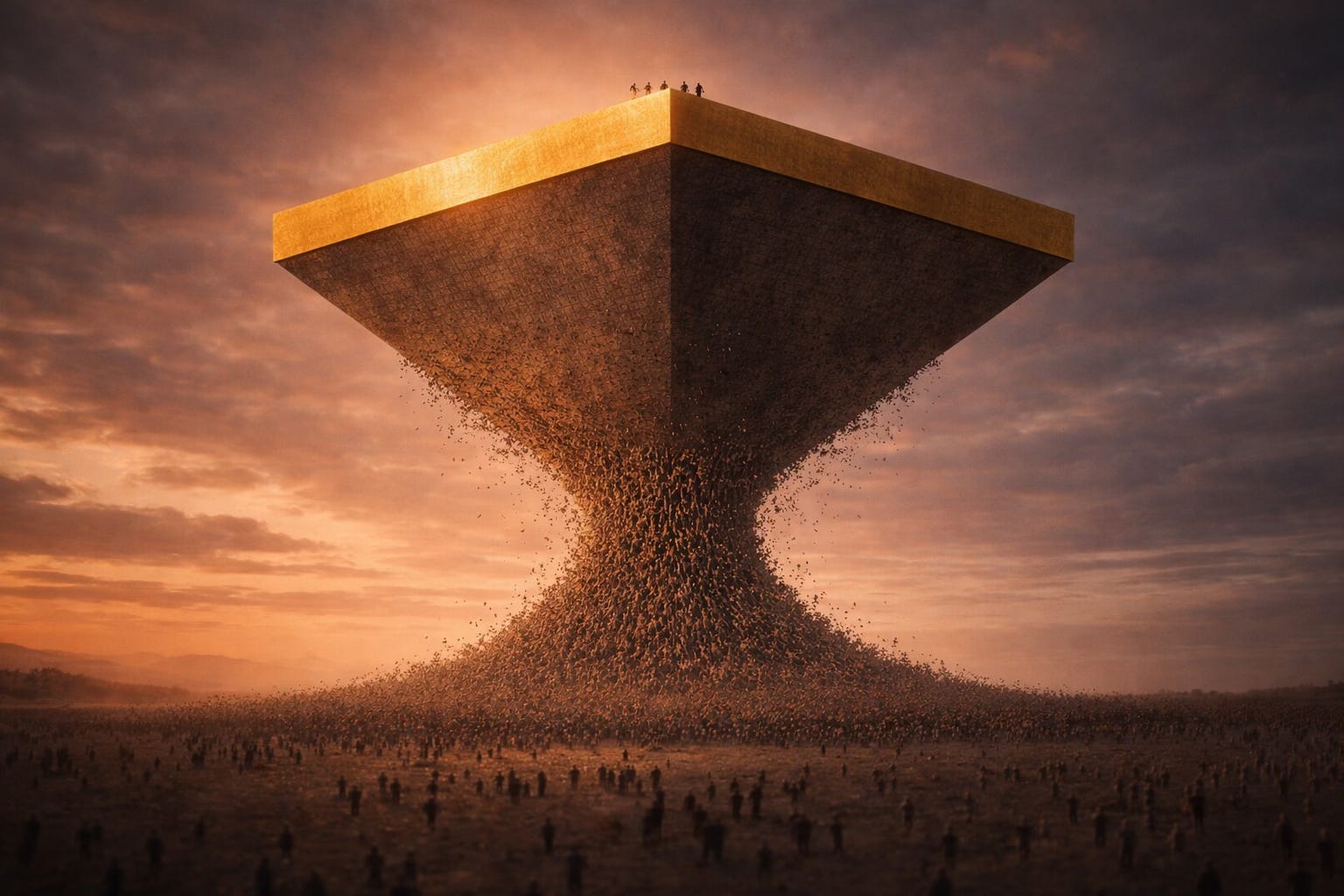
Nine hundred people have almost twice as much as 65 million households combined.
And at the very top? Fifteen people with $100 billion or more each. Their combined wealth: $2.4 trillion. More than half of what the entire bottom half of America shares.
Fifteen people vs sixty-five million households.
If you’re in that top 9%, your portfolio’s up. Your neighborhood’s safe. Your kids are thriving. But something feels wrong. The cultural ground is shifting. Your status feels less secure. The future seems uncertain.
This anxiety is real. It’s just not the same as Youngstown’s. One is economic survival. The other is something else.
And both kinds of anger have been fused into a single narrative of victimhood—a narrative that benefits people who have no intention of helping either group.
The factories didn’t close because of immigrants. They closed because of trade deals, automation, and policy choices. Who wrote those deals? Who moved those factories? Who’s now telling you to blame your neighbor? I always like this line from Robin Williams, "Politicians should wear sponsor jackets like NASCAR drivers, then we know who owns them."
[Where do you stand? Before reading further, use the calculator below. Enter your household income or net worth. See where you actually fall.]
WHAT WE FORGOT
We forgot why we built the institutions we’re now tearing down.
The alliances, the treaties, the forward deployments, the ugly work we don’t like to think about—that architecture kept great powers from fighting each other directly. For all the horror of proxy wars, the alternative was worse: direct confrontation between nations with 12,000 nuclear warheads between them.
The people who maintained that system don’t get to explain themselves on cable news. They just do the work.
We forgot that.
We also forgot the difference between being a winner and being a leader.
A winner dominates. Extracts. Tells the losers to shut up and take it.
A leader builds coalitions. Creates systems that benefit everyone—even if unevenly—because shared prosperity creates stability, and stability creates safety.
After 1945, we chose to be leaders. We could have extracted tribute from defeated enemies. Instead, we rebuilt them. We created the most prosperous, stable international order in human history.
Now we’re in danger of choosing to be winners instead. Threats against allies. Suspicion of every institution. The belief that strength means domination rather than responsibility.
“The strongest do what they can,” Bremmer quoted from Thucydides, “while the weakest are condemned to suffer what they must.”
That’s the law of the jungle. That’s what the world looked like before we built something better.
THE RESOLUTION
Remember the Doomsday Clock?
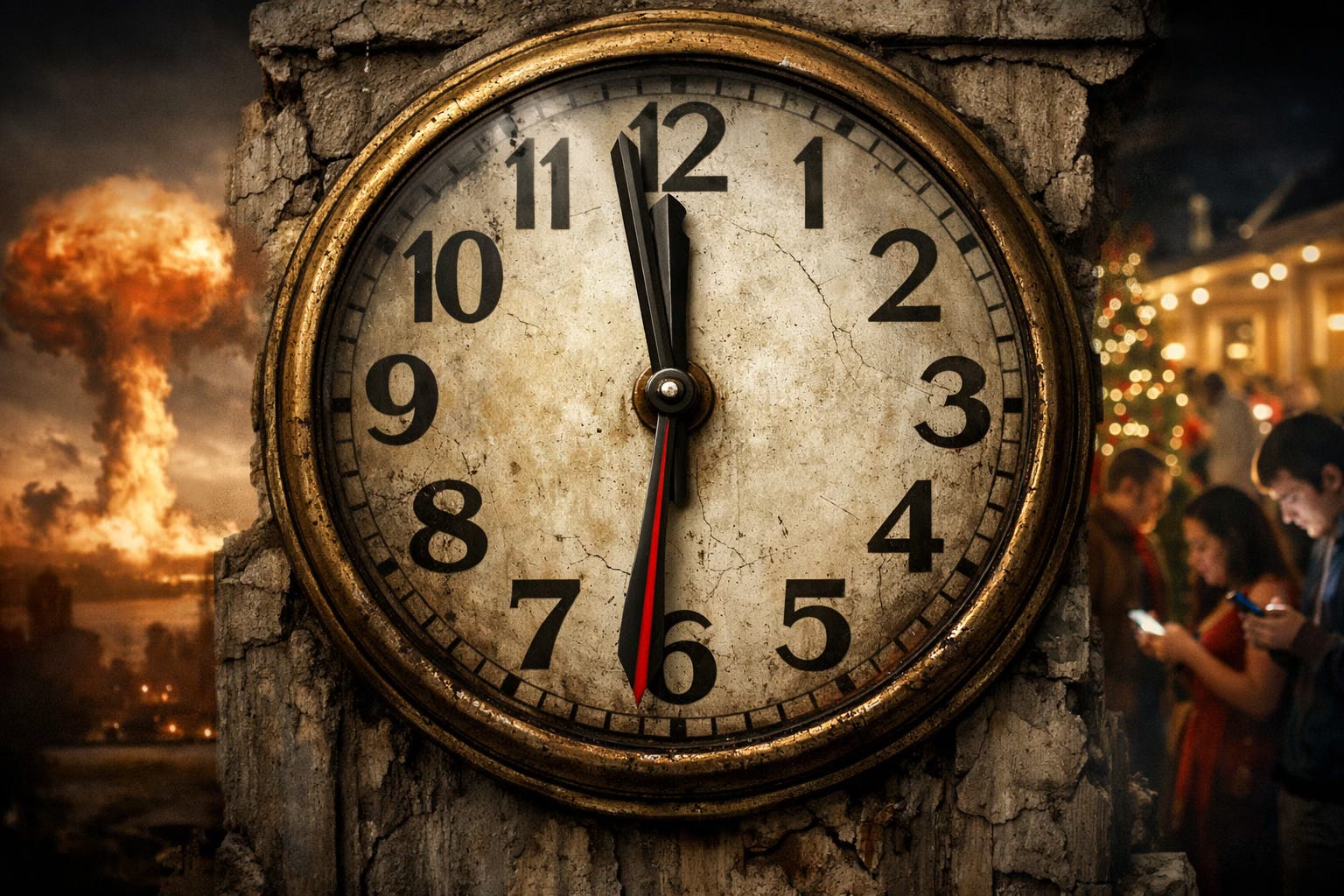
In 1947: seven minutes to midnight.
In 1991, after the Cold War ended: seventeen minutes. The safest it had ever been.
Today: 89 seconds.
Not minutes. Seconds. The closest it has ever been in its 78-year history.
While we’ve been counting down to champagne, the other clock has been counting too. While we’ve been making resolutions about gym memberships and screen time, the scientists who watch that clock have been moving the hands forward. Again. And again.
We forgot about it. It didn’t forget about us.
So here’s my suggestion for this year.
Forget the diet. Forget the gym. Forget the apps that promise to make you more productive. Those resolutions are fine. They’re just not the ones that matter right now.
This year, the resolution is simpler.
Remember.
Remember that the beacon only stays lit if someone tends it. Remember that the peace we inherited was built, not given, and that it can be unbuilt just as fast. Remember that we’re all in this together, whether we like each other or not.
We have the strongest hand any nation has ever held. We can play it like winners—extracting, dominating, telling the losers to suck it up.
Or we can remember what leaders do.
The clock is at 89 seconds.
Let’s make 2026 count not just for us, but for our families, our neighbors, our communities, our nation and the world as a whole.
THE SERIES AHEAD
This is the first of six parts examining what we’ve forgotten and why it will matter in 2026.
Part 2 will show you what nuclear war actually looks like—the 72-minute scenario our Cold War selves understood and our children never learned.
Part 3 will reveal how AI is already making life-and-death targeting decisions, with human judgment reduced to rubber stamps.
Part 4 will document how every guardrail is failing at once.
Part 5 will explain why the leaders who could de-escalate are trapped by their own rhetoric.
Part 6 will ask what we must do to change course.
KEY SOURCES
Doomsday Clock
Bulletin of the Atomic Scientists: Doomsday Clock Main Page
Wealth Distribution Data
Federal Reserve: Distributional Financial Accounts
Federal Reserve: Distribution of Household Wealth Table
Visual Capitalist: Who Owns America’s Wealth
Visual Capitalist: Top 1% Share Over Time
DQYDJ: Net Worth Percentiles
DQYDJ: Net Worth Calculator
Bremmer/Galloway Quotes
Prof G Pod: “Top Geopolitical Risks of 2025 — with Ian Bremmer” (January 9, 2025)
China Shock / Rust Belt Data
Autor, Dorn, Hanson: “The China Shock: Learning from Labor-Market Adjustment” (NBER, 2016)
“On the Persistence of the China Shock” (Brookings, 2021)
“The China Syndrome” (American Economic Review, 2013)
MIT News: Q&A with David Autor
Stanford FSI: China Shock and Its Enduring Effects
CEO-to-Worker Pay Ratio
Economic Policy Institute: CEO Pay in 2023
Productivity vs. Pay Gap
Economic Policy Institute: The Productivity-Pay Gap