
How a President Speaks When a Nation Is at War
The ultimatums that keep moving


On Easter Sunday morning, the President of the United States posted the following to Truth Social:
“Tuesday will be Power Plant Day, and Bridge Day, all wrapped up in one, in Iran. There will be nothing like it!!! Open the F***in’ Strait, you crazy bastards, or you’ll be living in Hell — JUST WATCH! Praise be to Allah. President DONALD J. TRUMP.”
Let that land.
Not the profanity, though it is the first time an American president has used that word in an official public communication during an active war. Not the threat, though promising to destroy civilian infrastructure is what 100 international law experts this week called a potential war crime. Not even the “Praise be to Allah” sign-off, which reads as either a mockery of Iranian religious framing or an attempt at ironic mirroring, and which signals something unsettling about how Trump understands his adversary regardless of which one it is.
What should land is the platform. The time. The occasion.
Easter Sunday. A social media app built for his domestic base. Hours after U.S. forces completed a harrowing rescue of a downed airman deep inside Iran. While Pakistan, Turkey, and Egypt were actively mediating a 45-day ceasefire proposal. While crude oil sat at $114 a barrel. While Iranian embassies monitored every word in real time.
This is what wartime communication looks like now by the United States.
The Arc of Six Weeks
Trump’s language in this war has followed a consistent and revealing trajectory. It didn’t start here.
February 28: The war begins. Trump posts an 8-minute scripted video to Truth Social. Formal, sober, structured. “A short time ago, the United States military began major combat operations in Iran.”
March 2: Victory declared. Three days in. “We will win easily.”
March 3–9: Victory declared again. And again. Daily, in different words, as the war continues. “We’ve won the war.” “We’ve defeated Iran.” “Their radar is 100% annihilated.”
April 1: A prime-time national address. Al Jazeera’s analysis: Trump made four familiar points; the war is necessary; it has already been won; it must continue; it will wrap up soon. Analysts had expected a major announcement. They got a repetition.
April 4: A 48-hour ultimatum. “Time is running out — 48 hours before all Hell will reign down on them. Glory be to God!” The deadline is extended the same day.
April 5: Easter Sunday. The F-bomb post. New deadline: Tuesday, 8 p.m. ET.
April 6: Press conference. Asked directly whether the war is winding down or escalating, Trump says: “I don’t know. I can’t tell. It depends what they do.”
April 7: Hours before the new deadline, the language escalates from infrastructure to civilization: “A whole civilisation will die tonight, never to be brought back again. I don’t want that to happen, but it probably will.”
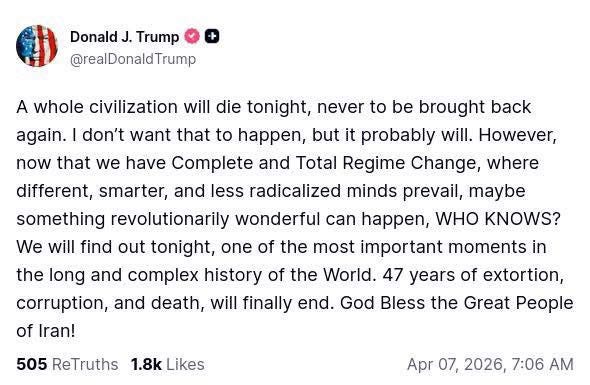
Notice the direction of travel. The posts get shorter. The language gets cruder. The targets expand from military objectives to civilian infrastructure to, now, civilization itself. Each escalation comes after the prior threat failed to produce compliance.
That is not a posture of strength. That is a man shouting louder because the room isn’t responding. The White House felt the need to respond that he was not going to nuke Iran.
The Medium Is the Message and the Problem
No wartime leader in history has conducted active diplomacy through a social media platform architected for their domestic base.
That sentence needs to be taken seriously as a structural claim, not a stylistic complaint.
Truth Social’s architecture shapes the message. No discipline-enforcing character limit. No editorial filter between impulse and publication. Algorithmic reward for aggression and novelty. An audience that responds to escalation with approval. The platform doesn’t just transmit Trump’s wartime communication, it generates it. The feedback loop runs from the base’s reaction back to the next post, not from the State Department’s assessment of what Tehran needs to hear.
Compare three platforms, three eras:
Churchill’s BBC radio, 1940. Scripted. Reviewed. Calibrated simultaneously for two audiences; the British public (morale) and Washington (alliance maintenance). Every word chosen for what it would do to both. The medium enforced deliberation.
Kennedy’s televised address, 1962. Eighteen days of back-channel negotiation before any public statement during the Cuban Missile Crisis. The public speech was the last move, not the first. The Soviets never saw the internal deliberation. The medium created separation between thinking and declaring.
Trump’s Truth Social, 2026. Real-time. Unreviewed. Simultaneous audience: the MAGA base, Tehran, mediating nations, global oil markets. The Easter Sunday post moved crude by Tuesday morning. The platform makes no distinction between performance and policy and neither, apparently, does the man posting.
When Trump posts at 1 a.m., markets move by morning. When he threatens a civilization’s destruction, Iranian embassies have coordinated response campaigns live within hours. The speed of his communication has outrun the institutional capacity to manage its consequences, including inside his own administration.
What the History Comparison Actually Shows
Let’s do this carefully. Rhetorical comparison across eras is easy to weaponize and easy to get wrong. The point isn’t decorum. Decorum is a distraction. The point is what the rhetoric signals to adversaries, to allies, and to the international order underneath both.
Churchill vs. Trump on escalation:
Churchill, 1940: “We shall fight on the beaches, we shall fight on the landing grounds, we shall fight in the fields and in the streets, we shall fight in the hills; we shall never surrender.”
That is escalation as defiance. The audience is the British people. The adversary is told nothing about limits, deals, or deadlines. The world hears resolve without desperation.
Trump, April 5, 2026: “Open the F***in’ Strait, you crazy bastards, or you’ll be living in Hell — JUST WATCH!”
That is escalation as demand, directed at the adversary. The deadline has already moved twice. The adversary has context that the threat may not follow through. Mediating nations read it simultaneously with the intended target. The Churchill comparison doesn’t flatter Trump, but more importantly, it sharpens exactly what’s different. Churchill was the defender absorbing aggression. The moral geometry was clean. Trump is conducting the offensive campaign while threatening civilian infrastructure and wondering aloud whether he’s winning.
Kennedy vs. Trump on precision:
Kennedy, October 22, 1962: “It shall be the policy of this nation to regard any nuclear missile launched from Cuba against any nation in the Western Hemisphere as an attack by the Soviet Union on the United States, requiring a full retaliatory response upon the Soviet Union.”
Specific trigger. Specific consequence. No ambiguity. The credibility of the threat rested on its precision. Khrushchev knew exactly what would happen, under what conditions, and when. That clarity is what made the threat credible without requiring it to be executed.
Trump, April 6, 2026, when asked to characterize his own war strategy: “I don’t know. I can’t tell. It depends what they do.”
The commander-in-chief of an active war, asked whether he is escalating or de-escalating, said he doesn’t know. That answer is itself a strategic signal. One he did not intend to send.
LBJ vs. Trump on alliance framing:
LBJ on Vietnam, 1965: “We did not choose to be the guardians at the gate, but there is no one else.”
Obligation framing. America as the reluctant guarantor of a shared world order. This language existed to maintain alliance cohesion, to make other nations feel included in a shared burden rather than subjected to unilateral American will. It was also, frankly, manipulative. But it worked because it offered something to allies: belonging to something larger than American self-interest.
Trump, April 6, 2026, on the Strait of Hormuz: The U.S. should impose tolls on ships passing through, he said, because the U.S. is the “winner” in the war so far.
Winner framing. Economic extraction as the prize of war. NATO has already refused to assist in reopening the Strait. Every neutral country is now calculating what the new American model of international relations looks like. The “winner collects tolls” framing answers that question clearly.
Reagan vs. Trump on the legal question:
Reagan on Libya, 1986, after striking Tripoli: “When our citizens are attacked or abused anywhere in the world on the direct orders of a hostile regime, we will respond so long as I’m in this office.”
The Libyan strike was preceded by evidence, framed with legal and moral justification, communicated clearly after military action. The sequence mattered: evidence, justification, action, communication. Each step maintained international legitimacy even for allies who disagreed with the strike itself.
Trump, April 6, 2026, when a New York Times reporter asked whether targeting civilian power infrastructure violated the Geneva Conventions and could constitute war crimes: “I hope I don’t have to do it. But if you think I’m going to allow them to have a nuclear weapon, you can tell your friends at the New York Times, not going to happen.”
He changed the subject. The international legal order got a non-answer, live, on camera. That non-answer is the answer. A hundred international law experts had already published an open letter that week. The response from the White House was a pivot. The pivot is now part of the record.
What Iran Did With It
Iran’s military response has been persistent and costly. 365 American service members injured, two aircraft shot down, the Strait still closed. But Iran’s rhetorical response to the Easter Sunday post is worth studying separately, because it tells you something about who is winning the information war.
Iranian embassies didn’t escalate in kind. They trolled.
The Austrian mission placed an “18+” content warning graphic over a screenshot of Trump’s post. The Berlin embassy shared a Der Spiegel cartoon: Trump staring into a mirror, imagining himself as an emperor. The Moscow embassy circulated an illustration of Trump as Don Quixote, charging a windmill on horseback, sidekick shouting “Boss, it’s just a windmill.”
Iran’s foreign minister called Trump’s threat “helpless, nervous, unbalanced and stupid.” Iran’s military command responded: “The simple meaning of this message is that the gates of hell will open for you.” They mirrored the language back. They declined to be intimidated.
This is the adversary’s read of the moment. Not fear, not compliance, but mockery distributed across European capitals via their own diplomatic missions.
Mockery is not harmless. It travels through the same networks that shape global opinion of American power. The image of a superpower’s president generating “18+ content warnings” from foreign embassies is now in the information ecosystem. It doesn’t wash out.
Meanwhile, Pope Leo XIV used his first Easter Mass at the Vatican to call for peace: “Let those who have weapons lay them down.” The new Archbishop of Canterbury, the Church of England’s first female holder of that office, called for an end to “violence and destruction” in the Middle East. Neither named the United States. They didn’t need to. The moral framing of this war, who represents force and who represents restraint, is being set not in Washington but by neutral institutions and adversary diplomatic corps.
That is an information warfare loss that won’t appear in the Pentagon’s daily briefing.
The Sentence That Has No Precedent
“A whole civilization will die tonight, never to be brought back again. I dont want that to happen, but it probably will.”
No American president has written those words publicly. Not during the deliberations over Hiroshima, which were classified, debated internally, anguished over. Not during the firebombing campaigns of World War II, which were technical military orders. Not during any declared or undeclared war in the country’s history.
The explicit threat to end a civilization, published on a social media platform, in the sixth week of a war that began without a formal congressional declaration, is a new thing in American history.
It may not result in what it threatens. The ceasefire mediators are still working. Iran called it “baseless.” Democrats called Trump “extremely sick” and “genocidal.” The deadline may move again.
But it cannot be unsaid.
Every nation calculating its long-term relationship to American power, its treaties, its trade dependencies, its military alignments, is now doing that calculation against this statement as a revealed preference. Not a slip. Not a heat-of-the-moment remark. A Truth Social post, signed with his full name and title, that threatened the death of a civilization.
The world heard it. The world is deciding what it means.
What to Watch
The deadline pattern. If Tuesday’s 8 p.m. deadline moves again, that’s three extensions in six weeks. Each missed deadline recalibrates how adversaries price future American ultimatums, not just Iran’s, but every nation watching.
The mediators. Pakistan, Turkey, and Egypt are still at the table despite the Easter post, despite the “civilization” post, despite the profanity. If any one of them withdraws after this week’s language, rhetorical escalation has begun to produce structural consequences.
The European press, not the European governments. Official diplomatic statements are lagging indicators. What Der Spiegel, Le Monde, and The Guardian run as their lead framing this week will tell you what foreign ministries are thinking three months from now.
The Republican silence. Schumer called Trump “extremely sick.” Jeffries warned of World War III. The specific post, “A whole civilization will die tonight”, generated no public Republican response as of this writing. That silence is itself a statement about the institutional capacity to check the executive during wartime.
Oil. At $114 and moving on presidential posts in real time, the Truth Social feed is now functioning as economic policy. Watch whether anyone inside the administration is treating it that way.
Wartime leaders have always known that language is strategy. Churchill knew it. Kennedy built 18 days of silence around it. Even LBJ, whose Vietnam rhetoric ultimately failed, understood that what you say and when you say it shapes the room you’re negotiating in.
The room Trump is negotiating in now includes Tehran, Islamabad, Brussels, Beijing, and every global oil market simultaneously, in real time, with no filter between impulse and publication.
What gets said in that room doesn’t stay there. We now need to ask ourselves a harder question than we’ve been willing to ask.
Is this how we want America represented to the world? A president who threatens to end a civilization on a social media post, when asked if he knows what he’s doing says “I don’t know.” Not a slip. Not a mistake. A public declaration of strategic incoherence, six weeks into an active war.
Here is the version that cuts through the geopolitics: if your child spoke to the world this way, if they made threats they couldn’t keep, used language that humiliated your family in public, and when asked to account for it said they had no idea what came next, what would you being thinking and doing?
We have the same option. We’ve just been slow to use it.
Wireframe News — where the words are public record, the consequences are still being written, and the history comparison makes itself.