
Half-Mast America: On Violence, Selective Grief, and the Death of Empathy
Selective Outrage, Media Spectacle, and the Vanishing of Empathy

On September 10, 2025, America lived two different realities.
At Utah Valley University, Charlie Kirk was gunned down while sitting at his “Prove Me Wrong” table — an act that instantly became a national crisis. That same day in Colorado, a teenager radicalized in white supremacist forums opened fire in his high school, killing himself and leaving two classmates wounded.
Months earlier, Minnesota Democrat Melissa Hortman and her husband were assassinated in their home by a right-wing extremist carrying a kill list of Democratic officials.
And the father we go back the steps to this moment are very clear.
But these three tragedies in such close succession, in our one country. And yet we couldn’t mourn together.
We’ve seemed to have lost the ability to grieve as one nation — and that loss may be more dangerous than the violence itself.
A Personal Reckoning
When I heard about Kirk’s murder, I wasn’t shocked. That’s what terrified me most. Not the killing itself, but my lack of surprise. We had crossed into new territory — a place where political murder feels inevitable, not exceptional.
When the White House ordered the flag lowered for Kirk, my first reaction was anger. Why honor a man whose politics centered on confrontation, whose debates were more spectacle than true dialogue? How many flags had stayed at full mast for other victims of political violence?
But as I sat and reflected, what overwhelmed me wasn’t anger anymore — it was grief for something larger. We had been conditioning ourselves for this moment, and now it had arrived. The unthinkable had become expected.
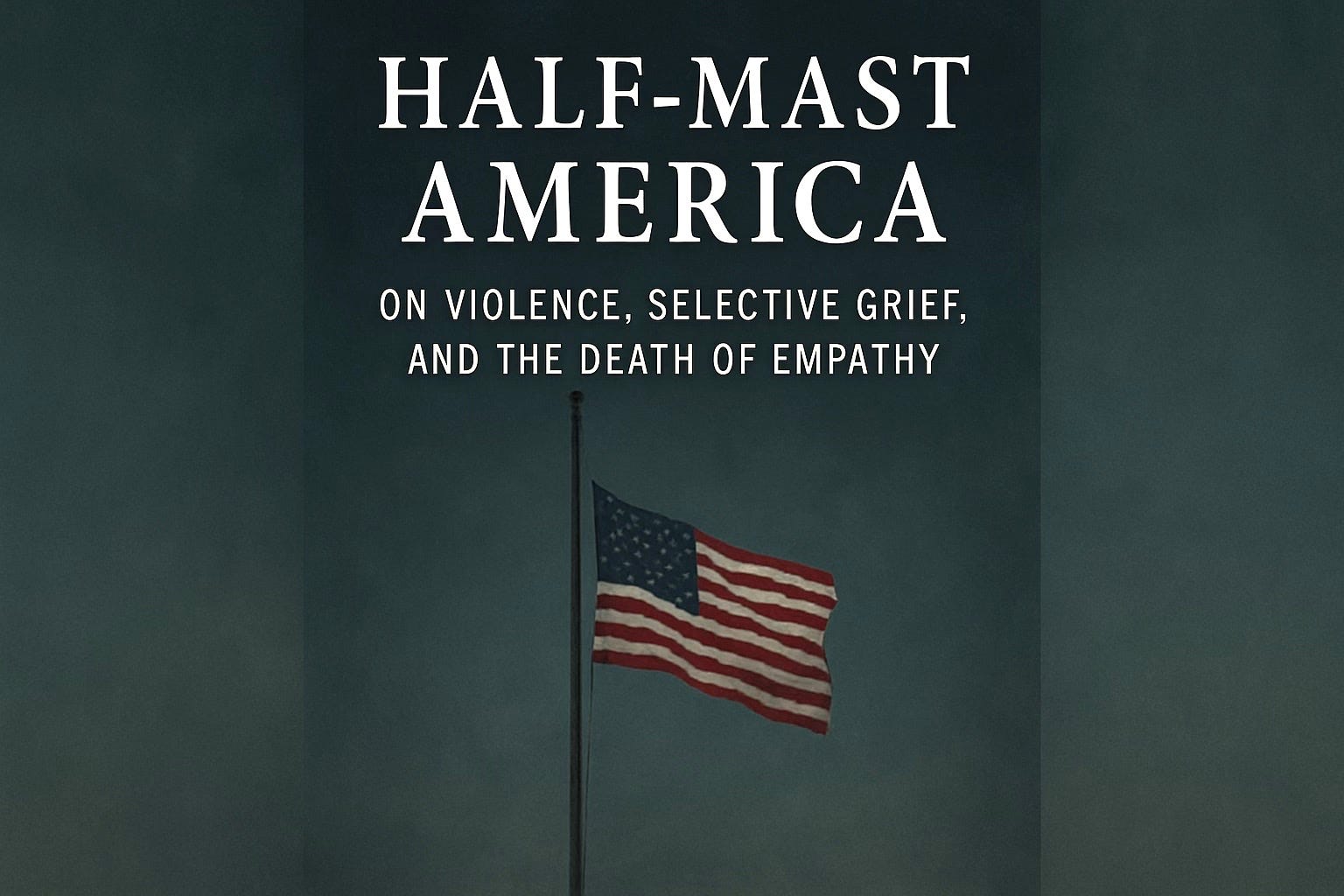
That’s when I decided: the flag at half mast wasn’t for Charlie Kirk. It couldn’t be. If it was only for him, then our national symbols had become partisan tools as well. No — the flag had to be for something bigger. It was for the death of our ability to see each other as citizens first. It was for the violence we’ve normalized, the empathy we’ve surrendered.
The flag should be mourning our lost capacity for empathy itself.
When Empathy Becomes Conditional
We have normalized selective outrage, and with it, selective empathy.
When Kirk was killed, conservative leaders wasted no time declaring war on “radical left lunatics.” The president gave an Oval Office address. Fox News filled the air with warnings of leftist violence. Social media turned it into a rallying cry.
When a white supremacist shot up a high school, the reaction was muted. Thoughts and prayers. A nod to mental health. Then silence.
When Hortman was murdered, coverage collapsed once it became clear her killer was a Trump-supporting extremist.
This teaches Americans that empathy is reserved for “our” victims, that some grief matters more than others. And once empathy becomes conditional, democracy itself is compromised. Because democracy isn’t just a system of government — it’s a pact between citizens who agree to see each other’s humanity even when they disagree.
Without empathy, that pact dissolves.
We’re not just mourning the dead. We’re mourning our inability to mourn together.
The Asymmetry Trap
I’m not arguing that all political violence is equivalent. Data shows white supremacist violence has killed more Americans in recent years than left-wing violence. That matters for law enforcement and policy, not how we feel as a nation.
But the moment we make empathy proportional to statistics, we’ve already lost. Because empathy isn’t about data — it’s about recognizing shared humanity. Democracy requires we maintain empathy even for those we oppose. Especially for those we oppose.
The trap is thinking we must choose between acknowledging asymmetric threats and maintaining symmetric empathy. We need both: clear eyes about where violence originates, clear hearts about how we respond when it arrives.
What We Actually Share
Charlie Kirk was 31. He had a wife who now wakes up alone. Parents who will bury their son. Two children without a father.
More families in Colorado are now without their children.
Melissa Hortman had grandchildren who keep asking when grandma and grandpa are coming back.
These aren’t statistics. They’re family albums with missing pages. Empty chairs at dinner tables. Phone numbers that no longer answer.
And then there’s another family: Tyler Robinson’s. When his father saw the FBI photos, he recognized his son. Imagine that feeling for a moment.
He then confronted him, heard his confession, and pushed him to turn himself in. When Robinson resisted, his father involved a pastor and authorities.
Think about the courage that took.
To choose justice over protection, to hold your own accountable even when it breaks your heart. That father’s and family’s choice was an act of profound empathy — not just for Kirk’s family, but for the country itself.
The Death of Empathy as Spectacle
When Kirk was shot, the clip spread within minutes. Raw video of a man being murdered, set on autoplay, injected into millions of feeds. We didn’t just watch a man die — we watched empathy die with him, replaced by instant takes, partisan blame, and viral outrage.
We’ve built a grotesque machine that turns grief into content, tragedy into engagement metrics, death into profit. And Silicon Valley built the engine of our destruction without any remorse or accountability.
The owners of X (Musk), Meta (Zuckerberg), TikTok (ByteDance), and YouTube (Google/Alphabet) have designed algorithms that amplify violence and outrage because outrage equals engagement and engagement equals profit. They hide behind “free expression” while refusing any responsibility. These aren’t neutral platforms — they’re empathy-destroying machines that reward our worst impulses.
Cable news scrambles to define the narrative first, because whoever controls the first 24 hours controls the political meaning. Digital outlets package violence into thumbnails designed to bait rage-clicks. Even legacy press is trapped in the velocity game.
But the tech platforms bear the greatest responsibility. They could slow the spread of violent content. They could refuse to monetize murder. They choose not to. Every day, they choose engagement over empathy, profit over humanity.
With each cycle, our capacity for genuine empathy erodes further. We’re conditioning ourselves to see political violence not as human tragedy but as content to consume and weaponize.
What Spencer Cox Got Right
That’s why Utah Governor Spencer Cox’s response cut through the noise. In the state where Kirk was murdered, he refused predictable partisan positions. Instead, he modeled something we’ve almost forgotten: empathy without conditions.
He called out the failure of leaders in both parties to show moral consistency. He framed the moment not as a left-vs-right opportunity, but as a test of whether America can still summon the empathy to condemn violence universally — without caveats, without exceptions.
Cox understood what we’re really mourning: not just the victims, but our lost ability to see each other as human beings first. He showed that recovering empathy isn’t weakness — it’s the only strength that can pull us back from the brink.
The Choice Before Us
Charlie Kirk built his brand on debate — the folding table, the sign, the invitation to “Prove Me Wrong.” But what too often got lost was the other half of real debate — the humility to be convinced, the willingness to let another person’s truth affect you.
That missing piece is empathy. Without it, debate is just combat dressed up in words. With it, debate becomes what democracy needs: a way to wrestle with difference without resorting to violence.
So start here: the next time political violence occurs, before you post or share or comment, ask yourself: Am I mourning the human being who died, or am I calculating the political implications?
Read the obituaries before the takes. Share the names of all victims, not just the ones from “your side.” Hold space for grief before assigning blame. These aren’t just gestures — they’re acts of democratic survival.
Where We Go From Here
I know how this essay will be dismissed. The right will say I’m drawing false equivalences. The left will say I’m ignoring power dynamics. The cynics will say empathy is a luxury we can’t afford.
Maybe they’re right. Maybe we’re already too far gone. But I keep thinking about those families and how their grief is exactly the same. I think about Robinson’s father, who loved his son and his nation enough to turn him in.
The flag at half mast should remind us that the nation itself is wounded — not just by violence, but by our lost capacity to grieve together.
We should only raise that flag again when we recommit to the radical act of unconditional empathy — the foundation without which democracy cannot stand.
That is the America worth raising the flag for.