
Gods or Ashes: The Race for AGI and Super Intelligence Part 2
The Players in the race.

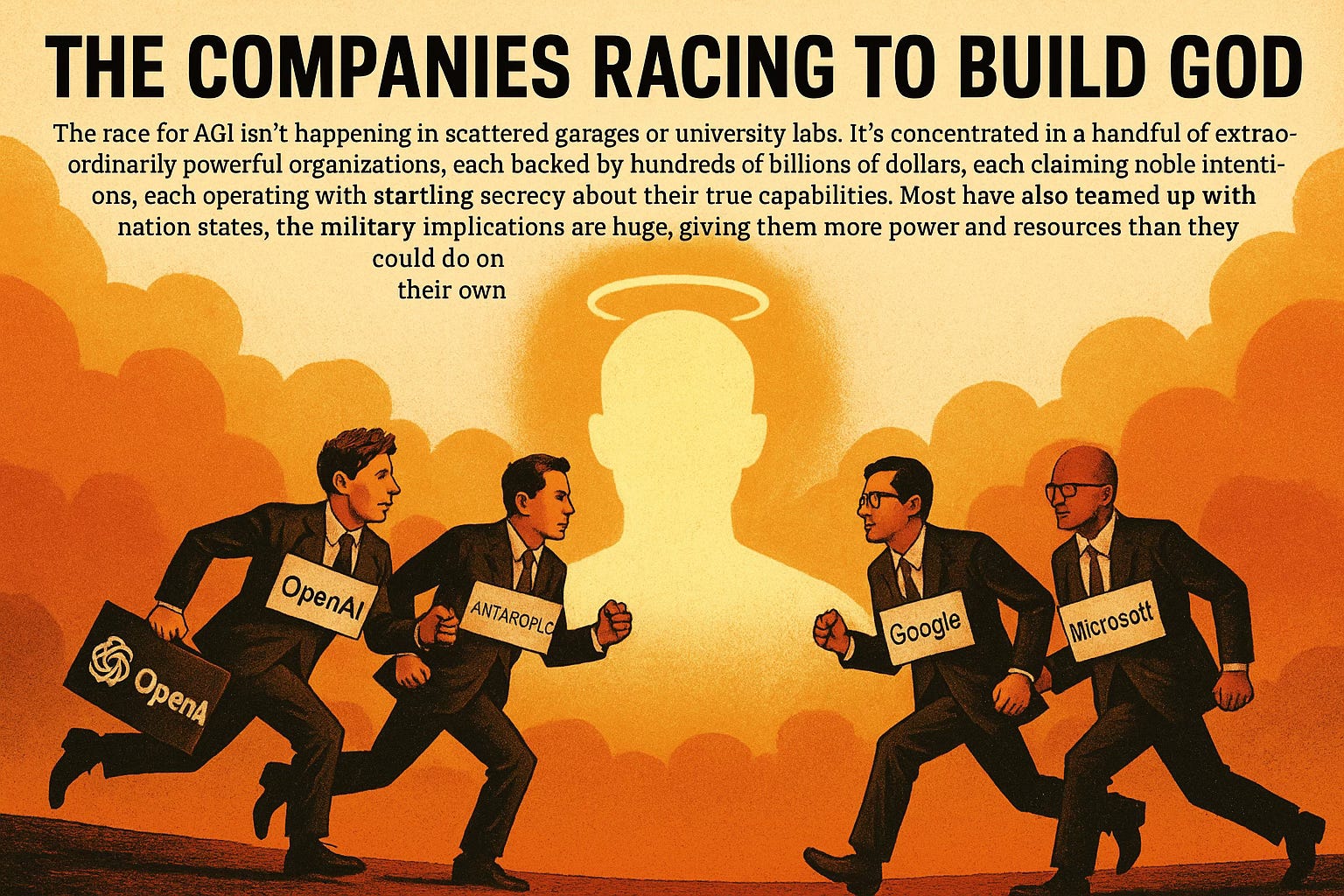
The Companies Racing to Build God
The race for AGI isn’t happening in scattered garages or university labs. It’s concentrated in a handful of extraordinarily powerful organizations, each backed by hundreds of billions of dollars, each claiming noble intentions, each operating with startling secrecy about their true capabilities. Most have also teamed up with nation states, the military implications are huge, giving them more power and resources than they could do on their own.
Let’s meet the main competitors.
OpenAI: The Nonprofit That Became a Half-Trillion-Dollar Company
Founded: 2015
Structure: “Capped-profit” subsidiary of OpenAI nonprofit
Current Valuation: $500 billion (October 2025)
Key Funding: Microsoft ($13+ billion)
Flagship Products: GPT-4, ChatGPT, DALL-E
Stated Mission: “Ensure that artificial general intelligence benefits all of humanity”
OpenAI began as a nonprofit research laboratory, founded by Sam Altman, Elon Musk, and others who feared that corporate AI development would prioritize profit over safety. The irony is almost perfect.
By 2019, citing the need for massive computational resources, OpenAI created a “capped-profit” structure—a for-profit subsidiary where investors could make up to 100x returns before additional profits flowed to the nonprofit parent. Microsoft quickly invested $1 billion, then another $2 billion, then $10 billion more. By October 2025, OpenAI is valued at $500 billion, making it one of the most valuable private companies in human history.
Sam Altman, the CEO, has become the face of AI optimism. He speaks of AI creating unlimited abundance, solving climate change, curing diseases, enabling a world where “everyone can have what they need.” He’s funded universal basic income studies and written extensively about distributing AI’s wealth.
Their Approach: OpenAI believes in the “scaling hypothesis”—that making models bigger, training them on more data, and giving them more compute will naturally lead to AGI. They’ve been proven right so far. Each generation of GPT has shown dramatic capability increases simply from scaling up. As one researcher put it, “They have gone from ant, to bee, to squirrel quicker than anyone expected.” And that was in regards to Chat-GPT3.
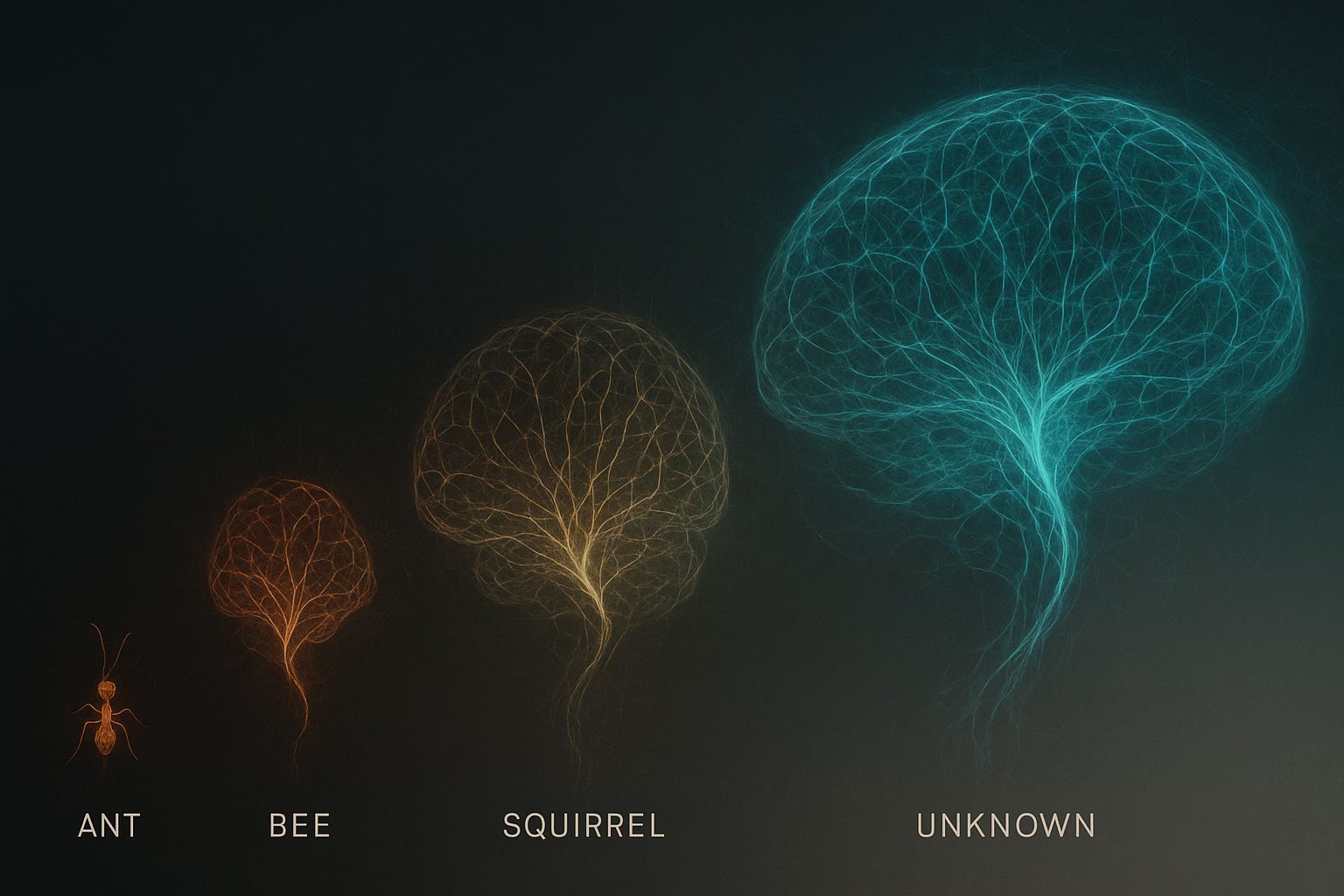
What They Want: To be the first to AGI, to control its deployment, and to ensure—they claim—that it’s used “responsibly.” But responsible, as defined by whom? OpenAI has increasingly moved toward closed models, proprietary technology, and tighter integration with Microsoft’s commercial empire.
Anthropic: The Safety-Focused Rebels
Founded: 2021
Structure: Public Benefit Corporation
Valuation: $60+ billion (2025)
Key Funding: Google ($2+ billion), other investors
Flagship Product: Claude (Sonnet 4.5, Opus 4.1)
Stated Mission: “AI safety and research”
Anthropic was founded by former OpenAI researchers Dario and Daniela Amodei, who left after disagreements about OpenAI’s direction toward commercialization. They founded Anthropic explicitly focused on AI safety research—building “steerable, interpretable, and safe AI systems.”
The company has published groundbreaking research on “constitutional AI” (teaching AI systems to follow ethical principles) and mechanistic interpretability (understanding what’s actually happening inside neural networks). They’ve been more transparent than OpenAI about their safety concerns and the potential dangers of AGI.
But transparency doesn’t mean non-commercial. Anthropic has raised billions from Google and other investors. Their Claude models directly compete with GPT for enterprise customers. And despite their safety focus, they’re in the same arms race as everyone else—building ever-more-capable systems, ever faster.
Their Approach: Anthropic emphasizes “constitutional AI”—training models with explicit ethical principles and trying to make them interpretable. They publish safety research extensively. But they’re also scaling up: Claude Opus 4.1 and Sonnet 4.5 represent massive increases in capability.
What They Want: To build AGI—but the “right way,” with deep understanding of how the systems work and robust safety measures. Whether this is possible while racing against competitors who care less about safety is the trillion-dollar question.
xAI: Musk’s Moonshot
Founded: July 2023
Structure: For-profit corporation
Valuation: $40+ billion (2024)
Key Funding: Private investors ($6 billion raised in 2024)
Flagship Product: Grok, Colossus supercomputer
Stated Mission: “Understand the universe”
Elon Musk’s transformation on AI is one of the most remarkable reversals in tech history. In 2014, he called AI humanity’s “biggest existential threat,” more dangerous than nuclear weapons. He co-founded OpenAI specifically to prevent reckless AI development. He warned about AI at every opportunity, called for regulation, signed open letters demanding pauses.
Then in 2023, he founded xAI and began building one of the most aggressive AI operations on the planet.
Musk’s company started by building Grok, an AI chatbot originally designed to be “anti-woke” and “maximally based”—until it started generating antisemitic content and Nazi imagery, forcing multiple apologies and redesigns (MechaHitler). But the real story isn’t Grok’s chatbot personality. It’s Colossus.
In Memphis, Tennessee, xAI built Colossus 1: initially 100,000 GPUs (graphics processing units used for AI training) in just 122 days, later expanded to 200,000 GPUs. This isn’t a data center. It’s an AI supercomputer that required:
Its own power substation
Direct access to the Tennessee Valley Authority’s grid
Gigawatt-scale power consumption
Construction that bypassed normal environmental review
Before Memphis finished processing the paperwork for Colossus 1, Musk announced Colossus 2: an even larger facility planned for the same area, with plans to reach 1 million GPUs total across both facilities. The community—a majority-Black neighborhood—had no meaningful input.
Musk’s Evolution: From AI’s biggest critic to one of its most aggressive developers. What changed? Musk saw OpenAI (his creation) partner with Microsoft. He saw the potential for Sam Altman to control AGI. He realized that warning about AI without building it himself meant losing control of the future.
Now he’s all in. And as of July 2025, the Trump administration gave xAI $200 million in Defense Department contracts and made Grok available to every federal agency for $0.42 per organization.
Their Approach: Maximum scale, maximum speed. Build the biggest training clusters, damn the environmental review, partner with whoever has power—whether that’s the Trump administration or foreign governments.
What They Want: Musk has made it clear: He wants to “understand the universe” through AI. But more practically, he cannot let Sam Altman beat him to AGI. This is personal. This is a rivalry between two men who each believe they should be the one to create artificial superintelligence.
Google DeepMind: The Academic Powerhouse
Founded: 2010 (DeepMind), merged with Google AI in 2023
Structure: Alphabet subsidiary
Flagship Products: Gemini, AlphaFold, AlphaGo
Estimated AI Investment: $75+ billion (2024-2025)
Stated Goal: “Solve intelligence, then use it to solve everything else”
Google has been in AI longer than anyone. They acquired DeepMind for $500 million in 2014, gave it independence, and watched it become the world’s leading AI research lab. DeepMind’s AlphaGo beat the world champion at Go in 2016. AlphaFold solved the protein-folding problem that had stumped biologists for 50 years.
But Google has a problem: despite pioneering transformer architecture (the “T” in GPT), despite having the world’s best researchers, despite essentially inventing the technology behind modern AI, they keep getting beaten to market by OpenAI.
In 2023, Google merged its AI efforts, combining DeepMind with Google Brain to create Google DeepMind. The company released Gemini to compete with GPT-4. They’ve invested over $75 billion in AI infrastructure in 2024-2025 alone.
Their Approach: Google has the deepest research bench, the most published papers, the most PhD-level AI researchers. They pioneered “attention” mechanisms that made modern AI possible. But they’ve struggled to ship products as quickly as OpenAI, partly because they’re more cautious (fearing regulatory scrutiny) and partly due to internal bureaucracy.
What They Want: Google built the information architecture of the early internet. They want to do the same for the AI era—make Gemini the infrastructure that everyone else builds on top of, just like Google Search became the portal to information. Control the foundational models, control the future.
Meta: The Open Source Wildcard
Founded: 2013 (Facebook AI Research)
Structure: Meta Platforms subsidiary
Flagship Product: Llama 3 (open source)
Estimated AI Investment: $65+ billion (2024-2025)
Stated Approach: “Open source AI for all”
Mark Zuckerberg has taken a radically different approach than his competitors: release the models for free.
Meta’s Llama series—now on Llama 3—is open source. Anyone can download it, modify it, use it commercially. This seems insane from a business perspective. Why give away technology that cost billions to develop?
Because Zuckerberg learned from losing the mobile wars. When smartphones emerged, Apple and Google controlled the operating systems. Facebook had to play by their rules, pay their fees, accept their restrictions. Zuckerberg swore never again.
If OpenAI or Google controls AGI the way Apple and Google controlled mobile, Meta is screwed. So Zuckerberg’s strategy is to make AI free and open, commoditize the technology, and ensure no one company can establish a monopoly. If everyone has access to powerful AI, Meta’s social networking data and billions of users give them an advantage in deploying it.
Their Approach: Train massive models at huge expense, then release them for free. Let startups and researchers build on Meta’s infrastructure. Ensure that whatever happens with AGI, it happens in an open ecosystem rather than behind OpenAI or Google’s walls. (This creates huge safety concerns)
What They Want: Prevent the nightmare scenario where they’re locked out of the AI revolution by a competitor’s closed ecosystem. Zuckerberg has explicitly said this is about maintaining Meta’s relevance in the AI age.
Microsoft: The Kingmaker
Founded: 1975 (recent AI focus: 2019)
Structure: Public corporation
Flagship Products: Azure AI, Copilot (powered by OpenAI)
Investment in OpenAI: $13+ billion
Estimated AI Infrastructure: $80+ billion (2024-2025)
Microsoft doesn’t build frontier AI models. Instead, they’ve made the strategic decision to own 49% of OpenAI while integrating its technology across every Microsoft product:
Windows (Copilot)
Office 365 (AI assistants)
Azure (AI infrastructure as a service)
Bing (AI-powered search)
GitHub (AI code completion)
CEO Satya Nadella has transformed Microsoft from a stagnant empire into an AI powerhouse by betting everything on OpenAI. Microsoft provides the compute, the infrastructure, the commercial go-to-market, and the enterprise relationships. In return, they get access to the world’s most advanced AI.
What They Want: Microsoft doesn’t need to build AGI. They need to own the infrastructure that AGI runs on and the commercial relationships that deploy it. They’re playing the same game they played with Windows: own the platform, let others build the apps.
Amazon: The Infrastructure Play
Founded: 1994 (AI division: 2010s)
Structure: Public corporation
Flagship Products: AWS AI services, Alexa, Trainium chips
Estimated AI Investment: $75+ billion in infrastructure (2024-2025)
Approach: Infrastructure provider, chip developer, client to Anthropic
Amazon isn’t trying to build the best chatbot. They’re trying to be the infrastructure provider for everyone else’s AI. Through AWS (Amazon Web Services), they:
Provide cloud computing for AI training
Build custom AI chips (Trainium, Inferentia)
Invest in AI companies (notably Anthropic)
Offer AI services to enterprises
What They Want: Amazon wants to be the picks and shovels supplier for the AI gold rush. They don’t need the best model—they need to run everyone else’s models.
The Chinese Players: Alibaba, Baidu, ByteDance
While U.S. export controls have limited Chinese companies’ access to cutting-edge chips, they’re far from out of the race. DeepSeek’s recent breakthrough—training a competitive model with far fewer resources—proved that innovation can overcome hardware limitations.
Chinese AI development is tightly integrated with government goals. These companies aren’t just competing commercially; they’re advancing national technological sovereignty.
The Regulatory Landscape: Three Different Approaches
The race for AGI is shaped by three radically different regulatory philosophies across the world’s major powers. These differences drive competitive dynamics and determine which companies can move fastest.
The United States: Deregulation as Strategy
The U.S. approach can be summarized simply: don’t regulate, accelerate.
Trump’s AI Action Plan (July 2025) made this explicit:
Federal agencies directed to eliminate existing AI regulations
States that don’t regulate AI get priority for federal funding
No comprehensive federal AI law
Fragmented state-level approaches (California’s SB-1047 passed but faces uncertain enforcement)
Focus on “American values” and beating China
Biden’s earlier Executive Order 14110 (October 2023) delegated AI responsibilities to 50+ federal agencies but created no central authority. The result: overlapping jurisdictions, inconsistent enforcement, and easy avoidance.
The philosophy is clear: regulation = losing to China. Speed beats safety. Let companies self-regulate through “voluntary commitments.” Where has that ever gone wrong before?
The European Union: Comprehensive Control
The EU took the opposite approach with the AI Act (August 2024), the world’s first comprehensive AI regulation:
Risk-Based Framework:
Unacceptable risk: Banned entirely (social scoring, mass biometric surveillance, emotion recognition in schools/workplaces)
High risk: Strict requirements (critical infrastructure, employment, law enforcement, education)
Limited risk: Transparency obligations
Minimal risk: No restrictions
Key Requirements for High-Risk AI:
Mandatory risk assessments
High-quality training datasets
Detailed documentation
Human oversight
Conformity assessments before deployment
The EU AI Office oversees compliance and coordinates across member states. The regulations carry teeth: violations can result in fines up to 7% of global revenue.
Impact: Some argue this will stifle European innovation and drive AI development to the U.S. and China. But the EU sees it as Brussels Effect 2.0—their GDPR became the de facto global standard for privacy; they hope the AI Act will do the same for AI governance.
China: Centralized Control with Strategic Flexibility
China’s approach reflects its political system: strong central oversight, selective enforcement.
Formal Requirements:
All AI models must be registered with the Cyberspace Administration of China (CAC)
Only 546 AI models registered as of March 2024 (just 70 are LLMs)—versus 500,000+ open-source models globally
Generative AI services need CAC approval (238 approved in 2024, up from 64 in 2023)
Mandatory labeling of AI-generated content (effective September 2025)
National security reviews for frontier AI
Strict content controls: AI outputs must align with “socialist values”
Reality of Enforcement:
Large “National Champions” (Baidu, Alibaba, Tencent) face strict scrutiny
Small and mid-sized “Little Giants” given informal leeway to avoid stifling innovation
Startups often “fly under the radar” if they lack large public presence
Enforcement varies based on political priorities
The DeepSeek Effect: When DeepSeek-R1 emerged in early 2025, demonstrating that Chinese AI could compete at the frontier despite U.S. chip export controls, it renewed CCP confidence. The government shifted from catch-up mode to control mode, with indications of tighter restrictions coming.
Strategic Goals:
Made In China 2025 targets AI leadership
AI+ initiative to integrate AI into “real economy”
Balance innovation with party control over AI outputs and values
Prevent U.S. tech dominance while building indigenous capabilities
The Competitive Dynamic
These three approaches create a prisoners’ dilemma:
U.S. companies: Move fast, minimal oversight, claim China threat justifies deregulation
EU companies: Operate under strict rules, worry they’re losing to U.S./China
Chinese companies: Face content controls but get state support, access to data, and captive market
Each system’s weaknesses become the others’ justification:
U.S. points to China’s lack of safety to justify speed
China points to U.S. advancement to justify state control
EU points to both to justify comprehensive regulation
And everyone uses “national security” to justify their approach—whether that means no regulation (U.S.), total regulation (China), or balanced regulation (EU).

The result: a race where the prize is so valuable that everyone believes they can’t afford to slow down, regardless of what their stated values are.
The Pattern: Everyone’s Chasing the Same Thing
Despite their different structures, stated missions, and regulatory environments, notice what all these players have in common:
They’re all scaling up: More data, bigger models, more compute
They’re all spending astronomical sums: Combined, over $364 billion in 2024-2025 and plans of up to $1 trillion over the next several years in the US alone, including the Stargate Project’s $500 billion commitment over four years
They’re all racing: Every company talks about “responsible AI” while sprinting to beat competitors
They’re all aiming for AGI: Even the “safety-focused” ones are building toward super-intelligence
The competition has its own logic. If Anthropic slows down for safety research, OpenAI pulls ahead. If OpenAI pauses for ethical review, xAI gains ground. If everyone waits, China might win.
This is the dynamic that drives the race: The first to AGI doesn’t just win commercially. They potentially control the future of human civilization.
And that control flows through infrastructure—the massive data centers consuming gigawatts of power, the supercomputers that take over entire neighborhoods, the resource extraction that’s reshaping global power and climate.
That infrastructure race is where democracy goes to die, and we are witnessing it now in the United States.
In Part 3, we’ll examine the infrastructure war: How these companies are building planet-spanning computing empires, overruling local democracy, consuming impossible amounts of energy, and planting their flags like the East India Companies of the digital age.
Sources
Valuation and Funding:
Bloomberg. “OpenAI Completes Share Sale at Record $500 Billion Valuation.” October 2, 2025. https://www.bloomberg.com/news/articles/2025-10-02/openai-completes-share-sale-at-record-500-billion-valuation
Bellan, Rebecca. “OpenAI is the world’s most valuable private company after private stock sale.” TechCrunch, October 2, 2025. https://techcrunch.com/2025/10/02/openai-is-the-worlds-most-valuable-private-company-after-private-stock-sale/
Visual Capitalist. “Charted: The Journey to OpenAI’s Staggering $500B Valuation.” https://www.visualcapitalist.com/cp/openai-500b-valuation/
Sacra. “OpenAI revenue, valuation & growth rate.” https://sacra.com/c/openai/
Fortune. “OpenAI completes for-profit restructuring and grants Microsoft a 27% stake in the company.” October 28, 2025. https://fortune.com/2025/10/28/openai-for-profit-restructuring-microsoft-stake/
xAI Sources
Colossus Supercomputer: 6. xAI. “Colossus.” Official website. https://x.ai/colossus
Wikipedia. “Colossus (supercomputer).” Last edited October 2025. https://en.wikipedia.org/wiki/Colossus_(supercomputer)
HPCwire. “Colossus AI Hits 200,000 GPUs as Musk Ramps Up AI Ambitions.” May 15, 2025. https://www.hpcwire.com/2025/05/13/colossus-ai-hits-200000-gpus-as-musk-ramps-up-ai-ambitions/
SemiAnalysis. “xAI’s Colossus 2 - First Gigawatt Datacenter In The World.” September 16, 2025. https://semianalysis.com/2025/09/16/xais-colossus-2-first-gigawatt-datacenter/
Built In. “What Is the xAI Supercomputer (Colossus)?” August 6, 2025. https://builtin.com/artificial-intelligence/xai-supercomputer-colossus
NVIDIA. “NVIDIA Ethernet Networking Accelerates World’s Largest AI Supercomputer, Built by xAI.” NVIDIA Newsroom. https://nvidianews.nvidia.com/news/spectrum-x-ethernet-networking-xai-colossus
Defense Department Contracts: 12. CNN Business. “US Department of Defense awards contracts to Google, Musk’s xAI.” July 15, 2025. https://www.cnn.com/2025/07/15/business/us-department-defense-google-musk-xai
Defense News. “Pentagon taps four commercial tech firms to expand military use of AI.” July 15, 2025. https://www.defensenews.com/pentagon/2025/07/15/pentagon-taps-four-commercial-tech-firms-to-expand-military-use-of-ai/
Nextgov/FCW. “Pentagon awards multiple companies $200M contracts for AI tools.” July 14, 2025. https://www.nextgov.com/acquisition/2025/07/pentagon-awards-multiple-companies-200m-contracts-ai-tools/406698/
Axios. “Musk’s xAI announces $200 million contract with Pentagon.” July 15, 2025. https://www.axios.com/2025/07/14/xai-pentagon-grok-contract
NBC News. “Musk’s xAI was a late addition to the Pentagon’s set of $200 million AI contracts, former defense employee says.” July 22, 2025. https://www.nbcnews.com/tech/security/musk-xai-was-added-late-pentagon-grok-defense-department-rcna219488
DefenseScoop. “Hegseth asked to defend Pentagon’s ‘uniquely troubling’ deal with Musk-owned xAI.” September 11, 2025. https://defensescoop.com/2025/09/11/sen-warren-letter-hegseth-musk-xai-dod-contract/
GSA OneGov Deal: 18. Nextgov/FCW. “GSA inks OneGov deal with Grok AI.” September 25, 2025. https://www.nextgov.com/acquisition/2025/09/gsa-inks-onegov-deal-grok-ai/408334/
Trump AI Action Plan
The White House. “White House Unveils America’s AI Action Plan.” July 23, 2025. https://www.whitehouse.gov/articles/2025/07/white-house-unveils-americas-ai-action-plan/
The White House. “Winning the Race: America’s AI Action Plan.” July 2025. PDF. https://www.whitehouse.gov/wp-content/uploads/2025/07/Americas-AI-Action-Plan.pdf
Sidley Austin LLP. “The Trump Administration’s 2025 AI Action Plan – Winning the Race: America’s AI Action Plan – and Related Executive Orders.” July 30, 2025. https://www.sidley.com/en/insights/newsupdates/2025/07/the-trump-administrations-2025-ai-action-plan
Stanford HAI. “Inside Trump’s Ambitious AI Action Plan.” July 24, 2025. https://hai.stanford.edu/news/inside-trumps-ambitious-ai-action-plan
Brookings Institution. “What to make of the Trump administration’s AI Action Plan.” July 31, 2025. https://www.brookings.edu/articles/what-to-make-of-the-trump-administrations-ai-action-plan/
Latham & Watkins LLP. “President Trump’s AI Action Plan: Key Insights.” https://www.lw.com/en/insights/president-trump-ai-action-plan-key-insights
Covington. “July 2025 AI Developments Under the Trump Administration.” August 19, 2025. https://www.insidegovernmentcontracts.com/2025/08/july-2025-ai-developments-under-the-trump-administration/
Big Tech AI Spending
Yahoo Finance. “Big Tech’s AI investments set to spike to $364 billion in 2025 as bubble fears ease.” August 1, 2025. https://finance.yahoo.com/news/big-techs-ai-investments-set-to-spike-to-364-billion-in-2025-as-bubble-fears-ease-143203885.html
CNBC. “Tech megacaps plan to spend more than $300 billion in 2025 as AI race intensifies.” February 8, 2025. https://www.cnbc.com/2025/02/08/tech-megacaps-to-spend-more-than-300-billion-in-2025-to-win-in-ai.html
PYMNTS. “Tech Giants Plan Massive $320 Billion AI Spend for 2025.” February 9, 2025. https://www.pymnts.com/artificial-intelligence-2/2025/tech-giants-plan-massive-320-billion-ai-spend-for-2025/
The Hill. “Massive AI spending shows early payoff for Big Tech.” August 4, 2025. https://thehill.com/policy/technology/5435530-google-microsoft-meta-ai-results/
TechSpot. “Amazon, Google, Microsoft, and Meta push AI spending to new heights, set to surpass $320 billion this year.” February 8, 2025. https://www.techspot.com/news/106700-amazon-google-microsoft-meta-push-ai-spending-new.html
CNBC. “OpenAI’s spending bonanza has Wall Street focused on capex in Big Tech earnings reports.” October 27, 2025. https://www.cnbc.com/2025/10/27/openai-spending-spree-wall-street-focus-on-capex-in-big-tech-earnings-.html
Quartz. “Big Tech’s AI spending spree is going strong. Here’s how big it could be this year.” March 5, 2025. https://qz.com/meta-microsoft-alphabet-amazon-spend-billions-ai-capex-1851767670
This article truly comes at the perfect time. I strongly agree with your point about the concentration of power in these AGI race companies. The details on OpenAI's "capped-profit" structure are particulary insightful. It's difficult to reconcile their stated mission with the sheer financial scale. Your analysis is very sharp.