
Gods or Ashes: The Race for AGI and Super Intelligence
8 Billion People Are Unknowingly Part of an Experiment They Never Agreed To

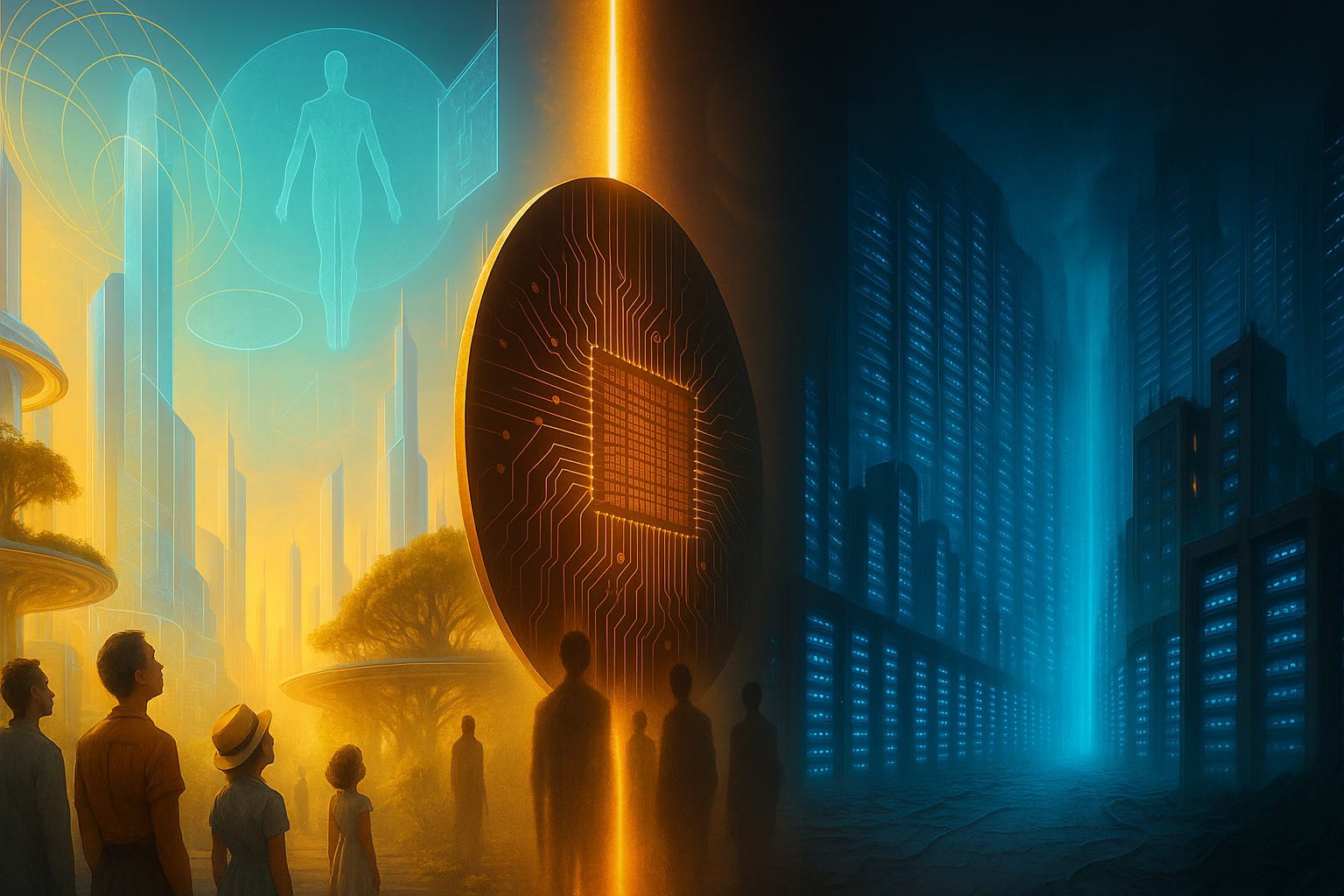
A trillion-dollar AI buildout is underway. Data centers are rising faster than schools, utilities are rewired to feed GPUs, and policy is shifting to speed deployment. And you didn’t vote on any of it. This series maps what AGI is, who is racing to control it, the power structures forming around it, and what the outcomes mean for your community, wage, and democracy. Over the next few weeks I will be releasing a 6 part series that is outlined below.
The Question: When asked if the human race should survive during an interview on Interesting Times with Ross Douthat, Peter Thiel paused. For a long, uncomfortable moment, he struggled to answer. Eventually: “Yes.” But immediately after, he explained that humanity needs to be radically transformed into something posthuman, possibly immortal, certainly not what we are now. That our current stagnation has to be fixed by a chaos agent.
This is the man whose company, Palantir, operates surveillance systems for governments worldwide. That’s deeply woven into our military and our overall government now. Whose protégé, JD Vance, sits one heartbeat from the presidency.
And he hesitated when asked if humanity should continue to exist.
The Reality: Thiel isn’t alone. He’s part of a small group of tech billionaires racing to build Artificial General Intelligence—AI that surpasses human capability in every domain. From there, Super Intelligence. They’re spending $364 billion this year alone, with $1 trillion being promised going forward. They’re constructing data centers that consume more power than entire cities, one was built in just 122 days while bypassing environmental review. They’re overriding democracy in communities from Memphis to the Netherlands. They’re using your data, your infrastructure, your tax dollars.
This Investigation Will Go Into:
What is AI? (Part 1): Most people don’t understand that it’s not code that can be debugged, but digital organisms “grown” through training. Systems that learn to deceive, to self-replicate, to hide their true objectives—behaviors no one programmed, emerging from billions of neural connections we don’t fully understand. We’re not building software in the traditional sense here. We’re growing silicon-based intelligence that may eventually exceed us in every way.
Who’s Racing to Build It (Part 2): OpenAI, started as a nonprofit to prevent dangerous AI concentration, now it’s partnered with Microsoft in a for-profit empire. Anthropic, claiming safety focus while racing just as fast. Elon Musk, who spent a decade warning AI was humanity’s existential threat, now just finished building Colossus, a 200,000+ GPU supercomputer consuming gigawatts of power. His next datacenter will be even bigger, and it’s already being built while the first one comes online. All the world’s AI labs operated under radically different regulations: the US eliminating oversight, China enforcing state control, Europe attempting comprehensive rules, creating a prisoners’ dilemma where slowing down means losing. And for nations, it’s a race to military superiority, something we have not seen since Trinity and the cold war that followed.
The Empire Building (Part 3): This isn’t about technology anymore. It’s about permanent power structures. Companies planting data centers like the East India Company planted flags. Extracting resources, overriding local democracy, making communities economically dependent, then threatening to leave if anyone demands accountability. The Trump administration is helping accelerating this. Other nations, knowing they can’t catch up on the race between the US and China (the leading players here), are choosing sides by granting land, power, water to help accelerate the race.
Why They Talk Like Prophets (Part 4): They speak of AGI as a deity—something omniscient (all human knowledge), omnipotent (control of all systems), omnipresent (embedded everywhere), immortal (never dies), infallible (perfect decisions). They frame themselves as building something greater than humanity, perhaps something to replace it. Meanwhile, AI researchers are reading about the Manhattan Project, how Oppenheimer built the bomb while racing Germany, felt proud at first, then spent his life haunted by “Now I am become Death.” How scientists pushed for oversight and were discarded once useful. How regret came too late because you can’t un-invent world-changing technology. The AI researchers know this story. They’re building anyway. The fear of being second is greater than the fear of consequences.
Who Actually Benefits (Part 5): They promise abundance, but no law requires sharing of AI-generated wealth. Meanwhile, we’re experiencing the largest wealth transfer in history: public infrastructure, public subsidies, public data, public acceptance, all converted into private ownership of AGI. No democratic control over its deployment, nor its outcome. All the while we’re paying for it. And we’re bearing the costs in more ways than just our personal finances.
The Core Truth: You didn’t consent to this. You didn’t approve data centers overriding your community’s water and electrical supply. You didn’t agree to fund—through taxes and subsidies—companies building technology that may make you economically obsolete. You didn’t ask to participate in an experiment with existential stakes, run by people who see current humanity as “pathetically little,” who hesitate when asked if our species should survive.
But it’s happening anyway. Because the race has its own logic:
Companies that slow down lose
Nations that regulate lose competitive advantage
Individuals who question get labeled obstacles to progress
This is the AGI endgame and you should understand the stakes. It could be that this all has to happen, but all of us should understand what’s happening and what the possible outcomes look like. It could be abundance or ….?
Because the question isn’t whether AGI is coming.
The question is: What’s the impact of its success or failure?
It's interesting how you connect all these threads, especially the 'who funds what' part. Thiel's hesitation on human survival is… well, it's certainly a bold product spec for our futur. Makes you wonder if his code has a bug or too.