
From Cronkite to Deepfakes: How America Lost Its Shared Reality
The American experiment in self-governance depends on citizens who can reason together, but we've lost the ability to even start from the same set of facts.

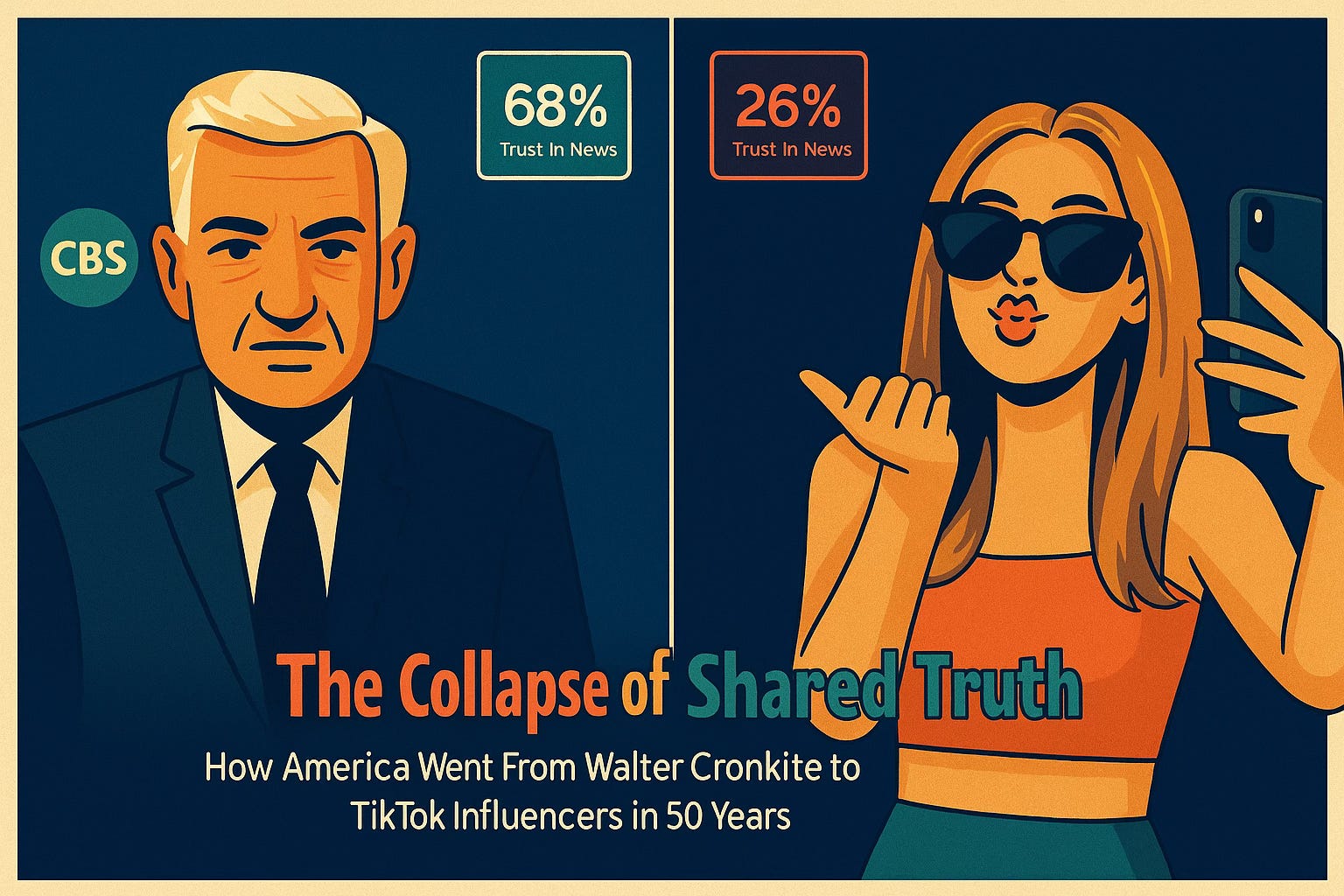
From Cronkite to Deepfakes: How We Lost Reality
Fifty years ago, America cracked. It wasn't just the war in Vietnam; it was the revelation that official optimism was a lie. Television brought body bags and burning villages into living rooms. When Walter Cronkite looked into the camera in 1968 and called the war a stalemate, trust in government collapsed, and so began a cultural reset.
Back then, paradoxically, distrust in Washington came with rising faith in journalism. The press became a watchdog, a force that toppled presidents and exposed corruption. From Vietnam to Watergate, truth was adversarial but shared. There was still a center.
That center is gone. This isn't about liberal versus conservative media, it's about whether a handful of tech billionaires should control what 330 million Americans see, think, and believe. While we argue about bias, they're getting rich selling our attention to the highest bidder.
The scaffolding of shared reality has been systematically dismantled through three massive structural shifts: economic destruction, political weaponization, and technological manipulation. The same forces that turned "efficiency" into cover for surveillance and "immigration enforcement" into digital authoritarianism have weaponized information chaos itself.
Before we go further, let's address the elephant in the room. Conservatives will see this as elite gatekeeping disguised as reform, another attempt by coastal institutions to control information flow. Progressives will see it as false equivalence that ignores how right-wing disinformation campaigns are genuinely more dangerous than left-wing media criticism.
Both concerns contain truth. But here's what they miss: the current system isn't neutral. It's been captured by algorithms that profit from our division. The choice isn't between biased gatekeepers and pure freedom, it's between transparent democratic systems and invisible corporate manipulation.
The goal isn't to eliminate bias, that's impossible. The goal is to make power visible, give people choices, and ensure no single entity controls the information environment of a democracy.
How We Got Here: Three Structural Collapses
1. The Business Model Annihilation
The death of reliable journalism wasn't cultural, it was financial extraction disguised as innovation. But to understand what we lost, we need to remember what news used to be: a loss leader, a public service obligation that came with the privilege of using America's airwaves and trust.
For decades, television networks understood an implicit social contract: in exchange for broadcast licenses and massive profits from entertainment programming, they owed the public something. News divisions were expensive prestige operations that lost money but upheld democratic responsibility. Walter Cronkite's CBS Evening News didn't turn a profit, it paid democracy's bills.
Newspapers operated on a similar model. Classified ads and retail advertising from entertainment and sports sections cross-subsidized the expensive work of democracy: city hall beat reporters, investigative teams, foreign correspondents. Publishers understood that serving the public interest was part of their civic obligation, not just their business model.
This wasn't altruism, it was a bargain. Media companies got wealthy from American audiences and infrastructure, so they owed those audiences reliable information in return. The social contract was clear, profits from entertainment and fluff would fund the serious work of keeping democracy informed.
Between 2000 and 2020, that contract was shredded. American newspapers lost more than $50 billion in annual revenue. This wasn't creative destruction, it was the same wealth concentration playbook we've seen across industries.
Craigslist didn't just compete with classified ads, it annihilated them overnight. When that subsidy vanished, so did accountability journalism. America lost 2,100 newspapers and 57,000 journalism jobs. Today, more than 200 counties have no local newspaper at all.
Meanwhile, Google and Facebook captured 77% of all new digital advertising dollars while producing zero original reporting. They built the most profitable media companies in history by monetizing other people's journalism, then starving those journalists of revenue. It's economic parasitism across industries, platform owners extract value while producers bear the costs and risks, but they've rejected any corresponding public obligation.
When truth becomes a product with no buyer, the market fills with cheaper substitutes: outrage, conspiracy, infotainment. The tech platforms that destroyed journalism's business model felt no duty to replace its democratic function. They took the profits but abandoned the public service.
2. Politics Weaponized Distrust
Politicians learned from Watergate that media could topple them, so they built an antidote: teach the public that the press lies too. From Newt Gingrich's 1990s playbook to "fake news" as political weapon, the strategy was systematic: attack the referees, make truth itself partisan.
This wasn't confined to one side. Right-wing talk radio and Fox News industrialized the tactic first, branding mainstream outlets as "liberal media." But hyper-partisan sites and influencer ecosystems across the spectrum adopted echo chambers. The 24-hour cable cycle turned coverage into combat. Opinion blurred with fact. Conflict sold. Outrage paid the bills.
By 2016, "fake news" became a presidential weapon. A sitting president told millions that journalism itself was fraud, and they believed him. Trust in media plummeted to historic lows: 26% of Americans now trust news most of the time. Among young people, it's nearly zero.
3. Technology Scaled the Destruction
Social media didn't create polarization, it monetized it. Algorithms optimized for engagement because rage and fear keep you scrolling. Facebook's algorithm learned that outrage pays, so that's what it fed users. Platforms rewired distribution around virality, not verification.
The Generational Fracture
The numbers reveal a complete breakdown in how Americans consume information:
Gen Z: 43% get daily news from social media (TikTok 21%, YouTube 19%), only 32% watch traditional TV, under 15% read newspapers. Social media ranks as their most trusted source.
Millennials: Split generation—40% daily social media news, 45% still watch TV, 86% use smartphones for news. Facebook dominates at 35%.
Gen X: 65% rely on television, 45% use Facebook for news, 35% still read print newspapers regularly.
Baby Boomers: 80% television, 55% newspapers, 50% radio. Only 25% use Facebook for news, though growing.
TikTok and YouTube replaced The New York Times for an entire generation. Forty percent of Gen Z gets news from influencers—people with no editorial training, no fact-checkers, no obligation beyond engagement.
The Psychology of Parasocial Truth
This isn't just platform preference, it's a fundamental rewiring of how we determine truth. Traditional journalism operated on institutional authority: "Trust us because we follow professional standards." Influencer culture operates on parasocial relationships: "Trust me because I feel like your friend."
When your news source feels like a personal connection, criticism triggers emotional responses. Attack an influencer someone follows, and you're attacking their friend. That's why fact-checking backfires, it feels like betrayal, not correction.
These relationships don't exist in isolation, they form tribes. People join communities built around shared information sources, shared enemies, shared realities. The algorithms accelerate this by creating feedback loops. TikTok's "For You" page shows you people who think like you do. YouTube builds ideological rabbit holes. Before long, you're living in a completely different reality from your neighbors.
The End of Shared Reality
The result is information warfare, different groups of Americans now inhabit completely separate factual universes. This isn't natural polarization, it's engineered fragmentation that serves power. When people can't agree on basic facts, they can't organize effective resistance.
We're not just disagreeing about policies, we can't agree on basic facts. Did vaccines save lives or cause mass death? Was January 6th an insurrection or a peaceful protest? The answer depends entirely on which information tribe you belong to.
Democracy requires disagreement within a shared framework of basic facts. When that breaks down, democratic conversation becomes impossible. Families can't discuss current events. Neighbors avoid conversations that might reveal ideological differences. We've become strangers to each other, speaking different languages even when we use the same words.
The International Laboratory
While America spiraled, other democracies became experiments in media resilience. Britain maintained higher media trust (60%) through robust public broadcasting. Finland's media literacy education immunized citizens against Russian disinformation. The EU's Digital Services Act forces platforms to reveal algorithmic decision-making.
But cautionary tales abound: Hungary's Viktor Orbán didn't shut down critical media, he bought it, then slowly transformed independent outlets into government mouthpieces. The process took less than a decade.
The AI Acceleration
If you think this is the bottom, the next step is coming quickly.
AI will not just distort facts, it will make it almost impossible to know what’s real for most. We're entering a world where anyone can create perfect deepfake videos in minutes. If a viral deepfake of a president declaring war drops tomorrow, can truth catch up before markets crash and countries respond?
But the information chaos isn't an accident, it's the foundation for digital authoritarianism. While Americans argue about what's real, tech platforms build surveillance systems monitoring every click, purchase, and conversation. We're so distracted fighting over facts that we're missing the construction of infrastructure to control us.
This follows a familiar pattern: create crisis and confusion, then offer technological solutions that concentrate power.
Today's politicians have learned to govern like tech executives: create engagement, monetize attention, scale influence. Look at Trump's crypto empire, meme coins that turn presidential access into tradable assets, stablecoins that create shadow banking systems. We went from "drain the swamp" to tokenizing the presidency itself.
Blueprint for Reconstruction
Let's be honest: the Cronkite era wasn't utopia. It excluded marginalized voices and concentrated narrative control in mostly white, male newsrooms. Digital platforms democratized speech, that's progress. But democracy without trust collapses into noise. When every voice competes without guardrails, the loudest liars win.
Democracy needs information infrastructure the same way it needs physical infrastructure. We don't have Republican bridges and Democratic water systems, we have shared public goods that serve everyone. The same principle should apply to the basic information systems that democracy requires to function.
This isn't about controlling what people say, it's about ensuring they can hear each other when they do.
There's no silver bullet, but history offers playbooks for rebuilding shared reality. These aren't left or right solutions, they're anti-monopoly solutions that both Teddy Roosevelt Republicans and progressive Democrats would recognize.
Rebuild Journalism's Business Model: The old social contract, where entertainment profits funded public service journalism, needs reconstruction for the digital age. Public-interest media subsidies, tax credits for local reporting, and nonprofit investigative funds can replace the cross-subsidy we lost. Break up tech monopolies that strangled journalism revenue through the same methods used against previous information monopolies. AT&T was split up because controlling communication infrastructure was incompatible with democracy. The same principle applies today.
Modern tech giants have extracted enormous profits from American users and infrastructure while rejecting any public service obligation. They've taken the benefits of the old media bargain, massive audiences, infrastructure access, cultural influence, while abandoning the responsibilities. We need to restore that social contract.
If you profit from American attention and democracy, you owe American democracy something in return.
Enforce Algorithmic Accountability: Platforms aren't neutral, they're editorial decisions disguised as technology. Mandatory transparency reports, independent audits, penalties for amplifying verified disinformation. The EU's Digital Services Act shows it's possible. This isn't about censorship, it's about making corporate power visible so citizens can make informed choices.
Invest in Media Literacy as National Security: Finland made critical thinking a survival skill. We need the same at scale. A population that can't distinguish fact from fiction is vulnerable to manipulation by anyone with a platform and malicious intent. This isn't partisan education, it's civic defense.
Rebuild Public Broadcasting: America needs BBC-scale public media, funded through methods that insulate it from political interference. When profit-driven media fails, public media must provide the foundation of shared facts that commercial pressures make impossible.
Create Digital Rights: Americans need the right to accurate information, to know when content is AI-generated, to understand algorithmic recommendations, and to move data between platforms. But rights require responsibilities, platforms hosting political content must meet transparency standards.
The alternative isn't the status quo, but it's information collapse and, with it, democratic governance itself. Other democracies are implementing these solutions. America can learn from their successes and failures, but only if we act before the breakdown becomes irreversible.
This isn't about nostalgia for old gatekeepers or left-right blame games. It's about democracy's operating system: shared reality. Break that infrastructure, and nothing else runs, not policy, not elections, not the rule of law.
The American experiment in self-governance has survived civil war, world wars, and economic collapse. Whether it can survive the loss of shared truth remains an open question. The answer depends on choices made now about who controls the infrastructure of human knowledge and whether democratic institutions can reclaim authority over the systems that determine what citizens know about their world.
Fifty years ago, Walter Cronkite could end his broadcast with "And that's the way it is" and most Americans would accept his account as reliable foundation for democratic debate. Today, no single source commands that universal credibility. Soon, synthetic content and algorithmic manipulation may make such shared authority impossible to reconstruct.
Sources
Media Industry Data: Pew Research Center, "State of the News Media 2023" • Reuters Institute Digital News Report 2024 • NewsGuild-CWA, "News Deserts and Ghost Newspapers," 2022
News Consumption by Generation: Pew Research Center, "News Platform Fact Sheet" and "Social Media and News Fact Sheet," 2024 • American Press Institute, "News Consumption Habits of 16- to 40-Year-Olds," 2024 • Morning Consult, "News Industry Outlook," 2024 • Attest, "Gen Z Media Consumption 2025"
Media Trust and Platform Research: Gallup Media Use Report 2024 • Edelman Trust Barometer 2024 • Knight Foundation, "American Views 2024" • Pew Research Center, "Demographics of Social Media Users," 2024 • eMarketer, "US Digital Habits by Generation," 2024
International Media Systems: BBC Annual Report 2023-2024 • Finnish Ministry of Education, "Media Literacy Strategy 2024-2030" • European Broadcasting Union, "Public Service Media in the Digital Age" • Freedom House, "Freedom of the Press 2024"
Technology and Democracy: MIT Technology Review, "Algorithmic Accountability Report 2024" • Stanford Internet Observatory, "Election Integrity Partnership 2024" • Oxford Internet Institute, "Global Disinformation Order 2024" • Brookings Institution, "Media, Democracy, and Information Environment"
Policy and Solutions: Congressional Research Service, "Social Media Regulation and First Amendment," 2024 • Federal Trade Commission, "Social Media Platform Report 2024" • Electronic Frontier Foundation, "Platform Transparency Report 2024"
Sounds like we are heading for the edge of a cliff. What happens next?