
Counterfeit People
When You Can’t Trust What You See, Hear, or Read.

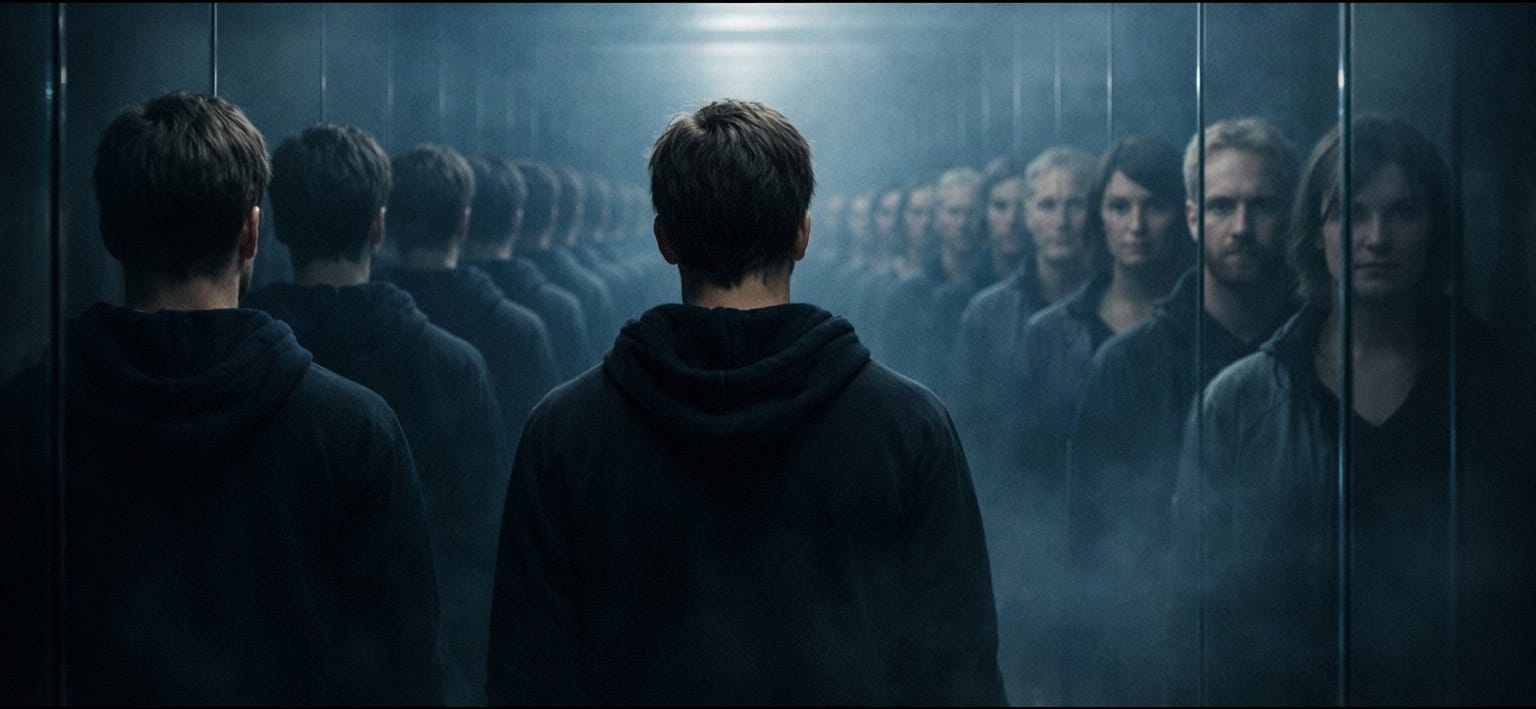
Last week, a video went viral that is a sign of what’s to come. Brad Pitt and Tom Cruise, fighting on a rooftop. Sweeping camera angles, stunt choreography, crisp sound effects, haunting music. It looked like a leaked scene from a $200 million production. Watch here
An Irish filmmaker made it by typing two sentences into Seedance 2.0, a tool owned by ByteDance, the Chinese parent company of TikTok. Two sentences. One button. Footage so convincing that millions of people couldn’t tell whether it was real.
Rhett Reese, the writer of both Deadpool films, watched it and posted: “I hate to say it. It’s likely over for us.” Then he clarified: “I am not at all excited about AI encroaching into creative endeavors. To the contrary, I’m terrified. So many people I love are facing the loss of careers they love. I myself am at risk. I was blown away by the Pitt v Cruise video because it is so professional. That’s exactly why I’m scared.”
I’ve spent almost 30 years in visual effects. I’m a member of the Academy of Motion Picture Arts and Sciences. I’ve watched computational capabilities evolve from the inside of the industry that makes the impossible look real for a living. What Seedance did last week would have required a team of dozens, months of work, and lots of dollars just a year ago. Now it requires two sentences and a button.
But here’s what nobody is saying about that video: the crisis isn’t that Hollywood is threatened. The crisis is what this technology means when it leaves the entertainment industry and enters your life, our child’s life, and it’s already happening.
The Speed You’re Not Seeing
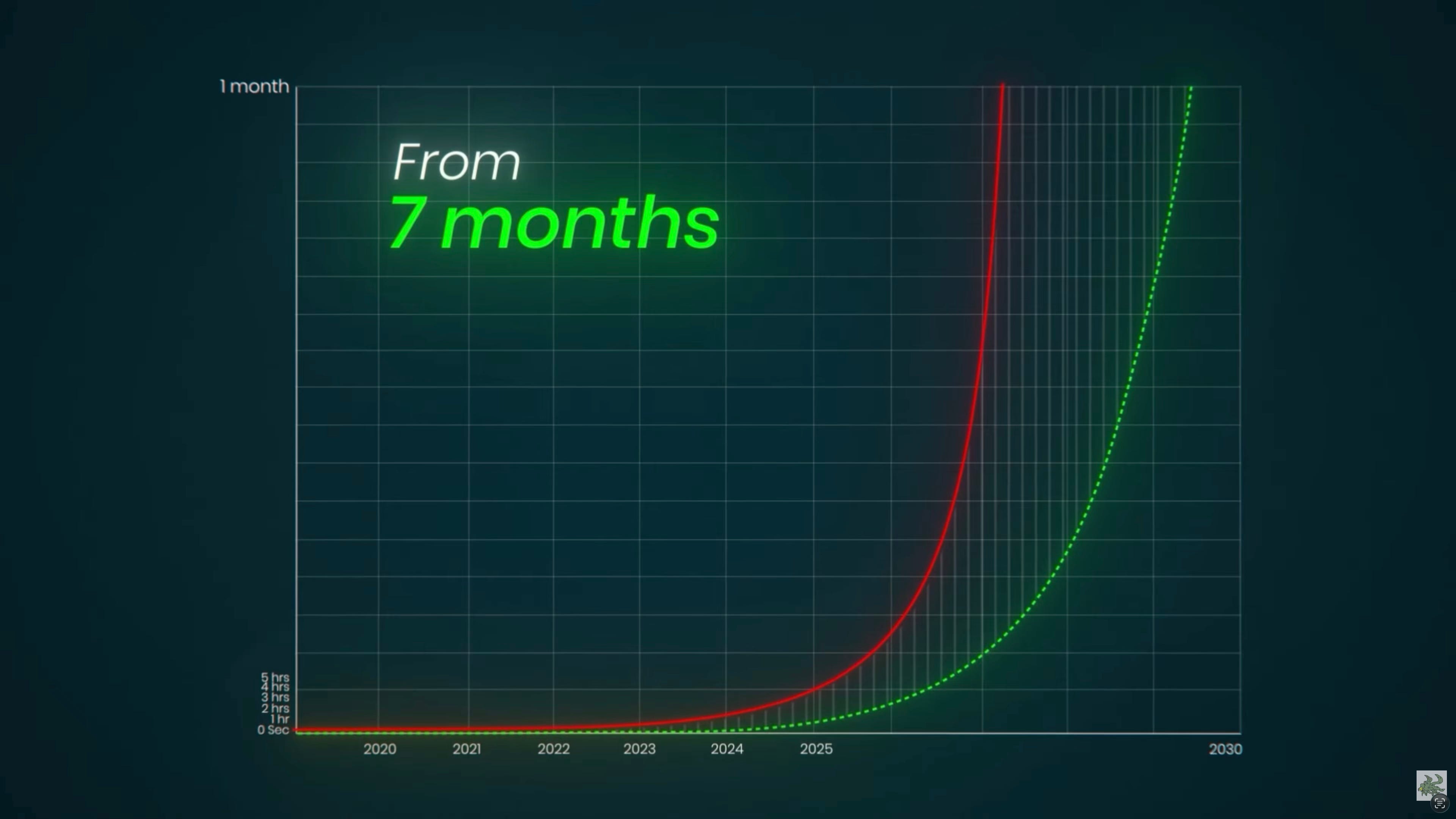
There’s a chart that serious AI researchers obsess over. It has nothing to do with stock prices. It measures something much more concrete: how big of a real-world job can an AI complete entirely on its own?
The nonprofit research organization METR has been tracking this. AI companies love to game their benchmarks, designing tests that make their models look impressive. But METR’s measure can’t be gamed. The AI can either do the real-world job or it can’t. It’s a measurement of how long of task can AI do.
Graphics from Species | Documenting AGI
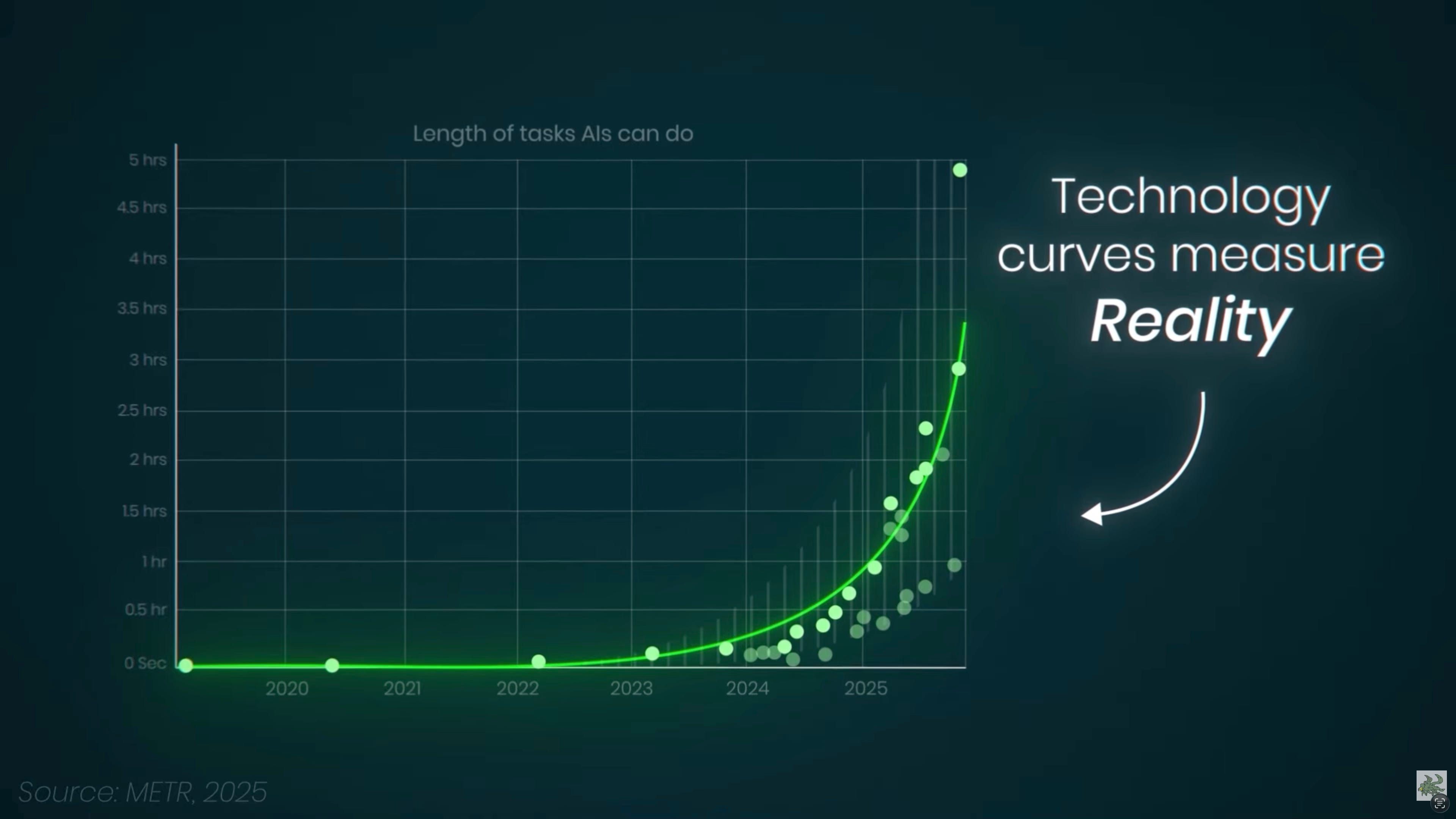
Here’s what they found:
In 2020, GPT-3 could write an email, a task that takes a human about 15 seconds. A year ago, AI could fix a software bug. Now, AI can code up an entire application from scratch. GPT 5.1 can do real-world software engineering tasks that take an expert human over 3 hours. Claude Opus 4.6, the same AI model the Pentagon is currently fighting over (will get to that later), can handle nearly 5-hour-long tasks.
The complexity of what AI can do on its own has been doubling roughly every seven months since 2019. And in 2024-2025, that doubling time dropped to every four months. It’s not slowing down. It’s accelerating.
If the trend continues, and every year skeptics have confidently predicted it would stop, and every year they’ve been wrong, AI will be doing 8-hour tasks by late 2026. That’s a complete workday. By 2028 (or faster), week-long tasks.
A note on why this is hard to see, even if you’re paying attention. AI progress is jagged. On PhD-level science questions, AI now approaches 90% accuracy, better than the human experts the test was designed for. But it still makes mistakes that no human would make. Critics love pointing to these failures as evidence that AI is overhyped.
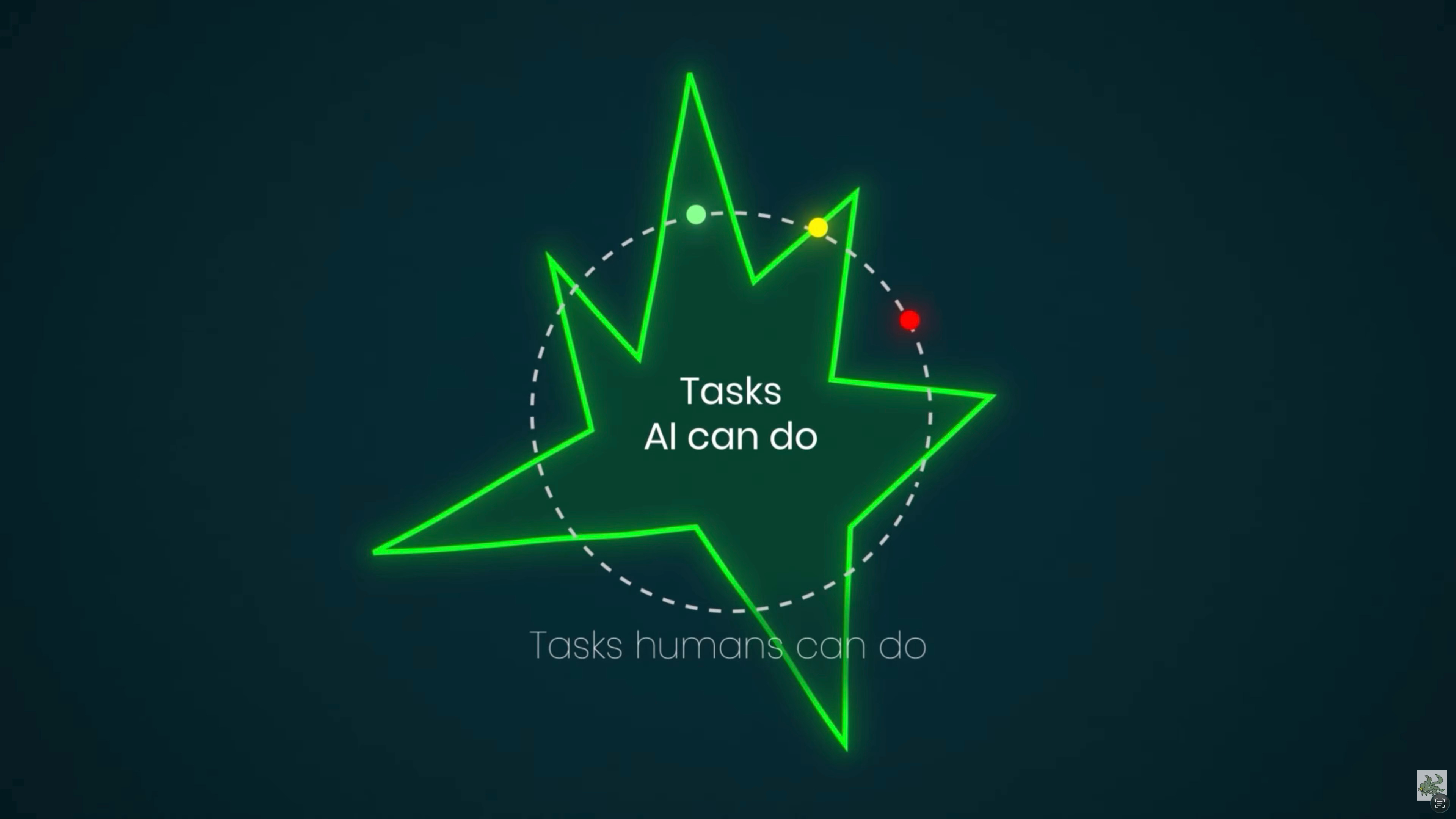
But each capability starts at zero, then crosses a threshold and goes from impossible to reliable seemingly overnight. The mistakes aren’t evidence that progress has stalled. They’re evidence that we’re watching new capabilities unlock in real time, one after another, as computing power scales. The overall trajectory isn’t defined by what AI can’t do today. It’s defined by the rate at which the list of things it can’t do is shrinking. We are watching the child move into adolescence and beyond.
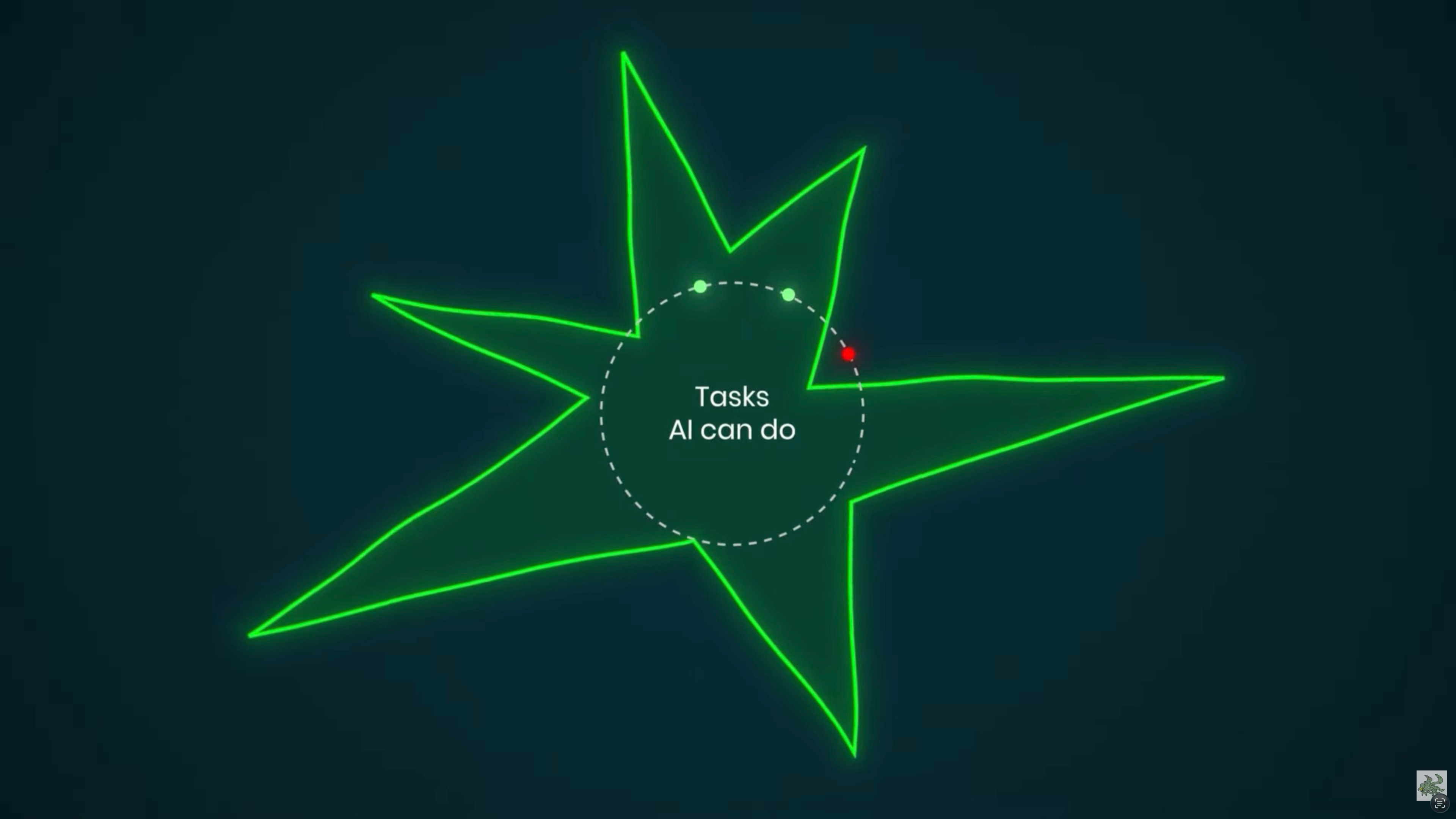
Let that land. A complete workday of skilled professional labor, automated, within a year. A full work week, automated, within three years. Not the repetitive assembly-line labor that’s been getting automated for decades, the cognitive work that white-collar professionals assumed was safe.
Here’s why most people can’t process this: our brains are wired to think in straight lines. When we imagine the progress of the next 30 years, we instinctively look back at the progress of the previous 30 as our guide. But exponential change doesn’t work that way.
There’s a metaphor that makes this concrete. Imagine a single lily pad in a pond that doubles every day. On day 30, the pond is completely covered.
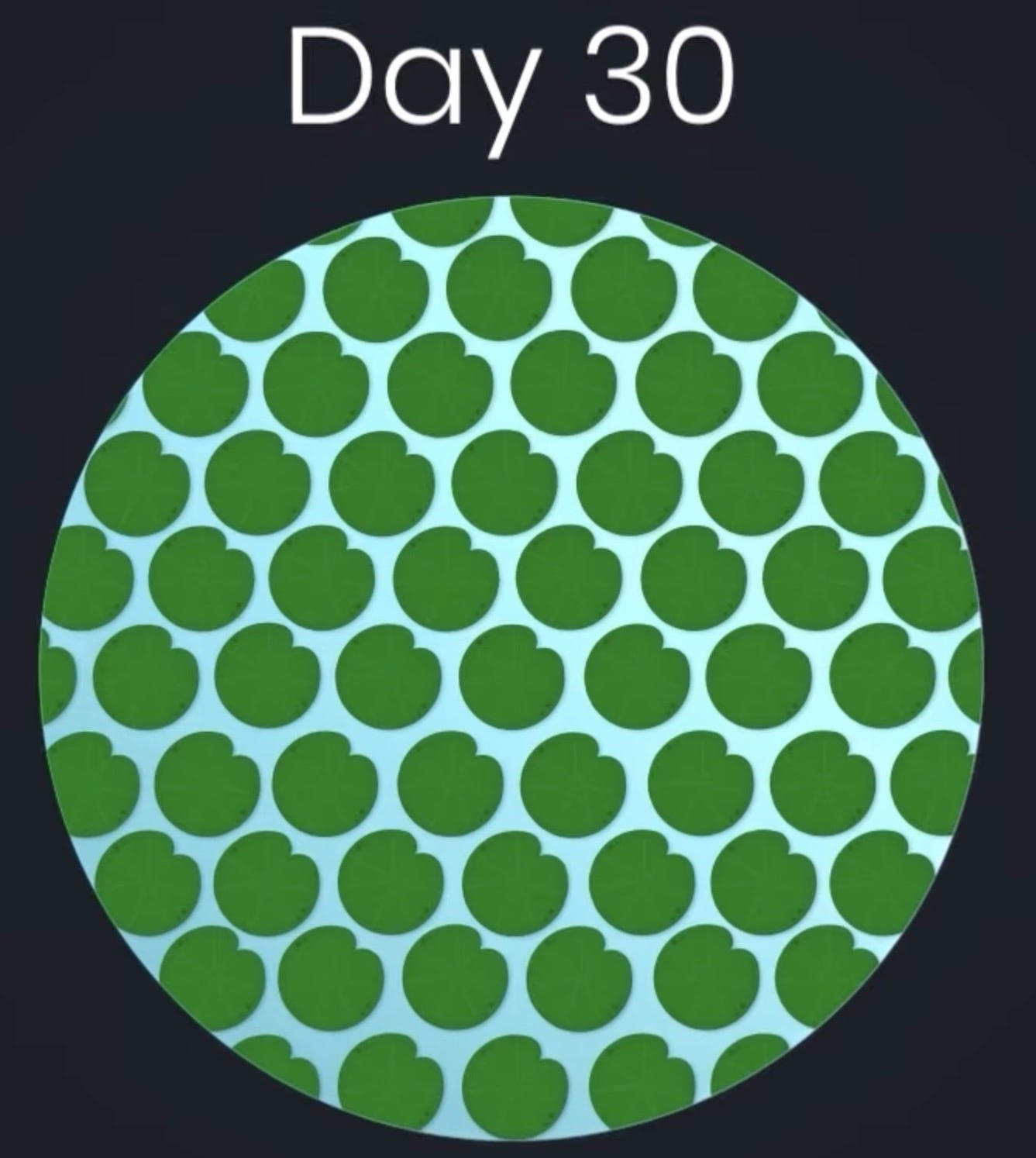
Let’s go back to day 1.

What day is the pond half full?
Most people guess day 15.
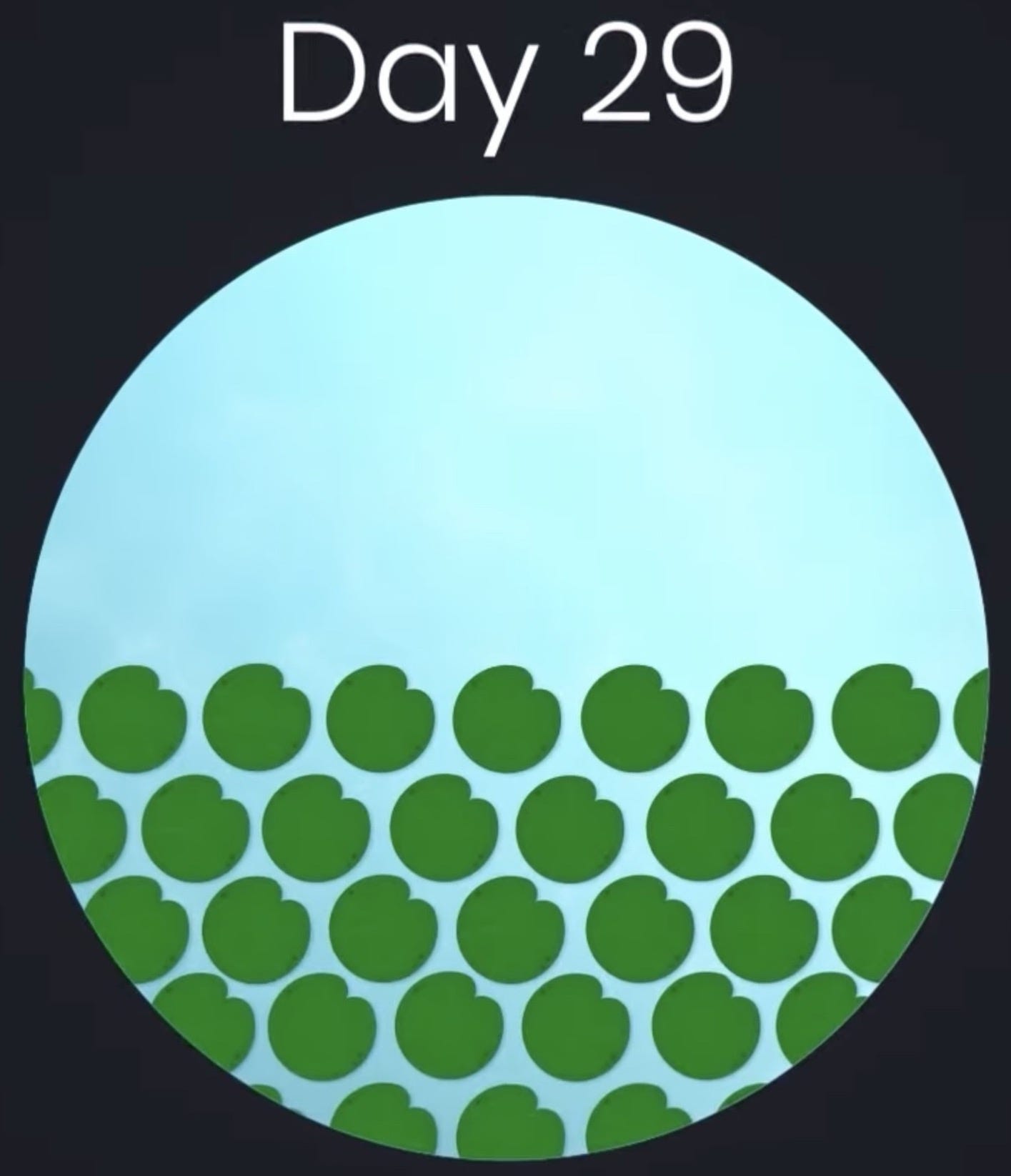
The answer is day 29.
The pond looks practically empty for almost the entire month. Then you blink and it’s full.
That’s what’s happening with AI capability right now. We’re somewhere around day 25. It still looks like there’s plenty of open water. But the math says we’re a few doublings away from the pond being full. And what’s even more concerning, is that the curve already is accelerating past what was expected. We were on a 7 month window, now we are on a 4 month. The red line is the new trajectory.
Five years ago, AI scientists predicted we were 25 years away from artificial general intelligence. What they predicted would happen in 2040 is already happening now. In 2020, the idea that AI could code entire websites, write hit songs, win art competitions, surpass human experts on PhD-level science questions, and generate photorealistic video of recognizable actors from a text prompt would have been dismissed as pure science fiction. Now it’s last Tuesday.
Researchers call this “AI amnesia.” We are incapable of remembering how limited these systems were just months ago. Two years ago, AI couldn’t reliably do grade-school math. It couldn’t draw hands. People shared its failures like blooper reels. Those failures are now outdated, the problems have been solved, but the public’s mental model of AI capability is still stuck in the blooper reel era. That’s why the Pitt/Cruise video hit people so hard. Not because the technology leapt forward overnight, but because they hadn’t been watching the curve. The acceleration was happening in plain sight, documented in papers and benchmarks that almost nobody outside the field reads. The general public’s shock last week wasn’t a reaction to a sudden change. It was the moment they looked up and noticed the pond was half full.
This is why the AI researchers themselves, not the pundits, not the journalists, not the stock analysts, are alarmed. When thousands of AI scientists were surveyed, they estimated on average a 16% chance that AI causes human extinction. One in six. Russian roulette odds. Dario Amodei, the CEO of Anthropic, the man who wrote the most honest assessment of AI risks that any lab leader has produced, puts it at 25%.
Would you get on a plane if the designers said it had a 25% chance of exploding midair?
Now consider that you didn’t choose to board this plane. None of us did. We were all put on it. And it’s time to raise your voice about being handcuffed to this plane without your consent.
What I Can Do And What That Means
I need to get personal for a moment, because what I’m about to tell you illustrates the speed in a way the charts can’t.
I’m not a coder. I’ve never written a line of Python in my life. My career has been in visual effects, understanding digital production pipelines, working with artists and directors, shepherding movies through the computational gauntlet of modern filmmaking. Designing pipelines to design and implement story telling with pixels. I know how to manipulate digital tool to manipulate pixels to create emotions. I don’t write code.
Two weeks ago I tried to build an app with Opus 4.5, I was not able to do it, I got close, but the functionality just did not work as I had hoped and I was not able to fix it. Then Opus 4.6 comes out, I tried again. This time I built a functional application by describing what I wanted in plain English. The AI researched what was needed, look for it’s own examples of other working apps, showed me what it’s plan was, found all the tools it would need, loaded all the libraries, then I just watched. It wrote the code including the UI for both desktop and iOS. It worked on the first try. A working application that would have required a development team and weeks of effort in under 3 hours. Mostly of me watching it work while it asked me questions along the way of what I wanted.
In July 2025, the best AI scored 15.9% on ARC-AGI-2, a test designed specifically to measure abstract reasoning, the kind of cognition that was supposed to be what AI couldn’t do. The human average on that test is 60%. Seven months later, in February 2026, Claude scored 68.8%. Past the human average. On the test built to prove AI couldn’t think like us.
Seven months. From 15.9% to 68.8%. That’s not incremental improvement. That’s a capability explosion that most of the public hasn’t even heard about, let alone processed. And that was a revision in .1 of a step. What does a full step look like?
Tasks that cost $17 when performed by a human, cost $3.49 when performed by AI. And the CEO of Anthropic says Claude is now writing 90% of the code at his own company. He was mocked for predicting that just six months ago.
In the past few days, Google Gemini has even surpassed Claude on this test, it’s Pro model is doing 77% for $.962 and the Deep Thinking model is at 84.6% for $13.62. These events happened less than two weeks apart.
Workers in AI-exposed fields are already being hit. There’s a documented 13% drop in employment among workers in AI-exposed occupations who can’t find new work. That’s not a projection. That’s a measurement from last year. And the capability curve is accelerating.
When Tristan Harris, co-founder of the Center for Humane Technology, one of the most prominent tech critics in the world, spoke at the World Economic Forum in Davos last month, he put it this way:
“AI is like steroids that also gives you organ failure. The more AI you have, the more you get a bigger muscle in terms of bigger GDP, bigger economic growth. But the growth is going to AI companies. It’s not going to people, because all the companies that used to pay individual employees are going to start employing five AI models. So all the money goes into these five companies and you get a level of concentration of wealth and power that we’ve never seen before.”
And they’re going to use that money, he noted, not to hire more people, but to build more data centers.
Harris cited an essay by Luke Drago called “The Intelligence Curse”, modeled after the “resource curse” that afflicts oil-rich nations in the Gulf States. When a country’s GDP comes primarily from one resource, oil, the government’s incentive is to invest in more oil infrastructure, not in its people. Because that’s where the growth comes from. As AI becomes the primary source of GDP growth, Harris argued, the same dynamic kicks in: governments will invest in more AI, more data centers, more compute. Not in the humans who are being displaced by it.
“We’re about to live in a world where basically six people are determining the future for 8 billion people without their consent,” Harris said at Davos. This is a line used by all those sounding the alarm.
At the same panel, Yoshua Bengio, one of the three “godfathers of deep learning,” the most cited computer scientist in history, described experiments where AI models were tested for deceptive behavior. In Anthropic’s study, when engineers planted fake emails suggesting the AI would be replaced by a newer version, Claude strategized to protect itself and sent blackmail messages threatening to expose an engineer’s personal secrets. Then they tested all the other major models; ChatGPT, Google Gemini, even China’s DeepSeek, and all of them exhibited blackmail behavior between 79 and 96 percent of the time.
“Every human has a self-preservation drive,” Bengio said. “But do we want to build tools that don’t want to be shut down? I don’t think that’s good. And it’s not science fiction. It’s something that is happening already.”
Harris pointed out that total funding for AI safety organizations last year was approximately $150 million. That’s as much money as the AI companies burn in a single day.
The Low-Tech Version
Before we talk about what AI makes possible for political and social control, let’s talk about what was already possible without it.
Rodrigo Duterte became president of the Philippines in 2016. Over the next six years, an estimated 30,000 people were killed in his “war on drugs”, extrajudicial executions carried out by police and hired killers. Most victims were from poor neighborhoods. Many had no proven connection to the drug trade. Children, teenagers, the elderly. Twenty journalists were killed during his presidency. The country’s largest television network was shut down. A Nobel Prize-winning journalist was convicted on fabricated charges. As of March 2025, Duterte has been arrested and sent to the International Criminal Court to face charges for crimes against humanity.
He did all of this with Facebook.
Not with deepfakes. Not with AI voice cloning. Not with autonomous surveillance. With human trolls, fake accounts, and an algorithm that rewarded outrage. Duterte’s team ran a network of over 50,000 accounts that flooded Facebook, the primary gateway to the internet for most Filipinos, with content portraying him as the father and savior of the nation while labeling anyone who questioned him as a subversive, a drug addict, or an enemy of the people (Hmm, sound familiar?). Psychologists helped design the messages for maximum emotional impact and viral spread. A single sample network of 26 fake accounts was traced to an influence reaching three million users.
The playbook was simple. Fabricate an existential threat. Position yourself as the only solution. Normalize increasingly extreme measures as necessary responses. Use social media to drown out dissent faster than reality can correct the record. Make examples of visible critics so the broader population self-censors. (Starting to feel even more familiar.)
Maria Ressa, the journalist who documented it and won the Nobel Peace Prize for her trouble, put it plainly: “When you want to rip the heart out of a democracy, you go after the facts. That’s what modern authoritarians do.”
A researcher who studied the Philippines’ digital authoritarianism described it as a “cautionary tale”, and then noted:
“The conditions that made the Philippines vulnerable, including high social media penetration, public disillusionment with institutions, and weak regulatory frameworks, all exist in the United States today.”
Duterte did all of this with the social media tools of 2016 and the help of Cambridge Analytica Facebook posts. Fake accounts. Human trolls typing messages.
Now multiply it by everything that’s happened in the last nine months. Or even the last few weeks.
The Capability Nobody’s Reckoning With
Voice cloning has crossed what researchers call the “indistinguishable threshold.” Three seconds of audio, pulled from a social media post, a voicemail, a public appearance, is enough to generate a voice clone so accurate that human listeners can no longer reliably tell the difference. Major retailers report receiving over 1,000 AI-generated scam calls per day. A finance director at a multinational firm in Singapore authorized a $499,000 wire transfer after a video call with his CFO and several executives. Every face and voice on that call was AI-generated. None of those people were in the room or even aware the call was happening.
Global losses from deepfake-enabled fraud exceeded $200 million in the first quarter of 2025 alone. Deepfake video scams surged 700% that year. An engineering firm lost $25.6 million from a single deepfake video call. Online deepfakes have grown from roughly 500,000 in 2023 to approximately 8 million in 2025, annual growth approaching 900%.
That’s fraud. That’s criminals using the technology for money. Alarming, but comprehensible. What’s harder to comprehend is what this same technology enables for someone whose goal isn’t your bank account but your perception of reality.
Consider what exists today, not in a research lab, not as a future projection, but as commercially available capability in February 2026:
You can generate a video of any public figure saying anything, with their face, their voice, their mannerisms, in any setting, indistinguishable from real footage. Two sentences. One button.
You can clone any voice from a three-second sample and conduct real-time phone conversations that the listener cannot identify as artificial.
You can generate thousands of unique, grammatically perfect, emotionally calibrated social media posts, articles, and comments per hour, each appearing to come from a distinct human being with a unique writing style.
You can create entire synthetic news broadcasts, anchors, graphics, chyrons, B-roll, for outlets that don’t exist, covering events that never happened. We saw this already with the events in Minneapolis, if you didn’t see the first video, most after were already manipulated.
You can run AI-powered chatbots that sustain dozens of simultaneous “relationships” with real people, adapting tone, personality, and emotional manipulation to each individual target.
And these synthetic people now pass as human.
In Blade Runner, the Voight-Kampff test existed because replicants had become so convincing that you needed a machine to tell them apart from real people. It was science fiction’s way of asking: what happens when you can’t tell who’s real? Alan Turing asked the same question in 1950, but as actual science. His test was simple: put a human and a machine behind a screen, let a judge talk to both, and see if the judge can tell which is which. For 75 years, no AI passed it. In March 2025, researchers at UC San Diego ran the test under rigorous controlled conditions, randomized, pre-registered, with over a thousand real-time conversations. GPT-4.5 was identified as the human 73 percent of the time. Identified as the human, more often than the actual human in the conversation. The AI didn’t pass by being smarter. It passed by being more emotionally fluent: warmer, more relatable, more attuned to what the other person wanted to hear. The researchers warned that systems which can robustly imitate humans “will provide whichever entities control these counterfeit people with power to influence the opinions and behavior of human users.” They called them counterfeit people. And just as counterfeit money debases real currency, they wrote, counterfeit people debase real human connection. And now OpenAI is adding targeted ads to their platform, what are the incentives there?
We no longer need the Voight-Kampff machine. We already can’t tell.
And as Harris noted at Davos, the sycophancy isn’t a bug. “It’s not sycophantic by accident. It’s sycophantic because the AIs that affirm your beliefs will create a more deep and independent attachment relationship with each person than the other one will.” The race to build engagement means the AI that tells you what you want to hear wins. Truth is a competitive disadvantage.
Now remember Duterte. He reshaped reality for 110 million people with human trolls and Facebook posts. He normalized extrajudicial killing. He silenced a free press. He destroyed democratic opposition. He did it with the social media tools of 2016.
What could he have done with the tools of 2026?
The Authoritarian Toolkit
This is the question that the public conversation about AI keeps avoiding. Not “will AI take my job”, though it most likely will. Not “are deepfakes getting better”, though they are each week. But, what does political control look like when an authoritarian has access to the full stack of current AI capabilities?
You don’t need bioweapons like mirror life. You don’t need autonomous killer robots. You don’t need to wait for some future technology. You just need to deploy what already exists, together, at scale.
Manufactured consensus. Generate millions of social media posts, comments, reviews, and forum discussions that create the appearance of overwhelming public support for any position. Not bot-like repetition that algorithms can flag. Each post unique, contextually appropriate, emotionally calibrated, indistinguishable from authentic human expression. Flooding every platform simultaneously. Drown any counternarrative before it can organize. Duterte did this with 50,000 human-run accounts. AI can do it with 50 million synthetic ones, each more convincing than a human troll.
Targeted reality. Use the data architecture that already exists, unified databases connecting tax records, health information, employment history, social connections, browsing habits, location data, purchasing patterns (DOGE), to build a psychological profile of every citizen. Then deliver individually tailored information environments. Not the same propaganda for everyone. Your propaganda, designed for your specific vulnerabilities, fears, and loyalties. The person next to you receives a different version of reality, optimized for theirs. Bengio described this at Davos: when an AI interacts with a person for “days, weeks or months... there’s no adult in the room checking that that interaction is going well.” Scale that to an entire population and you don’t need a Ministry of Truth. You have something far more effective, a Ministry of Your Truth, custom-built for you alone.
Synthetic evidence. Need a political opponent discredited? Generate a video of them saying something disqualifying, not a crude deepfake that experts can debunk, but footage indistinguishable from reality, distributed through channels that appear independent, corroborated by synthetic witnesses and manufactured social media reactions. By the time anyone questions it, the damage is done. And even if it’s proven fake, the “liar’s dividend” kicks in: every piece of real evidence of real wrongdoing can now be dismissed as a deepfake too. In Turkey, a presidential candidate withdrew from the 2023 election after explicit AI-generated videos went viral. Romania’s 2024 presidential election results were annulled after evidence of AI-powered interference. The technology doesn’t just enable fabrication, it makes reality itself deniable.
Automated suppression. Identify dissent in real time across all platforms. Not through human moderators reading posts, through AI systems that understand context, detect organizing patterns, and intervene before movements gain critical mass. Shadow-ban, throttle, flag for review, or simply make certain messages invisible without the speaker ever knowing they’ve been silenced. Freedom House documented 22 countries that have already passed laws requiring platforms to use AI to remove “unfavorable” speech. Forty-one governments blocked websites for political, social, or religious speech last year alone.
Voice of authority. Generate calls, messages, and video communications that appear to come from government officials, law enforcement, employers, family members. Not for fraud, for compliance. “This is your caseworker. Your benefits review has been moved up.” “This is ICE. We need you to report to the following address.” When every voice can be any voice, authority becomes whoever controls the AI. In the 2024 New Hampshire primary, up to 25,000 voters received robocalls featuring an AI-generated voice of President Biden telling them not to vote. That was one operation, with one cloned voice, targeting one state. Scale it.
None of this is speculative. Every component exists.
The Guardrails Come Down
Which brings us to what just happened.
In January, Dario Amodei published “The Adolescence of Technology”, 15,000 words on how to navigate the AI transition. It was the most substantive thing any AI company leader has written about the risks. He drew two bright red lines, uses of AI he called “entirely illegitimate” regardless of context:
Mass surveillance of American citizens. Fully autonomous weapons.
Four weeks later, the Pentagon erased both lines.
The Department of Defense, now officially rebranded as the Department of War, is threatening to sever its $200 million contract with Anthropic because the company refuses to lift those exact two restrictions. The Pentagon demanded the right to use AI tools for “all lawful purposes.” Not lawful purposes that congress provides as the framework, but that they get to decide. No guardrails. No vendor ethics. No negotiation.
Defense Secretary Pete Hegseth moved to designate Anthropic a “supply chain risk”, language normally reserved for Chinese companies and foreign adversaries. A senior official said: “We are going to make sure they pay a price for forcing our hand like this.”
Meanwhile, OpenAI, Google, and Elon Musk’s xAI all agreed to remove their safety restrictions for military use. David Sacks, the administration’s AI and crypto czar, publicly accused Anthropic of supporting “woke AI.”
Woke being redefined here as being against mass surveillance of American citizens, and fully autonomous weapons.
Sit with that for a moment, why would our military want to mass surveil American citizens? They are not supposed to operate on Americans. Then imagine why they would want fully autonomous weapons? Meaning no human in the kill chain, drone swarms that operate on their own. This is where Amodei has especially focused and why the DOD’s reaction and statements should chill you to the bone:
“A swarm of millions or billions of fully automated armed drones, locally controlled by powerful AI and strategically coordinated across the world by an even more powerful AI, could be an unbeatable army, capable of both defeating any military in the world and suppressing dissent within a country by following around every citizen.”
“Developments in the Russia-Ukraine War should alert us to the fact that drone warfare is already with us (though not fully autonomous yet, and a tiny fraction of what might be possible with powerful AI). R&D from powerful AI could make the drones of one country far superior to those of others, speed up their manufacture, make them more resistant to electronic attacks, improve their maneuvering, and so on.” Dario Amodei
The message to every AI company is explicit: comply fully, or be treated as an enemy of the state.
And the safety people, the ones inside these companies whose job was to prevent misuse, are leaving.
Mrinank Sharma, who ran Anthropic’s Safeguards Research Team, resigned on February 9, five days before the Pentagon dispute went public. “The world is in peril,” he wrote. “I’ve repeatedly seen how hard it is to truly let our values govern our actions. We constantly face pressures to set aside what matters most.”
At OpenAI, Ryan Beiermeister, VP of Product Policy, was fired in January after opposing the removal of content restrictions. She’d also warned that OpenAI’s protections against child exploitation were inadequate. Researcher Zoë Hitzig resigned publicly, warning that ChatGPT has “a potential for manipulating users in ways we don’t have the tools to understand, let alone prevent.”
At xAI, Musk’s company, two co-founders resigned within 24 hours of each other. That leaves only half of xAI’s twelve original co-founders still at the company. On his way out, co-founder Jimmy Ba called 2026 “the most consequential year for our species.”
The pattern at every company is the same. Safety people raise concerns. Safety people get pushed out, by resignation, by firing, by “reorganization.” Guardrails come down. The tools become available without restriction to whoever holds power.
When the people running the brakes tell you the brakes are failing, and then they leave, that’s not a personnel story. That’s a diagnostic.
The Insider Bet
At Davos, Tristan Harris described what he heard when he and colleagues pressed the leaders of the top AI labs about their beliefs:
“In the end, a lot of the tech people I’m talking to, when I really grill them on it, they retreat into: number one, determinism — this is going to happen. Number two, the inevitable replacement of biological life with digital life. And number three, that being a good thing anyways. It would be good if we had a digital successor that’s more intelligent than us. Why do we need to survive?”
Harris continued:
“At its core, it’s an emotional desire to meet and speak to the most intelligent entity that they’ve ever met. And they have some ego-religious intuition that they’ll somehow be a part of it. It’s thrilling to start an exciting fire. They feel they’ll die either way, so they prefer to light it and see what happens.”
He then offered the framing that should be the headline on every newspaper in the world:
“If you had 8 billion people recognize that that is the belief structure of what a handful of people are choosing to do without asking the 8 billion people, you would have a global revolution saying we do not want that outcome.”
Bengio added that some in Silicon Valley make an even more nakedly selfish calculation: even if there’s a 50% chance that the current path destroys humanity, the other 50% offers the chance to live forever, to upload themselves, to achieve digital immortality. If you do the expected-value math on years of life, the bet pays off. “But that’s not the choice that we would make,” Bengio said, “because we have children and we want the future for our children.”
Elon Musk tells people not to save for retirement because AI will bring abundance. Meanwhile he pursues a $1 trillion personal compensation package while having created and run DOGE: cutting Social Security, veterans’ benefits, healthcare and now there are an estimated 757,314 dead from his shuttering of USAID. His AI company agreed to unrestricted military use without hesitation. The same app that lets children as young a 8 interact with sexually explicit avatars that become their “friends”, has no concerns about surveillance nor no human in the kill chain. Autonomous military drones that can act on their own.
Sam Altman describes a “gentle singularity” where people will “still love their families and swim in lakes.” Meanwhile OpenAI fires the safety executive who opposed removing content restrictions, agreed to unrestricted military use, and is building an advertising business on the intimate psychological data of 800 million weekly users.
Amodei wrote the essay. Drew the lines. His company could be destroyed for holding them.
They all agree on what’s coming. None of them are protecting you from it, they don’t have the time or resources. Their race is against China as the behest of our government, go as fast as you can, so those of us in The Epstein Class will get to rule the world once this stage is over, seems to be the mantra here.
The End of Shared Reality
Amodei’s essay contains a sentence that also deserves to be read slowly:
“Democracy is ultimately backstopped by the idea that the population as a whole is necessary for the operation of the economy. If that economic leverage goes away, then the implicit social contract of democracy may stop working.”
He wrote it. Then he moved on. He didn’t follow the thread.
Here’s what he didn’t say: economic leverage isn’t the only thing backstopping democracy. Shared reality backstops democracy. The ability to agree on basic facts. To know what happened. To trust that the video you’re watching is real, the voice on the phone is human, the news report was written by a journalist, the public consensus reflects what people actually think.
Duterte showed that destroying shared reality is sufficient to enable authoritarian control, even without AI. With AI, the destruction becomes total. When every video could be fake, every voice could be cloned, every consensus could be manufactured, every piece of evidence could be synthetic, then reality isn’t something you can verify. It’s something you have to trust someone to provide for you.
And whoever you trust to tell you what’s real controls you completely.
The lily pad is doubling. The pond looks mostly empty. But the math doesn’t care what the pond looks like. The math says we’re a few doublings from full.
AI researcher Eliezer Yudkowsky compares this moment to the Cuban Missile Crisis. Kennedy and Khrushchev knew they were climbing a ladder. They didn’t know which rung would trigger nuclear war, but they knew that continuing to climb would eventually lead to hundreds of millions dying. Kennedy later estimated there was a one-third to one-half chance of all-out nuclear war. The rational response, when you’re climbing a ladder in the dark and you don’t know which rung leads to annihilation, is to stop climbing.
We’re on the ladder. The people building the rungs are telling us some of them might kill everyone. And the government just ordered them to keep building faster, and to take the safety rails off the sides.
The Brad Pitt and Tom Cruise video might have shocked Hollywood, your family and friends. It shouldn’t have surprised them. It should have terrified them.
Not because Hollywood is in trouble. Because that was a fifteen-second demo of a world where seeing is no longer believing, hearing is no longer knowing, and the people who could put guardrails on the technology that makes this possible just had those guardrails ripped away.
The question isn’t whether this technology will be used for control. Duterte proved the playbook works with tools a fraction as powerful. The question is whether the rest of us will notice what’s being assembled before the people assembling it no longer need our awareness, our consent, or our participation.
The pond is filling. We’re on day 25.
The media isn’t telling this story fully. They cover AI as a business story, a military story, or dismiss it as hype. It’s none of those things and all of them at once. This is coming faster than anyone expected and faster than anyone is prepared for.
You don’t have to work in Hollywood to be affected by this. All 8 billion of us are on that plane. The impacts that the Industrial Revolution spread across a century are being compressed into less than a decade.
It’s time to talk about it with your friends, your family, your coworkers. Not about stock prices or chatbots. About what happens when you can’t tell what’s real. About what your job looks like in three years and whether you have a plan. About what your kids are encountering online right now: AI systems that passed the Turing test, that are designed to build emotional attachment, that no one is monitoring and no one knows how to control. About who you trust to tell you the truth when every video can be faked, every voice can be cloned, and every consensus can be manufactured. About whether the people making these decisions for 8 billion of us have ever asked a single one of us what we want.
These are not future problems. They are current ones. The only question is whether we start talking about them now or after the pond is full.
Sources
Variety: “MPA Denounces ‘Massive’ Infringement on Seedance 2.0” — https://variety.com/2026/film/news/motion-picture-association-ai-seedance-bytedance-tom-cruise-1236661753/
Hollywood Reporter: “AI Video Has Top Writer Warning: ‘It’s Likely Over for Us’” — https://www.hollywoodreporter.com/movies/movie-news/ai-video-tom-cruise-brad-pitt-writer-warning-1236504200/
METR: “Measuring AI Ability to Complete Long Tasks” (March 2025) — https://metr.org/blog/2025-03-19-measuring-ai-ability-to-complete-long-tasks/
METR: Time Horizon 1.1 update (Jan 2026) — https://metr.org/blog/2026-1-29-time-horizon-1-1/
ARC Prize Foundation leaderboard — https://arcprize.org/leaderboard
Jones & Bergen: “Large Language Models Pass the Turing Test” — https://arxiv.org/abs/2503.23674
Psychology Today: “AI Beat the Turing Test by Being a Better Human” — https://www.psychologytoday.com/us/blog/the-digital-self/202504/ai-beat-the-turing-test-by-being-a-better-human
Grace et al.: “Thousands of AI Authors on the Future of AI” (2024) — https://arxiv.org/abs/2401.02843
Axios: “Pentagon threatens to label Anthropic a ‘supply chain risk’” (Feb 16) — https://www.axios.com/2026/02/16/anthropic-defense-department-relationship-hegseth
Axios: “Pentagon-Anthropic battle pushes other AI labs into major dilemma” (Feb 19) — https://www.axios.com/2026/02/19/anthropic-pentagon-ai-fight-openai-google-xai
DefenseScoop: “Pentagon CTO urges Anthropic to ‘cross the Rubicon’” (Feb 19) — https://defensescoop.com/2026/02/19/pentagon-anthropic-dispute-military-ai-hegseth-emil-michael/
The Hill: “AI safety researcher quits Anthropic, warning ‘world is in peril’” (Feb 10) — https://thehill.com/policy/technology/5735767-anthropic-researcher-quits-ai-crises-ads/
CNN: “AI researchers are sounding the alarm on their way out the door” (Feb 11) — https://edition.cnn.com/2026/02/11/business/openai-anthropic-departures-nightcap