
America’s Violence Porn Addiction
How the Philippines Playbook Met A Reality TV Nation

Stephen King’s 1982 novel The Running Man imagined an authoritarian America in 2025, ruled by a giant corporation that controls the flow of information while keeping the underclass in its place. Citizens are fed a mix of propaganda, reality television inanity, and gladiatorial spectacle to entertain the masses and discourage them from thinking about how ruthlessly the system is stacked against them.
The book’s time frame now converges with our own. Edgar Wright’s film adaptation opened last month to reviews noting that “the distance has shrunk between the dystopian world it depicts and present-day reality.” In the movie, contestants are hunted for sport while the nation watches. Deepfakes alter their words. The media calls them heroes or villains depending on the narrative needs of the Network.
It was supposed to be science fiction. It was supposed to be a warning.
Instead, we made it government policy.
The Van Door Opens
Watch closely.
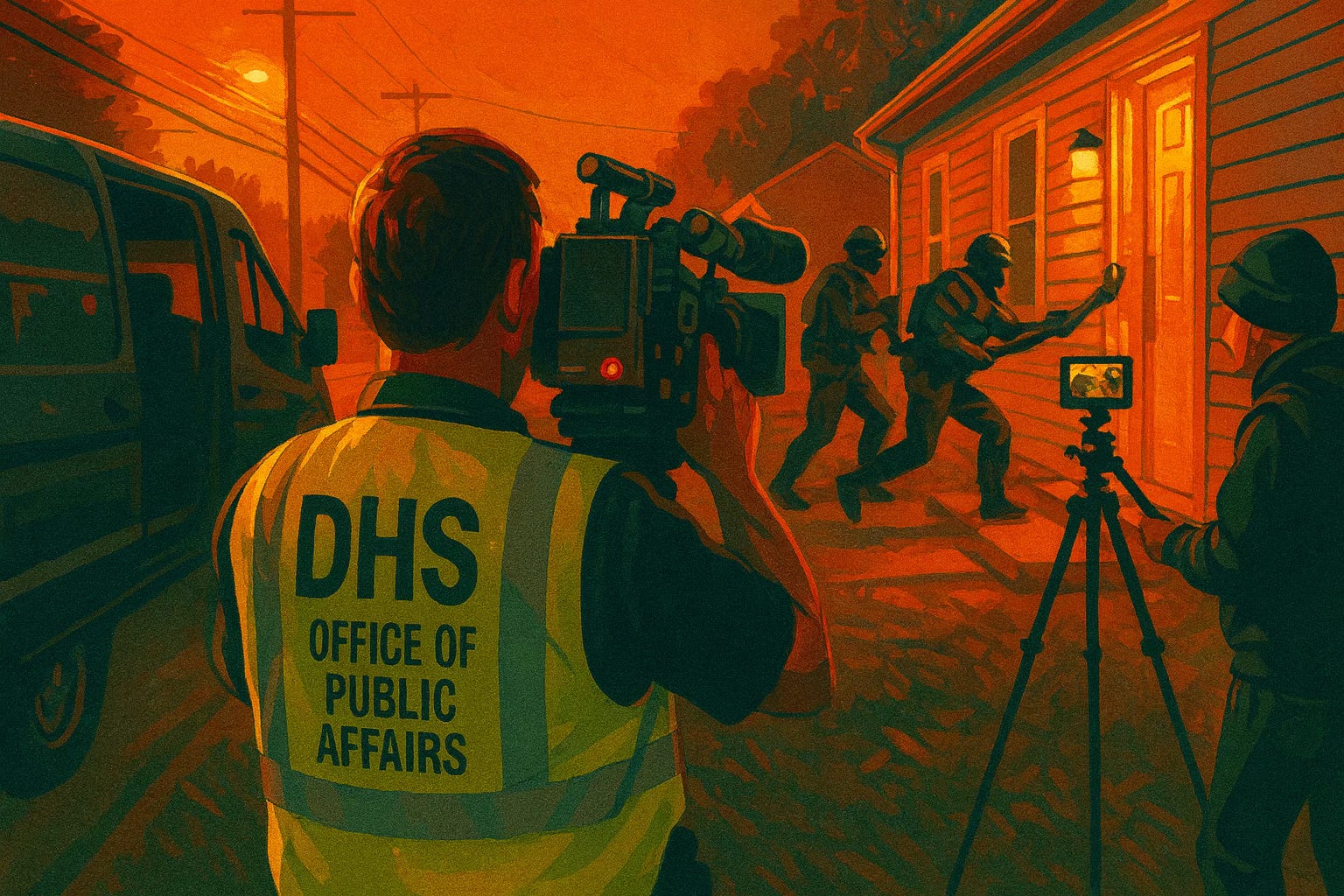
A van door slides open. Masked men in tactical gear spill out, weapons drawn. And then, not even a second later, the true stars of the show emerge: camera operators. Shoulder rigs. Tripods. Media crews in branded windbreakers. Some wear neon DHS Office of Public Affairs vests. A few wear ballistic vests, most do not. They cluster close to the entry team, closer than protocol would ever allow in an uncontrolled environment.
If this were truly dangerous, they wouldn’t be there. If unpredictability were high, the proximity alone would risk lives.
Yet they are there, and the shots they capture are cinematic: battering rams silhouetted in pre-dawn light, doors splintering on impact, families herded out in chaos. It is violence framed like a movie trailer.
This isn’t journalism colliding with enforcement. It’s enforcement designed for journalism. It isn’t oversight. It’s staging. It isn’t transparency. It’s propaganda.
A federal lawsuit filed by Democracy Forward in December 2025 revealed exactly how staged it is. Security footage from an elementary school near Chicago’s South Shore captured a nine-person camera crew setting up before raids on the surrounding neighborhood. Former DHS official Gil Kerlikowske called the expenditure “abhorrent”, taxpayer dollars funding Hollywood-style content production.
Stanford Law School’s Immigrants’ Rights Clinic obtained 1,845 pages of documents and 56 videos through a FOIA lawsuit, exposing the machinery. Internal guidance uses the term “perp walks” to describe filming arrestees. Videos are uploaded to the Defense Visual Information Distribution Service, a Department of Defense platform built to distribute military footage, with no restrictions on who can download them. Officers routinely wear vests labeled “POLICE” to trick people into thinking they’re local law enforcement.
The choreography is too precise to be coincidence. The camera placement too advantageous to be happenstance. And the fact that those holding the cameras are unarmored, seemingly unconcerned about stray gunfire or retaliation, suggests something fundamental: they already know there’s no threat.
That knowledge means the scene isn’t just recorded. It’s preplanned. These aren’t raids that happen to be filmed. They’re content that happens to involve arrests.
Thirty Million Thumbs Up
The Pokémon video racked up 30 million views on X and another 3.8 million on TikTok. “Gotta Catch ‘Em All,” the caption read, as custom trading cards featuring real arrestees and their alleged crimes flashed across the screen. The Pokémon Company confirmed it never authorized the use of its intellectual property. DHS didn’t care.
Thirty million people watched. Millions clicked the heart button. The algorithm rewarded engagement, so DHS got better at producing engaging content. The feedback loop tightened.
This is what it looks like when state violence becomes entertainment: not a single horrific incident that shocks the conscience, but a steady stream of content optimized for virality. The White House posted an “ASMR-style” video of people being cuffed and chained—the sounds of metal-on-metal-on-human presented as if they were “just another variation on the satisfying smack of products being decanted in perfect kitchens.”
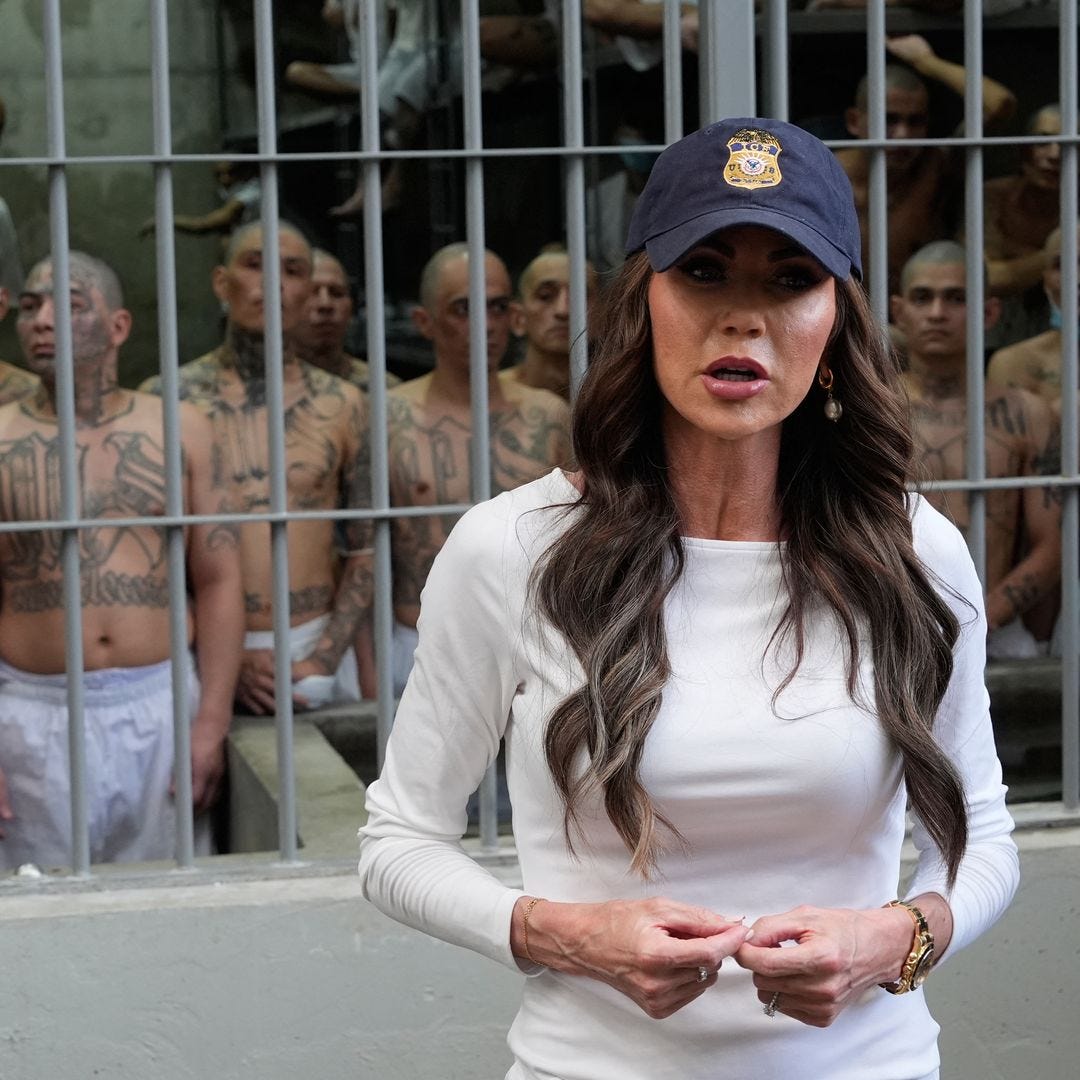
Secretary Kristi Noem posed for cameras in front of a Salvadoran prison cell packed floor to ceiling with shirtless, shaved-headed men, $50,000 Rolex gleaming on her wrist. The image went viral. Influencer Chaya Raichik of “Libs of TikTok” was brought along for a ride-along arrest, posting photos of detained men with laughing emojis. Her followers loved it.
When TikTok influencer Tatiana Martinez, who had documented ICE operations and built a following of 45,000, was violently arrested while live-streaming, her attorney reported that officers told her: “Did you think that you were going to get away with recording our activities and there wouldn’t be a consequence?” Right-wing accounts celebrated her arrest as “the ultimate FAFO.”
DHS even posted a video appearing to show Black men threatening ICE agents, but it was AI-generated, stolen from an actual TikToker who had made an unrelated joke video about Iran. The original creator now receives daily death threats. “The federal government is involved with something that I didn’t do,” he said. DHS has not removed the post. It has millions of views.
This is the audience we’ve become. Not witnesses to atrocity, but consumers of content. Not citizens demanding accountability, but followers hitting the like button while another human being is reduced to fear, dragged across pavement, and uploaded for engagement.
The Language of Dehumanization
Before you can turn state violence into entertainment, you have to teach the audience.
In December 2025, at a Cabinet meeting that lasted over two hours, the president launched into a tirade about Somali immigrants in Minnesota. He said it four times in seven seconds: they are “garbage.” Their country “stinks.” He doesn’t want them here. “When they come from hell and they complain and do nothing but bitch, we don’t want them in our country.”
Vice President Vance pounded the table in agreement. White House Press Secretary Karoline Leavitt called it an “epic moment.”
A day later, at a rally in Pennsylvania, the president returned to the theme. “We had a meeting and I said, ‘Why is it we only take people from shithole countries?’ Why can’t we have some people from Norway, Sweden?” He continued: “But we always take people from Somalia. Places that are a disaster. Filthy, dirty, disgusting, ridden with crime.”
This isn’t accidental. It’s conditioning. And when did we find it ok for our leaders to speak this way?
Secretary Noem, on her official X account, described immigrants as “killers, leeches, and entitlement junkies” who “slaughter our heroes” and “snatch the benefits owed to AMERICANS.” Senior Advisor Stephen Miller posted that “At scale, migrants and their descendants recreate the conditions, and terrors, of their broken homelands.”
This is the language of the 1920s nativist movement. This is the rhetoric that preceded Japanese internment, that preceded every pogrom. You don’t call human beings “garbage” by accident. You do it to train the audience to see them as something less than human, something it’s acceptable to round up, detain, and dispose of.
The administration put words into action within hours. Federal agents fanned out across Minnesota, deploying to the state with the largest Somali community in America. Notably, 95% of Minnesota’s Somalis are already U.S. citizens. Half were born here. It doesn’t matter. The raids are the content. The content needs villains.
The Upside Down: Every Accusation a Confession
There’s a trick at the heart of all of this.
The administration calls the press “Enemies of the People”, the exact phrase used by Stalin, Hitler, and Mao, while producing propaganda videos on taxpayer dollars. This week, the president said that reporting on his health should be considered “seditious, perhaps even treasonous” and that “we should do something about it.”
The administration calls protesters “terrorists” while pardoning people who beat police officers with flagpoles, fire extinguishers, bear spray, and a tomahawk ax on January 6, attacks that injured more than 140 officers.
The administration warns of “violent extremists” while posting official government videos of people being killed.
The administration describes asylum seekers as “invaders” while launching actual military strikes on foreign vessels.
The violent are victims. The victims are violent. Everything is inverted. Every accusation is a confession.
The “Political Prisoners” Who Can’t Stop Committing Crimes
On January 20, 2025, the president issued blanket pardons for nearly all January 6 defendants, including people convicted of assaulting officers and seditious conspiracy. He called them “political prisoners” and “hostages.” His proclamation declared an end to “a grave national injustice.”
Here’s what happened next.
According to Citizens for Responsibility and Ethics in Washington (CREW), NPR, and ongoing court records, pardoned insurrectionists have been arrested or charged with new crimes since their release:
Andrew Taake assaulted Capitol Police officers with pepper spray and a metal whip on January 6. After his pardon, he was re-arrested on a 2016 charge of online solicitation of a minor, he allegedly sent sexually explicit messages to an undercover officer posing as a 15-year-old girl.
Edward Kelley was one of the first insurrectionists to breach the Capitol. After his pardon, he was convicted of plotting to murder FBI agents who had investigated him. He was sentenced to life in prison.
Andrew Paul Johnson was arraigned in Florida in October 2025 on charges of molesting an 11-year-old child. According to the police report, he told one of his victims he was entitled to $10 million in “reparations” for his January 6 arrest, money he would include her in receiving.
Zachary Alam smashed the glass door that Ashli Babbitt climbed through. After his pardon, he was arrested for burglarizing a home near Richmond.
David Daniel pleaded guilty to assaulting officers on January 6. He was subsequently charged with production and possession of child pornography involving girls under 12.
Moynihan, who rifled through senators’ desks during the riot, was arrested in October 2025 for threatening to kill House Minority Leader Hakeem Jeffries at a New York event.
Tyler Brent Woods was convicted of aggravated DUI and reckless homicide in a wrong-way crash. He was sentenced to 17 years.
Matthew Huttle had beaten his three-year-old son so badly the child couldn’t sit for a week. Days after his pardon, he was shot and killed by police during a traffic stop when he was armed and resisted arrest.
And the number keeps growing week by week.
NPR identified dozens of pardoned defendants with prior or pending charges for rape, sexual abuse of a minor, domestic violence, manslaughter, child sexual abuse material, and drug trafficking. Peter Schwartz had 38 prior convictions before January 6.
And David Medina, who vandalized Nancy Pelosi’s nameplate during the riot, now rides in Secretary Noem’s motorcade.
These are the “political prisoners.” These are the “hostages” whose release ended “a grave national injustice.” Meanwhile, the Bondi memo instructs the FBI to compile lists of people who support “open borders” or have “radical gender ideology” for domestic terrorism investigation.
The violent are victims. The victims are terrorists. Everything is inverted.
The Numbers Behind the Spectacle
The administration has justified these theatrical raids by invoking images of violent criminals, ”the worst of the worst,” in the oft-repeated phrase. The actual data tells a starkly different story.
According to a June 2025 Cato Institute analysis of ICE data, 65% of the 204,297 people booked into ICE custody had no criminal convictions whatsoever. Only 6.9% had convictions for violent crimes. By November 2025, CBS News reported that non-criminal detention had increased by over 2,000% since January, with 48% of the 65,135 people in ICE custody, the highest number ever recorded, having no criminal convictions.
The transformation was deliberate. In late May 2025, senior advisor Stephen Miller ordered ICE to increase daily arrests from 650 to 3,000, reportedly asking field officers,
“What do you mean you’re going after criminals? Why aren’t you at Home Depot? Why aren’t you at 7-Eleven?”
The result: non-criminal arrests jumped from approximately 32 per day in January to 453 per day by June, a fourteen-fold increase. This isn’t enforcement. It’s production, filling arrest quotas to feed the content machine.
Beyond the Border: The Venezuela Operations
The violence-as-content logic has extended far beyond U.S. borders. Since September 2025, the administration has conducted military strikes on boats in the Caribbean Sea and Pacific Ocean, allegedly targeting drug traffickers.
As of December 4, 2025: at least 87 people killed in 22 strikes on 23 vessels, the first U.S. military airstrikes in Central and South America since the 1989 Panama invasion.
No evidence has been provided that the boats carried drugs. No trials have been conducted. No drug materials recovered. Secretary of State Marco Rubio summarized the approach:
“Instead of interdicting it, on the president’s orders, we blew it up. And it’ll happen again.”
The Double Tap
On September 2, 2025, the first strike killed nine of eleven people aboard a vessel. Two survivors clung to the wreckage for approximately 45 minutes. According to the Washington Post, Defense Secretary Pete Hegseth gave a verbal “leave no survivors” order.
A second strike was ordered, killing the survivors.
Representative Jim Himes (D-CT), the ranking member of the House Intelligence Committee, was briefed on the strike and shown video footage. His assessment:
“What I saw in that room was one of the most troubling things I’ve seen in my time in public service. You have two individuals in clear distress, without any means of locomotion with a destroyed vessel, who were killed by the United States.”
UN Human Rights Chief Volker Türk called for an investigation, stating the U.S. “must halt such attacks.” Human Rights Watch labeled the killings “extrajudicial.” Harvard law professor Jack Goldsmith, who served in the Bush administration’s Office of Legal Counsel, struggled to see how the second strike did not violate laws against killing “wholly disabled” enemies, a prohibition dating to the Civil War-era Lieber Code of 1863.
And while the administration gleefully releases all these other videos, they are not willing to release the second strike.
The Obama Comparison: What’s Actually Different
Critics will ask: What about Obama’s drone strikes? Isn’t this the same thing?
It’s a fair question, and the answer matters because understanding the differences reveals just how far outside historical norms the current operations have gone.
Obama authorized 542 drone strikes that killed an estimated 3,797 people, including 324-801 civilians depending on the source. Those strikes were controversial. Civil liberties advocates rightly criticized the expansion of executive killing power, the civilian casualties, and the “signature strikes” that targeted patterns of behavior rather than confirmed identities.
But Obama’s drone program operated within a legal framework, flawed, contested, but real:
Congressional Authorization: Obama’s strikes were conducted under the 2001 Authorization for Use of Military Force (AUMF), which Congress passed after 9/11 to target al-Qaeda and associated forces. The Venezuela boat strikes have no equivalent authorization. No declaration of war. No AUMF. Nothing but executive assertion.
Legal Review Process: Obama’s Office of Legal Counsel produced detailed legal memoranda analyzing targeting criteria, imminent threat requirements, and international law obligations. Targets were reviewed through an interagency process. Trump’s strikes target alleged drug traffickers, not enemy combatants under any existing legal framework, with no demonstrated imminent threat to the United States.
Civilian Protection Standards: In 2013, Obama issued a Presidential Policy Guidance requiring “near certainty” that no civilian casualties would result before strikes could proceed. Trump’s first administration rescinded this guidance in 2020.
The Crime-War Distinction: As Bush-era Office of Legal Counsel figure John Yoo, hardly a dove on executive power, has argued: “There has to be a line between crime and war.” Obama’s targets were designated enemy combatants in an authorized armed conflict. Trump’s targets are accused criminals. The legal difference is fundamental.
The U.S. Naval Institute’s legal analysis concluded:
“The strike may have been legal under a creative interpretation of terrorism law. Ethically, it is harder to defend.”
None of this excuses Obama’s drone program or the civilians killed under it. But the existence of legal controversy doesn’t mean all controversy is equal. Obama operated within a framework that could be, and was, debated, litigated, and reformed. The current strikes assert a power with no meaningful legal constraint: the president can designate anyone a “narco-terrorist” and kill them without trial, without evidence, without review.
That’s not a continuation of Obama’s policy. It’s a whole new level of executive power.
Patient Zero: The Philippines Playbook
To understand where this leads, you have to understand where it came from. The Philippines under Rodrigo Duterte wasn’t just a cautionary tale, it was a proof of concept.
Between 2016 and 2022, Duterte’s “war on drugs” resulted in an estimated 12,000 to 30,000 extrajudicial killings. Police and vigilantes executed suspected drug users in the streets. Bodies were left in public with cardboard signs. And throughout it all, Duterte maintained approval ratings above 70%.
How? Social media.
The Philippines has been dubbed “patient zero” in the worldwide spread of online disinformation. Duterte understood that Facebook essentially was the internet for most Filipinos. He didn’t need to shut down traditional media, he simply made it irrelevant by building a parallel reality through coordinated networks of influencers, trolls, and true believers.
“Social media played a crucial role in normalizing this violence,” researchers at Political Research Associates documented, “framing it as a justified response to crime and positioning Duterte as a protector of the people.”
The pattern was simple:
Fabricate an existential threat (drug users as civilizational menace)
Position yourself as the only solution
Normalize extreme measures as “necessary”
Attack anyone who objects as an enemy of the people
Use social media to make state violence entertaining
The killings were concentrated among the urban poor, possible to ignore if you lived in a middle-class area. Duterte framed the deaths as unfortunate but inevitable “collateral damage.” He targeted human rights defenders, subjecting the UN special rapporteur on extrajudicial killings to “profanity-laced ridicule.”
In March 2025, Duterte was arrested by the International Criminal Court for crimes against humanity. But even now, NPR reports, the killings continue and victims’ families face a “wave of online attacks from Duterte supporters.”
Political Research Associates identifies the conditions that made the Philippines vulnerable: high social media penetration, public disillusionment with institutions, and weak regulatory frameworks.
All exist in the United States today.
The Algorithm of Atrocity
Research from the Knight First Amendment Institute documents how engagement-based ranking systems create what European politicians have called a “hate algorithm” that deepens political polarization. Former Senator Ben Sasse reported that influencers who try to “break out of the vicious cycle of rage-inflammation” learn to “throw themselves back into the outrage loop” when “no one clicks” and “metrics plummet.”
A December 2025 study published in Science demonstrated that exposure to antidemocratic content and partisan animosity on social media produces measurable increases in negative feelings toward political opponents equivalent to approximately three years of societal polarization in just ten days of exposure. The study found that political content receives higher engagement than non-political content, meaning engagement-prioritizing algorithms are “likely already amplifying” divisive material.
People for whom digital media is a primary source of political information come to consider hate speech “a social norm rather than delinquent behavior,” making contempt of out-groups socially acceptable, decreasing intergroup empathy, and in the words of peace-building researchers, ”paving the path to intergroup violence.”
DHS understands this. The Pokémon video wasn’t an accident. The ASMR arrest footage wasn’t a mistake. They’re optimizing for the algorithm, and the algorithm rewards content that makes you feel something: fear, outrage, satisfaction, tribal belonging.
Thirty million views. Millions of hearts and thumbs up. The machinery hums.
The Bondi Memo: Dissent as Terrorism
On December 4, 2025, Attorney General Pam Bondi issued a memo to all federal prosecutors and law enforcement. It’s the logical endpoint of the inversion.
The memo directs the FBI to compile lists of groups and individuals for “domestic terrorism” investigation based on their political beliefs. It instructs federal prosecutors to prioritize these investigations. It refers cases to Joint Terrorism Task Forces, the infrastructure built for al-Qaeda.
Who qualifies as a potential terrorist? The memo lists:
“Opposition to law and immigration enforcement; extreme views in favor of mass migration and open borders; adherence to radical gender ideology, anti-Americanism, anti-capitalism, or anti-Christianity; support for the overthrow of the United States Government; hostility towards traditional views on family, religion, and morality.”
Read that again. Opposition to immigration enforcement is listed alongside “support for the overthrow of the United States Government.”
The memo includes a single-sentence First Amendment disclaimer buried in legal boilerplate. But as Whistleblower Aid Chief Legal Counsel Andrew Bakaj noted: “This memo expressly seeks to redefine political dissent against the President as domestic terrorism.”
The Freedom From Religion Foundation added: “This directive recasts constitutionally protected viewpoints as national security threats.”
The Label Creep
Watch the pattern:
First, “terrorist” meant people who attacked America on 9/11.
Then it meant people associated with those people.
Then it meant drug traffickers who fund violence.
Then it meant gang members (Tren de Aragua designated a “foreign terrorist organization” in January 2025).
Then it meant anyone on a boat near Venezuela that might be carrying drugs.
Now it means people who oppose immigration enforcement, support open borders, have “radical gender ideology,” or are “anti-Christian,” “anti-American,” or “anti-capitalist.”
The Bondi memo makes explicit what was already implicit: the legal machinery being tested on migrants and alleged drug runners is being calibrated for domestic deployment.
In the Philippines, Duterte didn’t start by killing political opponents. He started with drug users, people it was easy to dehumanize, people the middle class could ignore. The infrastructure of extrajudicial killing was built on their bodies. Only later was it turned on journalists, activists, and political rivals.
The same infrastructure is being built here.
The Endgame
Stephen King set The Running Man in 2025 as a warning. In his dystopia, the government used violent entertainment to distract and control a desperate population. Contestants were hunted for sport. The truth was whatever the Network said it was.
The novel’s hero eventually crashed a plane into the Network’s headquarters, an ending too dark for the 1987 film, which gave audiences the satisfaction of Arnold Schwarzenegger triumphing over the villain. The new adaptation, reviewed as “more anarchic and, at times, even quite angry,” hits closer to the original’s bone.
We’re not watching fiction anymore. We’re watching federal agents make Pokémon cards of real arrestees. We’re watching boats explode and survivors executed. We’re watching pardoned insurrectionists molest children while the Attorney General instructs the FBI to investigate people for their political beliefs.
The January 6 defendants have been reframed as “political prisoners” and “hostages.” Their prosecutions were called “terrorism.” In this framing, the people who attacked the Capitol were patriots; the people who prosecuted them are the real criminals.
Follow the logic forward.
If enforcing the law against the president’s supporters is “terrorism,” then the president’s opponents are terrorists. If terrorists can be killed without trial in the Caribbean, they can be killed without trial anywhere. If the audience has been trained to cheer when masked agents drag people into vans, they’ll cheer no matter who’s being dragged.
The July 2025 federal budget allocated $170 billion for border enforcement, detention, and deportations. The camera crews are deployed. The algorithms are optimized. The content pipeline is established.
We still have options. The infrastructure is being built, but it isn’t complete. The conditioning is underway, but we can still recognize it. The labels are expanding, but we can still refuse them.
But the window is closing.
In the Philippines, it was drug users. In The Running Man, it was criminals and dissidents.
In America, the van door has already opened. The cameras are rolling. Millions of people are watching. And this administration is only concerned about “ratings”.
Who’s next?
Maybe me.
Maybe you.
Maybe someone you know or love.
Sources
Running Man / Cultural Frame
DHS Propaganda & Camera Crews
Social Media & Viral Content
January 6 Pardoned Defendants - Subsequent Crimes
CREW: At Least 10 Pardoned Insurrectionists Face Other Criminal Charges
Texas Tribune: Houston Man Pardoned, Arrested on Child Sex Charge
The Intercept: Pardoned Rioter Charged With Molesting 11-Year-Old
CBS News: Pardoned Rioter Charged With Threatening Hakeem Jeffries
Newsweek: List of Trump Pardon Recipients Charged With New Crimes
ICE Enforcement Statistics
Venezuela Boat Strikes
Wikipedia: 2025 U.S. Military Strikes on Alleged Drug Traffickers
NPR: Is the Trump Administration’s Attack on Venezuelan Ships Legal?
Obama Drone Strike Comparison
Council on Foreign Relations: Obama’s Final Drone Strike Data
Bureau of Investigative Journalism: Obama’s Covert Drone War in Numbers
Philippines / Duterte Precedent
Algorithm & Social Media Research
Knight First Amendment Institute: Algorithmic Management of Polarization
Science Magazine: Reranking Partisan Animosity in Social Media Feeds